If you started a sports team, what would the colors and mascot be?
Sports have never been my thing, and to be frank I don’t think, but can’t be sure, that this has anything to do with what people used to see as a masculinity compromised by me being queer. As a student in London though, I remember following the sad career of Justin Fashanu, the footballer, hounded out of the sport, and life, by his brother John’s evaluation by homophobia and a sick and restrictive version of the masculine. This didn’t help me feel anymore attracted to football., though I honour still the sweet and lovely Justin.

Justin Fashanu (1961 – 1998) By http://www.7sur7.be/7s7/fr/1510/Football-Etranger/article/detail/757282/2009/03/10/Un-club-de-football-pour-gays-voit-le-jour-en-Angleterre.dhtml, Fair use, https://en.wikipedia.org/w/index.php?curid=24030254
Rugby was always a strange item though. While struggling financially as a graduate student at Leicester, I spent some time working behind the Student Union bar at Leicester University. Wednesday night was always my shift and always the night for the Rugby 🏉 Club. Big macho boys, these lads were, beefy always if sometimes a beef turning to layers of fat. Excess weight didn’t stop them enjoying what to a queer observer like myself seemed like an excessive interest in each other’s bodies – preferably naked and streaking through the bar holding back their genitals in cupped hands from the interest of other beefcake players, who, even when their girlfriends were conveniently in tow, took a lively interest in those genitals, even if only to speculate on their size in admiration for the huge or disdain for the tiny.
All of this was considered quite cognitively assonant with extreme masculinity then, which had always been in locker rooms and changing rooms associated with the dimensions of the real man’s phallus. Rugby was a hard game for hard large men with …. (you can finish the sentence for yourself though it must contain ‘hard and large’). What must be avoided is the male who is considered ‘soft’ and that adjective could cover a lot of ground within which masculinity was tested against femininity (I wrote a blog on a particular brilliant use of this binary by a recent debut novel by Robert Jones Jr. The Prophets (2021) – about slavery incidentally – which can be accessed at this link). What in particular was ‘soft’ was kissing. Men could feel their masculinity unquestioned after all in the 1950s if they had penetrative sex with a man as long as they were not the passive partner, and they didn’t (God forbid) kiss. Many a queer novel of the time investigated this such as Martyn Geoff’s The Plaster Fabric, with its brilliant dust cover by the 1950s queer artist, John Minton, which pits a hard-muscled guardsman against a slight queer student of art ( a soft subject if there was one in the 1950s).
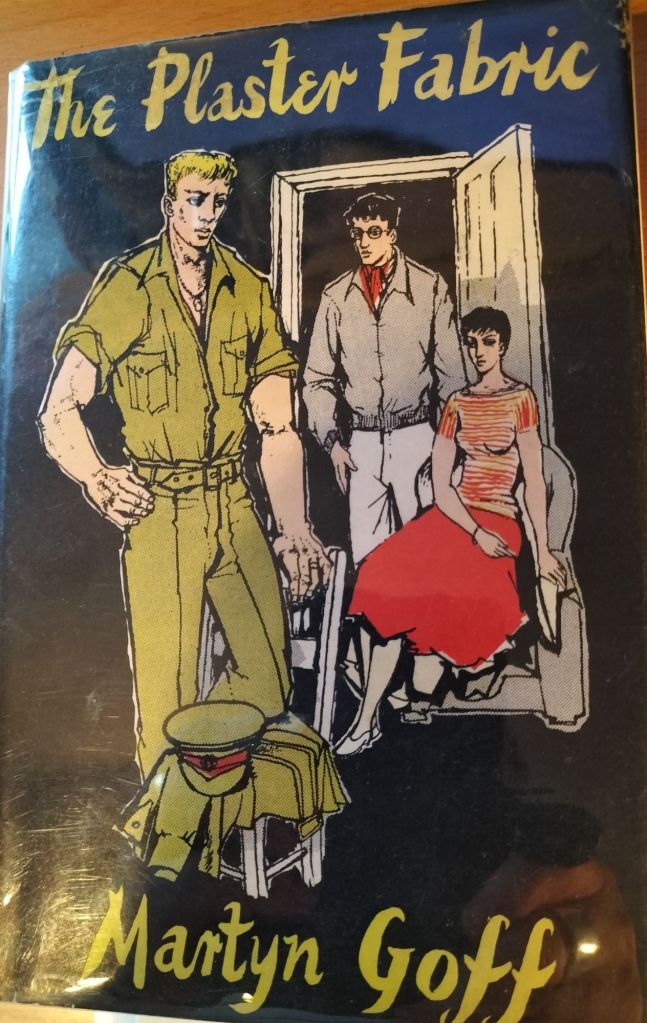
As in the novel, a woman is placed between the more effete artist-type and the guardsmen (working-class guardsmen were notoriously available to queer men in the period without that querying their base sexual identification provided their role in sex was always the ‘masculine one’ – see my blog that discusses, amongst other things, this dust jacket). Yet last year (2023 if you’re not sober yet) a film come out called In From The Side that actually showed two hunky-enough-to-be-hard rugby platers kissing (see below).

It’s a lovely film but even the queer press were over-curious about whether the Alexander Lincoln (the actor on the left of that soft focus pink and purple shot in a gay male disco was actually gay. The online publication Queerty announced jubilantly, where team indicated was not a local rugby but queer affiliation:
Yup, he’s playing for our team!
Alexander Lincoln is a rising film and television star who popped up on our radar last year with his role in the British romance In From The Side, a.k.a. the “gay rugby movie.”
However, let’s face it, it is equally interesting to me whether he is a real rugby player, given my upbringing in the 1960s. Things have changed in the assessment of male sexuality, supposed behavioural range and the imagery of maleness since my day, when as a boy I merely assumed I must have a large residue of femininity in my nature and physicality. Nonsense of course for the enormous range of traits normatively (but incorrectly) called dubbed masculine and feminine vary independently as brilliant biologists like Anne Fausto-Sterling have tired telling us in these days where trans-exclusion has become an ideology mistakenly named ‘science’ for it is far from that arena where uncertainty, rather than arrogant affirmation of the J.K. Rowling type, reigns as the nature of the beast, even in some regions that call themselves ‘feminist’. Queerty use the still from the film below to tantalise queer men who think that the daze of Lincoln might be on them as he points to an empty space in his pristinely virginal bed.

It is true then, that is is, as its publicity bruits (citing Pink News of course) that this a film our community has been ‘waiting for’ but I am not sure the ability to claim the macho grimace between men, however we interpret its potential, as in the film poster above – one geared to a queer market for the film, is a hundred-per-cent positive move. I think this is because the degree to which the early Gay Liberation movement (I was in it) in some quarters targeted stereotypes of ‘feminised men’ was always fair on men, whatever their sexual choice, who from interactions of both possible genetic and social causes – such as imitation or ‘modelling’ (in Bandura’s terminology) of available models of the ‘queer’ – had traits of behaviour, appearance or psychology that were dubbed feminine in the early twentieth century ans sometimes before. Yet this is indeed a film for our times iconographically.

Shakespeare constantly played with stereotypes of the male and female in his comic scenes such as, for instance, those concerning the servant of Goneril, Oswald in King Lear. In Act 1 Scene 4, The Duke of Kent having disguised himself as a commoner is asked by Lear ‘…, what art thou?’. To this Kent simply replies: ‘ A man, sir’. That claim to basic masculinity is enough in the scene for Shakespeare to pit Kent against the servant of Goneril, charged by her in the previous scene, not to show respect to her father’s supposed authority. This incident follows:
LEAR: O you, sir, you, come you hither, sir. Who am I, sir?
King Lear Act 1 Scene 4: lines 78ff. Available at: https://www.folger.edu/explore/shakespeares-works/king-lear/read/1/4/
OSWALD My lady’s father.
LEAR “My lady’s father”? My lord’s knave! You whoreson
dog, you slave, you cur!
OSWALD I am none of these, my lord, I beseech your
pardon.
LEAR Do you bandy looks with me, you rascal?
⌜Lear strikes him.⌝
OSWALD I’ll not be strucken, my lord.
KENT, ⌜tripping him⌝ Nor tripped neither, you base
football player?
LEAR I thank thee, fellow. Thou serv’st me, and I’ll
love thee.
KENT, ⌜to Oswald⌝ Come, sir, arise. Away. I’ll teach you
differences. Away, away. If you will measure your
lubber’s length again, tarry. But away. Go to. Have
you wisdom? So.⌜Oswald exits.
Whatever the association of a ‘base football-player’ in the text, the whole confrontation of Kent with Oswald is typed as that between a real and a pretend ‘man’, a man handy in fights and one not at all so – possessed rather of an effete rejection of either verbal or physical play between men (‘I’ll not be strucken, my lord’). I have never seen a production in which this was not delivered by Oswald in high camp. But the physical hardening of male stereotypes (possibly most clearly beginning in the ‘macho’ iconography playfully adopted by The Village People in the 1970s.
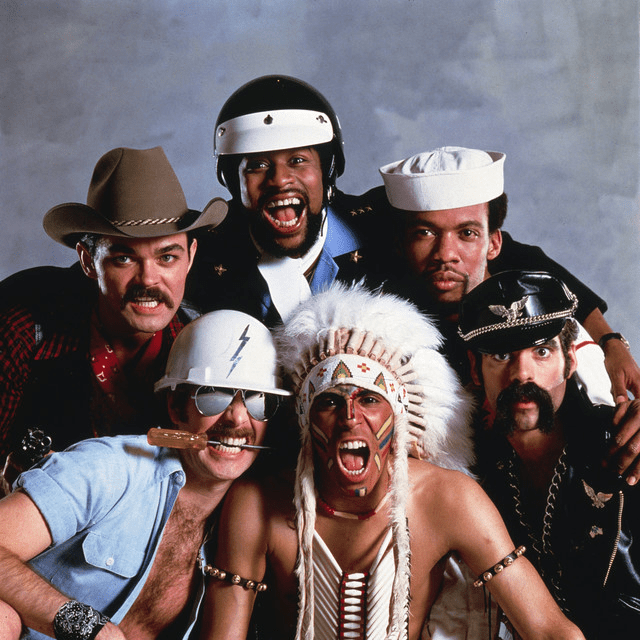
But I think the key word in describing this move was ‘playfully’. The Macho stereotypes of leather man biker, cowboy, construction worker, policeman and so on were somewhat consciously about satirising a trend in the gay scene as well as fostering diversity. The stereotype of the ‘Red Indian’ alone poked fun at the cowboy stereotype. It was no more about creating new ‘identity’ than were some versions of drag, though they too made a radical point about gender as an element in the diverse rather than playing up to binary identity roles. Likewise in Chapter 25 of Howard’s End, though written in 1910, E.M Forster could write of social practice and institutions, as observed by a woman of intelligence and culture, Margaret Schlegel, as being ‘a forcing-house for the idea of sex‘, and radically questioning sex/gender binaries.
The low rich purr of a Great Western express is not the worst background for conversation, and the journey passed pleasantly enough. Nothing could have exceeded the kindness of the two men. They raised windows for some ladies, and lowered them for others, they rang the bell for the servant, they identified the colleges as the train slipped past Oxford, they caught books or bag-purses in the act of tumbling on to the floor. Yet there was nothing finicky about their politeness: it had the Public School touch, and, though sedulous, was virile. More battles than Waterloo have been won on our playing-fields, and Margaret bowed to a charm of which she did not wholly approve, and said nothing when the Oxford colleges were identified wrongly. “Male and female created He them”; the journey to Shrewsbury confirmed this questionable statement, and the long glass saloon, that moved so easily and felt so comfortable, became a forcing-house for the idea of sex.
E.M. Forster ‘Howard’s End’ Ch. 25 available at: https://www.sparknotes.com/lit/howardsend/full-text/chapter-25/
For me then to choose a rugby team in sombre masculine colours such as those that appear in In From The Side would for me be retrograde. I even critiqued (in a blog available at this link) such moves in a very conscious gay male novelist like Philip Hensher in A Small Revolution in Germany, one of his latest novels, as too obviously unaware of the need to play with sex/gender stereotypes rather than confirm them in the interests of saying to queer men that they can be, if they want. identified as ‘real men’. I have seen too many men and boys screwed up by that paradigm of what is acceptable in sex/gender/sexuality self-presentation, such as presents itself so viscerally in this passage:
Joaquin’s kiss when it came, was a fact of inevitable nature, like a warm front predicted on the news bulletin and then experienced without surprise, … I had no idea, or not much, that it was in me to kiss a twenty-two-year old Chilean Spartacist until it was actually happening, and once it started. … (leading to) a more certain and individual sense that I was meant to be kissed like this, with the solid arms around my back and shoulders, the thick trunk of the tongue in my mouth, pushing back at my own tongue, the rough rub of Joaquin’s face against mine, … His odour was all around me.
Philip Hensher (2020) in ‘A Small Revolution in Germany‘:82 (my omissions)
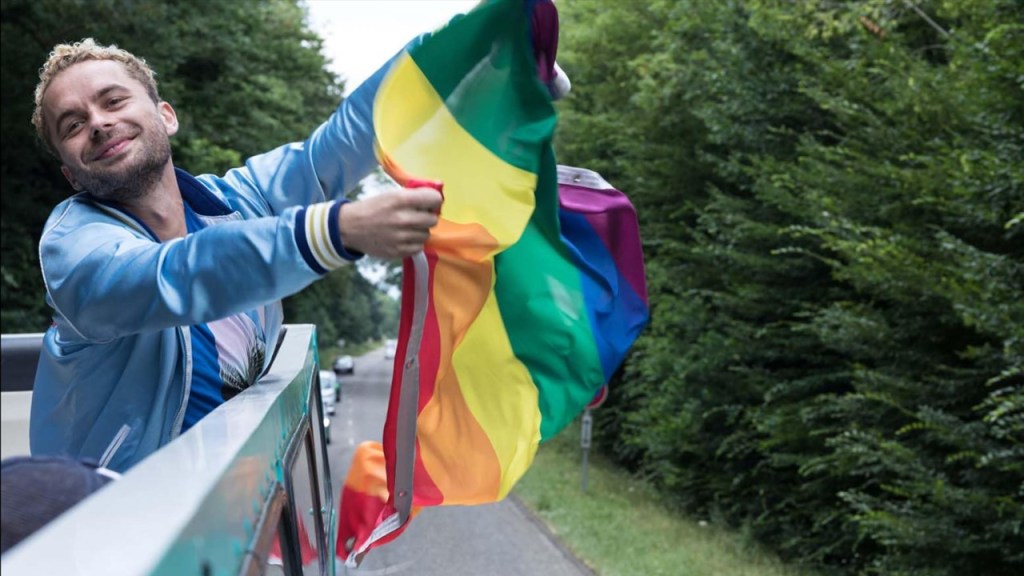
Being kissed by a ‘real man’ is the whole point here and is presented (here and elsewhere in the novel) as a ‘fact of inevitable nature’ that so easily feeds into some of the transphobia also buried in there, as a supposed protest against post-modernity gone too far. No, let’s rejoice too in a sports group that can embrace a range of sex/gender expression. In fact there is a French comedy film already (there is even a sequel to it) that will do the job of nominating for me ‘a sports team’, its ‘colors (sic.) and mascot’. That film is The Shiny Shrimps and ‘came out’ (in every sense of the term) in 2019. My answers then to the question today are all in the collage below from stills of that film. My team is, of course, a swimming team (not that competitive to tell the truth), its colours – those of the extended LGBTQ+ rainbow flag (with a tendency for purples and pinks predominant) and my mascot a touring open-top bus.
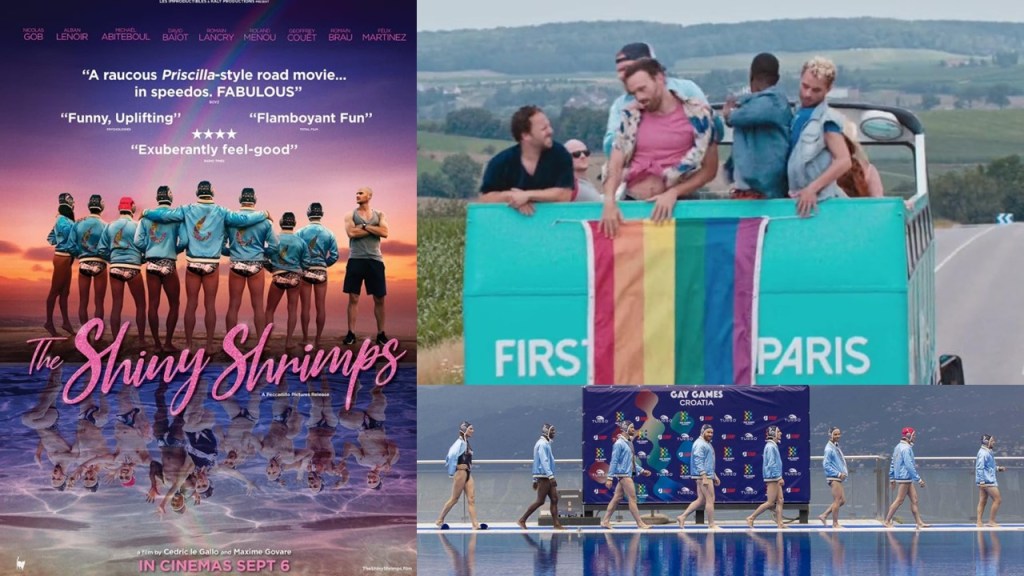
The film is essentially about sports as play not competition. The sportsmen on the DVD cover with their back to us are reflected in the shimmer of the water as in full play. When they process, they fail to do it (thankfully) in military style (though some do better than others and such diversity is surely the point). The story is about a swimming coach who is found homophobic by his Sports Association and given, as a punishment, the job of coaching an entirely queer team for a Gay Games in Croatia to which he must travel with them. He learns really not only from the team but from his children, who have no hang ups such as his about sex/gender consistencies and supposed integrities. It waves a flag, this film, it really does! Pure fun but play with purpose – perhaps as ‘sport’ ought to be.
All my love, of course
Steven xxxxxxx
 Steve_Bamlett_blog