Can a novel really deal with stories that dive deep into a consciousness of things that likens its progress to motion in “a mazed labyrinth, devoid of pattern or meaning”? This is a blog on John Williams’ (1948) debut Nothing But The Night. The edition used was published in 2016 by New York Review Books, New York.
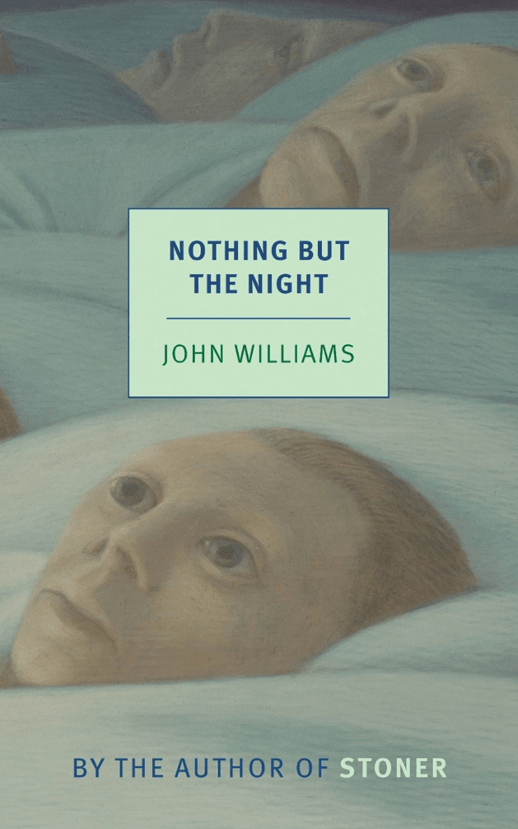
It is obvious from the first paragraph and sentence (in fact they are one and the same thing in John William’s Nothing But The Night) that the novelist wants to impede the progress of an over-hasty reader. That reader gets locked from the start about the problem of the consciousness that will confront them: ‘eyeless, brainless, and remote’. In this slim book, that, in truth, in being read takes what seems a process in time that seems to age its reader, has to grapple with a value-system that from the start negates every tool we pride our mastery over as readers. We like to think we assess sensation, thought, words and the ability to come to decisions ourselves in reading prose or poetry. Instead we have, now in paragraph/sentence two, a consciousness that is ‘an insensible thing’ at least ‘in dream’, that values what it does in these negations: ‘Wordlessly and thoughtlessly’, unaware of having ‘any choice’ in determining its circumstances.
Though many novels start with dreams, especially Gothic or Gothic-tinged novels (I think immediately of Daphne du Maurier’s Rebecca), to focus that dream on the lack of events or identity that characterise the point of view that is narrated. All we have is an impersonally noted gender identity, a ‘he’ not an ’I’ (another hint on the verbal pun ‘eyeless’). I will suggest later that this grateful succumbing to the lack of realisation of an identity has much to do with the tribulation the gendered subject of the narrative has with masculine identity. For in this novel, the narrator, we will eventually know as Arthur Maxley, has, at first, a desire only to be undead (not alive but not dead) in the ‘womb of nothingness’, with his ‘singular ability’, being ‘to differentiate between himself and darkness’. That darkness is anything that counters masculinity, including loss of control of a situation.
Arthur Maxley defines a dream as precisely a lack of control, the trigger to being plunged into darkness and the very mechanism of dreams. Dream work as, articulated in this prefatory chapter, renders Arthur passive to a greater power: feminised in the terms of the book, as it were. We shall see this in scenes and interactions later in the story in episodes concerning his parents, women, and one short-lived appearance by a man clearly typecast as queer. Arthur begins knowing:
that the only power he possesses is that convenient to the dream, the state of mind in which he exists. He is the tool of a dark prankster, a grim little joker who creates worlds within world, lives within life, brains within brain. All his illusionary power comes from this gleeful scenarist whose whim is to bestow and withdraw.
All characters in novels are the subject of a ‘prankster’ or ‘gleeful scenarist’, for they are subject to the power of the authorial ‘authority’ that creates them, and this one seems to know that, though attributing the author’s agency to the dream mechanism (true too in its own way). Here the character is subject, and will be throughout, in particular to scenarios not of his own making, though they are of an everyday nature. The term ‘scenarist’, stands out in its own sentence, and is an alternative to the modern term ‘screenwriter’. It is particularly appropriate to the making of ‘scenarios’ (scripted descriptions of events in a film) in the days of silent cinema. But the prankster here is a more powerful male. This ‘other’ authority masters the situation the narrator cannot control themselves alone and who thus begins to feel ‘less secure’ in authorial hands, having ‘feeling thrust itself boldly upon him, and suddenly in an illogical transition’, demanding that he answer those thrusting importunities, very like the sexual demand, that will occur in this novel later, with ‘something, an identity imperfect and alive’. [1]

Before that moment, whether the darkness encompassing him is an enclosed womb or ‘a vast stretch of dark’ barely seems to matter for where nothing is allowed to appear clearly, nothing can ever be enclosed by definition. States of liminality that escape the binaries of birth and death, being and non-being, inside and outside and sometimes male and female, are the stuff of Gothic fantasy and at times the consciousness that obstructs us getting into this novel, for a little time, seems intent on realizing its Gothic potential. The ‘unearthly detachment’ of the dream consciousness spies a ‘youth’ from whom he wants escape, lest he make ‘a fatal contact with that body’, a body whose skin texture he can sense and see the veins on ‘the lids of his resigned, closed eyes’. Shockingly to him, in the crush of things ‘he felt some part of him touch the youth’. It is strange, isn’t it, for prose to play these queer tricks (which ‘part of him’ for instance) in the animation of attraction and repulsion between male figures, that hardly gets cleared up when Arthur realises he himself is that youth and one subject to violence from the only social world he knows.[2]
The youth will turn out to be Arthur himself split from his own consciousness in the dream, at a moment of extreme vulnerability to people he thought his friends at a party held by his older and reticent distant friend’s home, Max Evartz. He finds himself ‘screaming’, like a woman one might say (but again in terms of an older conception of the masculine) and certainly like that woman, Claire, he later accosts and perhaps attempts to rape, as return the gesture ‘screaming wildly, lustily, in concentrated hate, and he knew why …’.[3]
What is inside and outside Arthur in all this dream play is very unclear. I have characterised that uncertainty as Gothic and that characterisation seems to play over the self-description, as we only later learn it to be, of his own youthful allure. There is something of the vampire about this ‘youth ’sitting passively in a chair too large for his slight frame:
He was pale, but his pallidness suggested something more than a mere lack of sunshine, There seemed to be a doughy cushion beneath his skin: …, as if it lacked the resiliency of healthy skin and muscle. set against this pallidness was a surprising pair of blood-red lips. It was not exactly a sensual red, not an unhealthy red. On the contrary, it seemed to be the only health feature of an otherwise sick countenance.[4]

Who would have guessed that the colouring of the vampire would become a go-to stuff of the male sex-object, though it is.
Everything is both liminal and beyond the boundaries of the norm – neither pale nor red, neither healthy nor sick, and, neither self nor other. With this ‘resting body’, ‘he merged, became one with it in a sudden and inexplicable chemistry, realized in a brief flash of agony that this his real identity, that this was himself’.[5] This is a moment of sad Gothic beauty that is the only communion between bodies that has anything in it that might be about an acceptance of each other between bodies, that is contradicted only by the hate it attracts from outside the couple. The scenario is one of queer love fantasised.
There is equal fantasy in his sexual encounter with Claire, whom he meets in a restaurant that specialises in being a locus for heterosexual encounters, but who is powerless, because poor and dependent on male attention to sustain her life. There is even the hint of prostitution, though of a refined and hidden kind that even the cab-driver recognises in taking Claire home with Arthur to a place ‘inexpensive, soiled and forgotten’, giving ‘an ironic lie to her appearance’. She, like him, prefers the ‘eye-oppressing dark’ and resists Arthur putting on the light which both find ‘liquid’ in that they disguise bodies from each other. Caught in the moon however, Arthur sees Claire and red lips like that, in the dream already recounted, he saw in himself, but ‘parted in a rapt, unconscious little smile of expectation’ with ‘the tips of her small teeth gleaming beneath the red lips’.[6]
This ‘expectation’ is what, it seems, turns Arthur’s expected sexual passion into something indistinguishable from sexual revulsion and he strikes her violently, drawing blood. Arthur will then be punished by a man who seems to look after Claire, and perhaps a neighbour but also perhaps a pimp. The violence used by this ‘large man’ is appetitive too, he ‘licked his lips’; before violently laying hands on Arthur, in the arms of which Arthur notices (for he seems to see it in cinematic slow motion) ‘the muscles bulge up from the wrist’. There is something of the redirected homoerotic in the violence here as well as the symptoms of homophobic violence, though ostensibly used of men who abuse women. There is anyway much in common between these things in a society where masculine sexuality is shaped so by powerful heteronormative ideologies and where consciousness of desire and revulsion get so terribly mixed up in the male psyche. It explains what seems grotesque in observations of this ‘large man’, who is so powerful but whose ‘stubbled face in front of him contorted and became something hideous and unspeakable’. [7] The ‘unspeakable’ is the stuff of Gothic fiction.
I would say that this also speaks through the complicated relationship of Arthur to his father, which extends to barely disguised revulsion at his father’s sexual feelings for women that may mask itself under Athur’s apparent loyalty to his dead mother. Their faces continually fuse in his memory into the stuff of a ‘familiar nightmare’.[8] The father is anyway a kind of iconic patriarch often confused with ‘Our Father, which art’, God Himself.[9]
It is only when his real father, identified now as Hollis Maxley, admits his vulnerability and lack of confidence in his own masculine display, based on his story of that male stereotype, ‘the logger’ riding the river and on admitting he hadn’t ‘been a very good father’, that he ‘saw his father for the first time’, and for once they speak ‘gently’ to each other. They speak of and attempt to mend the broken nature of Arthur’s vision of his father’s confused past sexual life: a history of liaisons with women, including his mother.
However it breaks again. Thinking, as they dine together and he sees a woman cross the room to greet Hollis that she is his dead mother, only later becoming recognised as a merely ‘deceptive figure’. The misogyny and sexual jealousy both speak out here.[10] He registers his final rejection of his father, once associated with the birth of mental ‘monsters’, with a ‘twisted mask’ over his face, ‘where incommunicable pity and hate struggled vainly with contempt and unacknowledged love’. Unacknowledged love matters in this novel and is its queering element, though this does not argue for it being a novel of repressed male-to-male love but one which plays with the scenario amongst others.
We will learn later of Art’s mother’s suicide, in a section that reads as half-memory and half confabulation, where he ‘floated aimlessly’ as in another dream of the day or night. In this dream-like state he remembers or fantasises a confrontation between mother and father mediated by his mother’s possession of phallic power for a moment in the form of a gun. It is a vision ‘very old and familiar to him, a thing he had seen and known in a previous life’, and, whatever the trauma an observed parental suicide might suggest, the horror here has as much to do with his mother’s looks of passion and appetite towards his father I think, like that he’ll later see in Claire:
The boy turned his dull unbelieving face upon his mother. The serenity of the face was gone, destroyed; and in its place there was there was a deeply, exultant, mad, fierce ectasy. He could not tear his eyes away from that face grown suddenly strange and unknown. It swelled in his vision, menacing and insatiable, threatening to devour with its intensity all that it saw.
The grotesque mask lasted only a moment. Then it fell apart, and the contorted face smoothed out; …[11]
The contorted face and grotesque mask mirror the man who beats Arthur up at the end, but what stands out here is a blood-red hungry mouth that are mirrored too in the lips of Art in his own dream and Claire in the later sexual encounter. Female passion, or perhaps even merely ‘feminised’ passion (a hungry passive want as it appears in this novel) is revolting. It calls forth violence in the face of sexual demand, a violence that seems to fear being literally eaten by the appetite of another.
If I am right about the queer content of this novel, it would justify its strangest section, the episodic story telling of the visit to Arthur of his friend, Stafford Long. Stafford is clearly typed as ‘queer’ in the sense this word was used then. He smiles ‘softly, mysteriously’ at Arthur, speaks in ways that exaggerate his emotionality and render it ‘over the top’. He finds male behaviours, like drinking through the day or dancing clubs (where women are met) ‘disgusting’, or ‘absolutely filthy’ (his italics); which views he expresses in a ‘high, mincing, unmistakable voice’. He has alternative ‘nicer’ venues to which he would prefer to take Arthur. About these ‘nicer places, much nicer’ Arthur says to him that he will not be persuaded into ‘going into another one of your places’, suggesting both that he has been before and feels distinct from them and their implied (at least implied to me) queerness. Stafford feels hurt that Arthur is suggesting that there is something here for Stafford to be ‘ashamed of’.[12]
Steve
Stafford is used to the homophobia of supposedly heteronormative men. He brindles at their mutual friend, Evartz (he who held the party in Arthur’s dream), having called him a ‘damned little fairy’. His demands of Arthur at this meeting are for money to help him escape into a life printing poetry but his manner, far too often for Arthur, obliterates the boundary a table otherwise conveniently provides. Stafford is described as implicitly over assuming, even sexual, the strength of connection between the men, with hints of innuendo, or things than Stafford can read thus:
The innocence disappeared. A new look of confidence taking its place, and he relaxed, leaning forward across the table.
…
Suddenly, Arthur burst out, “God damn it, Stafford, I told you I don’t have money. If I did, I’d let you have what you want.”
Stafford leaned across the table. “Would you?2 he asked breathlessly. “Would you really, Arthur?”
He said, wearily. “Yes, I’d let you have it.”
Stafford insinuated himself a little farther forward until it seemed he was supported only by the table-top.[13]
Of course, all of this is based on inference based on association with acts of proximity-seeking, words like ‘insinuated’, which are unbearably louchely suggestive but not conclusive of intent beyond extortion of money from a friend. However, I think they cannot be missed, for the only reason for this episode is the contrast between it and that later with a woman whom he can romanticise. Here too both Claire and Arthur are sitting at a dining table, unafraid of being supposed queer or even empathetic to queerness. This interaction is described as rather being a thing of norms – champagne with a ‘delicious creature, here beside him’, a ‘woman of mystery’ (he has only just met her) whose interaction is the stuff of ‘things in a magazine story’.[14]
Later the heterosexual couple have ‘insinuated themselves’ (that rich word again) onto a dance floor where she ‘pushed herself against him with a detached hunger’.[15] And, as they move to the inevitable sexual contact back in Claire’s apartment, this female hunger will become a threat, like the mad ecstasy he imagines himself to see on his mother’s face before her suicide.
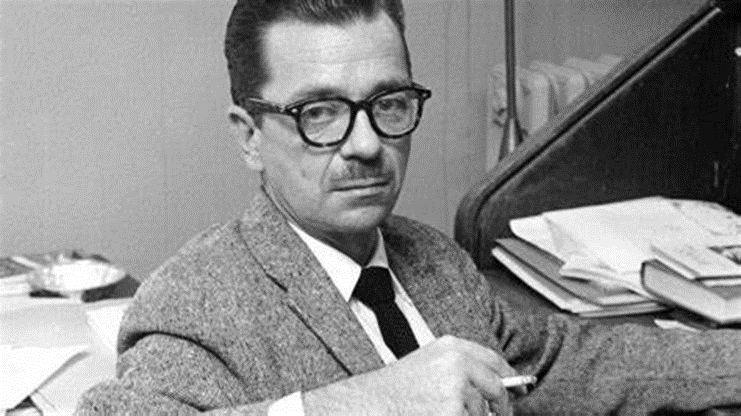
John Williams
John Williams was a puzzle. His widow, Nancy Gardner Williams, claims ‘he wasn’t contradictory or contradicted about himself’. She says that he ‘just kept going’, and this despite a traumatic response to war time killing and death that led to lifelong nightmares. None of that however can explain why this novel is so fascinated by depths that become the subject of unresolved fantasy that never resolve or even become explicit.[16]
Moreover, it is unclear to me that it would help to see the novel as pathologically orientated, for it works like the modern queer novel seeking to undermine the normative. After all, look again at this phrase about the dream mechanism personified as a ‘prankster’: ‘a grim little joker who creates worlds within world, lives within life, brains within brain’. Notice that, as in all Gothic thematics – ancient or modern – it undermines things considered unitary in their role in one person (a world, a life and a brain) and replaces with multiple versions (worlds, lives and brains), possibly contradictory ones. Do read this book. It fascinates.
With love
[1] John Williams (2016: 1f.) Nothing But The Night. New York, New York Review Books.
[2] Ibid: 6
[3] Ibid: 6
[4] Ibid: 5
[5] Ibid: 6f.
[6] Ibid: 106 – 109
[7] Ibid: 115f.
[8] Ibid: 23
[9] Ibid: 11f., 17
[10] Ibid: 56ff.
[11] Ibid: 99
[12] Ibid: 39 – 42
[13] Ibid: 43 & 46f. respectively.
[14] Ibid: 75f.
[15] Ibid: 77f.
[16] Nancy Gardner Williams (2016: 127 & 121) ‘Jungle of the Soul’ in ibid: 119 -127.
 Steve_Bamlett_blog
Nice post ✉️
LikeLike