Tell us one thing you hope people say about you.

Jack B. Yeats (the poet’s brother) Man in a Room Thinking 1947
The immediate temptation with a question like this is to imagine what people gathered around your grave at your funeral would say. I hope that they might say ‘he had a fascination of what’s difficult ‘. If they say this, they may not say it in those words, because they are by Yeats in a poem few read and less like, other than as an autobiographical side-line on the great poet’s involvement with the Abby Theatre. In truth I love in the poem really only the first few lines:
The fascination of what’s difficult
Has dried the sap out of my veins, and rent
Spontaneous joy and natural content
Out of my heart.
I think I have always equated the line ‘the fascination of what’s difficult’, denoting the thing I would ideally like people to notice, if anything, with the overwhelming complexity of the given world (that world into which we are ‘thrown’). And this is particularly the case in things thought to be simple, or, well ‘ ‘just natural or common’. It’s a maddening trait no doubt in the eyes of others, for it means the slightest action or word might be unfolded through contradictions, ambiguities and implications into many layered and sometimes internally fractured propositions about life, a relationship (or one in particular), and even words or gestures. It feels pertinent even of those ‘looks’ people exchange and / or suppress from one another. It is, an attitude to life akin to what people call ‘over-reading’, seeing patterns that aren’t there. John Burnside in his memoir even tells us that there is a specific mental health diagnosis for this trait and that he was given it by a psychiatrist.
It is ‘apophenia‘, a diagnosis that Blair and colleagues in 2021 say ‘was coined by Klaus Conrad to describe a core feature of psychosis: the perception of meaningful patterns where none, in fact, exist’ before telling us that thinking has changed and that he diagnosis is used mainly to describe a subset of symptoms in schizophrenia (for those who believe in that diagnosis) called false positives. (1) Burnside stuck as a novelist and poet with the need to pattern, with the understanding that the patterns we develop should be communitarian shared ones (not unlike the vision of Mark Fisher in a blog I refer to elsewhere), which he calls la vie commune, because the truly selfish pattern-imposers are those awarded the entitlement, by the interests of the few under capitalism, to destroy the beauty of complex worlds by their simplistic developments that are truly really regressivements. I summarise what he says in an essay in Aurochs and Auks: Essays on Mortality and Extinction (quoted in my blog on it linked here ).
Developers develop everything in ways that translate those things or the things they work upon into malleable reductions of a complex world that they can then own. Burnside is correct to include in these, developers of psychotropic prescription drugs who, before they can make a profit, must colonise the mind, thinking, feeling and sensing as things only understandable as chemical processes that can be externally manipulated. Burnside however, who has confronted the psychiatric system himself, will:
… remain unpersuaded that the chemistry of the brain accounts entirely and conclusively for the life of the mind – a phenomenon that finds its full expression, not in an individual cerebellum, but out there, in the constant play of la vie commune. (2)
There are quite a few times when I have been accused of ’the perception of meaningful patterns where none, in fact, exist’ and sometimes that has been given psychiatric interpretation in relation to depression or anxiety. I call it noticing and would defend it with and like John Burnside. It is a skill vital to social workers who sometimes also make ‘false positive’ assessments sometimes (in most deadly ways in cases of abuse). The Cleveland child abuse ‘scandal’ was based on this accusation against health workers. Only recently have these ‘meaningful patterns’ they perceived and supposed then ‘not to exist’ been proven as indicators of actual abuse for which some parental perpetrators got away unscathed, according to Bea Campbell at least. That is another debate. Yet I think I would still champion the need to read the evidence more closely, in relation almost to anything.
So with that defence, I go on to be proud of what others see as ‘over-reading’ things. It is the trait that attracts me and others to novels where complexity hides beneath the simplest of slips of the tongue or apparently careless remark – most noticeably in those great novels who render simple lives complex like Jane Austen and George Eliot, where suddenly we turn a corner and find, in Emma for instance, something dark in Frank Churchill or deep and vulnerable as in Miss Bates. Henry James could barely stop himself. The opening of The Portrait of a Lady is a perfect example of prose that by continually asserting the simplicity, the agreeable and the delightful inits opening scene and the story to unfold from it, contradicts those very assertions with dark hints of underlying complexity that come in part from the rhythmic regressions in its sentence structures, and the way they chime with the way time passes by noticing shadows that were not only long but within the gap provided by a full stop are ‘lengthening’.
Under certain circumstances there are few hours in life more agreeable than the hour dedicated to the ceremony known as afternoon tea. There are circumstances in which, whether you partake of the tea or not—some people of course never do,—the situation is in itself delightful. Those that I have in mind in beginning to unfold this simple history offered an admirable setting to an innocent pastime. The implements of the little feast had been disposed upon the lawn of an old English country-house, in what I should call the perfect middle of a splendid summer afternoon. Part of the afternoon had waned, but much of it was left, and what was left was of the finest and rarest quality. Real dusk would not arrive for many hours; but the flood of summer light had begun to ebb, the air had grown mellow, the shadows were long upon the smooth, dense turf. They lengthened slowly, however, and the scene expressed that sense of leisure still to come which is perhaps the chief source of one’s enjoyment of such a scene at such an hour. From five o’clock to eight is on certain occasions a little eternity; but on such an occasion as this the interval could be only an eternity of pleasure. The persons concerned in it were taking their pleasure quietly, and they were not of the sex which is supposed to furnish the regular votaries of the ceremony I have mentioned. The shadows on the perfect lawn were straight and angular; they were the shadows of an old man sitting in a deep wicker-chair near the low table on which the tea had been served, and of two younger men strolling to and fro, in desultory talk, in front of him. The old man had his cup in his hand; it was an unusually large cup, of a different pattern from the rest of the set and painted in brilliant colours. He disposed of its contents with much circumspection, holding it for a long time close to his chin, with his face turned to the house. His companions had either finished their tea or were indifferent to their privilege; they smoked cigarettes as they continued to stroll. One of them, from time to time, as he passed, looked with a certain attention at the elder man, who, unconscious of observation, rested his eyes upon the rich red front of his dwelling. The house that rose beyond the lawn was a structure to repay such consideration and was the most characteristic object in the peculiarly English picture I have attempted to sketch.
Henry James ‘The Portrait of A Lady’ Chapter 1. Available free at: https://www.gutenberg.org/cache/epub/2833/pg2833-images.html

Dark shadows around the marriage to Osmond by Isabel Archer
In the opening of The Portrait of A Lady as quoted above, an old man who does not know he is looked at by those who attempted to read what is within him, us in short, looks at the ‘rich’ object gathered from a life in pursuit of wealth and cannot rest as the day tells him he ought to be able to do, for at his death, which like the lengthening shadows that will come soon, he must consider where and for what purpose that wealth represented by his ‘rich red house’ will be disbursed. On this wealth and its consequences to Isabel Archer, the novel hangs – one where people are watched for their next move, the motivations of each examined for its less obvious, its ‘darker’ purposes and darker ends (as in that treacherous marriage to the shadows themselves of the class system,Gilbert Osmond). And, after all, I think, as I wonder why I want to see under the surface to the hidden and, as yet, unprojected material of the complex consequences of apparently simple decisions,isn’t it true more generally and for ALL OF US, St. Paul’s evangelical purpose aside, that none of us see each other ‘face to face’ but ‘through a glass, darkly’.[3]
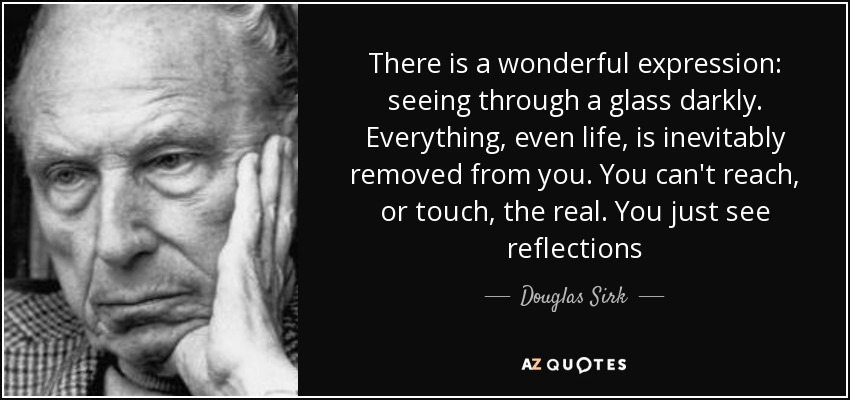
The ‘dark obsesses and ‘fascinates’ because it is difficult. It is what Spenser promised Elizabeth I in proffering her a poem (in the Preface to The Faerie Queene, that glorified her, that was also a ‘darke conceite’ (sic.). It may be that Spenser was only pointing to the difficult complexities of the layers of his allegory here but ‘darkness’ hides much more in Shakespeare and Milton, and thereon to James and Virginia Woolf in the succession of writing towards modernism. It is true of the dark of film noire in Douglas Sirk. And this is true moreover of what ‘is difficult’ and ‘dark’ in more ‘static’ painting too, where chiaroscuro effects in seventeenth century art overlaid ever simple scene with a burden of meanings that suggested the hidden, at its best in Rembrandt, sometimes only suggested by the degree of hatching and light variation in a darkened portrait.

In Yeats, the ‘difficult’ that fascinates him is described in the rest of the poem I start this blog with, and those ‘difficulties’ that are explored therein seem to most of us relatively, in the grand scheme of things, trivial (things people who have a job do every which day). It has not even to do, as in Spenser, with the difficulty implicit in a poet’s highly wrought language. It is about the everyday tribulations, such as his often were at the time, with theatre management (in the handling of his Irish folk plays at the Dublin Abbey theatre), ordinary and plain ‘people politics’ – or ‘the management of men’ in his term. He even laughs as he curses at how his own plays are such that they have to ‘be set up in fifty ways’ (the whole poem can be read and is appended to the end of this blog). But the gist of that poem for me, and that thing I would ideally like people to notice about me, is all in the lines I start by quoting.
These opening lines are instinct with pain, mind. What goes hand-in-hand with the ‘fascination of what’s difficult’, after all, is the sense of loss of ’spontaneous joy and natural content’. This could mean anything, of course, so vague are the terms, but they are certainly FELT as you read the poem if not explicitly understood. In one sense, the words may denote the difficulty I have with ‘fun’, on which I blogged recently (see that blog at this link) but, on the other it is about the deep longing for the certainties, absolutes and truths that cannot be available in modernity except by acts of ‘bad faith’, self-delusion, or by insistence on holding onto to that for which you have no evidence just because it pleases and comforts you. There is an irrecoverable loss here that is something like that of the ‘Sea of Faith’ Matthew Arnold bemoans in Dover Beach.
But, be that as it may, the evidence of close reading of personal accounts (ignoring the idiomatic certainties with which they are unconvincingly sprinkled), even closer observation of life and the ever-greater depths below surfaces that contemporary thought, starting I would say with Marx and Freud, reveals and keeps on doing so, so that the surface of our own communication becomes itself tricksy, does not afford belief that anything in the outer world, or even in the deeply imagined or dreamed inner worlds, of fantasy and science fiction is either ‘spontaneous or ‘natural’. All content is difficult and therefore fascinating. Only an empty box is truly empty, and even then, if the box stays closed, it may contain Schrodinger’s cat.

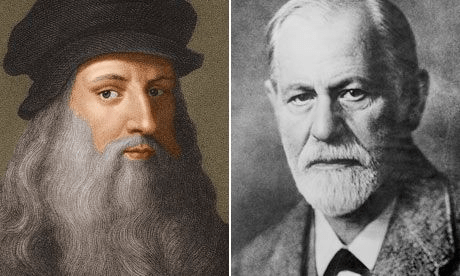
Sometimes people say to me: you think too much, you analyse everything, you never let it rest, just as the old man in the opening of the James’ novel above does not really rest though it looks as if he is so doing. But the need to ask multiple nested questions of ‘reality’ seems driven in me, I often reflect. Freud said that Leonardo da Vinci’s endless questioning was that of a child still working out its relationship to its mother’s body – the earliest container of it’s life – trying to re-penetrate the cause and meaning of its existence and what it essentially is with endlessly unanswered questions of ‘Why?’, The questions stem from that unexplained mystery of an origin that never gets satisfactory explanation. That explanation given by Freud itself now seems too end-stopped for understanding the relation of anxious questioning to the felt complexity of a world too overwhelming at times though, I think. Don’t you?
I think instead the issue is existential and rooted in the condition of modernity – the angst is a turbulence within a reflexion of that complex world of self and other in an inadequate mirror – truly a ‘glass darkly’ that cannot help but distort. St. Paul hoped for a moment ‘face-to-face’ with Christ but modern human beings don’t really have any sound basis for hope that ‘face-to-face- interaction will be anything less distorted or delusory in its effect. For even ‘face-to-face’ people find ways to make interaction a playing at games consciously or unconsciously. After all the best counsellors know the rules of Gerard Egan’s The Skilled Helper by experiential noticing of the sub-channels of communication with others, if they are sufficiently aware of how to engage with trust with or without spontaneous existential authenticity on their side (though Carl Rogers – Egan’s precursor – so championed that latter trait in the counsellor as a necessity).
When you truly love too (or at least when I do) you feel it as if from the bottom of your being (for in love you believe in the existence of something describable as your essence (the problems of the ontology of the self [or Being and Nothingness] solved in something that feels like redemption). Falling out of love, rejection or loss though often show that such beliefs in both self and other one called ‘love’ were in fact multiple constructed beliefs, concomitant and contingent products of overcharged emotions and the overvaluations those involve. In fact I would say that the same transference and countertransference, and, projections and interjections as in the psychotherapeutic situation are being exchanged here in love exchanges. Nowadays we prefer it more simply formulated than in those psychodynamic terms, as in the sub-psychodynamics of Eric Berne’s The Games People Play. However, the apparent simplicity of the Berne model, which made it extremely popular when I was young, hides a whole series of unstable exchanges of identity in which the certainty of ‘adulthood’ on which Berne’s schema rests its therapeutic interventions, seems the one we must challenge first of all in the days when no binary like child/adult can be trusted as a certainty (see my blog post on that at this link).
In the end, though, I have no choice, and. I believe, we have no choice, but to face a world that is by its nature uncertain and difficult, dark and sometimes without assistive design to enable a planned intervention. Humans, of course, impose patterns on the world offered to them by their senses that may either be patterns constructed collaboratively in culture and then introjected or may be ones individuals project so forcefully they are believed by others. Whatever, these patterns seek to impose order and meaning on the world in which much is random. Even though this may be the case though, we need to continue to discover and work with such patterns to escape the power of imposed hegemonic cultural patterns that serve only the self-interests of the privileged and powerful few. Otherwise we would have no politics – and indeed I think we are nearly at that situation now: as Mark Fisher and Matt Colquhoun show though they argue for kicking against the pricks with confidence fostered in new collective groupings of affirmative identity (see my blog at this link).
I think then, since I, and as I say ‘we’ too, MUST embrace complexity for the world is complex. However, we also owe it to ourselves to assert that spontaneity and the ‘natural’ is possible too, even as a contingent accident of our human interactions. In those human interactions we always re-discover that people can be, and therefore are, capable of love and beauty of action, thought and word, and often in a togetherness beyond ‘love’ which can involve pain that no-one would look for, or you would think not. So the point seems that we should not feel overwhelmed by complexity but BE FASCINATED by it. For in fascination lies all our curiosity, and without curiosity, perhaps we are already the walking dead. And this is how learning can go. I recently looked again (heavens know why) an assignment I did on a Open and Distance Learning MA course and found this summary of widespread concern about the zombification of university learning and teaching. Here’s the paragraph:
The crisis in the ‘idea of the university’ is recorded by many witnesses (Evans 2002:106ff). Harper (2013:31) describes the ‘zombification’ of university culture, characterising the commercial culture of contemporary universities (to others known as ‘McDonaldization’) as the animation of a ‘dead’ liberal critical traditions that universities were once said to embody in vivo. (4)
So maybe if I could get not get people to say at my funeral that I had ‘a fascination with what’s difficult’, they might at least say, that as a teacher, social worker, counsellor and friend he was not a zombie. If they would say that, as the few gather at my open grave (that’s a fancy because I opt for cremation in my will) they will continue “At Least, I hope not“. Not that I am vengeful. Lol.

With love
Steven
[1] Scott D. Blain,1,* Julia M. Longenecker,2 Rachael G. Grazioplene,3 Bonnie Klimes-Dougan,1 and Colin G. DeYoung1 ‘Apophenia as the Disposition to False Positives: A Unifying Framework for Openness and Psychoticism’ in J Abnorm Psychol. 2020 Apr; 129(3): 279–292.doi: 10.1037/abn0000504 Available at: https://www.ncbi.nlm.nih.gov/pmc/articles/PMC7112154/#:~:text=The%20term%20apophenia%20was%20coined,et%20al.%2C%202009).
[2] The italics in this quotation, apart from on the words in French, are mine’. From a blog on John Burnside’s (2021) Aurochs and Auks: Essays on Mortality and Extinction Cornwall, Little Toller Books. https://livesteven.com/2021/11/29/every-lapse-from-the-imaginative-into-the-idees-recues-of-orthodoxy-is-disappointing-this-blog-reflects-on-burnsides-2021-aurochs-and-auks-essays-on-mo/
[3] 1 Corinthians 13:12, King James Version, “12 For now we see through a glass, darkly; but then face to face: now I know in part; but then shall I know even as also I am known”.
[4] For the blog version of the assignment see: https://livesteven.com/2019/06/09/the-open-up-teaching-learning-project/. The references inside the quotation refer to: Evans, G.R. (2002) Academics and the Real World Buckingham, The Society for Research into Higher Education & Open University Press & Harper, R. (2013) ‘’Being’ post-death at Zombie University’ in Whelan,A., Walker, R. & Moore, C. (Eds.) Zombies in the Academy: Living Death in Higher Education Bristol, Intellect, 27 – 38.
Yeats’s poem
The fascination of what’s difficult
Has dried the sap out of my veins, and rent
Spontaneous joy and natural content
Out of my heart. There’s something ails our colt
That must, as if it had not holy blood
Nor on Olympus leaped from cloud to cloud,
Shiver under the lash, strain, sweat and jolt
As though it dragged road metal. My curse on plays
That have to be set up in fifty ways,
On the day’s war with every knave and dolt,
Theatre business, management of men.
I swear before the dawn comes round again
I’ll find the stable and pull out the bolt.
 Steve_Bamlett_blog