In the wake of the passing of Mark Fisher which Matt Colqhoun describes in their books, Matt finds significant meaning in words from the funeral address of Mark’s colleague and friend, Kodwo Eshun, which describe Mark’s ability ‘to “gather people into gatherings”; his talent for “making movement”’. Both Kodwo and Matt link this to Mark’s affirmation of ‘the ways in which we ourselves must “consent not to be a single being”, engaging with each other in our “affective proximity”, all the while “being alert to the temporality of theory”, its “shifting grounds”, its “drastically advanced regression”, its “turbulence”.[1] This is a blog on understanding why there is an impersonal and public politics of variations of intimacy in relationships and attachments that feel private. It is also on why this blogger feels inadequate to review, other than as a distant voice in a desert, books by Matt Colquhoun, focusing here on Postcapitalist Desire: The Final Lectures by Mark Fisher as edited and introduced by Matt (2021) and Egress: On Mourning, Melancholy and Mark Fisher (2020). Both books are published in London by Repeater Books.
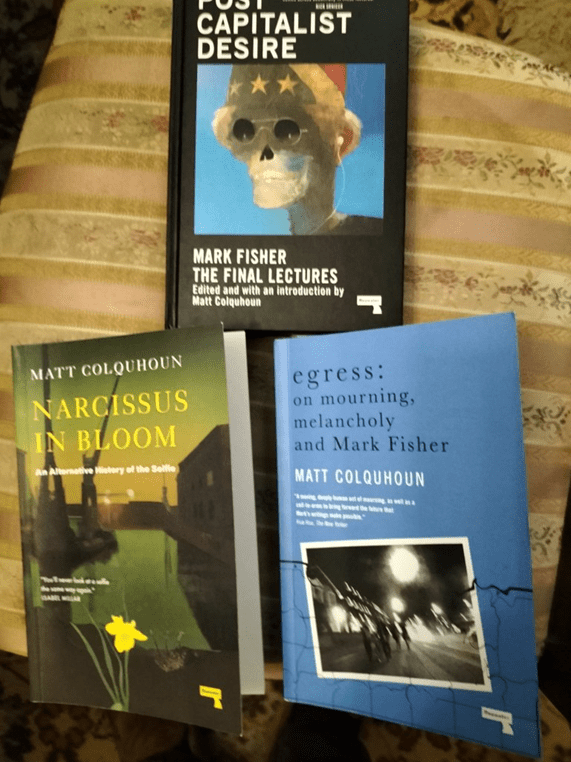
This blog was predicted in a lighter one: at this link. I am using the same photograph of Colquhoun’s present books in print.
I should start by predicting a later theme of this blog by warning that this blog is neither a review, evaluation nor even adequate description of Matt Colquhoun’s books. I tried to discuss the first I came across, his latest book, in an earlier blog at this link. On Twitter/X, Matt was kind about this blog though he must have known its shortcomings, which are those of a person not versed enough in contemporary cultural theory and, though they may not have known this, a person who feels too old and retired from academic discourse to follow the route to competent understanding further.
My response to their work was at the level of its absolutely fascinating fusion of BOTH interacting impersonal summaries of cultural theory and theorists AND personal statements about a life indicated to have experienced significant ruptures, in mental health, functional competence by the person’s own standard of judgement and sexed-and-gendered sexual/romantic being. One thing in that blog shows my vacillation with some of the theoretical-cum-personal content, though it is possibly minor.
At one point in Narcissus in Bloom (2023) – I cannot find the precise quotation now – Matt talks about the inflexibilities of a society that makes such a fuss about being asked to take more care that the pronouns used in personal descriptions of others match that other person’s choice of pronoun. I noticed that but in reading slided over it (without taking a page reference therefore). It was only as I started writing my blog and was near its end that I discovered that Matt’s personal pronoun preference was they. This ensured entirely that the end of that blog would change and shorten the blog as a whole for I feared I had it all wrong, rather than partly so. Yet the part where I admit this issue is the very part Matt quoted (by screenshots) on Twitter / X.
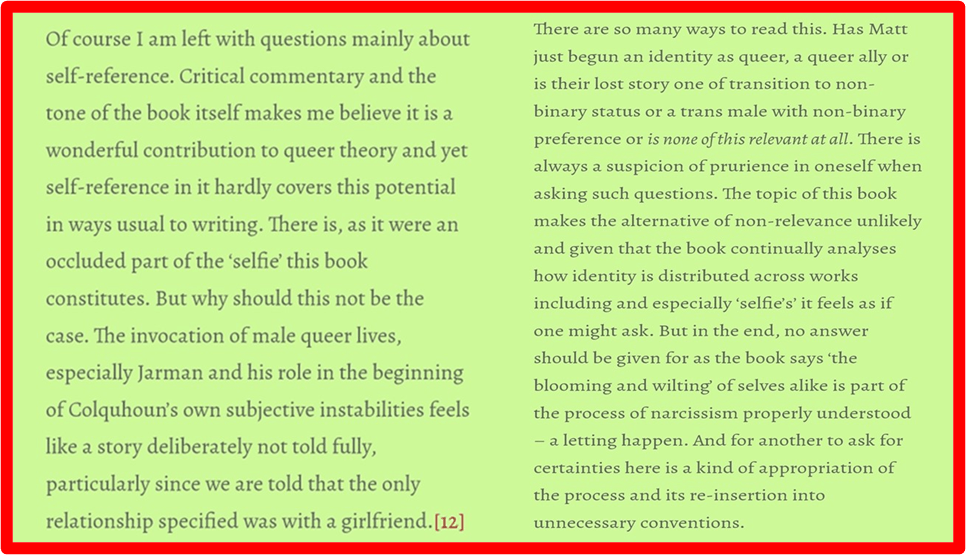
Mattie, their name on Twitter, says of these quoted pieces (save my blushes): ‘The ending of the book *is* ambiguous but this is exactly how I would want it to be read’. (https://twitter.com/xenogothic/status/1731780312005272051) (extracted 13/12/23)
In fact the blog makes frequent mistakes in its pronoun use, where I missed replacing he, him or his for they, them or their, but I have left the errors extant now to record my own learning process. Having read Matt’s two earlier books, I now know that Matt used to accept the ‘masculine’ pronoun in descriptions in the book cover summaries, for instance, and that these texts use this pronoun in some references. I will stay with they however herein, being Matt’s choice now and given the importance to them of living and leaning into a communalised identity. It is likely that they also use the term for many different reasons – for personal, theoretical and impersonal reasons.
And herein my admission of feelings of inadequacy in sending out this blog. It won’t stop me doing it for these feelings of inadequacy also have, as with the depression examined in Egress, the same capacity of being read in the sense in which they indicate a state, not of just personal feeling, interior and private but of an impersonal reflection of public life and social institutions. We soon find out about Matt’s, and Mark Fisher’s, experience of anti-depressant medication (SSRIs) and of the power over prescription and non-description by a fractured health system that led Matt and possibly Mark into Antidepressant Discontinuation Syndrome (ADS) that exacerbated Matt’s behaviours of self-harm and self-medication by over drinking alcohol, and experiencing disabling mind-states (I know them well myself).
However, these issues are not just personal, they insist, for depression is ‘a political issue precisely because it transcends, obliterates and often falls between the boundaries set by our proud social institutions and capitalist realities’.[2] Later, as we learn more about Mark’s suicide too, Matt cites Mark’s own essay Good for Nothing about the complicated effects arising from and bound up into, discoursing about one’s own’s inner feelings of anxiety and depression :’be it individual or collective, “is partly constituted by a sneering ‘inner’ voice which accuses you of self-indulgence – you aren’t depressed, you’re just feeling sorry for yourself, pull yourself together – and this voice is liable to be triggered by going public about the condition”’. This helps not just Matt but a collective gathered together to discuss Mark after his suicide for they were all ‘questioning whether we had the right or the expertise to talk about certain issues, seeking a sense of solidarity beyond the limitations of our atomised selves’.[3]
It feels the stranger for me to admit my feelings of anxious inadequacy in the light of Matt’s achievements, though I do not know them as those friends, co-workers and learners, knew Mark Fisher. Nevertheless, I think I still have to do so. Otherwise, I will openly be able to write knowing that there is much in Matt’s work I don’t yet understand, and some (no doubt) I will never understand. This is because I know, not only that my knowledge of the ‘theory’ he speaks of so eloquently in these books (and shows Fisher doing the same as their precursor) will never be complete or even adequate, but also because I will resist ever, in my retirement, ever reading abstruse and difficult (and often French) theory again. Yet Mattie’s circle on Twitter / X know their Badiou and their Lyotard, in ways I never shall make the effort to do so (not saying I could understand them if I did). Though I still find time for Lacan, Barthes and Foucault – for they were available to me in younger days and I read them, puzzled often but compulsively.
A fairly irrelevant picture but eh! it’s a nice picture of the Pompidou Centre as I saw it in the 1980s & it has Lyotard and all the thinkers are mentioned (less so Baudrillard)
Moreover, there is another clue to my feelings of inadequacy in that last sentence before the picture of the Pompidou Centre – my references to ‘younger days’, ‘retirement’ and age generally. For these have two effects on me that might, and I think do, disqualify me from commentary on the analyses of modern theoretical innovation open to Matt.
First, my tastes are set in some old-fashioned cycle that keeps insistently referring me in my blogs to the classics established in my training under old-fashioned ‘subject’ definitions of what was known as the study of English Literature and Language at UCL in the 1970s. Hence Spenser, Milton, Shakespeare, Arnold, Tennyson and Browning still assert relevance to me in ways Badiou or an essay, however fascinating by Blanchot (absolutely vital to the theoretical and interpersonal stances of Matt and Mark) never now will be.
These tastes are not just (relatively) fixed in my fascination in ways that theory, apart from Freud. Marx and Engels versions of theory which I revere, can’t be as they are for Mat because they are fictions in various genres. After all, Matt is learned in both visual art and literatures in many ways to which I can also not aspire and seem out of my reach. I read the discussions on his timeline with learned others about k-punk or innovatory film and /or music with a sense of increasing alienation. I cannot imagine even making a step into those cultures, aware of the shock involved to my habitual range of knowledge, skills, ‘taste’ for sensations or even value-systems which, despite myself, still seem alien and ‘too young’ for me and too large to enter at this stage of my life, which I yearn to call ‘belated’.
Secondly, the consciousness of age difference is not a feeling I find analysed in Matt or Mark’s books (and, of course, for Mark never will be for ‘age cannot wither him’ now). But it lives in me. It is nevertheless a feeling and subjective consciousness that is ‘a political issue precisely because it transcends, obliterates and often falls between the boundaries set by our proud social institutions and capitalist realities’, and often links to the depression and anxiety linked to before in this blog’s visit to Matt’s work.[4] The sections of Matt’s book on ‘acid communism’ still pass me by, casting a ‘cold eye / On Life, on Death’, a state of feeling old Yeats had inscribed on his gravestone. But Yeats could do that hubristically, knowing the reputation he had gained as Irelan’s national poet – of an Ireland as it came into being from under English rule. I have no such confidence – though as for ‘hubris’ let others judge.

What I do feel able to comment on is another way in which Matt in these books lends analysis and profound descriptive talent to showing how personal and the political come together in the performance of role identity and issues of status in social institutions and socio-political groups and emotional attachments. The saddest moment of reading Postcapitalist Desire for me in the text of Fisher’s formal lectures (with interruptions and the delivery of papers extant by anonymised summary) transcribed by Matt (and I think others) lies in the end of Lecture Five on ‘Libidinal Marxism’ delivered on 5th December 2016, the last before the end of the term and before Mark’s suicide in the holiday break from work at Goldsmith’s College that followed. Aware of the sense of the pace of time eating into the session, Mark says, breaking into his own argument about how ‘Lyotard seems here (to have) a gloriously hemmed-in quality’ just after he says, with a questioning tone in his voice, that it is summed up in the ‘fact that’ his writing ‘cannot do anything beyond itself’: “Oh gosh, we’re nearly coming to the end …”.[5]
There is something like the catharsis of tragedy here for me, partly because the instantiation of the lectures as dramas (sometimes they break genre boundaries in teaching from lecture to seminar), though it is limited as an example of Aristotelian catharsis because it is only imitation of experienced human feeling of intensity in the way that any record of speech is. It is not even about a pre-knowledge of his own death, but it is so unconsciously, in the way that Mark Fisher apparently spoke of as a way forward in left political sociality and solidarity that involves not just collective consciousness raising (and the homophonic ‘razing’ of false consciousness in Lukács’ sense) but also a narrative of ‘unconsciousness raising’ which he found in Westworld (as film and TV series) in which contemporary right-wing ‘zombie’ neoliberalism meets the ‘spectre of Communism’, which clearly haunts more that Europe now.[6]

Westworld too, as much of the Xenogothic material analysed by Matt that is even more recent and widely analysed, escapes my ancient ken. It feels too much to absorb now into the limits of my cognition, emotion, sensations and value-set but I find the analysis not half fascinating and compulsive to read in Mark’s and Matt’s hands.
What I think though that these books of analytic-synthesis illustrate is that our consciousness is in need of repair and liberation, and that this process must be the avoidance of false consciousness (that attributes all and everything to the realm of individuals alone) and erases it by replacement with raised understanding of the systemic ubiquity of a process Mark calls the repetitive cycle of ‘resubordination’, that induces the sense of personal responsibility and failure as our sole response to the world and is the thing that hides behind labels like anxiety and depression. Matt writes:
Mark wrote that depression “is the shadow side of entrepreneurial culture” – it is, in itself, a symptom of “what happens when magical voluntarism confronts limited opportunities.” … / Elsewhere, he wrote about how our collective depression “is the result of the ruling class project of resubordination.” The illusionary meritocracy to which our ruling classes profess allegiance is nothing more than a trojan horse for the enforcement of their own ideals, behaviours and standards. As a result, within our political lives most explicitly, we accept “the idea that we are not the kind of people who can act”.[7]
The left, they both argue, needs to recognise that unconsciously, it too is locked into a paradigm of hopelessness attached to a lost world of simpler relations of production and consumption, a visible ’bourgeoisie, or ruling class, on the one side and a proletariat and lumpenproletariat aware by virtue alone of their place in the economic system of the need to rise against it were it not for their ‘false consciousness’ alone. Things are not so simple, and perhaps they never were, although it is a mistake (false consciousness or a ‘confabulation’) to say that this is because,as Mark quoted John Prescott, whilst Deputy Prime Minister under Blair, as saying, that “we are all middle-class now”, but because we are still governed above by a ‘self-fulfilling process of coercion’ that leads us to:
believe in capitalism’s self-confidence despites its blatant failings and inconsistencies, again speaking to the intense stupefaction and paralysis of human agency and imagination’. … Capitalism is not consensual but its processes of stratification have now spread so far and so deep in our collective psyche that we daren’t think to question them – or, worse still, we forget that we even have the capacity and agency to do so.[8]
And since, as Mark Fisher says the “current ruling ontology denies any possibility of a social causation of mental illness”, we end up with a regime of SSRIs controlled by medical authority and justified by the presence in the bodies of the depressed of deficits of serotonin, that is, as Fisher also correctly says, not a CAUSE of depression but just evidence that mental illnesses are all ‘neurologically instantiated’ (which he again rightly goes on to say ’says nothing about causation’.[9]
More important in this book and Narcissus in Bloom, are the pointers to ways of rising confidently, even narcissistically in the terms of the latter book, above false consciousness and into the potential of new and every varying selves that can be experienced only by a letting go of the idea of agency as only a personal thing and seeking self instead in the potentials arising from those experienced through new groupings, collectivities and communities of people, conscious of their ideological marginalisation and continual resubordination.
Fisher is clear that some versions of community are false and serve capitalism (as with ‘community care’) but others lean towards a freeing of collective and individual action and self-belief in the interests of a changed society. I pointed towards community and the communitarian ideas in this writer in my last blog on Matt. However, I think I understand that set of ideas a little better now, and their relationship, which is frankly admitted to be one that cannot as yet be fully articulated, if ever, for the thing it describes is an emergent not existing phenomenon. The pointers in the texts are towards something I keep thinking of, rightly or wrongly, as a communal ‘subject’, a ‘we’ or ‘them’, which may be a basis for Matt wanting to use the pronoun ‘they’.
It appears in the cited words of Simon Sullivan as a product of accelerationism, rightly understood,[10] saying that, ‘left accelerationism … “involves something more immediately recognisable: a communist subject, or a subject that is the product of collective enunciation”. Mark Fisher imagines that acceleration in this way will ‘offer up platforms for a new and different kind of subject to emerge”.[11] This leads to those partial quotations in my title in brilliant passages of writing about the mode of collective mourning for Mark, involving razing/raising of consciousness and this new ‘communal subject’ emergent in the prose. Let’s revisit my title in the summary:
In the wake of the passing of Mark Fisher which Matt Colqhoun describes in their books, Matt finds significant meaning in words from the funeral address of Mark’s colleague and friend, Kodwo Eshun, which describe Mark’s ability ‘to “gather people into gatherings”; his talent for “making movement”’. Both Kodwo and Matt link this to Mark’s affirmation of ‘the ways in which we ourselves must “consent not to be a single being”, engaging with each other in our “affective proximity”, all the while “being alert to the temporality of theory”, its “shifting grounds”, its “drastically advanced regression”, its “turbulence”.[12]
We should note here that, in anticipation of the advent of speech about a new breakthrough in ‘the importance of music in Mark’s thought’, this passage is musically arranged. It shows that theory is not a stable static element but one that has significant duration, with motion that is progressive and regressive and instantiates ‘turbulence’ without precisely naming it. Here I feel inadequate again, for it is precisely the modernity and comprehensiveness of modern theory of which I am in deficit, though I think I know its ‘turbulence’ and ordered anxiety. Using Blanchot in particular, Matt paints a picture of a politics I have fallen in love with:
As the capitalist state enforces its own model and constitution on the modern subject, with freedom reduced to the implicit and unbalanced equation of state sovereignty with the sovereignty of the individual, communism becomes a quasi-poetic call for a sociality that is uninhibited and attentive to the already existing flows of human life itself, innately fragmentary and fluid.[13]
The illustrations of all this lie in the chapter on ‘Acid Communism’, where egress from the status quo is through mourning and loss but towards a ‘joyful mourning’ (the feel here is of Nietzsche’s Dionysus). If I find the chapter ‘Acid’ culturally alien, it is because it involves a step I would need to take too long in preparation to know the artforms invoked, the preface to the chapter is not alien, and IS BEAUTIFUL, explicating the movement from ‘hauntology’ (a spectral ontology of transition) to the experience of emerging freedom (with echoes of Lacan diffused though Slavoj Žižek, a thinker I desperately admire but only dimly know). Except I do see the point of distinguishing a politics of desire from the haunted right-wing associations of a politics of pleasure, with new wants – which become in Narcissus in Bloom, queer wants.

Slavoj Žižek by Amrei-Marie – Own work, CC BY-SA 4.0, https://commons.wikimedia.org/w/index.php?curid=119893485
What haunted Mark was a similar notion: a collective subject that has long been desired but still resists instantiation. Here a spectre is not what is left of something dead or lost. It is atemporal; an “eerie identity”, representing both a failure of absence and a failure of presence. It is desire without absolute lack.
… The production of politics has had much the same effect (as that described by Marx and Engels in The Communist Manifest of commodity capitalism on the old feudal mind) on us as subjects. Eroticising desire, launching it into the unknown and forbidden lands; beyond borders, boundaries and limits. Pleasure becomes, in contrast, fatally associated with the familiar.
I yearn to parse this with my understanding of it but that would be senseless for it speaks in parts through its rhythms (excluding my summary in italics of course). If you feel the beauty of Matt’s theoretical prose of rhythmic counterpoints, you will love these books, but I urge on you most Narcissus in Bloom, for it sings with the voice of we and they.
With love (and sorry Matt if you read this)
Steven
[1] Matt Colquhoun (2020: 187) Egress: On Mourning, Melancholy and Mark Fisher London. Repeater Books. .The quotations are from, as cited in footnote 5 for this chapter (ibid;289), the Mark Fisher Memorial Lecture by Kodwo Eshun.
[2] Ibid: 26 – 29, the quotation is on page 29.
[3] Ibid: 191
[4] Ibid: 26 – 29, the quotation is on page 29.
[5] Mark Fisher [Matt Colquhoun (Ed.)] (2021: 207) Postcapitalist Desire: The Final Lectures by, London, Repeater Books
[6] Matt Colquhoun 2020 op.cit: 137
[7] Ibid: 31
[8] Ibid: 42
[9] Ibid: 55
[10] It needs to be understood not as a speeding up of capitalist process to its goal in fatal contradiction, but in a process of speeding up of selected positives in the ‘benefits’ of capitalism (never more than ideological in capitalism as a system itself.
[11] Ibid: 39
[12] Matt Colquhoun (2020: 187) Egress: On Mourning, Melancholy and Mark Fisher London. Repeater Books. .The quotations are from, as cited in footnote 5 for this chapter (ibid;289), the Mark Fisher Memorial Lecture by Kodwo Eshun.
[13] Ibid: 199f.
 Steve_Bamlett_blog
Nice post ✉️
LikeLike