


There are so many things that the figure of Jesus Christ in the New Testament says that even a non-believer like myself has to applaud. However, just as I do not accept that there is ONE God that is the repository of all truth whether I or anyone else understands it, I also cannot accept the lesson that is so often at the centre of Christian values and which appears (though not for all, as some wonderful Christians show us) to say that that there is only ‘one thing needful’. In the fuller New International rather than the King James Version ‘few things are needed—or indeed only one’, is the translation given of the same phrase in Greek which is a much more circumspect expression of the point but adds up to the same thing.
In the Bible story in The Gospel of Luke Chapter 10 verses 38 – 42, Jesus says that the ‘one thing needful’ is illustrated by Mary, the sister of Martha, to Jesus; on His visit to their home. Whilst sister Martha does all the cooking, serving and hosting, Mary just ‘sat at Jesus’ feet, and heard his word’. Here is the full King James text:

38 Now it came to pass, as they went, that he entered into a certain village: and a certain woman named Martha received him into her house.
39 And she had a sister called Mary, which also sat at Jesus’ feet, and heard his word.
40 But Martha was cumbered about much serving, and came to him, and said, Lord, dost thou not care that my sister hath left me to serve alone? bid her therefore that she help me.
41 And Jesus answered and said unto her, Martha, Martha, thou art careful and troubled about many things:
42 But one thing is needful: and Mary hath chosen that good part, which shall not be taken away from her.
The person I admire never thinks there is ever ONLY ‘one thing needful’ and, in the light of that credo, sacrifices every other call on them to follow that one need. Christendom, and other religions that are monotheistic in nature, too often pretend that there is only one such call on believers – one imperative that lords it above all others. Moreover, to the cynic, which I may be but I hope not, the call for ‘one thing needful’ in Christendom gave the green light for the abandonment of the view that there is a world mission that applies to us all to be forever in pursuit of the GOOD as Plato saw it. They replaced it with a belief that just sitting and adoring the representative of the true Godhead and listening to its words (in basilica, church, chapel or temple) was all that was necessary for GOODNESS. Meanwhile EVIL prevails, whilst the believer thinks the only call upon them is to express that it is not good what is happening and that evil will get its punishment in another place than now.
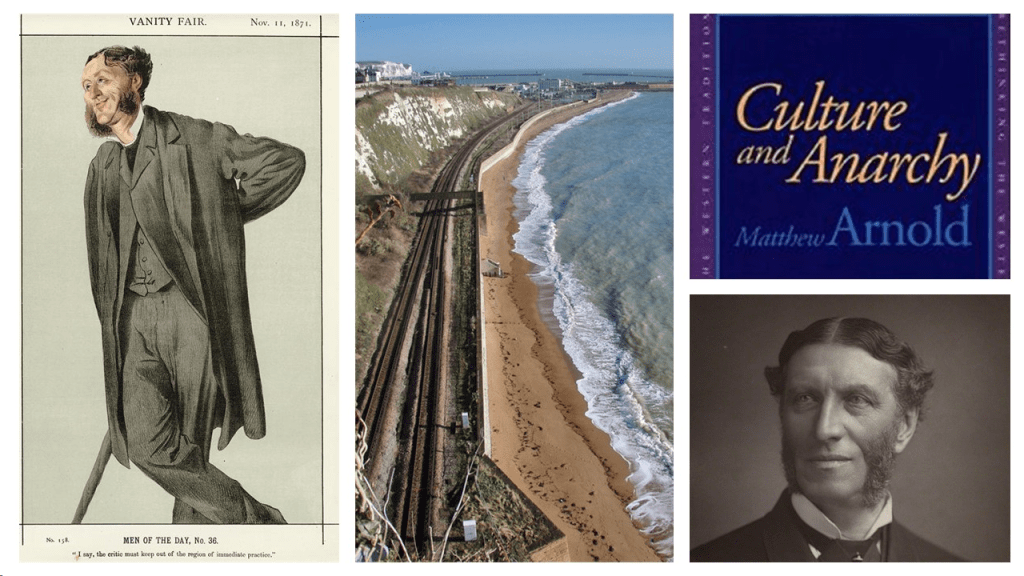
I am, as you will have guessed, not the first to find exception to this reading of the Biblical text quoted. Matthew Arnold, poet and educator, in 1869 published the book Culture and Anarchy (text available at the link) as a means of railing against a belief that the need that should guide nations should be so blinkered that it aspired to one aim alone and did not address itself to a wider culture, one he associated with Hellenism, or the ideals of human perfectibility in all and every, or at least many, domains. He traced this belief system (which he called, in shorthand, Hebraism, but which would be less anti-Semitic were it named Judaeo-Christianity) to its location in the Puritan tradition in English history, culture and society, and which, in the nineteenth century, he characterised (with Milton in Samson Agonistes in the seventeenth century but there speaking of Royalism) as Philistine. In Chapter Five (sub-titled ‘One Thing Needful’) he says:
The Puritan’s great danger is that he imagines himself in possession of a rule telling him the unum necessarium, or ‘one thing needful’, and that he then remains satisfied with a very crude conception of what this rule really is and what it tells him, … He is, I say, a victim of the tendency to cultivate strictness of conscience rather than spontaneity of consciousness. And what he wants is a larger conception of human nature, showing him the number of other points at which his nature must come to its best, besides the points which he himself knows and thinks of. There is no unum necessarium, or one thing needful, which can free human nature from the obligation of trying to come to its best at all these points. The real unum necessarium for us is to come to our best at all points.
You may think Arnold labours the point, with the Latin version of ‘one thing needful’, as if he is comparing Roman militaristic Imperialism to Greek ‘sweetness and light’, but the substantive issue comes across the better for that I think. There are many things that are needed to be done. To reduce them to one is crass and, in most cases, self-serving and a power-grabbing ploy.
Nevertheless, we are told, in education that specialism is key to national success, in politics that there is one priority (growth of the economy) and the pursuit of excellence in only one field our only hope for skilful attainment. I will not try to illustrate where, when and why I believe that to be the hegemonic value system of our time though. Indeed, I think we get evidence of it all the time.
Matthew Arnold became quite melancholy about it even in late Victorian England, believing that love and belief in others (he called it the ‘Sea of Faith’) had become such a personal and privatised thing that it was sensed in the world only between betrothed lovers and otherwise was a ‘long, withdrawing roar’ of the tide on Dover Beach and other loveless ‘naked shingles’ (even more the case for Dover after Brexit):
…. now I only hear
Its melancholy, long, withdrawing roar,
Retreating, to the breath
Of the night-wind, down the vast edges drear
And naked shingles of the world.
The person I admire seeks, not excellence in one thing but, to be good enough in as many domains as they have the capacity, and can acquire the self-efficacy, to be. And I think it is even more the case when the skills and arts required are those that enhance the life of ‘ the many not just the few’ or, at its worst, one person, themselves or one other, ONLY.
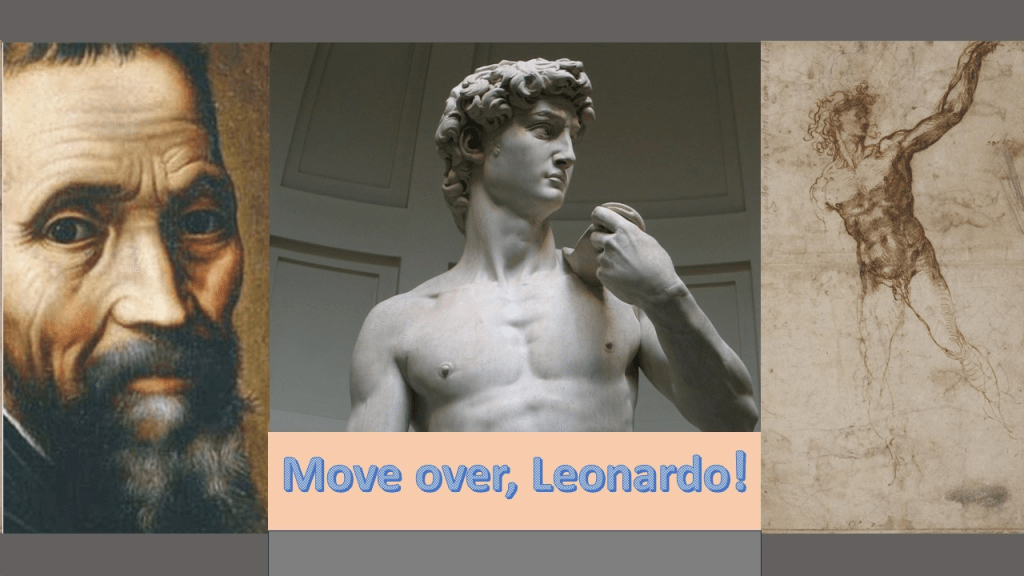
I think I thought that from an early age where I moaned to my teachers that I thought that, in the sixth form, I should be able to take subjects in the natural and social sciences, and the arts as well. One teacher I loved said: ” We aren’t cultivating Renaissance man here, Steven”. He then added with a cheeky smile: ” Or do you really think you are Leonardo”. I fumed. Nowadays, I would have said,”NO, just Michelangelo – he chose more beautiful young men!’.
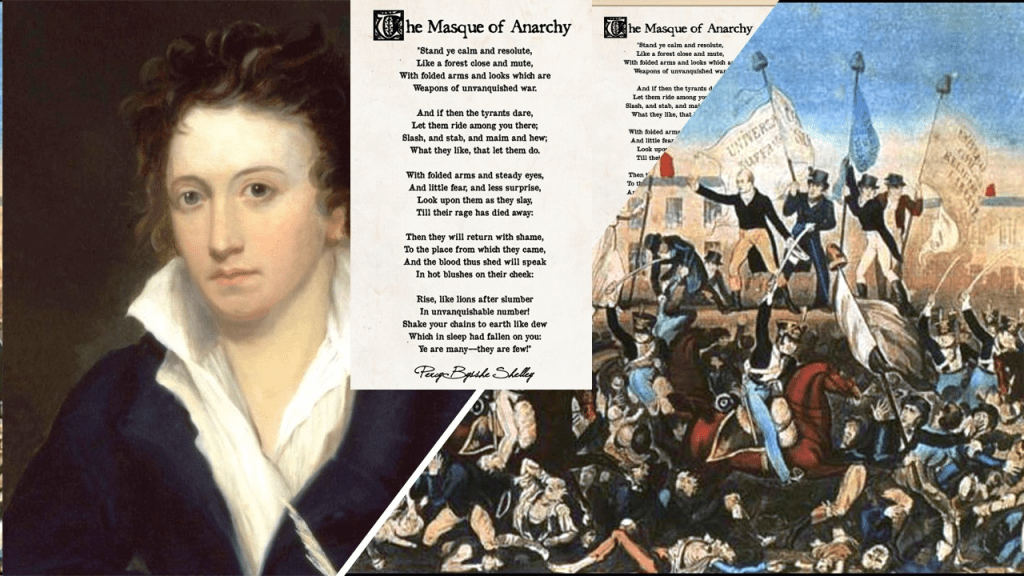
Shelley had the right idea. Deplore a government that pretends one thing matters, like the service of municipal law and order in corrupt Manchester, while its workers ‘clemmed‘. Remember with Shelley, in The Masque of Anarchy, that we “are Many, they are Few’. And, on top of that, recall that it is capitalism that has alienated the many from the skills, values and knowledge it reserves to itself, in order merely to hoard it in a box called HERITAGE that capitalism is too bored to ever open. The history of working class aspiration to education has always asked for knowledge, skills and values in many domains not just one, or two at most and certainly not only in the technical subjects.
Thus endeth the sermon for today. Meanwhile, let’s say it for Martha, whom few champion. To love is not always to feel it MUST be demonstrated, nor ever justifies oppressing others whilst you sit and listen and feel enlightenment. To be ‘careful and troubled about many things‘ in a world where it would be not only selfish but crass to do anything else, is what we need.
Love you all and your potential in so many things.
With love
Steven xxxxx
 Steve_Bamlett_blog