What technology would you be better off without, why?
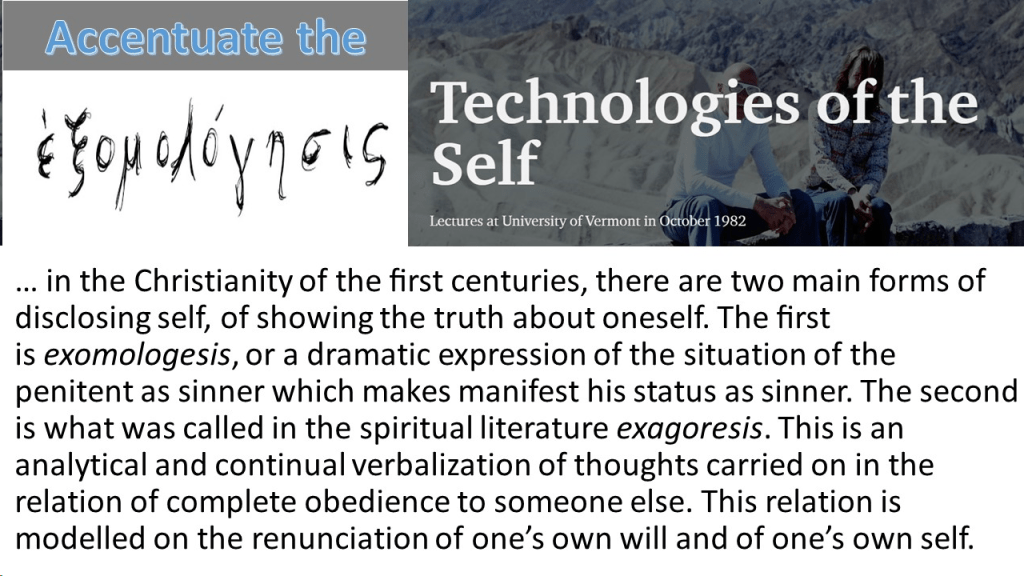
According to Foucault, the modern management of self is to accentuate the ‘exomologesis’ (or dramatic demonstration) of the negation of self in one big exaggerated monologue (actually it’s ‘exagoresis’ but ‘exaggerated monologue’ is smarter) in which you talk about your self-abasement to what is and has to be: that is the binding force of ‘technologies of self’. We would be better off without ’em.
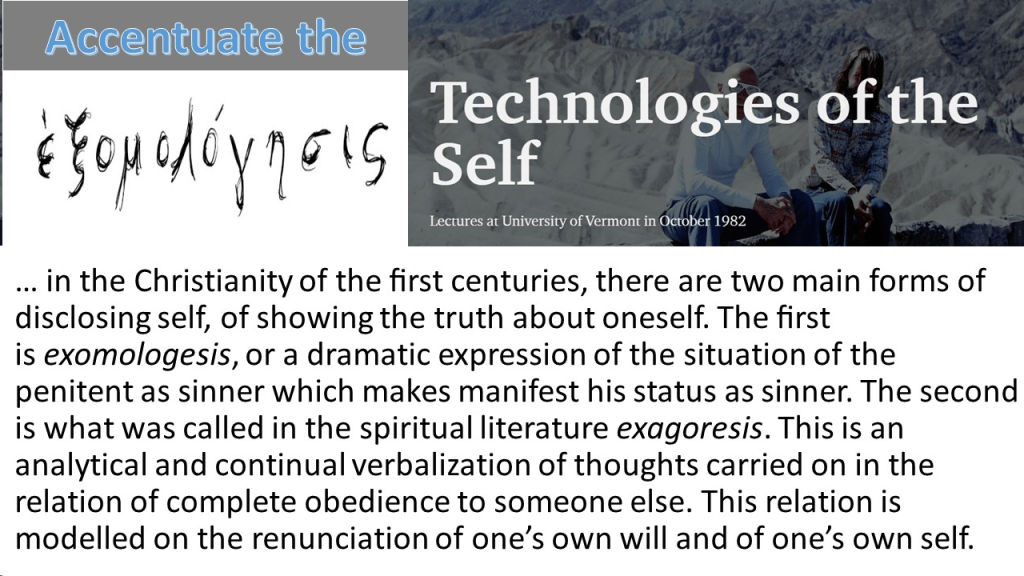
Foucault addressing the University of Vermont in 1982 on ‘Technologies of the Self’ excerpts from: https://foucault.info/documents/foucault.technologiesOfSelf.en
To John Hoggart
A dedication
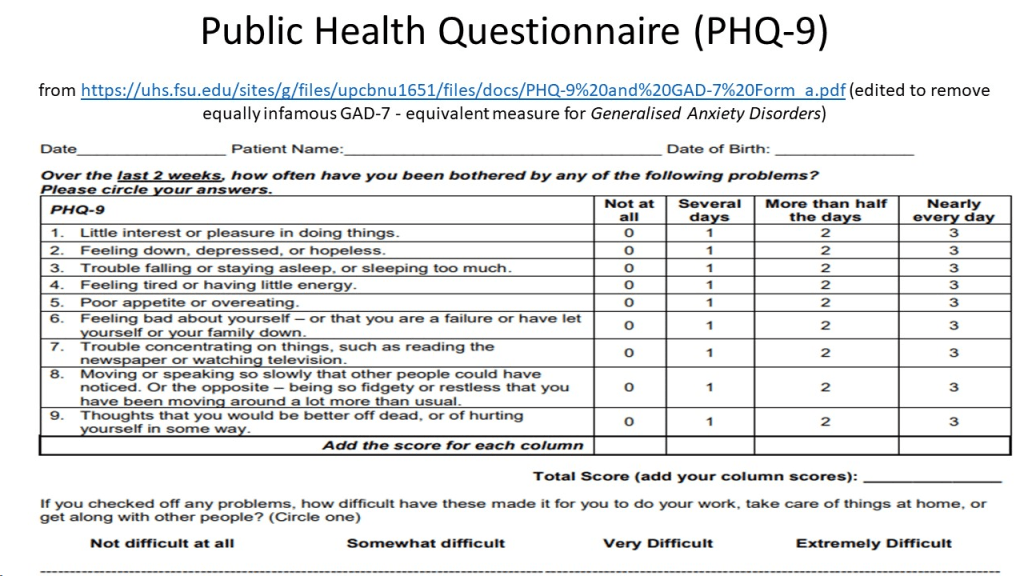
In Foucault, technologies have always been invented to create a convenient distance between the practitioner of work with, or upon, persons and bodies (often both together) such that the expertise of the examining institution and ideology is given preference over the subjective and messy visceral sensitivity of what is left of the person (or the SELF) when you reduce them to an object of your ‘care’ (sometimes called ‘support’ or sometimes ‘cure’ or ‘curation’). There is a ‘discipline’ of these technologies that assumes a technocratic meritocracy of expertise and science in their use and which justifies its objectivity by involving measurements, and instruments with which to measure. The very first one of these ‘technologies’ examined by Foucault was the stethoscope, which increased the distance of doctor from the patient’s body, especially the female ‘hysteric’ body, and reduced the ‘patient’s’ experience to the measure of distance of their bodily noises to a pathology diagnosed by measurement from norms. They became a ‘patient for that patience was the only skill required of them. In modern mass psychiatry, the grossest version of these instruments of measurement is the Public Health Questionnaire [PHQ] (the best known being the PHQ-9 scale for depression). The latter is considered so safe an instrument, which is thought of very few other mental heath scales, that it does not require expert interpretation but is itself the institution and therefore available to anyone at anytime on the internet; it is the almost PERFECT TECHNOLOGICAL TOOL OF THE SELF therefore.
In the early Christian Eastern Church, the SELF was experienced primarily as the symbol of fallen nature and of sin. This fact could be continually dramatised by some form of abject penitence or even martyrdom in which SELF IS RENOUNCED. Foucault saw martrdom as the perfect form of technical exomologesis, as defined above. Better still, the universal type of self possessed by everyone could delegate the extremities of self-renunciation to be performed for them by a ‘professional’ – which might be a man standing on a pillar in the desert (a stylites) or sealed in a cell (an anchorite).
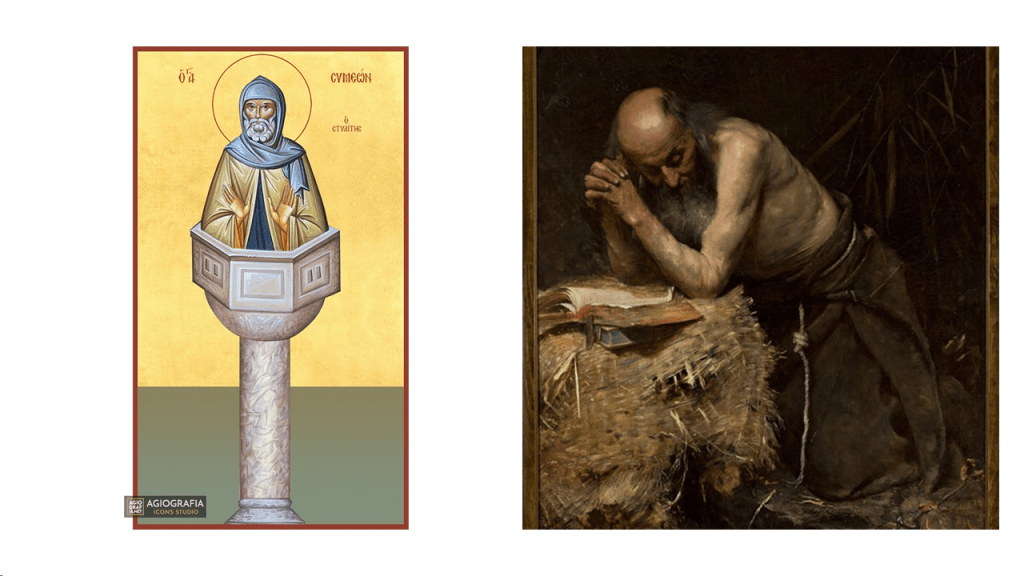
Even though saintly others did the extreme drama of self-renunciation for you, the point however was for every person to feel that they were implicated in this. The rigours of the Stylites was, you had to think as you observed their show of suffering, recording and exemplifying your own inner abasement and identity as a sinner. That it had this universal application is what saved it from looking like an a rather arrogant and attention-drawing practice in the professional, though Tennyson’s characterisation of the Byzantine Saint Simeon Stylites in the modernity of the nineteenth would have none of the latter self-justification.
Although I be the basest of mankind,
From scalp to sole one slough and crust of sin,
Unfit for earth, unfit for heaven, scarce meet
For troops of devils, mad with blasphemy,
I will not cease to grasp the hope I hold
Of saintdom, and to clamour, mourn and sob,
Battering the gates of heaven with storms of prayer,
Have mercy, Lord, and take away my sin.Let this avail, just, dreadful, mighty God,
This not be all in vain, that thrice ten years,
Thrice multiplied by superhuman pangs,
In hungers and in thirsts, fevers and cold,
In coughs, aches, stitches, ulcerous throes and cramps,
A sign betwixt the meadow and the cloud,
Patient on this tall pillar I have borne
Rain, wind, frost, heat, hail, damp, and sleet, and snow;
And I had hoped that ere this period closed
Thou wouldst have caught me up into thy rest,
Denying not these weather-beaten limbs
The meed of saints, the white robe and the palm.O take the meaning, Lord: I do not breathe,
Full poem available at: https://www.english.cam.ac.uk/multimedia/tennyson/simeon.htm
Not whisper, any murmur of complaint.
Simeon, expert in the technologies of the self, is an a prime example, somewhat satitrised by Tennyson, who always laughed when he read the poem aloud, of what I call in my title (after Foucault) ‘the ‘exomologesis’ (or dramatic demonstration) of the negation of self but it is in the process of becoming something the more usual form of self-technology, better known to the sophisticated psychological technologies (especially those known as the ‘alienists’) of the nineteenth century. The aim is not exactly ‘redemption’ but it does bear some resemblance to the version given of that process by Simeon Stylites in Tennyson’s version, where ‘this period closed’ could be the period of professional psychological consultation:

Image by W. E. F. Britten, for a 1901 scholarly edition of Tennyson’s early works.
And I had hoped that were this period closed
Thou wouldst have caught me up into thy rest,
It isn’t ‘rest’ exactly that is promised by such consultations, or latterly short-term ‘therapy’, nor is it ‘cure’ or even palliation from distress. In fact no-one much is interested in what it means for the person embarked upon sailing through these technologies. Instead what absorbs the ‘helping institution is only in the achievement of lower scores in the instruments of measuring their effects on you: the infamous and ubiquitous PHQ-9 and GAD-7 scores. What remains after this is just a discipline of self-talk technologies that attempt to convince one that one is ‘alright’, ‘okay’ or ‘normal’.
These self-talk technologies we can, after Foucault’s brilliant definitions, call ‘exagoresis’. The definition of that from Foucault is: ‘the analytical and continual verbalization of thoughts carried on in the relation of complete obedience to someone else’. Such discourses are a continual exaggeration of one’s own insufficiency for being other than alright’, ‘okay’ or ‘normal’ as ‘someone else’ sees these things. Of course, it doesn’t feel like subjugation to another for that ‘someone else‘ is most likely to be an image of an acceptable or good enough self-image that it was the real aim of therapy to cause you to introject.
Interestingly enough we don’t fully identify with that self-image and therefore don’t project it into our continuing relationships to others.Instead it persists as the aim of our self technologies, the things we use to care for and support that better self that we have been told will emerge from that process. It never does. If it did, we would see its falsity clearly.
Once upon a time those technologies were the exercises used In Cognitive Behavioural Therapy (CBT) and whose continuation was regarded as necessary, things like keeping a thought diary and evaluating the ‘reality’ of each recorded thought for instance, or when that went out of fashion mindfulness exercises that keep you in the present, such as body scanning. Now, the institutions seem to have lost faith in mindfulness too., realising perhaps that, divorced from its Oriental origins based on a numinous view of the world, it was the thinnest of technologies.
Now we are left with norms, or at best, a kind of existential angst wherein we realise we are all in the same kind of boat one that making choices as authentic to our individual circumstance and humane values as possible.. I have every sympathy with the last view of basic human ontology, except that I think we might as a group of beings across all species be all together, rather than each being in a boat of our leaky own, on a Raft after the sinking of the Medusa.
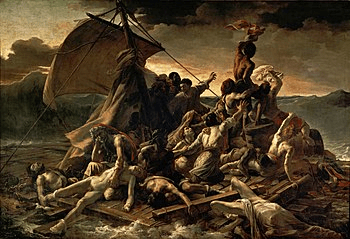
If we want to stay afloat, we aren’t going to do it by each adopting a technology of self-care and support. If we want to reach a safer destination we are going to have to co-operation. In Gericault’s The Raft of the Medusa painting the depressed but caring, like the sitting man with white hair and his head on his hand just above is, or the other man to his side looking aimlessly around, do as little for the good of the raft as the naked dead and dying but, at least, they have self-talk, and are, perhaps, are ‘in the moment’. My own preference might be to the man waving his shirt as a flag, whilst being aided by the surveillance of the seas of some (with varying efficacy since one man seems to mistake what he sees as religious vision and falls into madness). The main reason for wishing to be him is that all he is trusts in the men that hold him to the raft, so much so that he has no ‘self’ without their strong and wise hands.
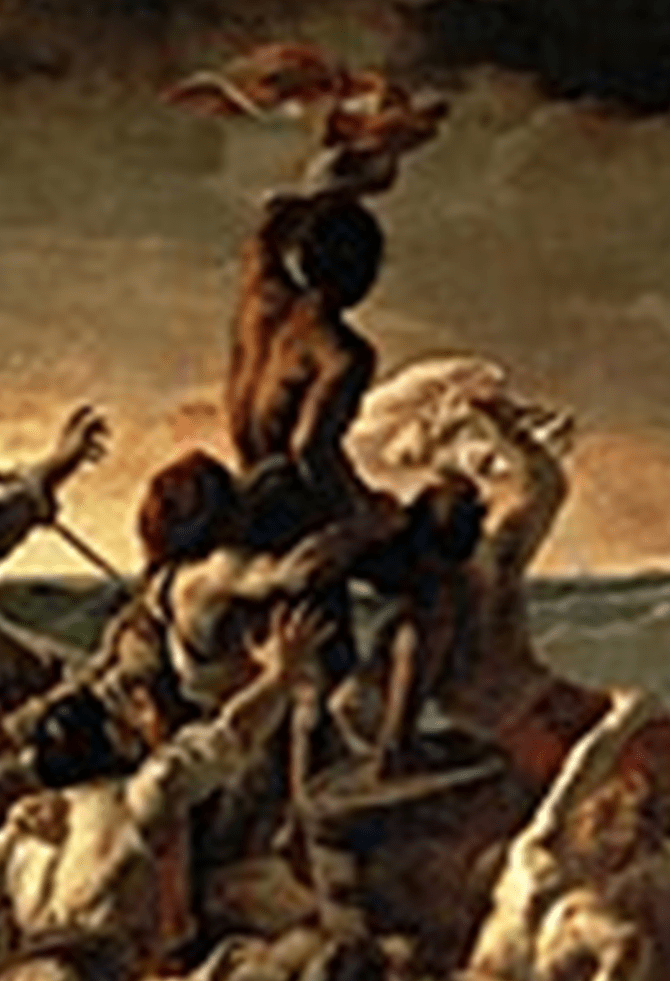
We would be better off with a strong politics and civic identity, based on a notion of the importance of being rather than institutions that know better and otherwise support in us only ‘technologies of the self’. But do not hold your breath for its advent
Nevertheless, I know there are lovely people out there. hold on and I will hold on to you, I promise. Together we get there. Alone, being ourselves’, sustained by our technologies by a failing system, we get nowhere but join the gradual slide into the water of those naked bodies.
All my love
Steve
 Steve_Bamlett_blog