What are the issues related to the representation or not of cis queer men in contemporary novels that make the representation of young male working class in terms of their cis masculine heterosexual development a focus? From Graeme Armstrong’s (2020) The Young Team to Michael Magee’s (2023) Close to Home (with a bow to queer analogues by Douglas Stuart (2020, 2022) and Jon Ransom (2022)).
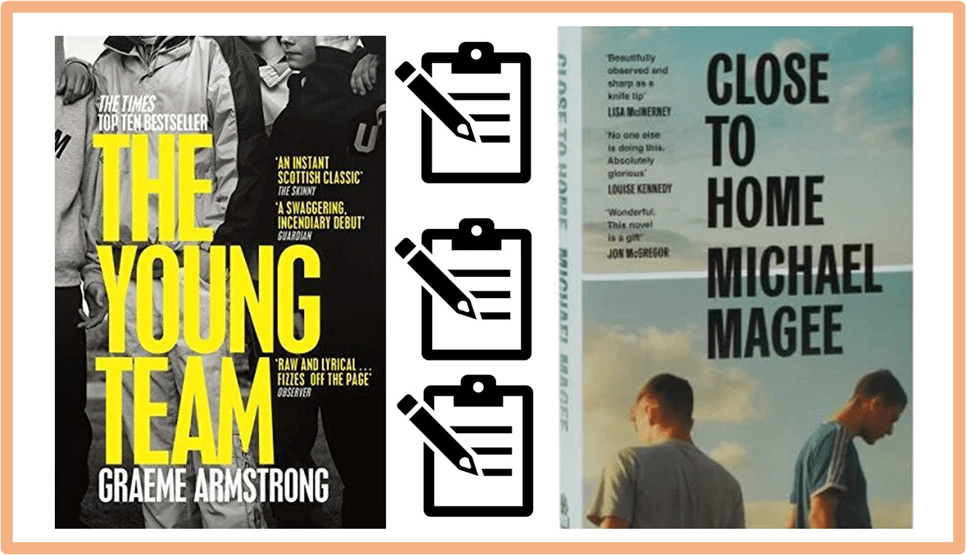
Working-class voices and working-class stories that ring true are still rare in literature and this novel fills a hole that you would think was, or ought to have been plugged. It is not, however. Perhaps this is understandable for we assume access to reading and things to read easier for the middle-class and the desire to see oneself in such a social mirror more readily fuelled by a bookish background. But that might be to carry a damaging bias from the outset about the working-class. We shall see that the book does carry the means to redress that bias. I think the self-education of the working class ill represented although its presence in the past is recorded in, for example Brian Friel’s Translations, Tressell’s The Ragged-Trousered Philanthropists the movements for miners education in the Ancient Classics I have sometimes written about (see this link). Past Labour governments expanded higher education so that the children of the working class are now becoming educated themselves although glass ceilings still seem to abound (see my blog on the collection Smashing It).
In Close to Home published this year (2023) by Michael Magee, which sparked these musings, Sean is educated (at Liverpool University) and well-read – though his preference for Milan Kundera unexplained and, for me, it needs to be, not being a fan – but he remains in any criteria of judgement within the orbit of working-class life and under a glass ceiling of low opportunity. Kevin Goddard in The Guardian in fact summarises its achievement well in this introductory passage, which invokes the novel’s class appropriateness and skill of handling in the context of a contemporary publishing scenario still dominated by middle-class voices writing about middle-class storylines, and in, middle-class narrative voices, mode, and accents:
Far too many debuts of recent years claim to capture what it is like to be a young person in this age of intersecting economic and social crises, when in reality they focus on a set of experiences that are much narrower, much more class-specific and much more temporary. If you were being uncharitable, you could boil many such books down to “recent arts graduate feels emotionally, financially and erotically unsatisfied and works in the service industry while they figure their life out”. This sense of ennui simply isn’t a luxury that is available to many who are living at the sharp end, where the parlous state of things feels both systemic and permanent.[1]
Of course there have been working-class originated writers who remained writing about some pattern of working-class male lives for some time. But, to cite Barbara Streisand: ‘Was it ‘all so simpler then’ in the 1950s? The classic working novels of that time made no bones that the aim for many such men was to escape the working class at any cost, and the novels pictured in the collage below each show scheming and traitorous working class male protagonists who made getting the bourgeois ‘girl’ away from their mothers (by getting them pregnant) an essential part of their escape from the working class. These were par excellence ‘angry young men’ novels. And without doubt, assumptive angry young heterosexual working-class men, even though the search for power and money took precedence over romance, or even sex in the main plotlines.
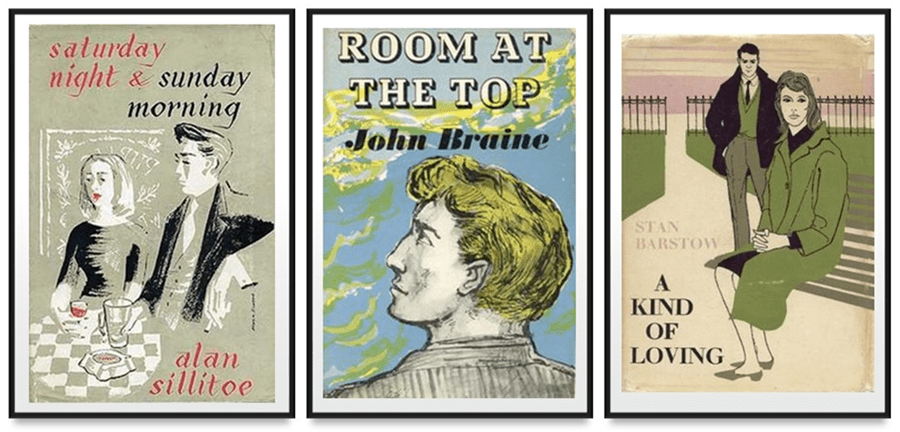
Was it ‘all so simpler then’ in the 1950s?
I wonder why I want to write this then, for at first I found Goddard’s description close to my own appreciation of the novel. I think it is because recently I have become aware much more that, as I feel entirely visible as a gay man myself, though still aware that this is not possible for all and particularly for young queer working-class cis men, where standards of masculinity are perceived by themselves to be tougher and less yielding, even to reality, and the range of queer personae are drastically limited and only for the extremely brave. Whether this characterisation of the working-class is true needs scrutiny of course. On the other hand, I also find, with Michael Handrick that the culture of queer life, at least in terms of a queer reading public can seem dismissive of working-class cultures: stereotyping them as overly limiting. I have blogged on Handrick twice, first because I needed to see the difference between us in terms of generation – for he is a young man – and second more fairly, concentrating on his concern with trauma responses (the links lead respectively to each blog if you wish to read them).

Handrick has made me all the hungrier I think for a fair assessment of the intersecting feature of queer working-class lives that takes both subject-positions seriously and especially their interaction in believable narratives or in emotionally true symbols. I have found one that fulfills the second of those aims in a novel called The Whale Tattoo by Jon Ransom – and I have blogged on this in the past, a blog you can read from this link. I highly recommend that debut novel.

Close To Home is the debut novel of Michael Magee, a literary editor for Tangerine, a publishing house that promotes working-class writing. But, not having read reviews I bought it on the evidence of its ‘blurbs’ (comments by writers about the book on the rear of its dust jacket). Here I found ample praise from Patrick Gale, a queer man (married to a male farmer no less) but also a serious writer of novels that have always had at least some reference to queer themes or characters, though not always centrally. He says that this novel ‘does for Belfast what Shuggie Bain did for Glasgow’. I cannot fault that judgement but given that the comparison was by him and used as an illustration of comparable achievement a novel about a young queer working class man growing up in Glasgow, I had hopeful expectations of a novel that was as knowing about growing up queer in a working class community as is Shuggie Bain and Young Mungo (see links on title for my blogs – the better one is on Young Mungo).
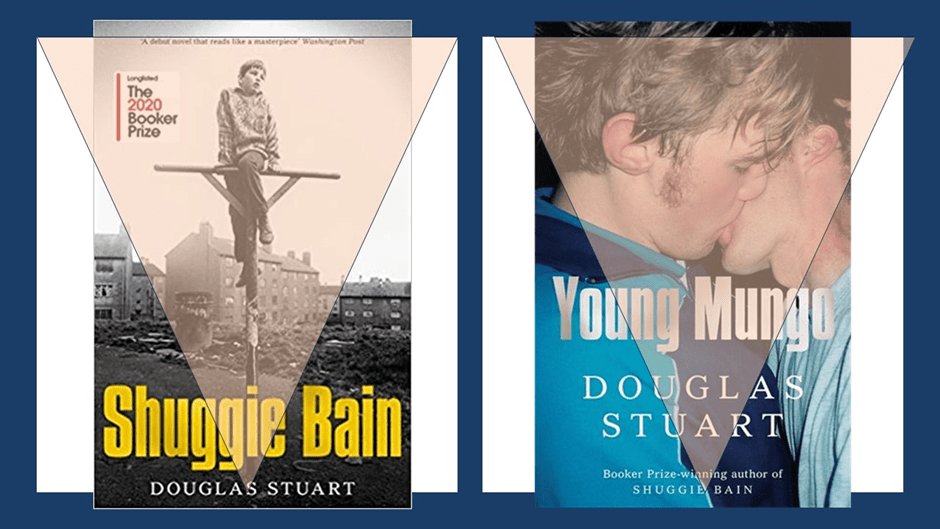
However, to have such expectations is unfair on Magee I suspect. And the fact that, in the end, this novel does not acknowledge the existence of young queer gay males, except in as much as words referring to that area of human diversity are used as insults. I think that it is probably necessary to represent that kind of language for it in the realist novel for, realistically of course, it captures a truth of the language used out there that is part of the ethos of working-class males growing up and socialisation. But I hope it isn’t going to be forever the only representation of talk about queer men
In truth, as I read Magee, I held my breath in the hope that his meeting with Conor, a young man associated with an ex-girlfriend, Mairéad, in whom he remains interested, would lead to some more prolonged romantic relationship. It was not to be. Mairéad, on the other hand, it transpires does in the event turn out to be bisexual and in a relationship; somewhat secreted, with a student, Julia, whom Mairéad later drops as readily and easily as she does Sean, when her life takes a turn to something in Germany she wants more, the independent life of a jobbing artist. For this reason, I find this novel satisfying because it acknowledges the queer domain intersecting relatively comfortably with a working class one. Its characters may use ‘gay’ as an insult, as we shall see, but that is not at the cost of the potential exclusion of the potential of both queer characters and queer experience within a flexible biopsychosocial context. I will illustrate that later.
First though, I need to justify why I held Magee to account in the first place for offering a picture of the psychosexual life of working-class communities that is believable because I read Patrick Gale’s blurb (and that is not his fault obviously) with an eye to getting more than that, something Douglas Stuart and Jon Ransom definitively give). I think, for a long time I have been a little perturbed by a blog review I wrote on publication of a debut novel by Graeme Armstrong, a good working-class identified Glasgow writer called The Young Team. The whole blog can be accessed at this link but I will cite the piece that gives me most concern about my own demands on writing – not as a critic but as a reader so longing for a novel that fulfils the demands of reporting the feel of the intersection of queer and working-class experience. I wondered if I could justify now having read Magee what I said about Armstrong, not without malice let it be said for he is a good writer, in 2022.
This is a difficult novel to talk about appropriately. My own training, which I often regret, in the reading and teaching of the tradition of the novel wants to leap upon its highly plotted symbolic structures, and its tentacles in literary English or literary Scots. However, from the first acquaintance this novel is clearly doing different things from the tradition, in that it seeks to reproduce the voice of those rarely represented as having a voice, young contemporary Scottish working-class heterosexual males living life only with the help of the stimulus of drugs. Even Trainspotting fails the test for this subject, its protagonists being much older.
I have my own concern that this widening embrace of the working-class male youths virtually eradicates a knowledge of real non-stereotypical queer males as an element of that population, in a way for instance that for instance James Kelman’s The Dirt Road or Alan Bissett’s Pack Men, rather neglected these days, does not. As a gay man born in the working class I find this a problem, though perhaps only for me. That is because the novel tends in my view to render all the goals validated within it for mature male development as those that are represented by a concomitant heterosexual relationship. It is implicit in the novel that for these boys literature outside the contemporary realist is ‘heavy gay’. And its narrative authority seems to differentiate quite starkly between the emotions appropriate within one sex (male or female) and from those between the sexes in ways that naturalise the heteronormative. Azzy tells us that the heightened feeling from ‘uppers’, drugs which give to sentient bodies an emotional and physiological rise, make the young men:
… light, manoeuvrable, irritable, sexual, sensual. Yi huv overwhelmin feelins ae brotherhood wae yir own sex n absolute love n affection fur members ae the opposite sex. It turns no bad tae fuckin stunnin.
Now this is just Azzy’s generalisation but the general sense that gay masculinity that is not encompassed by brotherhood also exists is never established otherwise in the novel. I feel I have to say to this – that it is impossible that the ‘teams’ of Glasgow never contained queer members but the novel never exposes the boys, and Azzy in particular, to that likelihood, apart from their suspicions that imprisonment might mean men ‘takin it up the shitter’. So I’m not calling for a change in Azzy’s subjective perspective but for the working-class novel to be as open to the reality of gay experience as different from the perspectives used to save the concept of working-class masculinity from that option. But let’s leave that alone. Because I would not use it to rob this novel of its monumental achievement. Moreover, the novel insists there is a need to:
account fur the alienation fae the normal that our lifestyle created. The sufferin of young Scottish males largely untold, behind bravado n the expectation that yi hud tae fulfil the role ae hardman n no even huv the feelings yir meant tae talk aboot.
Reading that now helps me to see why I think Magee’s novel avoids the pitfalls in Armstrong’s for the queer reader looking for themselves or their youthful experience in this novel. ‘Gay’ is used in Magee too, and very often of the central character, Sean. When Sean asks his brother’s friend, Terry, about what Anthony (his brother) has said to him about Sean, Anthony breaks in with: ‘That you’re as gay as get-out’.[2] The ‘Ra’ (IRA) man Fra, when Sean approaches him on an offender’s community service project, thinking Fra ‘upset’ and perhaps wishing to ‘talk’ (a thing, as we know, ‘real men’ don’t do) says to Sean: ‘Are you a fucking faggot or something’.[3] His friend Ryan jokes to him that he sees written up in the night a message for Sean which he (mis)spells out: “Y-O-U-R-G-A-Y”.[4] But none of this is anything but banter – although its unrelieved negativity is surely as harmful to a young working queer man as it is in reality.
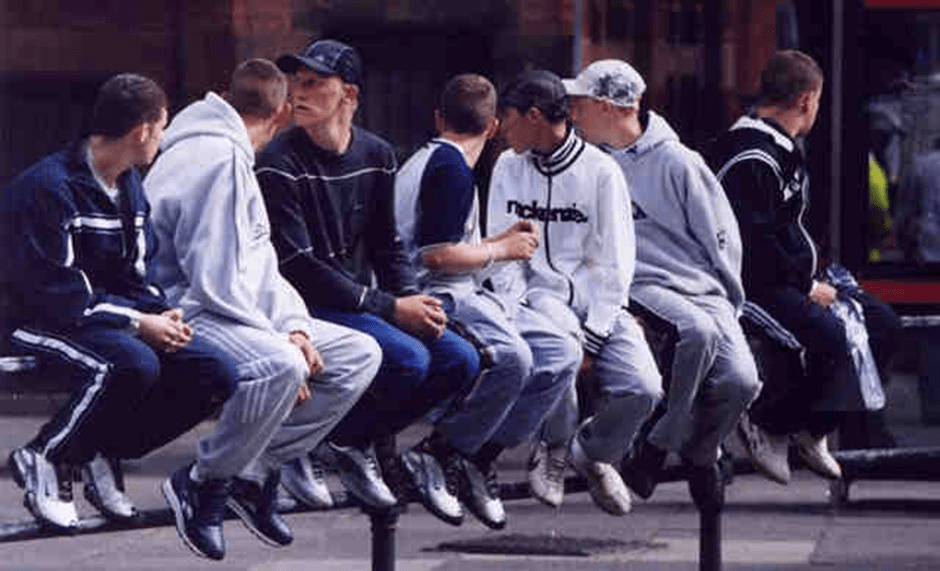
Photo from Chadda, B. (BCHADDA) (2012) ‘Turning off the stereotypes’ Available at: https://biancajchadda.wordpress.com/2012/12/17/turning-off-the-stereotype/
I think what makes Close to Home superior to The Young Team, though I am talking ONLY of the effect of the absence of a representation of young queer men in both books comparatively in this judgement, is that it has a deeper and less fetishised idea of masculinity. It does not rely on norms, as Armstrong’s does in his novel, at least in the eyes of its narrator who explains that these young men, referring to their drug-dominated ‘lifestyle’, feel ‘the alienation fae the normal that our lifestyle created’. In Close to Home I suspect there is no ‘normal’ from which to be alienated. There are instead choices that lie in psychological dynamics that are both biological and psychosocial and which manifest themselves in interactions between the feelings related to the felt proximity of human bodies to each other, choices and the effects of power in biasing to bad and unethical choices that are an abuse of power.
Close to Home deals openly with the potential for sex between males in the closeness of male bodies to each other, even when that might be prompted by boredom and frustration or just chance (especially after the effect of alcohol or other drugs) in unequal and bothersome interaction. That both novels ignore embodied attraction and romance (other than between brothers – an interesting side issue) between the males in them remains the case however, but that can fairly be said to be often absent from socialisation protocols into masculinity in any society or homosocial grouping. This means, of course, that even in Close to Home male-to-male sexual experience is presented negatively but it IS represented, even if only as an unexplored potential. Even if we just take the opening of the novel, which starts with a moment of male-on-male irrational violence, about his attitude to which the novel becomes a kind of Bildungsroman of moral and emotional development for Sean (who will, in the end, admit, his violence had no excuse) soon segues into another life-style ‘choice’ occulted in everyday homosocial living on the margins of poverty.
When Sean goes home, his failed attempts to look for a party, at 5 a.m. in the morning, when already ‘the birds were out’, lead to the resigned choice of him saying he is ‘going to bed’. The dialogue that follows is masterful and plays with the reader just as each play, as it were, with each other about the meaning of their actions and words. It is necessary to quote at length (hence the photograph below):
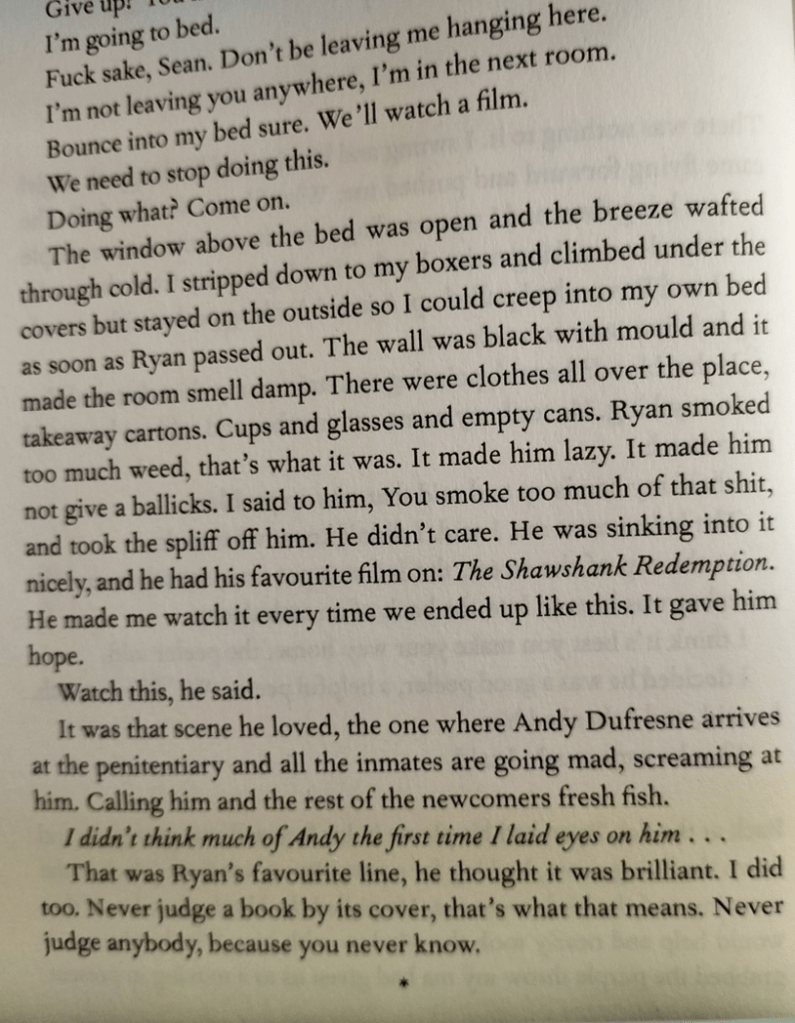
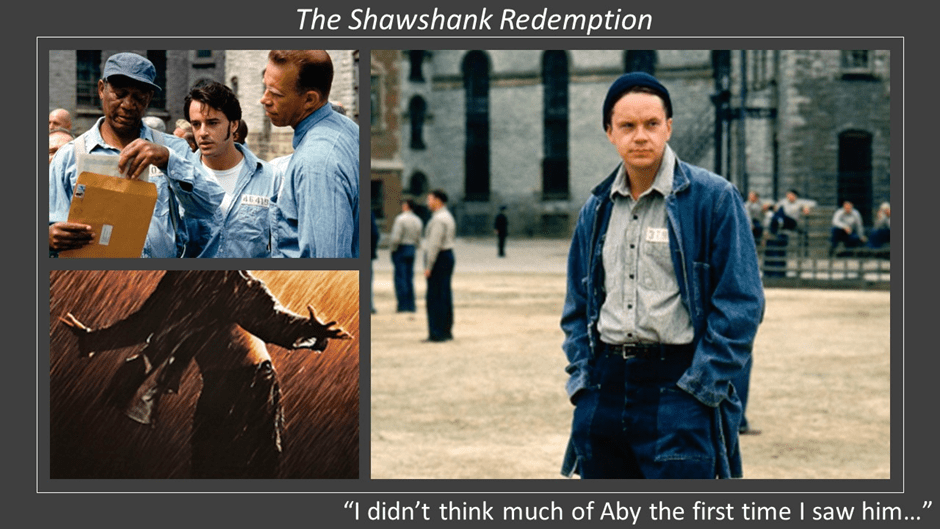
This, in my view, plays many allusive games: even the context of men eyeing each other up in an all-male prison, is I think allusive and playful – on a level with the boys questioning each other about the meaning of their mutual decisions, obviously repeated from earlier occasions, as Sean agrees to ‘bounce’ into bed with ‘Ryan’ (of course no innuendo is intended by the lads, but the fact that they have knowing / unknowing references to this possibility is fascinating – to me at least), they say to each other: ‘We need to stop doing this. / Doing what? Come on’. Similarly the underlying knowledge that men who test each other’s appearance against reality in male prisons interacts I would say with the well-known scenario of men who have sex with men there because no heteronormative option exists for them. “I didn’t think much of Aby the first time I saw him…” may not be a sexual evaluation in the film or in this reportage by Ryan of The Shawshank Redemption, but it plays that game, just as does the term ‘fresh fish’, with its inevitable connotation of substitute women, although the term has a long specific history in US prisons: ‘Calling him and the rest of the newcomers fresh fish’.[5]
Ryan is a strange customer. On this, our first look at him, we are swayed by Sean’s view that smoking too much ‘weed’ had ‘made him lazy. It made him not give a ballicks’,[6] but here is a ‘fresh fish’ to the reader. Later we learn from Sean, as he contemplates why one woman turns him down, that ‘he was a good-looking bastard, and when he was on form, there was nobody better to be around’.[7] Once in bed together Sean takes careful precautions against any intended or unintended embodied sexual contact between them, as you have read in the photographed passage above: ‘I stripped down to my boxers and climbed under the covers but stayed on the outside so I could creep into my own bed as soon as Ryan passed out’.[8]
The way I read this is to show that even straight identifying men find the presence of uncovered and unclothed bodies to have potential to contact beyond mere touching. Moreover, though he sleeps too later with Mairéad the sexual invitation and its acceptance is functional, almost a reflex of bodies having sought warmth from each other but go further with an understanding that this ‘can’t be anything other than what it is’.[9] Which is what exactly? Games of closeness play with the secrecies involved in illegal drug transactions but they conceal playful jokes – as here where the ‘present; one man gives to another is concealed like the punch-line of a joke:
… Finty McKenna planted his lips on the side of my face..
Got as wee present, he said, and dragged me into the toilets.
It was a bag of gear. …[10]
The very visceral body contact is greatest in Sean’s contact with his brother, Anthony. But this contact – of kissing and hugging (still heteronormative for brothers even in the UK and Ireland) is played out, often with highly ambivalent expressed emotion, in relation to sexual abuse of Anthony by his father (Sean calls him ‘Da’), an abuse Anthony thinks may have weighed in upon Sean, the younger brother, too, and, in Sean’s mind though he claims he was not abused himself, potentially on his Dad’s daughter to his second wife, Aoife. There is a kind of pen-portrait of Da’s life (his full name is Seamus Maguire) in the novel through Sean’s eyes as he searches for information of what became of him after he left his mother and escaped the vengeance of the Ra (the IRA) in which both Dan and Sean’s mother had been involved, in retribution for that paedophiliac crime and sin against Catholic thinking. Sean searches and finds and interview which shows he may now live in the country and have found fame and wealth as a sporting marksman. In trying to confirm this identity Sean recalls a shooting trip in which he accompanied his father. There is a short description of two memories that seem have fixed in Sean’s mind – first of being shown how to shoot by his father, Da’s body closely guiding Sean’s from behind, and second Da skinning a rabbit he has shot and holds up as ‘a slippery pink carcass’.

As I re-read this passage I note the fact that vulnerability of the rabbit recalls Sean’s own vulnerability to his father, whether he was sexually abused by Da as Anthony clearly was or not, and the feeling of Da behind him concentrates on the feel of a man’s body on one’s own, but one that is vulnerable and young, male body and skin:
… sometimes he’d let me have a go on the gun. I’d feel his weight behind me as he guided the rifle in my hands, showing me how to follow the trajectory, and when the disc dropped, we would squeeze the trigger together, my ears popping with the sound.[11]
Is this sexualised? Is the rifle playing the role of a phallus, the pop of ‘orgasm’ (as a pop is in male slang)? Is the confused pleasure of this that associated with children remembering the trauma of sex demanded by someone with authority over them and whom they love. If so, this is painful.
However, my point here is that we learn of Seamus Maguirre’s life not as an example of queer sex but of how accidents of bodily contact seem to spill over into potential sex dependent on power or negotiation, though in some cases as with a father and child negotiation is just another exercise of power. Nothing like this occurs in The Young Team and could not be imagined within its paradigm of masculinity. The issue about sex and physical closeness is not only there in terms of a possible exploration of male queer love but of that between females too. For we learn I think that in relationships power can shift and sex be somewhere between an exchange of goods, or expression of power, especially its withdrawal and still be thought of by one of the partners as ‘love’ for which they had not been prepared for the end. That in a nutshell is the story of Julia, literally abandoned by Mairéad, just as Sean is abandoned by her, both wondering if the sex was payment for a room that was needed and could not be afforded or something else, for in truth as Sean says Mairéad ‘don’t tell me fuck all’.[12]
If I am right about this, this is a most subtle novel that does not wear all its cleverness on its sleeve but tucked in its socks, or secreted in its mouth (as things are when Ra followers are when they take them to Long Kesh. In fact it is a great novel, if that is so, and uses queerness – almost absent on the surface, as cleverly as it does all its other observations of a life out of the norm and secreted, like that of the IRA murder and revenge squads. My only disappointment I have referred to before – that Conor’s party born of ‘whispers and glances’ in a beer garden doesn’t end with Sean snuggling in, Conor too having been abandoned by Mairéad, with the latter when he sees him ‘curled up in a single chair with his hands tucked between his thighs’.[13] After all, why are we told it is a ‘single’ chair – is it that the prose suppresses the potential of what might be had it been a ‘sofa’ or a ‘double chair’ (if such a thing as the latter exists).
This piece is a grumpy one as usual but I come out of it with the feeling that the straight queer novel is amongst us. It opens up norms to alternative potentials. My feeling is that Armstrong, a good writer after all, will gain such subtlety from his second novel onwards, and though the novel of queer working-class is possible, else how could we get Jon Ransom and Douglas Stuart, it is not the only kind of novel needed to enrich our sense of working-class life. But let us learn from Michael Magee if that is the case, for I think he may be there in his debut novel.
Give it a read. Do!
With love
Steve
[1] Keiran Goddard (2023) ‘Close to Home by Michael Magee review – Belfast struggles’ in The Guardian (Fri 21 Apr 2023 07.30 BST) Available at: https://www.theguardian.com/books/2023/apr/21/close-to-home-by-michael-magee-review-belfast-struggles
[2] Michael Magee (2023: 237) Close to Home London, Hamish Hamilton
[3] Ibid: 179
[4] Ibid: 93
[5] Ibid: 4. The term ‘fresh fish’ has a long history in the USA apparently. As in this fascinating bit of research: New prisoners It was used to refer to new prisoners as far back as 1863. Memphis daily appeal, October 15, 1863:
The heavy door swung mournfully back, re-echoing the doleful groans of its neighbours, and as it closed behind us, we found ourself in what is termed in prison language, “the yard.” surrounded by at least a hundred vagrants, thieves, burglars, etc . whose united voices rent the air with ” Fresh fish, fresh fish, I say” Ah ha! thought we, not so bad after all. The keeper, in anticipation, doubtless, of our arrival, or perhaps instructed by the Hon. Judge, had provided a Red Snapper or Pompano for our entertainment But alas ! we were soon undeceived.
A similar misunderstanding is reported at Libby prison in the Daily intelligencer of November 10, 1863.
It wasn’t good to be fresh fish. Cleveland morning leader, April 26, 1864:
An ingenious device for picking pockets has been invented by the rebel prisoners confined at Wheeling Va. When a new prisoner arrives some of the initiated starts the cry of ” fresh fish ” which is understood to convey the knowledge of the arrival. When the new prisoner is ushered in he is immediately seized by the occupants of the room, placed in a blanket and thrown up. They continue to toss the new comer in this manner until his pocket-book falls out, when he is released and the pocket-book is confiscated.
The Daily Dispatch of November 13, 1863 reports of similar robbings at Libby prison following a cry of “fresh fish, fresh fish”.
Although sometimes they were protected (for a while). Daily intelligencer, April 19, 1864, has a similar explanation of the technique as the Cleveland morning leader, and then continues:
Yesterday morning when Robert Y. Conrad and his distinguished friends were ushered into the prison room, the cry of “fresh fish” was started as usual, and the prisoners were about to serve them as they had served others, but as they were confined as hostages and were supposed to have considerable sums of money, Lieut. Moore interfered, made a chalk mark across the floor as the dividing line, and prohibited the thieves from meddling with the newly arrived prisoners, which in our opinion was quite right and proper.
Finally, Daily intelligencer of May 18, 1864, prints a litany invented by Libby prisoners:
RELIGIOUS SERVICES AT THE LIBBY.
From the Enquirer.
A number of the prisoners at the Libby who have been “on hand” for a long time, tired of the hum-drum of prison routine, and with the true spirit of New England morality, have gotten up a burlesque “litany,” a copy of which one of them, who has been there for twelve months, has enclosed in an envelope and addressed to Beast Butler. The document passed inspection on yesterday, and will duly be forwarded by flag of truce. The following is a copy. The “fresh fish” alluded to, it is almost unnecessary to say, means nothing more than-fresh arrivals; the constant introduction of new prisoners having become, to the old ones, au intolerable bore.
Libby Prison, Richmond, Va.
Sunday, May 1, 1884.
PRISONERS’ LITANY
Most respectfully submitted to Maj. Gen. Butler, United States Commissioner of Exchange:
From torpedoes and surrounding bayonets and Beast Butler, good Lord deliver us.
From lice and bed-bugs, good Lord deliver us.
From corn bread and black beans, good Lord deliver us.
From rebel favouritism, good Lord deliver us.
From special exchanges, good lord deliver us.
From fresh fish, good Lord deliver us.
From twelve months’ confinement, good Lord deliver us.
From truce boats, good Lord deliver us.
Amen, amen, amen.
Most respectfully,
Your obedient servant.
PRISONER OF 12 MONTHS’ CONFINEMENT’ (https://english.stackexchange.com/questions/142055/what-is-the-origin-of-the-term-fresh-fish/142102#142102 ).
[6] Magee op.cit: 4
[7] Ibid: 197
[8] Ibid: 4
[9] Ibid: 80
[10] Ibid: 16go on the gun. I’d feel his weight behind me as he guided the rifle in my hands,
[11] Ibid: 116f.
[12] Ibid: 151
[13] Ibid: 151

