
Middle East and North African Art, the cult of Orientalism, Western stereotypes of Arab art and the culture of resistance. Voices: A fine exhibition at the Durham Oriental Museum, Durham University. 29 September 2023 – 12 May 2024
Let’s start off with a theme and it would seem to me on first sight that there is no better artist in this exhibition to prompt a theme to start with than Adnan Samman, an artist originally from Syria and now living in Hungary. His register style seems to be collage art that is digitally mastered and usually has two major registers split roughly between a top filling two thirds of the area of the picture and featuring some scene from the modern Syria modern with a scene from below it related to a Western ‘Orientalist’ interpretation of Arab life, replete with stereotypes of an exoticised and depoliticised ‘Arabia’. The aim is of course to force us to see the area that used to be homogenised in the term ‘Arab nations’ in the light of their modern history. I call this ‘ Re-visioning the Orient’, with my tongue slightly in cheek.
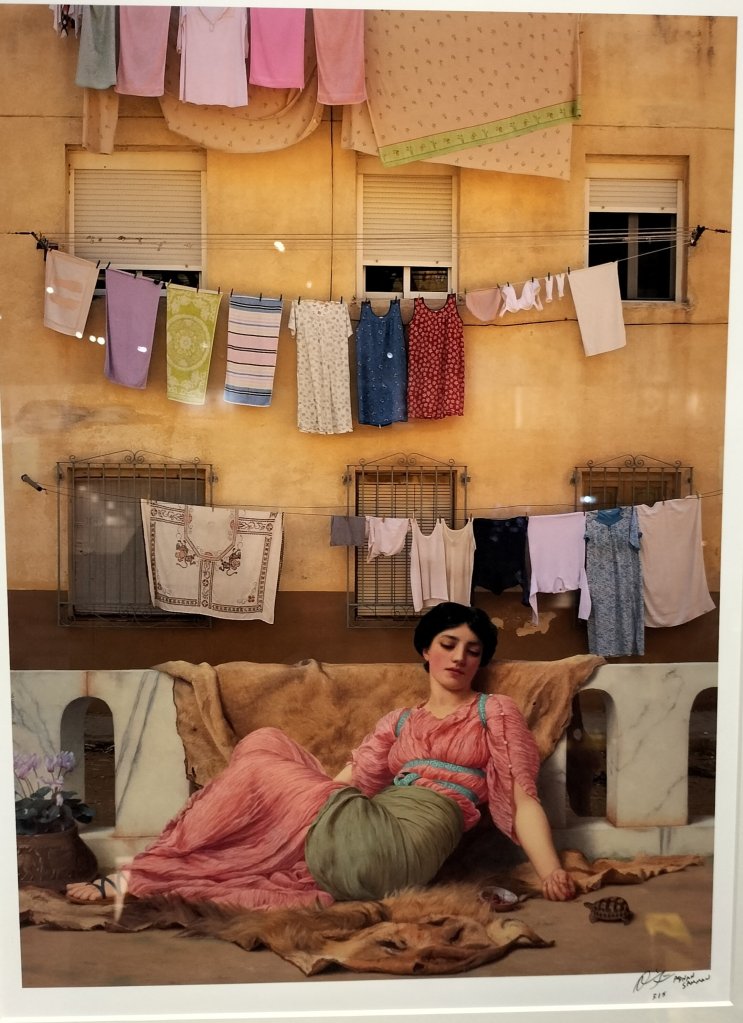
However, with all the works I show here I feel not learned enough to comment much other than to draw the obvious contrast of an exotic, romantic, sensuous and somewhat sensual in a manner fully expectant of sexual availability, usually heteronormative and from the perceptive of a powerful player – the gaze of a male upon whom women wait (and serve) or for whom they wait. The harem is the Westerner’s Orientalist subject par excellence and above a woman waits in the harem, from a Western painting I have not identified or tried to do so amidst glorious sensuous fabrics. Above her a scene from Syrian life where clothes and fabrics are being dried from a tenement set of flats that is in no way luxurious but covered with everyday fabrics. Absent women are in the upper register of that picture only by virtue of their household maintenance work.
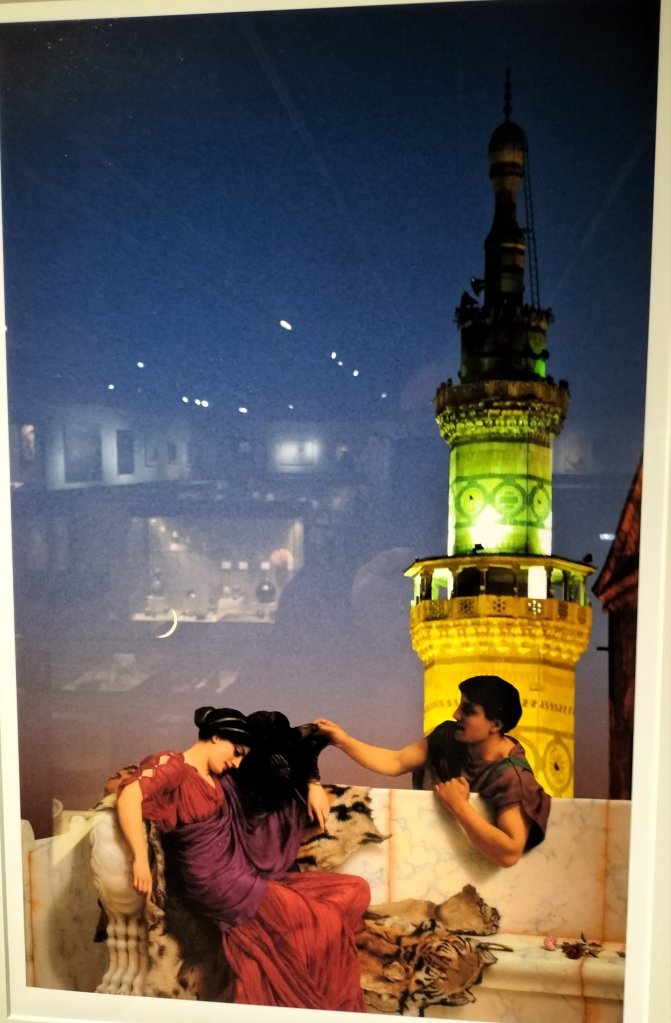
In another picture, marred by a reflection of the museum in the glass, shown below Orientalist fairy tale is exampled in a story scenario of a passive young woman awaiting her male lover to have scale the walls to her roof abode where she sits weary with exhausted desire on an animal skin.
The purpose of this piece though, I have to say, is not to review this exhibition but to record its powerful imagery. One of the difficulties for me however of this brief visit is that I was merely finding your way into an exhibition of a subject otherwise unknown to me. Hence these generalisations about it must be aware of the tentative nature of the judgement I can make and the depth of ignorance about some issues of importance one must show in yourself in doing so. In particular, I regret not taking notes that marry artwork to the individual artists celebrated in this exhibition and in many cases, rather than make a mistake where it was most likely I would do so, I have not attributed some of the works but merely pointed to the significance of certain artists as revealed in works where I cannot yet name the artist. Please forgive me – artists whom I have omitted or whose names got lost – because my notes were not good enough and I had no list of works on show. I almost wish I could draw up a law that exhibitions always created take-away lists of names of the art and artist. Lol.
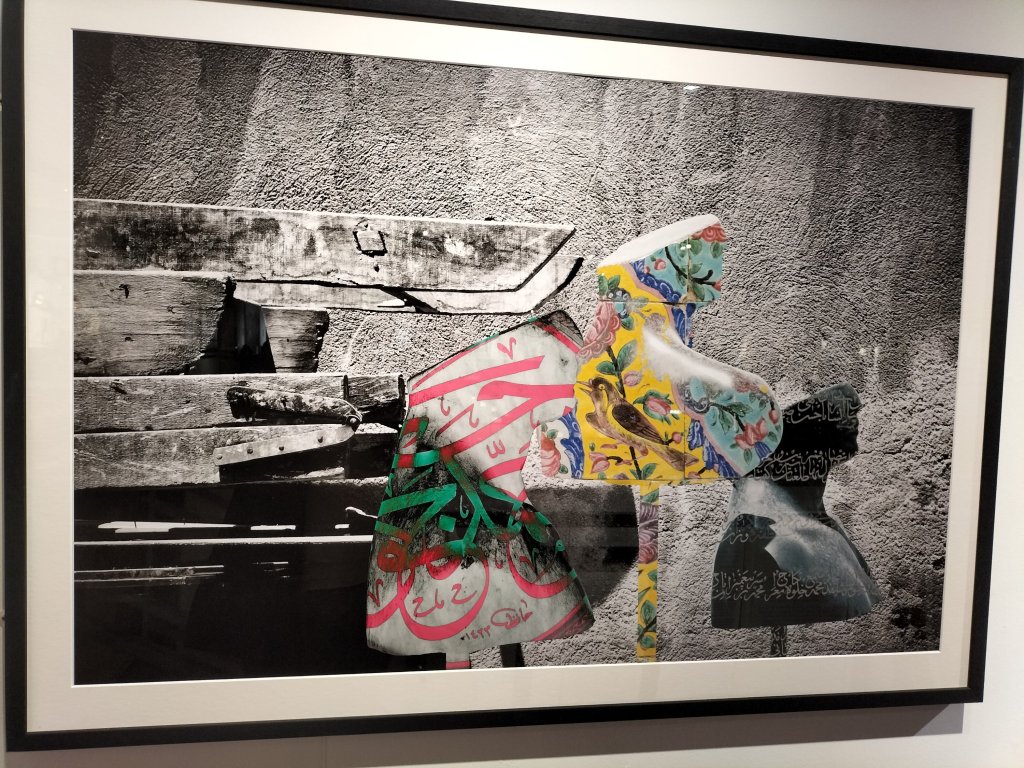
And some things I do not understand, such as Khosravi’s Untitled of 2018, above. I loved it but cannot comment upon it. It’s effects are clearly subtle and are based on readings refined by knowledge of contexts I do not have regarding the meaning and absence of colour decoration. What is clear I think that a whole tradition of the use or otherwise of iconic imagery and calligraphy might here be evoked particularly in the variation in the doubling of the bust of a figure and its torso that are part of a melding of figures of past and present, and possibly ascetic against luxuriously decorated art.
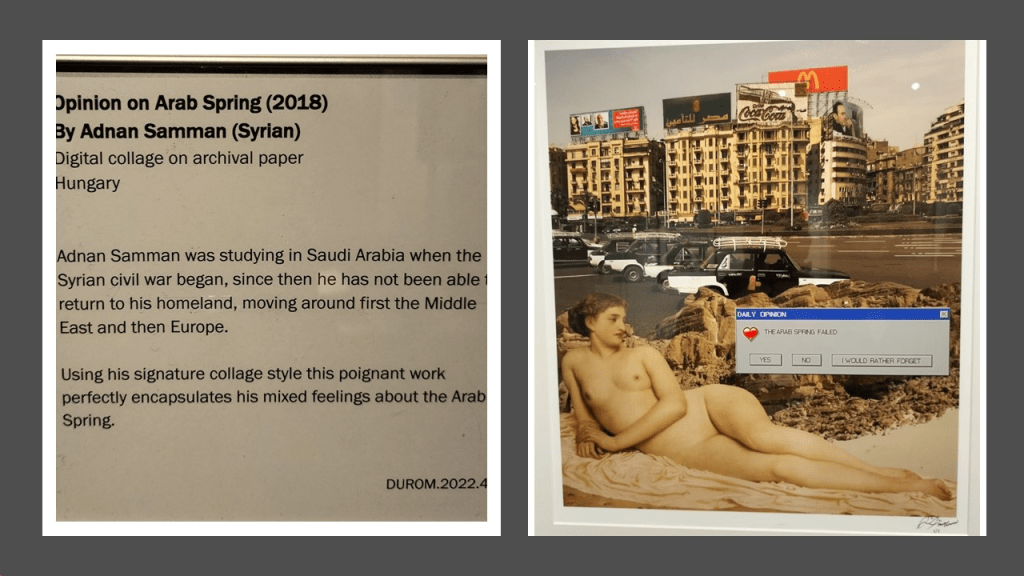
In contrast Adnan Samman gives scope for opinion on Middle Eastern and North African politics as in Opinion on Arab Spring below, which using the same register split we saw in earlier collages (his ‘signature style’ according to the plaque below) he shows how impossible it is perhaps to register the significance of events in its politics in the light of the onslaught of Western ideology in both registers seen. The force of Western art might turn Easter nation into a beach for holidaying, a mode of life where even Western art motifs are rendered as trivial as a session of sun-bathing but it is equally powerful in dominating its buildings with its logos (MacDonalds of course). Perhaps even the ubiquity of superficial opinion polls (this one seeking opinion on the success of ‘the Arab Spring’) in the light of an oppressive Syrian government is propped up by Western powers.
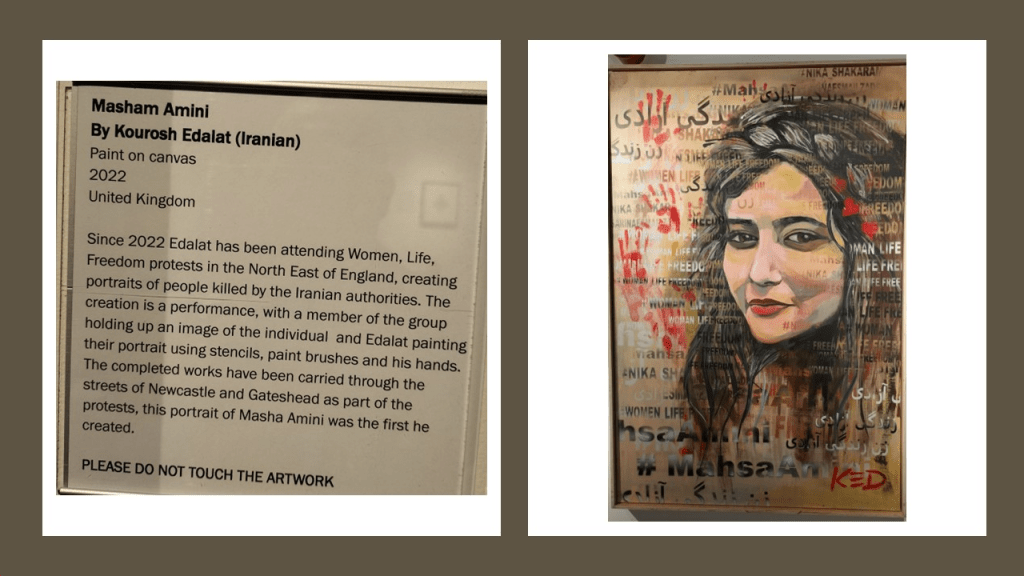
Sometimes the politics are iconic as in Kourosh Edalat’s art venerating martyrs of the feminist cause in Iran – so much so that her pictures of heroes accompanied by wall graffiti and bloody hands can be carried in protest marches in Newcastle/.
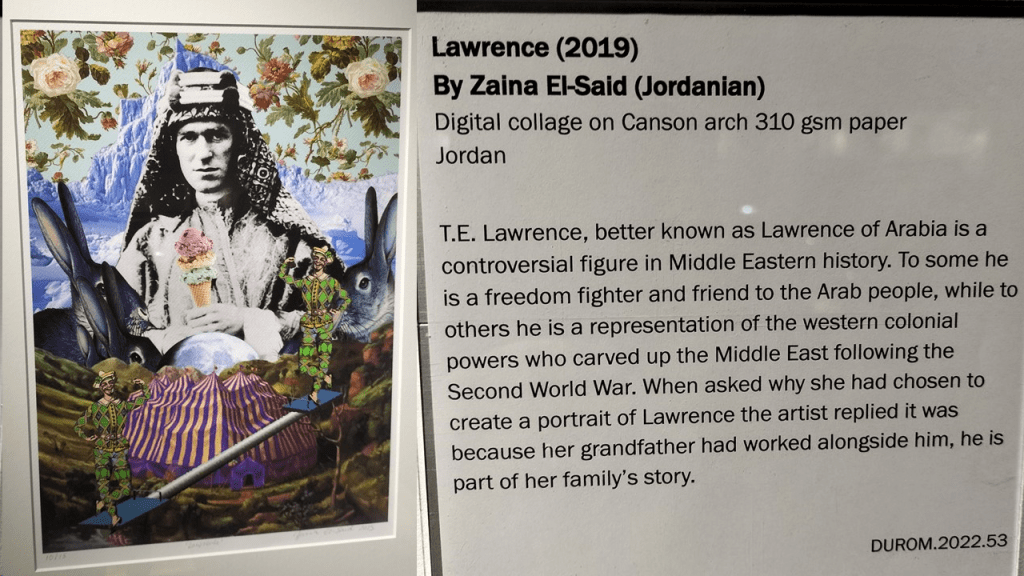
Themes like this often have to be put against Western ignorance obfuscated by our own cultural heroes, such as the strange figure of ‘Lawrence of Arabia’. In fact as the plaque below shows, we may know too little of what all this means to the politics of Middle East and North Africa as this enigmatic portrait of T.E. Lawrence below shows. Lawrence both was and was not a fact of their politics, certainly aware of the desires for a Pan-Arabian politics but possibly complicit in its frustration and the fragmentation of nations that accompanied that frustration and plays itself out in the politics of Jordan, the West Bank and Gaza today, tragically so today.
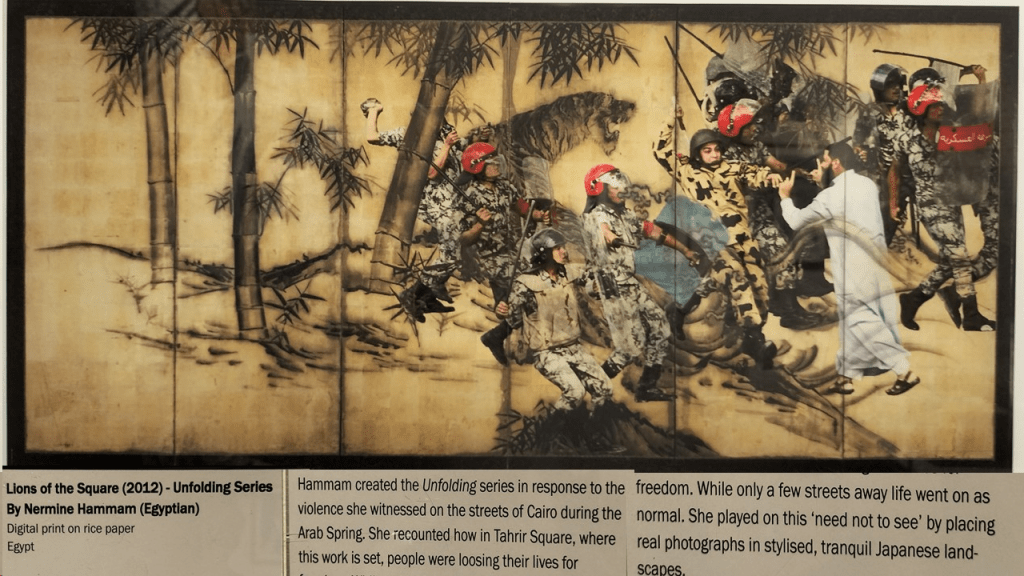
Sometimes Oriental archetypes are used complexly and I do not know how to read the collage below, from Lions of the Square, by an Egyptian artist and referencing the ‘Arab Spring’ commencing at Tahrir Square using Japanese symbols of contemplative peace as a background. Here collage uses the fragmented realities it is built upon to draw important nuanced views of the contemporary world in the East generally, where peace and aggression meet. There is however little of nature in the militarised aggression shown here.
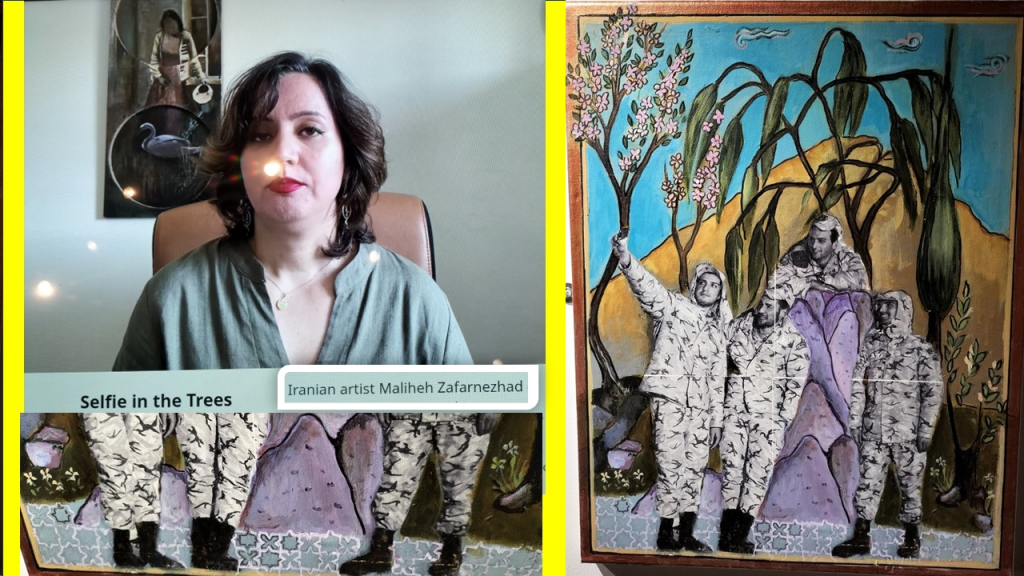
One artist in particular, Maliheh Zafarnzhad has used her personal past in Iran, including photographs of family faces to create complex collages of images of past and present, war and peace, art and nature, and both art and nature against hard political realities which might include the politics of armed patriarchy. There is to much here hat I cannot read but it is moving – even those cartoon-like boots against a patterned tile floor, Persian artifice against powerful aggressive attitudes to art.
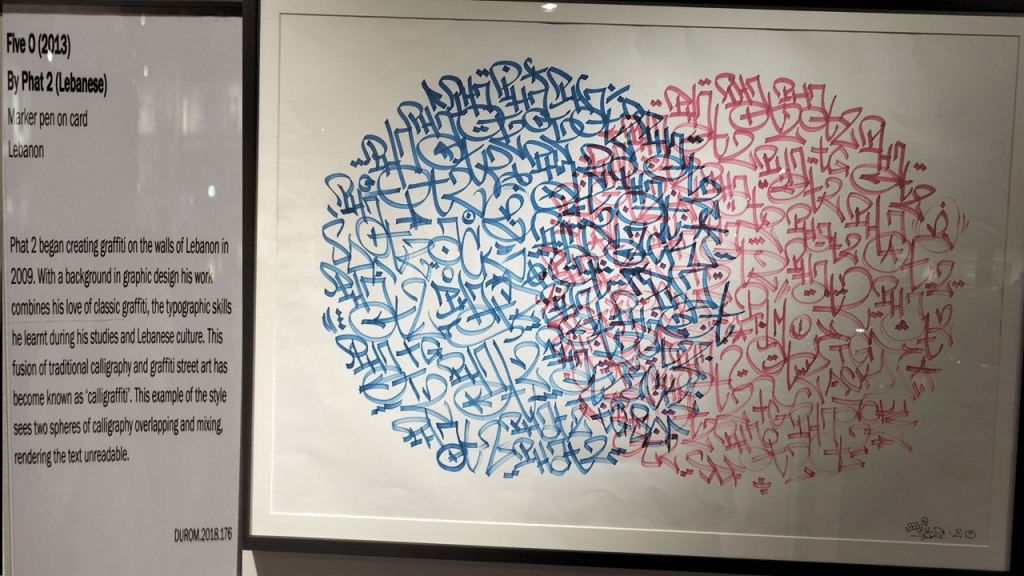
Other art says a lot more about the tradition of seeing calligraphy as art as a means of uniting past and present, high and low; and religious art against gritty and visceral political street art. Of course here i have no idea of how to comment further but I love the image.
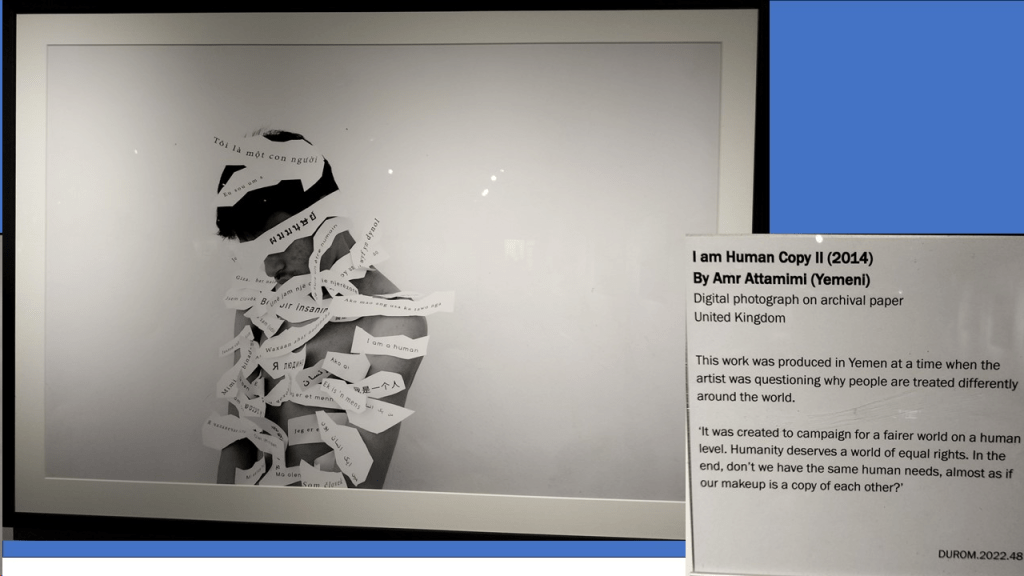
Images of political alienation from human rights and even basic naked humanity seem easier to understand, although in the context of the brutalities of the Yemen I wonder if we get how moving is Amr Attamini’s portrait of the naked torso of a man obscured by scripts of words in different global languages that think they are about his rights, whilst ignoring his misery.
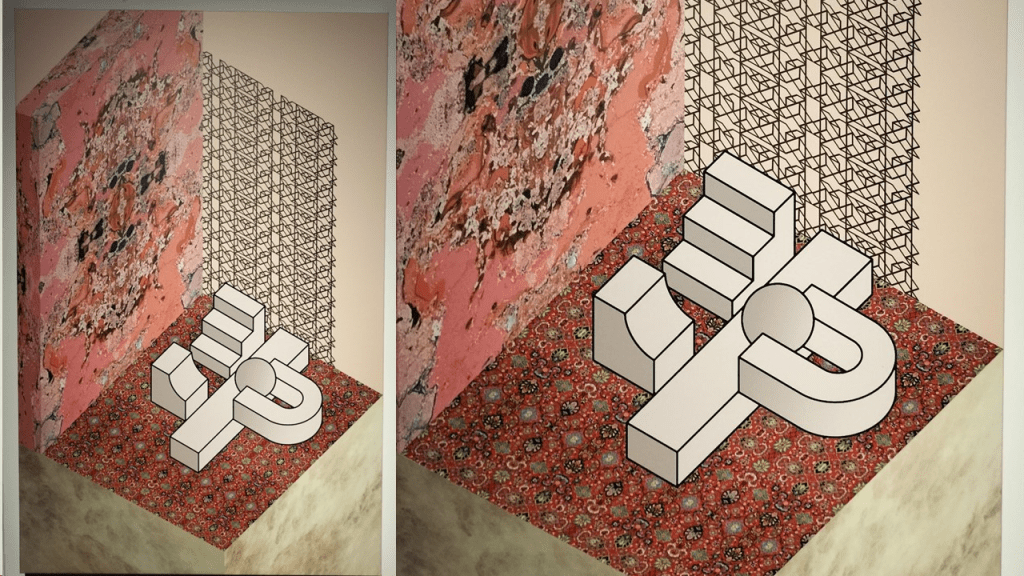
My notes are too scattered to attribute the following two images but they feel to me to illustrate how colour is used critically and affectionately at the same time as a commentary I cannot quite read. Art needs a longer duration and these are powerful and beautiful collage images, working with or without human figures – a basic issue in Islamic Art and its own complex relationship to the art of the past of this region.

I want to end with two works by a Palestinian, Hani Amra, in which collage is used to emphasise fracture and the edges of comparison so important in the lived political world of contemporary Palestine and the Palestinian diaspora. The sense of beauty and ruin, attempts at making that must make for destruction are so moving here – if possibly too merely contemplative in the present plight of Palestine.
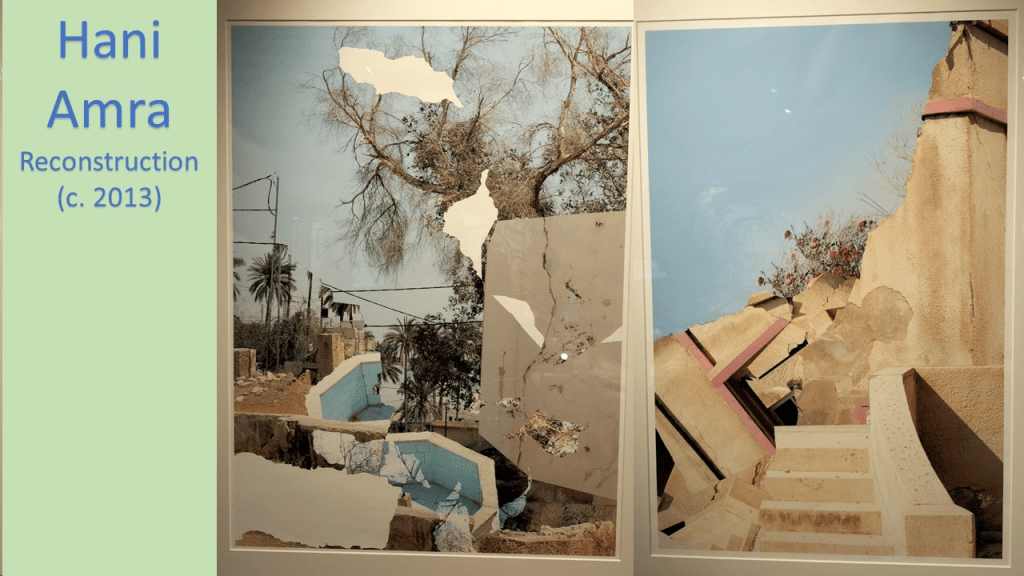
Parts of one image are just torn out of life in this ‘reconstruction’ which is as little an aesthetic reconstruction as is the divided land held onto without effective national rights in the West Bank and Gaza a ‘reconstructed’ Palestine. Diaspora art in particular emphasises these fracture. Witness a favourite novel of mine, Isabella Hammad’s Enter Ghost, which works a bit like some of these collage works. See my blog on Hammad at: https://livesteven.com/2023/05/05/i-heard-the-wings-of-something-enormous-shuddering-on-the-air-the-way-the-body-rehearses-for-danger-i-was-having-the-flight-reaction-i-would-have-once-had-a-long-time-ago-to/.

Another complex image above I can’t attribute but love. The butt of satire points in many directions including the Occidentalism (an inverse of Orientalism surely) taken up in Eastern Middle-class groupings
Do see this exhibition. Clearly I need to go again and concentrate more. If you can help with comment to put me right, I welcome it.
With love
Steve
 Steve_Bamlett_blog