What are your favorite websites?

Today’s is not a question that I immediately relate to for I use the web as a tool and rarely ‘favour’ a particular site, except when it meets a need in my learning, leisure and, in the case of social media, pleasant (and sadly unpleasant) aspects of my personality. I suppose the latter case here is the source of ‘favouritism’ in the ranking of websites and explains the once mighty power of Facebook and Twitter (which I still refuse to call ‘X’). It felt worth visiting a dictionary at this point to query the term ‘favorite / favourite’ in the first place. One less relevant thing I learned here is that the choice between those spellings of the word has an interesting history that goes back to its Indo-European roots and involves differential influence from its transition from French and/or Italian. Another and perhaps it is relevant is that, in English, the term was first a noun before it was an adjective in common usage and that the ‘u’ in it came into English through a slightly different word, ‘favour’, which was used often to signify a physical symbol of a preferred choice. See for instance Mirriam-Webster online dictionary on the term for this point, which clarifies less in retrospect than it does at first gasp (for I hunger to know how the use of ‘favour’ as word came to be both verb or noun and how these came to relate to each other historically):
History of the Word ‘Favorite’
English speakers had favorites before they had a favorite version of something; in other words, the noun—as in “chocolate ice cream is my favorite”—is older than the adjective—as in “chocolate is my favorite flavor.” It all began in the late 16th century, when English speakers seem to have been charmed enough by the Italian noun favorito to make favorite (with no “u”) from it. The ultimate source was Latin favor, meaning, well, “favor.” English already had that one: favor had mostly been spelled favour since it had arrived in Middle English by way of Anglo-French in the 14th century.
https://www.merriam-webster.com/grammar/favorite-or-favourite-usage
Etymology, of course, obfuscates and rarely clarifies. But it is interesting isn’t it? The reason for saying anything about it however is NOT just because it gives me something to say but that it shows that having a favourite thing is a matter of diverse and complex motivations, that sometimes indicates a subjective preference hard to understand. When it is easy to understand or sometimes one that motive might not be acknowledged because it implies something shady about what favourites do to make themselves favoured, especially to people considered more powerful and of higher status than they. A great deal of Christopher Marlowe’s play Edward II plays with this word a lot in this respect as noblemen of the court wonder why a commoner should be preferred over them. They wonder, perhaps, but most often they assume that the commoner, Gaveston, is offering Edward sexual favours.

For Gaveston himself to be a favourite is the sign of a love that is idealised. In one speech he compares his favour in Edward’s eyes to the subject of Christopher Marlowe’s greatest poem, whose heterosexual male protagonist, whose naked limbs become the favoured fascination of Neptune, the god of the seas even though Leander dives into Neptune’s domain to find the love if a woman, Hero. In the following, Gaveston refers to a letter from the King – itself a sign of ‘favour’ and therefore ready to earn the name of a ‘favour’ itself.
Gaveston: What greater bliss can hap to Gaveston
(Christopher Marlowe, Edward II, 1.1.1-9)
Than live and be the favourite of a king?
Sweet prince, I come. These, these thy amorous lines
Might have enforced me to have swum from France,
And, like Leander, gasped upon the sand,
So thou wouldst smile and take me in thy arms.
I have not I think found a website which I feel must be addressed with ‘amorous lines’ from me. Nor would I swim the English Channel for one. In that respect I think favouring a website is mainly utilitarian or based on needs that are temporary and pass quickly for most people. In fact, were I mathematically inclined, I might be able to analyse the mass of data the web keeps on itself for it is a reflexive medium. Take the following webpage from the site SIMILARWEB, which adjudges the ranking of favourites using an algorithm that calculates place in relation to statistics measuring variables like ‘average visit duration’, pages seen per visit and ‘bounce rate’ (defined as ‘the percentage of visitors to a particular website who navigate away from the site after viewing only one page’ – https://en.wikipedia.org/wiki/Bounce_rate).
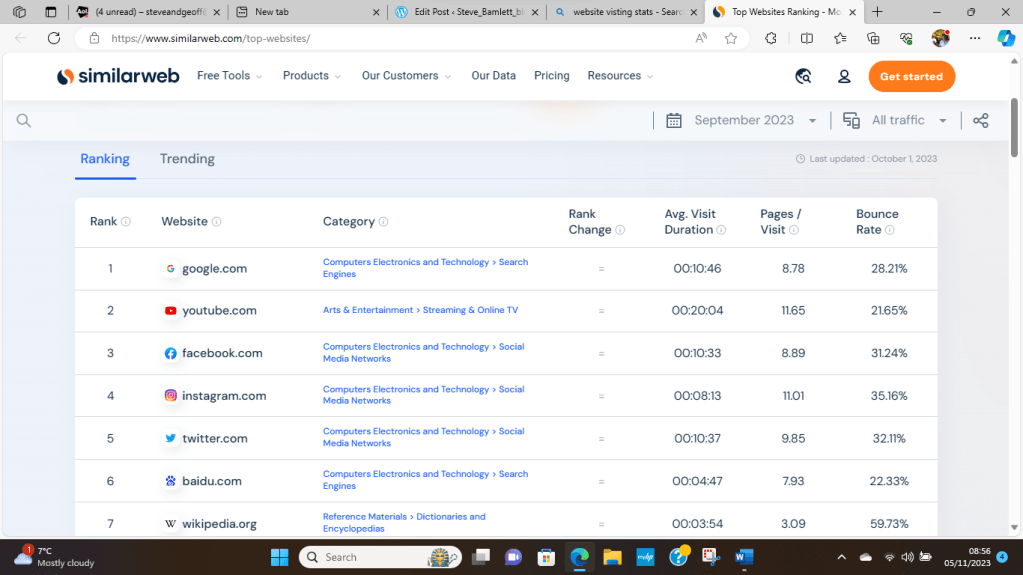
Screenprint of https://www.similarweb.com/top-websites/
That Google should top this pole is hardly surprising given its market dominance of the search-engine options, its advertising and the fact that its name is used generically to name use of any search engine – as in ‘I Googled it’. Otherwise dominance is for far more varied reasons. YouTube has a social aspect but is also used as a means to launch video-publishing services of all kinds and for education. As a teacher I used it far more than I do now but then or now I would never call it a favourite for the word seems to mean much more than a statistically provable preference – it involves a demonstrable liking despite the costs of showing that liking as Edward II’s love of Gaveston did, not only before his queen -wife, Isabella, and the nobles but a whole nation he was meant to represent. In the Similarweb list we come, after the sites named above, to the social media sites – Instagram, Twitter and so on. Of course Wikipedia has a high bounce rate because it is used so functionally – by me, for instance, when I want explanatory links to terms – as I did with ‘bounce rate’ above.
None of them are favoured, I would guess but the social media sites. They are just where they are because of their pragmatic usefulness to people. Maybe even Twitter can be explained for that, although in it guise as ‘X’ its use has changed. People who used it to accumulate huge followings without any conventional reason for being favoured use it less – or if they do so have to pay for the privilege and will have to pay more as Elon Musk’s campaign to ‘monetise’ the site takes off. Lonely people and people who felt they were less well regarded than they could make themselves appear with the control and anonymity offered by social media used it too. Some people were looking for an ‘in-group’ which reflected or echoed them (hence the common appellation of it as an ‘echo-chamber). These characteristics of Twitter were indeed an aspect that Musk’s algorithm changes favouring a right-wing version of ‘free speech’ and monetisation strategies seems to have targeted. Some, I include myself, are trying out Bluesky as an alternative. On that site there is though an awful lot of cheering ourselves up and badmouthing Musk for the fact his actions have not killed off X and that Bluesky has not yet proved itself in an open market – one enters after all only by invitation.
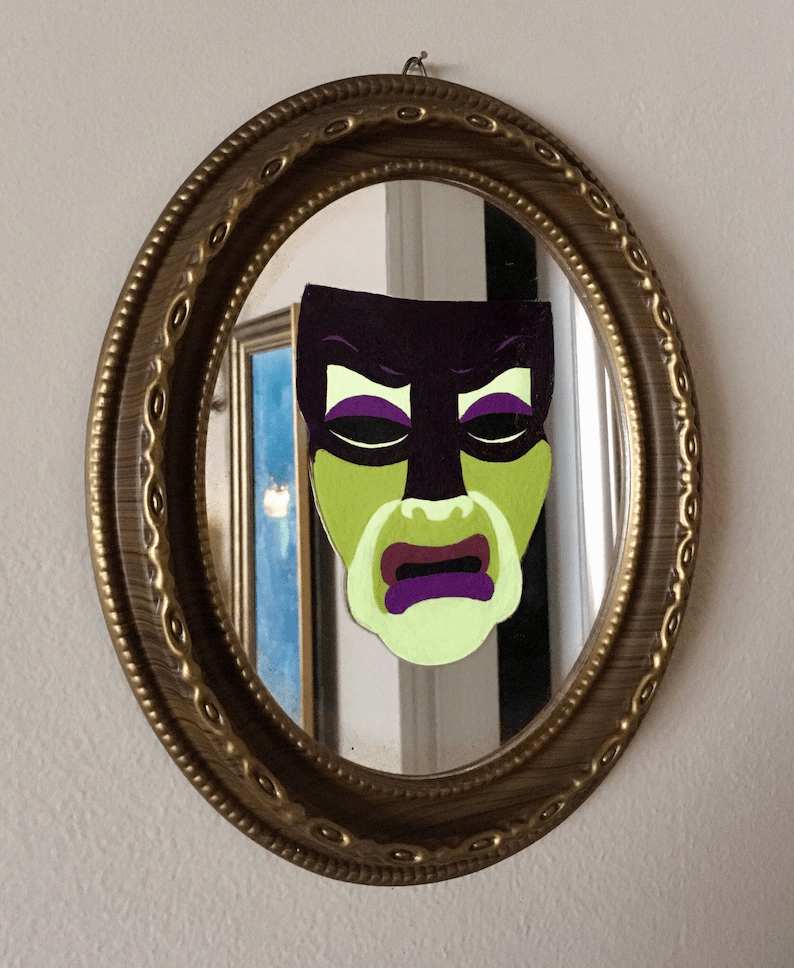
So I don’t, in my use of word, have a ‘favourite / favorite’ site but I see some may do. Some of the reasons for this are scattered across this set of musings posing as a blog, but if they are active they probably act in interaction with each other and sometimes (often) with people who would say: ‘I don’t know why I like that site, but I do’. These kinds of subjective choices can be analysed, but once you do, they get banished from awareness for people rarely like to know why they do things lest the reason terrify them or lower their self-esteem. Some people have a love / hate relationship with sites for that reason, just as they may have with mirrors – because neither reflects the best of yourself ALL OF THE TIME. And being liked by others, because it can be a means of liking yourself, is one way of possessing a magic mirror. Some gauge their likeability from the number of followers they have or ‘likes’ on their tweets. In the absence of other evidence that satisfies you, this seems to me a key reason for social media – with exceptions of course but not always including me, to be honest. In that sense, it is so like the magic mirror in Snow White: ‘Mirror mirror, on the wall – who is the favouritist of us all!’
With love
Steve
 Steve_Bamlett_blog
شكراً جزيلاً
LikeLike