What historical event fascinates you the most?
Prompt – blog 3rd November 2023
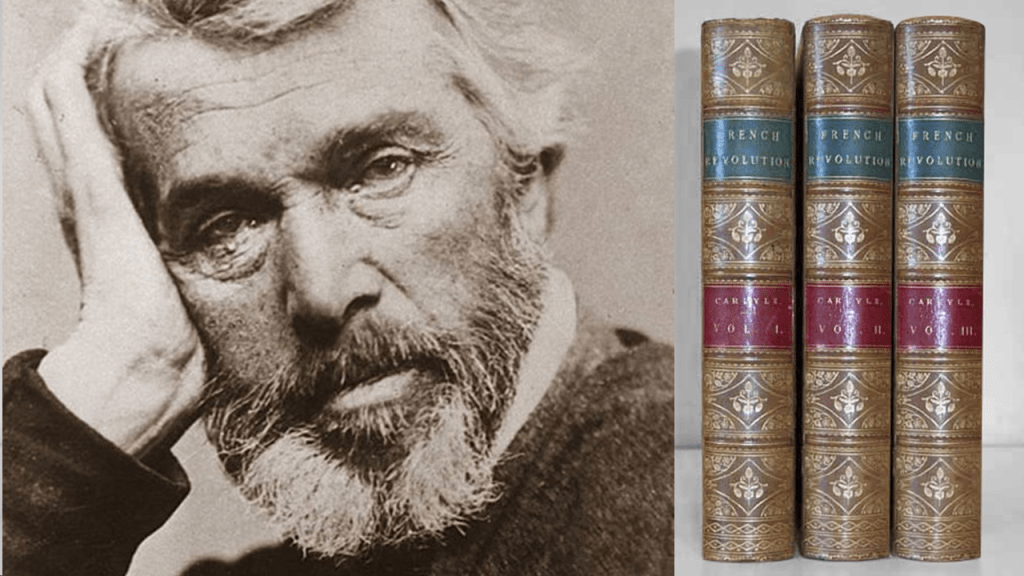
Thomas Carlyle wrote a book on The French Revolution in three volumes in 1837. It contains a lot of words. The purpose of those words is to turn actions by people that occurred in France from 1789, although the book starts well before that, into an EVENT, in the contemplative reading of which readers can be encouraged to find significant meaning, or, at least, to find out why such an event matters or ought to matter to them. The page below from that book (from Book 1, Section 11, Chapter 1) has a contentious chapter title: Astraea Redux. The story of Astraea, as told by Ovid , concerns the last of the pantheon of immortal Gods to leave the world and signal the end of the Golden Age of peace, stability and political hope for perfection and JUSTICE on earth. Astraea became the symbol of JUSTICE. Her return, which Virgil uses in his his Fourth Eclogue as the signal of a return of a period of JUSTICE and peace on earth, was used by him to flatter the Emperor Augustus and gain vital patronage. In Western Christianity the myth becomes transfused into the hope of a second coming of the Messiah or Christ. It was used politically by Edmund Spenser, echoing Virgil’s use of the myth too in making The Aeneid an epic poem of national origins to make the Golden Age of Augustus in Rome the equivalent of Elizabethan England in The Faerie Queene: both divine and a friend of mortal stabilit, Elizabeth-Astrea could be seen as the hope of peace in Nation, State and Church. Elizabeth I was therefore hailed as Astraea herself by poets, even Sir Walter Raleigh in his poetry and his written histories. Later, John Dryden’s Astraea Redux, used the myth to seek the support of the restored Stuart monarchy under Charles II, as distant a true believer of justice as any one could mention in the sad annals of the series of wasters called the British monarchy.
Clearly in Carlyle’s book, the French Revolution is going to be interpreted in a context of vast political change, whatever the historian’s empathy, which even if he HATED the extremities of human suffering were, never really friendly to liberal politics though he thought he believed in JUSTICE however much he also believed that MIGHT IS RIGHT. More important he wanted to establish, for historiography, what it means to call something AN EVENT. Read below the highlighted passages for instance:.

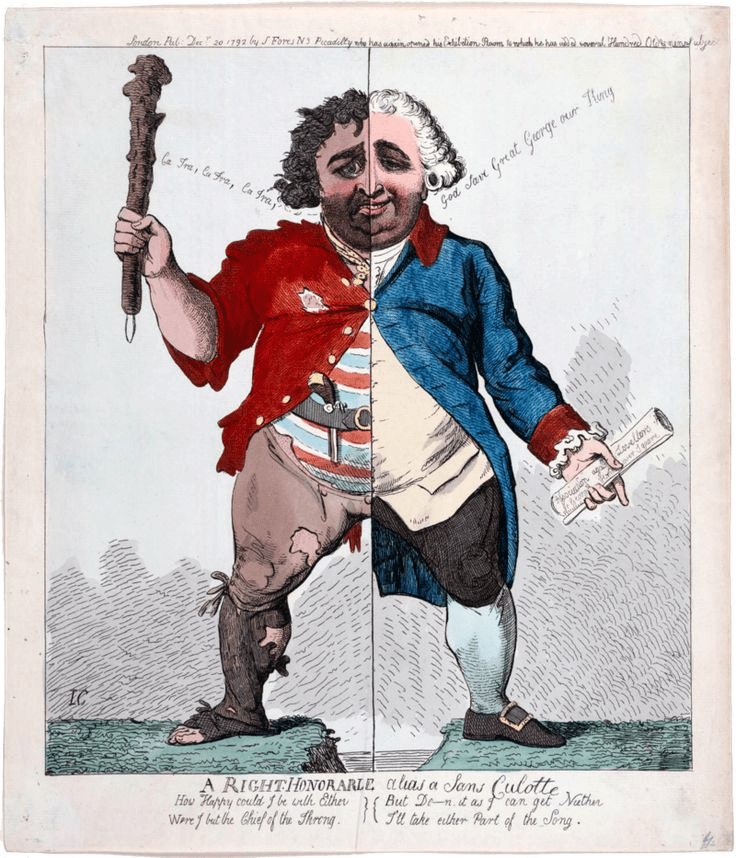
For Carlyle then a mythological symbol reinforces but perhaps also creates an ironic commentary on the idea of this revolution, the first to be seen as an effective force against the old regime of corrupt kings, despite the claims of the English Civil War. Its historical significance for Carlyle, unlike the Civil War, was the role in it of what he called ‘mad sansculottism‘, the revenge of the oppressed lower classes – known as sans-culottes to distinguish them from the well to do from the form of legwear they wore (or did not wear – see the English cartoon below) – to turn against years of being silenced, marginalised and oppressed, even if that must institute TERROR in vast proportions.
I think Carlyle is correct in interpreting ‘events’ as symbols of a change to the rhythms of the status quo, whether for good or ill. Very often that meaning will be hard to predict during the event – think for instance of the present bombardment of Gaza in the Middle East. Even after the event, its significance will be heavily contested. What matters is the capacity of any of these symbols to make ‘history’ for those who resist being silenced or marginalised either from a position of yet unasserted superior power or from less empowered, historically speaking in the history of statehood formation in the whole span of human time, margins or ‘underground tunnels’. Carlyle’s extended parable of the life of a tree is wonderful. Nothing in that life makes much noise – even its mighty and noisy fall, in the context of the absence of a ‘shout of proclamation’ for things considered repetitively cyclical, over whatever span of time, common and thus insignificant. The tree may have grandeur but it is relatively silent, except in its death, and even that forest-dwellers get used to.
The event I want to signal out is precisely like that, because in LGBTQI+ history, the raiding of the only venues in which people marginalised from public history was common and thus could be ‘got away with’ by those enforcing laws they feel for some ideological reason necessary. Stonewall Inn was different. Again it was not the first time a group of people resisted overwhelming state power, but it has registered itself as something that, in Carlyle’s words, requires to be ‘spoken of and recorded’. And that because through a process of other events, all part of the process of continuing resistance now become forceful it aimed, again as Carlyle puts it, to be a ‘a disruption … a dislocation and alteration’, become that which ‘involves change’, and for some ‘involves loss’. Carlyle wanted to hold onto things – he was ambivalent even about change that he knew was absolutely necessary – hence the beauty of that book Past and Present of 1840, with its clear pointer to 1848, what was to become known across Europe but in Britain too as ‘The Year of Revolutions‘. But let’s return to Stonewall Inn.
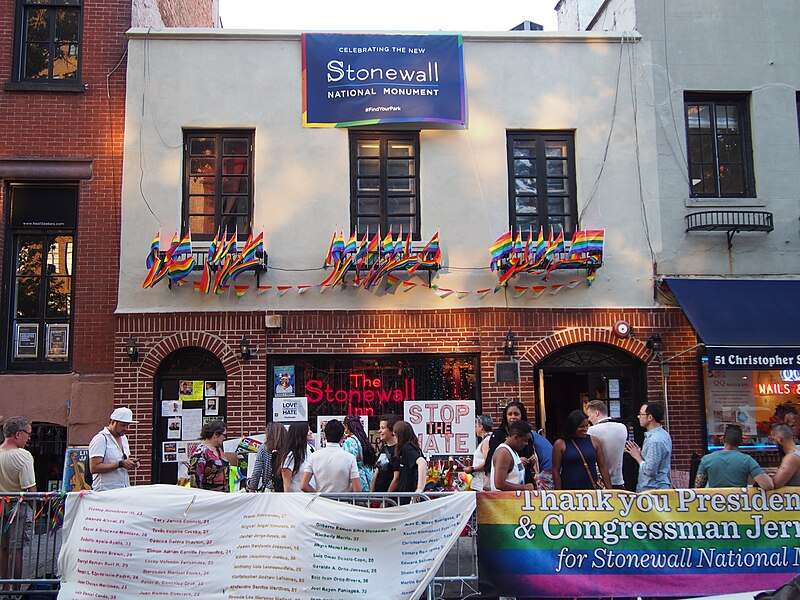
Outside of the official business district, the Stonewall Inn, a gay bar on Christopher Street in Manhattan’s Greenwich Village. A 1969 police raid here led to the Stonewall riots, one of the most important events in the history of LGBT rights (and the history of the United States). This picture was taken on pride weekend in 2016, the day after President Obama announced the Stonewall National Monument, and less than two weeks after the Pulse nightclub shooting in Orlando.By Rhododendrites – Own work, CC BY-SA 4.0, https://commons.wikimedia.org/w/index.php?curid=49720738
As important as the event was the many words spoken and written by it and the actions of veneration of grateful campaigners that followed. Finally a Democrat Party under President Obama was willing to monumentalise the event – a great act of speaking of and recording. But it is NOT ENOUGH to be fascinated by an event that speaks history, especially for LGBTQI+ communities for in the last five years the world has been plagued by a contested narrative of Stonewall as a SYMBOL of LGBTQI+ successful resistance and insistence on a diversity of norms for living rather than for a hegemonic heteronormative one. Worse the contest supposedly comes from within our community and has called itself the LGB Alliance, intent on eradicating even from spoken and written history the presence of trans and non-binary people in the events of Stonewall. Their inclusion IS A MATTER OF RECORD but history is interpretation as well as record and involves the prejudices and biases of its re-tellers, as Carlyle well knew.
No matter of RECORD however is enough, the charity Stonewall set up in commemoration of the event and furtherance of its aims as interpreted then in the UK by Matthew Parris, Michael Cashman and Ian McKellen, among others (and not all men) has recently been asked to step back from support of trans causes that have become known by some, such as the late Conservative MP co-founder of Stonewall.
Writing in The Times, Stonewall co-founder and former Conservative MP Matthew Parris criticised the charity for getting “tangled up in the trans issue” and being “cornered into an extreme stance”. Kelley responded that support for transgender rights was the norm for LGBT organisations and that she was “really comfortable” with Stonewall’s direction as an organisation.[104]
Wikipedia: https://en.wikipedia.org/wiki/Stonewall_(charity)
On this matter I think the event, its continuing interpretative development and organisations set up to develop the story and its interpretation as political action, have to remember that Stonewall Inn was not a haven of political discussion but a marginalised place in which people of marginalised identities were forced to meet. On the stree to protect diversity of self-expression lesbians, gay men and drag queens, as well as some people identifying as trans and non-binary stood together. They had personal difference but they did not interpret these as opening the floodgates as Julie Bindel does to ‘perversions’ and ‘paraphilias’, although those labels have neen used to condemn all of us in the past, even Julie Bindel. See, for example, this piece on Stonewall veterans who were also trans people of colour: https://www.mic.com/articles/121256/meet-marsha-p-johnson-and-sylvia-rivera-transgender-stonewall-veterans. nevertheless I admit to a bias to diversity. I can see the virtue of good journalism on this, though that has never included ideologues like Bindel. Here is a good start of an acceptabpble journalism. i will leave you with it: https://www.newstatesman.com/culture/books/2021/09/how-to-talk-about-trans-rights.
But if I have picked the Stonewall Riots as an event I believe of great significance to me and my community is not because of some fascination, which sounds to me pathological, but because we are never exempt from the need to speak of ,and record, such events, for to be silent might mean a return to silence and the margins for some – and perhaps, eventually, for all of our community. SPEAK UP. ACT UP. BE SEEN.
With love
Steve
 Steve_Bamlett_blog