What does it mean to be a kid at heart?
You always have to start with terminology in these questions and the most glaring term here is ‘kid’. For, of the many stereotypes Western society (and perhaps more globally now with the primacy of Western values on social media and the long reach of the insidious side of the world-wide-web) the term ‘kid’ evokes the most warm views and positive aspirations of what being younger than one currently is means. That may only be the case for adults because adolescents often feel it is a slur on their attempt to wrest adult status from authorities over them like parents, school or early employers. The view popular among young adults might be represented by a webpage on WikiHow. That webpage gives you 3 overarching ‘methods’ to engineer for oneself feeling ‘like a kid again’.
Each method has a series of suggested exercises, all of which are described as positive recommendations to free up the inner child – the person who feels they have no responsibilities or cares of their own or a belief that what cares they might have are the responsibility of others. Of course, all this assumes that the adult is relatively privileged (in work-life balance, income and other circumstances). At least they must be privileged enough to take time out of their responsibilities – a view conveyed in the imagery on the page in which all these adults are impeccably dressed and groomed (in a way a ‘responsible adult’ might judge those things) and comfortable enough financially to take the advice given.

METHODS
https://www.wikihow.com/Feel-Like-a-Kid-Again
- 1 Thinking Like a Child
- 2 Acting Like a Child
- 3 Maintaining a Youthful Perspective
There are no Bash Street Kids here, though that freedom of care about appearance in itself, including the ‘naughty’ behaviour that goes with in the Beano, can be a sign of the release of adult inhibition, with the proviso that that behaviour does no significant harm or ignore the fact that children may be capable of inflicting such harm.
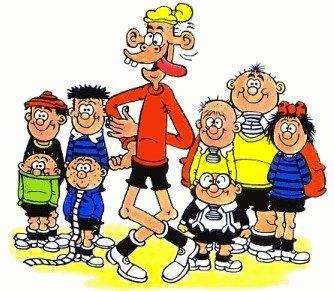
Bash Street Kids: scanned from ‘Beano’, Fair use, https://en.wikipedia.org/w/index.php?curid=7936255
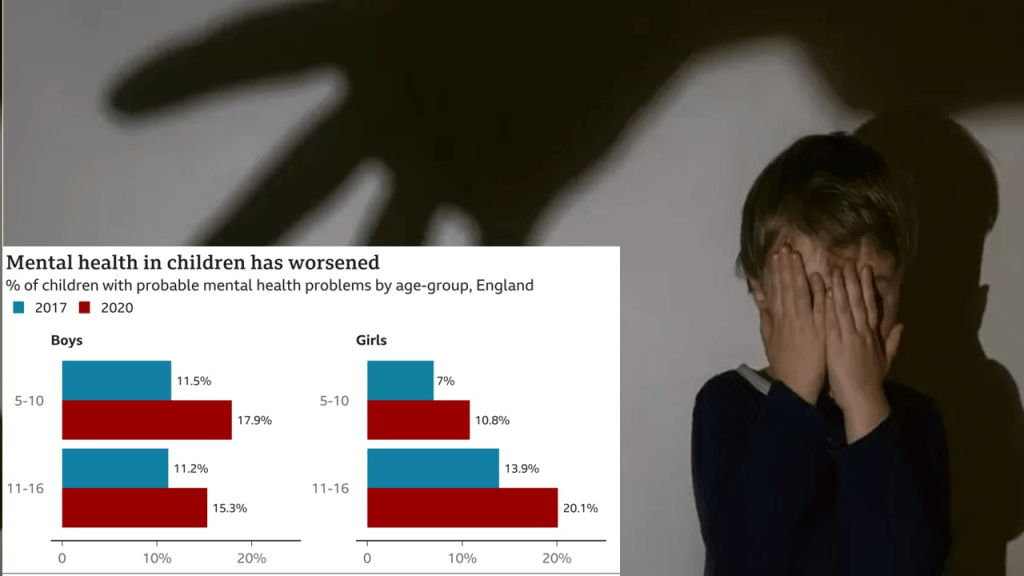
On a more serious note, it ignores the fact that some children endure hardship from poverty, malnutrition, physical and sexual abuse and bullying from all directions and that services for the treatment of mental and physical ill-health are so poor in number and quality that they could not serve a distressed child population eligible for such services even if it were not growing as much as even NHS figures (notoriously under-estimated because based on approaches to services in which people have lost faith) as it is currently in the UK.
Developmental psychodynamics has had a huge influence on thinking about the survival of child-like modes of sensing, being and enacting in people being the conventional age span of childhood. It is a problematic psychological paradigm that, I think oversimplifies the process of development and overvalues and fetishises the concept of adulthood as a rational time-space. In some forms it abandoned overt focus on internal dynamic relationships for one on relational dynamics in human interactions – behavioural ones sometimes but also others more strictly to do just with communication. The most notorious was that approach promoted by Eric Berne, Transactional Analysis. I don’t intend though to say more here than to point out what his view did to thinking about the notion of the ‘child within’ as manifested in communications. Some taste of that might come from the collage illustration below.

In Berne’s view the child lived on in the adult in two forms. First, the Child (C), based on the responses the person had as a child in interactions with parental authority and care and the other, the Parent (P) based on the child’s perceptions of the parental figures involved in their childhood. as a product and factor in human transactions (including communication). The Adult (A) is an ideal standpoint in interactions and is a position of ego strength, acting with and reacting within a reasonable and emotionally controlled framework. This subjective position however is always presented as one to which to aspire rather than being naturally available. The following paragraph from Wikipedia on Transactional Analysis categories explains the three subject positions I have mentioned (available in full from the link in this sentence).
Parent (“exteropsyche”): a state in which people behave, feel, and think in response to an unconscious mimicking of how their parents (or other parental figures) acted, or how they interpreted their parent’s actions. For example, a person may shout at someone out of frustration because they learned from an influential figure in childhood the lesson that this seemed to be a way of relating that worked.
Adult (“neopsyche”): a state of the ego which is most like an artificially intelligent system processing information and making predictions about major emotions that could affect its operation. Learning to strengthen the Adult is a goal of TA. While a person is in the Adult ego state, he/she is directed towards an objective appraisal of reality.
Child (“archaeopsyche”): a state in which people behave, feel, and think similarly to how they did in childhood. For example, a person who receives a poor evaluation at work may respond by looking at the floor and crying or pouting, as when scolded as a child. Conversely, a person who receives a good evaluation may respond with a broad smile and a joyful gesture of thanks. The Child is the source of emotions, creation, recreation, spontaneity, and intimacy.
The text in the collage above in this blog concentrates on the ways in which Child and Patient roles in the ‘games people play’ explain negative effects in communication, interactions and behavioural transactions. People play-act ( or ‘act out’) roles from childhood scenarios that create and reinforce the kind of repetitions in relationships that Freud would have called a transference and / or counter-transference of psychic material from the past into the present situation . But, though I find this analytic tool useful to reflect on conversations and my role in them, I still feel that they are of limited use because of the presumption that they are the explanation of all of the misdirection that shape most communications in the present and their future consequences. Authority often assumes, for instance, negative parental forms as a necessity of its undemocratic sociopolitical inflexibility.
Leon Seltzer, a developmentally orientated humanist psychotherapist, finds in a framework developed in a web-form simplification of the traits of this approach that valorises adult cognitive rationality and ego strength. From that position he advocates the adult revisiting and repairing childhood perceptions that were interpreted as traumatic at the time in what he calls (with his link to the webpage left active by me) ‘a comprehensive therapeutic approach aptly named “Lifespan Integration.”‘
If we engage in this kind of disciplined work on ourselves, such an endeavor will help enable us to evolve into the fully integrated adults all of us, consciously or not, aspire to be. And the very essence of our evolution depends on our ability to access, make peace with and then fully integrate that insecure, self-doubting child that has constrained us in our lifelong journey toward self-actualization.
Leon F. Seltzer, Ph.D. (2008) ‘The “I Feel Like a Child” Syndrome
Do you sometimes feel as though you’re really a child inside?’ in ‘Psychology Today’ (online December 24, 2008). Available in https://www.psychologytoday.com/gb/blog/evolution-of-the-self/200812/the-i-feel-like-a-child-syndrome
This view would soon eradicate any empathy for entrenched traumas, especially those related to abusive power relationships with psychosomatic and psycho-sexual consequences that cannot be resolved in the easy way this passage suggests. Worse it might establish a paradigm in which the traumatised felt blamed rather than supported by professionals.

I think then I have said enough to suggest that I think this question is far too problematic, for me, at least, to answer without lots of caveats as in this blog. For some the ‘child within’ represents a core vulnerability, which needs to be accepted and cared for if it is not to emerge repetitively in dysfunctional terms or worse. For some it is a ‘free child’ responding against constraints. But that motif is too often I think used to explain rightful anger at oppressions that are very real in families, groups and larger entities like nations and to pretend that only consensual politics are required and that ideological paradigms have no power.
As for the desire to ‘play’, as children play, in adults, I think that too is wrongly attributed to developmental regression to an earlier state of being. In my view, play and work are only polarised binaries in the most ideologically framed forms of thought. Play and work interact throughout all behaviour and that is why I think the most trapping if ideologies is that of becoming your ‘true self’ or ‘ acting like yourself’. That is because healthy ‘selves’ are flexible and changeable according to the context. By this I do not mean just adapting to the state of the current world and its views but being able to stand within, without and between the potentials that shape our actions in the world. Without this we are truly stuck, a kind of constipated nature unable to avoid and void the worst aspects of the past and present and move into a more hopeful future.
As for what a child is really like, it is time not to listen to the skewed memories of adults formed by theories. Our only source of evidence likewise must not be JUST the memorial remnants of bad experience of childhood. The answer is to listen to children and young people directly. That is not easy and difficulty of communication increases massively in the face of current childhood trauma, and / or ingrained traumatic responses, in such a way that indirect means of communication, like those using role-play with objects and / or interpretation of painted or crafted work by the child, in tentative statements, by a trained adult for the child to reflect upon – as initiated by Melanie Klein. These methods are dependent on careful use such as hers and some of her followers. However, there are guidelines of lower sophistication that work if used with sensitivity, empathy and an exceptional ability to actually hear what is being said, even in visual and other channels of communication. Try, for instance, those ones suggested below. Listening to children is rare but needs to become not so. I don’t want to elaborate on that though. Maybe someone else will, starting with UNICEF recommendations (use this link to see them) which are a definite start.

So let’s return to the ‘child within’ especially that which might be within me. I know the fantastic guy known as RJ- The Observer among our blogging colleagues has said to me in interactions that, though virtually three times his age, I act as if young-minded. I accept that as the compliment I think it is intended to be, or at least I hope so for I very much like this hopeful presence on this web platform.
So whoopee! Whose for an ice-cream and a game of hide-and-seek. Lol.
All my love
Steve
 Steve_Bamlett_blog
Nice.
A well structured and informative article. It is fascinating to see the tremendous efforts you put, to convey the complete message with data, stats, quotes, snippets and style.
Indeed, there are many lessons to be learned from your impeccable work and young heart.
Looking forward to it.
LikeLike