


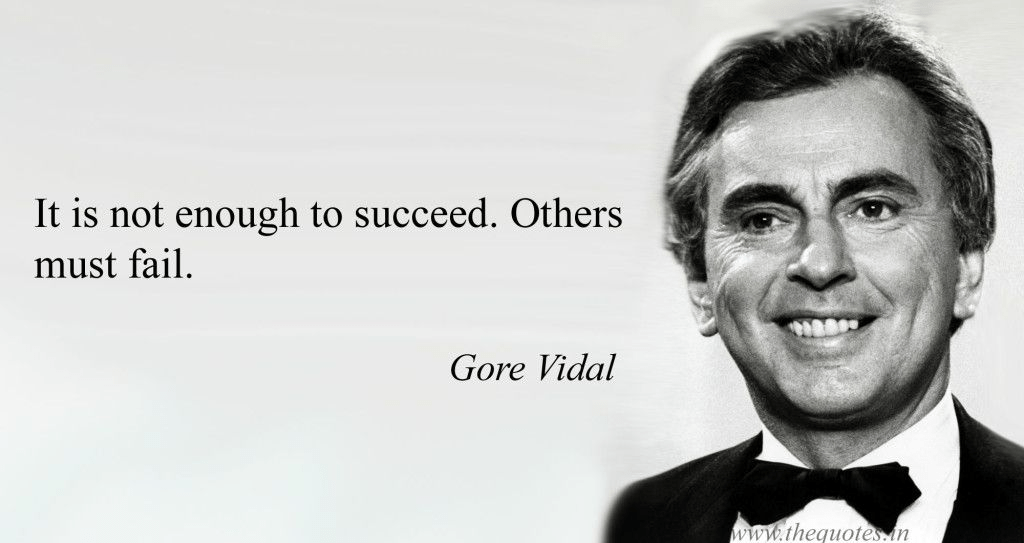
I am no great fan of ‘success’. Hence the Gore Vidal quotation. But whilst we are on Gore Vidal’s sayings we might strike a note of caution. The better known quotation of his (which may well turn out – as much he mouthed or wrote did – to be someone else’s saying) seems to suggest a certain coldness in the man with which even his friend and biographer, Jay Parini, concurs. But whether that coldness can be exported to other sayings of his is more doubtful for people change through long careers and Gore was 86 when he died. Below, however, it is attributed to him as if there were no doubts of its origin, or the accuracy of the record of what was actually said (which there is):
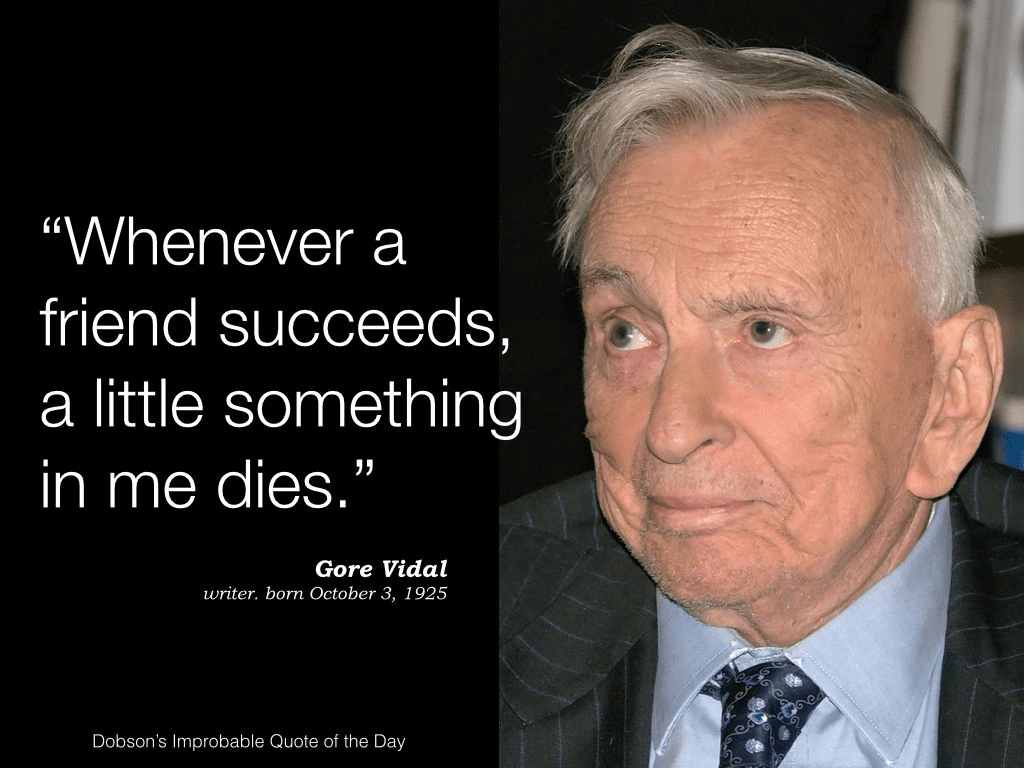
There is, by the way, a discussion of whether the latter phrase is his and its accurate form in https://quoteinvestigator.com/2014/09/11/friend-succeeds/. However, while the latter quotation definitely attests to the worst in Gore Vidal, the quotation I start off with does not and can be read in a much more kindly way and with reference to the United States idealist democrat and queer activist novelist (of a rather patrician kind) he once was. In brief he was not always only the famed ‘gossip queen’ persona he later fostered, sitting amid his riches in an Italian villa and punching out, by then, ever duller books. He was a fan of fame but he liked also to unearth lesser known (at least in the non-ecclesiastical world he helped to usher into being) figures from history like Julian the apostate Byzantine Emperor in his 1964 Julian, a novel I rather like – despite its length and need of editing.
There is something true about the statement: ”It is not enough to succeed. Others must fail’. And what is true in it is that success as a concept in the modern world is far too often seen as meaningless unless set in a sea of others’ failure, or at least comparative failure. Even the way the prompt question is posed today assumes this – we will it assumes name someone whose success makes others shine a little less, at least for us. American democracy, he famously believed, was a myth based on the ability of the successful few to rule over those who could be persuaded they were not worthy of achieving distinction themselves, as in this famous saying: “The genius of our ruling class is that it has kept a majority of the people from ever questioning the inequity of a system where most people drudge along, paying heavy taxes for which they get nothing in return”.(1) It is true that, even here, a kind of Oscar Wilde like facility with words takes over from any attempt to spread political wisdom, but we get the point that success is just another ruse to make others feel they are failures, comparatively or absolutely.
That is the aim of Tennyson’s version of Ulysses I think too:
It little profits that an idle king,
By this still hearth, among these barren crags,
Match’d with an aged wife, I mete and dole
Unequal laws unto a savage race,
That hoard, and sleep, and feed, and know not me.
Alfred Tennyson ‘Ulysses’ available in full at: https://www.poetryfoundation.org/poems/45392/ulysses

How tedious are other kings, Ulysses says, who do not want to be named as a ‘success’ in the JetPack prompt question on WordPress, he seems to say. Life is ‘still’ and ‘barren’ with the aging wife and dull son, and unexciting and rather despotic politics of his time. He might despise the people he rules as a ‘savage race’ for the dullness of their lives but he needs these absolute failures from the base of an unequal society to ‘know’ him nevertheless. Worse than that the hoi polloi only ‘hoard, sleep, and feed’ to fulfill their sad lives and, to make it worse, ‘KNOW NOT ME’. Successful people need unsuccessful others to point the significance of their lives to the world.
According to Lawrence R. Samuel in a Psychology Today webpage entitled The Psychology of Success, the definition of success I have used above is a fallacy attributable to the nature of competitive ideology so central to the USA as a democracy of supposed merit. Of course, whether it is truly about merit other than in the ‘American Dream’ is doubtful, as Arthur Miller’s The Death of a Salesman showed long ago. Indeed that play is a fine one to think of in terms of this question. Samuel nails down that misunderstanding of success, which he sees as merely achieving a thing that you attempt to do, by calling it the ‘contender syndrome’ (someone else’s phrase) after the famous presentation by Marlon Brando of a working-class aspirant to ‘SUCCESS’ in On The Waterfront.
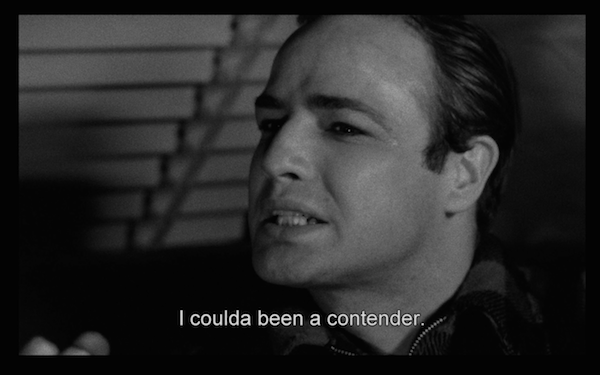
What Abby Ellin called in Psychology Today in 2010 “contender syndrome” was without question an unwelcome presence related to the psychology of success. The sense that one hadn’t lived up to one’s full potential was a disturbing sensation for many, especially when comparing one’s list of achievements to those of others. Ellin reported that therapists were seeing more people suffering from the condition (that referred to Marlon Brando’s character Terry Malloy’s iconic line “I coulda been a contender” in the 1954 movie On the Waterfront), a result perhaps of the comparative nature of social media.
https://www.psychologytoday.com/us/blog/psychology-yesterday/202306/the-psychology-of-success
As Samuel goes on to say modern psychology embraces a notion that failure is part of success, rather than its opposite, an idea I have mooted before. To see it otherwise is merely to embrace the inevitably of enduring and unchangeable inequalities, whether innate, of fortune or skill. Some of these qualities do not equate with the notion of success as inherent in certain people who ‘come to mind’, for what comes to mind is often the effect of the repetition of names, advertising or hype. It is the basis of ‘celebrity’ culture which curses our television screens with quiz shows that have no other purpose than to make success seem random and pointless (hence I think the success of the quiz of the latter name).
It follows then that I am not keen to name the success of someone generally known, though I have no problem in hailing the success of a friend, whose existence at all is a success in my eyes though they do not seek that appellation from me or the world in general. Hearing of such success does not involve even a ‘little something’ dying inside me. Some prefer, as I have cited Samuel in saying, to see success not as the opposite of failure but the attempt to achieve something and the process of attempting it, so that failure too becomes part of that process – as it inevitably is in all human learning that admits, as does much real learning, of ‘trial and error’. However Samuel throws a seed of doubt by saying that this is a ‘comforting’ idea for most of us (since we actually do see ourselves as failures in some if not all ways). The issue is, I think, that lives cannot be valued if they are seen in these terms – what is seen as success one day, after all, can be seen as failure the next.
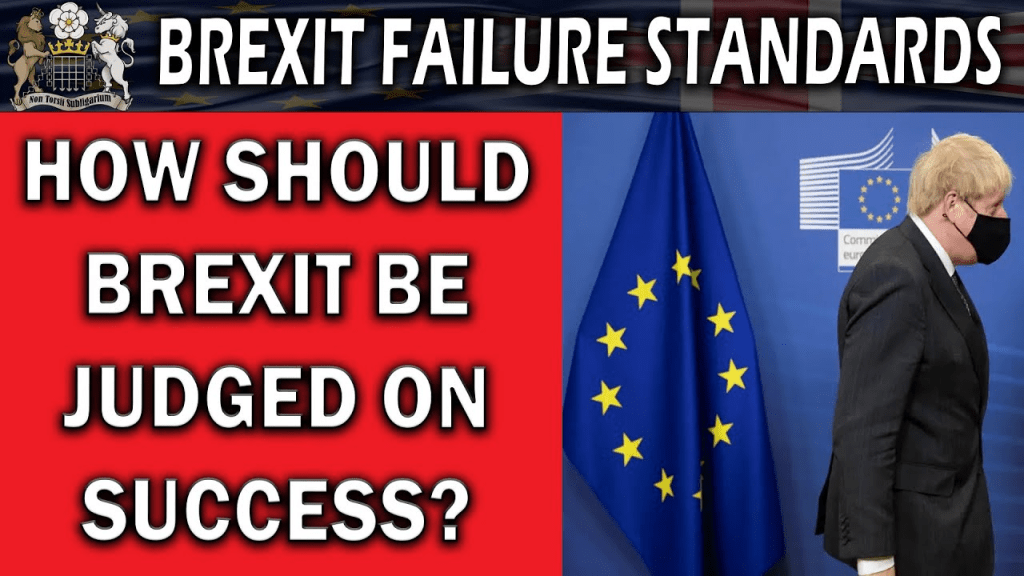
We have a government in the UK currently that seems to have illusory pride in its success: the management of COVID, Brexit, immigration policy. Yet all of these successes begin now to be what they always were, the pursuit of a chimera not based on evidence. And that government and its named governors now appear as sad memories of inadequacy to a role, sometimes based on ideological constructions of success. And maybe all success – except achieving EVENTUALLY what you try to do – is just an ideological construction of success, a point in politics we can associate too with Tony Blair and Keir Starmer (as masters of illusions of success too).
So no political names here, though some names are those of decent people. Of names in the arts I would name too many – but even here, surely the achievement of a name is the least of their achievement, something evident in stories of people early labelled as ‘failures’ like Lemn Sissy in his book My Name is WHY. The achievement of beauty (even discordant beauty) and truth however – there is another matter. I CALL IT THE ACHIEVEMENT OF GOOD not success.
________________
(1) Source is: https://www.theguardian.com/books/2012/aug/01/gore-vidal-best-quotes
 Steve_Bamlett_blog