What principles define how you live?
Life needn’t end. That gnomic sentence does not mean I think I or anyone else will not die ( nor that an endless personal life is a desirable idea). Nor does it mean that I believe, and urge belief in others, in a personal afterlife. Personally I find the idea of continuous personal life without an end to it an appalling idea. But as a species we are, I think, obsessed with the belief that life is defined in individual and personal terms, and not continuous between persons in space and time over distances, however unimaginable or closed to our personal experience.
It’s an old idea but one thoroughly submerged under the ideologies of self that pass as thinking everywhere. I may not sense my link to others, however physically near or distant they are, but that closeness is a fact as near to the spiritual as you can get. Perhaps, too, it is as much of a putative spiritual domain admits of facts rather than helpful fictions. And that continuity of links is what makes space and time relevant to humans, though it does not, just as importantly, make humans sovereign over space and time. For the continuities in life cross species and life-types and ‘live on’ in the continuities imagined and experienced between life and death.
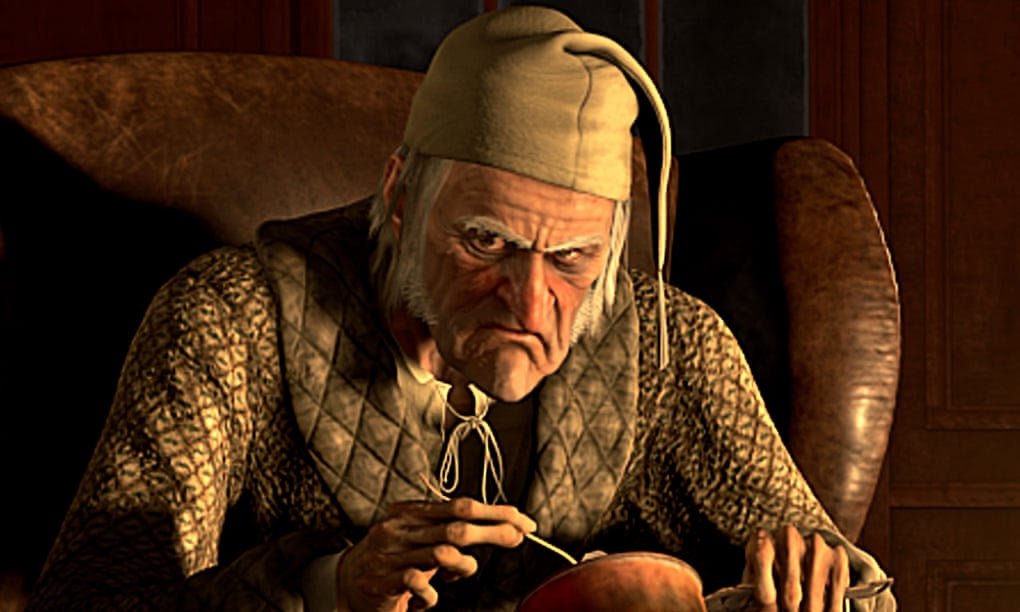
I think the continuity principle sees distance as a principle not a fact, for how we know distance is a thing amenable to change of nature, just as we feel ‘close’ to people distant from us in time and space, whether that be a friend in Australia or a lost pet. I don’t think this is just a matter of symbolic expression. It is a sign that such continuities are already part of most lives. This is so much the case that we invent the stereotype of the miser, hugging everything they have close to their only yardstick to measure the reality of things (that wasted, cadaverous and only just embodied idea of self). The miser or hoarder is the emblem of the life imagined without the principle of continuity. It is this that makes the emblem of Dickens’ Scrooge still useful to us without the flimsy machinery of religion and Christmas festivity surrounding it.
Continuity is a difficult principle to live by and it can engender false typologies of itself, such as the stereotype that is vulgarly so often associated with Buddhism. People seem to believe such believers, as a kind of reductio and absurdum argument against them, are afraid to ‘live’ in any way the rest of us recognise as ‘living’, unless they, in the process, ingest or step on a small being and end a life with which they are continuous, even if it that event remain forever unknown to them.
Its true difficulty as a principle to live by lies in the fact that its reality is counterintuitive to beings raised in cultures of the majestic self and not always registered consciously to the senses, sometimes indeed incapable of being so. Its fictional manifestations range from those of religious texts and art to Gothic novels, Sci-Fi and popular films of horror and awe. A tremendously beautiful recent novel, about which I have blogged (see in list below for link), is Martin MacInnes’ In Ascension.
Continuity would, as in that novel, make the origin of all life (and not just human or even animal life) a necessary starting point to which we make continuing communion. It would shape communities so that their boundaries did not exclude the environment, for that too is either a form of life, even if sometimes a long dead form, or otherwise connected to it. It may not be a sad thought that we return to dust. When we think that dust from the origin of life in our universe, returned to us by space is being examined, as we speak to each other now, in laboratories of the wider world, it should make us pause and reflect.
Green politics too would not seem discontinuous to our pragmatic dealings with the world, and this is why the poet , Zaffar Kunial, stresses the word ‘Continuing’ to point out that we need to be always ‘in,’ as well as objectively ‘outside’, even simultaneously, our experience of the natural world and its destruction by humans like us and sometimes us ourselves. For a link to a Kunial blog I did see the list of links below.
These principles must not be seen as a mystic alternative to real thought, whatever that is. If the Ragnarok now in progress environmentally is to achieve anything good, it will be to show that the evidence of continuing is even now being felt, in the force and strength of climatic changes and the mass extinctions they have created now in process.
We could start like Scrooge by feeling our continuity to work colleagues as Scrooge did, even underlings and their children, till the very thought of them as underlings becomes unthinkable. It would be unthinkable because we recognise that the thought of not caring about others is truly what our historical culture urged us to imagine and then allowed those whose interests it serves to harden it into ideology. For not caring is ideology more than its opposite – the principle of continuity of caring for and with everything.
Well that’s enough, or is it .. for after all we need to continue. Be continuous with me, please, you ones who I wish to call my each and every one beloved. …..
Never end with a FULL STOP.
With love
Steve.
For In Ascension see: https://livesteven.com/2023/09/05/booker-2023-this-is-a-blog-on-martin-macinnes-2023-in-ascension/
For Kunial blog see:
Zaffar Kunial’s (2022) ‘England’s Green’ is a miraculous book of poems divided between those gathered under the term ‘IN’, and those similarly gathered under ‘OUT’. This blog is a way of preparing to hear him read at the Durham Book Festival at the Gala Studio on Friday 13th September 5.30 – 6.15 p.m.
or Ragnarok blog see:
Is Ragnarök on its way? It is but if we ‘knew’ that and were fully informed by that knowledge, we would be urging Governments to act – and now!
 Steve_Bamlett_blog