What have you been putting off doing? Why?
When I puzzle about an issue in my life I often turn to poetry for help. We live in a world where time is literally money and action matters more than reflection, which is too often considered passive. It is as if clichés like ‘time waits for no-one’ or ‘fortune favours the brave’ were written into our prescription for living and everything else gets put under a pile with the label ‘ procrastination’ put upon it.
And, it is true that it is possible that we waste time holding back from acting on our wants and desires or hiding them away so that they metamorphose into something strange and perhaps warped by waiting, and the consequent accumulation of frustration and it’s associations.
That is what William Blake meant in the aphorism: ‘Better murder a baby in its cradle than nurse an unacted desire’. He wasn’t recommending child murder but acting when a thought or feeling is young, innocent and fresh (to wit a baby) than let it age into frustrated perversion of crabbed experience – the stuff he thought that really motivated evil like child abuse and exploitation. Experience warps, Blake thought, and roses become sick roses; sickened by the dark secrets’ of an invisible worm ‘that flies by night’.

But is acting on desire the best prescription? Are all first desires laudable and innocent? Browning thought not and he illustrated that in two poems I will use here. The first makes a general point. He imagines, in the collection Men and Women, two lovers meeting on the plains around Rome, the Campagna. Should I make love to this woman? He thinks. But before he reflects further, touched accidentally by the heat and warmth of her body, he succumbs and takes her – in the tired Carpe Diem image of the poem, he plucks ‘the rose’. I cannot say if Browning thought of Blake’s The Sick Rose at the time .he wrote this.
But the truth Browning’s male lover, who is the speaker in this poem, discovers, and possibly then hides away again, is that physical possession would satisfy him in itself and slake entirely the appetite for his beloved by killing it. For a ‘good minute’ only he enjoys her love, and her body with it, but then that good minute ‘goes’. Hence his call to ‘Help me to hold it’. This is an oblique reference to the Greek God of passing time and opportunity in life, Kairos, who has one lock of hair, by which (if you are fast enough) you can hold him for moments longer than otherwise and use his gifts – act your desire rather than nurse it.
This is I think a wisdom Blake and other Romantics lacked, a wisdom paid to waiting for that moment where reflection touches upon the enduring and action is good in ethical ways and not just for the moment, to be regretted afterwards. And Browning knew that in these cases most regret might fall on the women who bear consequences of sudden passion – of reputation or of bearing a child without support and social validation. Browning was intensely aware of that fact.

Chronos and Kairos
The true God of time, Chronos, awaits the outcome of enduring tests of one’s worth, tries to put the ‘infinite within the finite’, which is Browning’s definition of poetry. Here these points are in the verse itself.;
No. I yearn upward, touch you close,
Then stand away. I kiss your cheek,
Catch your soul’s warmth,—I pluck the rose
And love it more than tongue can speak—
Then the good minute goes.
Robert Browning ‘Two in the Campagna‘ available at: https://poemanalysis.com/robert-browning/two-in-campagna/
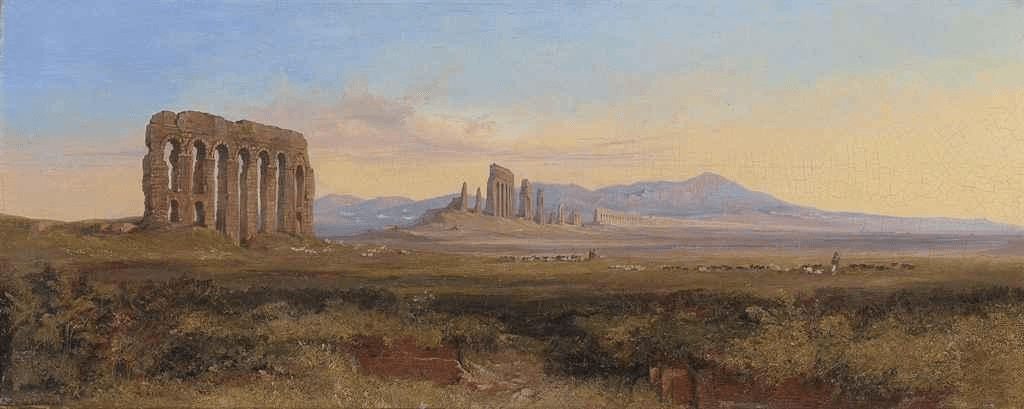
Edward Lear ‘In The Campagna’
In case that point was missed he made it again in a poem about a lover who, in order to gain a female lover beyond him in terms of social class and income, murders her. It is one of two poems called Madhouse Cells. It is Porhyria’s Lover. Porhyria, actually the name of a disease associated with the madness of George III, is the genteel lady. She expresses simultaneously her passion for her working man lover and the regret it can go no further without damage to her name and fortunes. The lover ponders but in the excitement of the minute he enacts a desire that might have been better unacted and nursed instead, till soothed from its moment of overwhelming but only apparent necessity.
That moment she was mine, mine, fair,
Perfectly pure and good: I found
A thing to do, and all her hair
In one long yellow string I wound
Three times her little throat around,
And strangled her. No pain felt she;
I am quite sure she felt no pain.
Robert Browning Porhyria’s Lover available in full: https://www.poetryfoundation.org/poems/46313/porphyrias-lover

Porphyria’s murder puts her in his possession – she is ‘mine, mine’. He barely notices that once that fact is acknowledged, she, as a lifeless corpse, will become nobody’s. And she has paid the price of his Kairos worship.
Now Browning never makes it simple. Usually he upbraids male desire for its lack of reference to what endures. In one of his letters he says he so loves the scent of flowers that he is led to consume them by mouth rather than appreciate and reflect on their potential for something richer and longer-lasting. But Porphyria is not free of moral blame in this poem, although in My Last Duchess, that duchess definitely is free of such blame. The fault lies I think in why you write poetry in the first place. Is it to satisfy an immediate desire and have ‘ a good minute’ shared with a reader, or is it to reflect on the horrible multivalence of what it means to love in time and ‘our time’ in particular?
And if instead of seeking opportunity from the one hanging lock of Kairos, we embrace the old man in full acceptance of his hoary gift (I mean Chronos, Father Time himself), we learn our duties as ethical persons are wider than fulfilling a selfish desire. They embrace the marginalised, the poor, the mad, those on the boundaries of social experience. And you can’t do that if all you care about is the good minute of orgasmic pleasure or vengeance as your only model of pleasure and fulfilment.
So, if I have put things off, it may be better they were put off until better guidance prevailed from the wisdom of either ages past or that leaning into the future to make it better. It is not always true that immediate action strikes while the iron is hot. More often the iron is too hot and we shatter it as we see happening in the hothouse on the border of Gaza and Israel.
I have been putting off forgetting (or trying to) someone I loved intensely, for even had I tried I would have failed and the damage to my own memories and I met stability would have been immense. Even acting to find a substitute immediately was wrong – more pathological than any sick rose might be. But listening to others opens options rather than closing them. Unacted desires fade into the fantasy they were all along and the true beauty of others in your life shines clearly.
Thank you Geoff, Joanne, Mike, Mark and Heppy. Your love and guidance got me through more than counselling did.
All my love
Stevie
 Steve_Bamlett_blog