What is your favorite hobby or pastime?
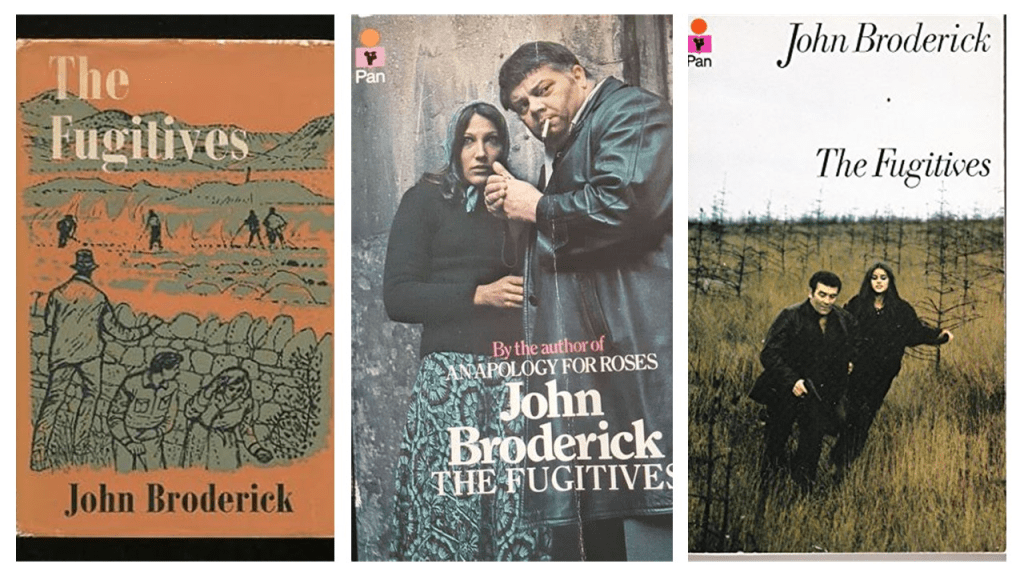
In a neglected novel called The Fugitives by John Broderick, he writes:
But just as people will live on in houses demolished by a bomb, going through the ritual movements of everyday life; so Lily adapted herself to the uncertainty of her existence’.
This is probably a strong statement and there is no doubt that this is appropriate to the novel’s circumstances. The Fugitives deals with Lily, the sister of Paddy who has completed a murder for the IRA. Lily loves Paddy almost incestuously (though that remains unacknowledged) and in the complicated terms of the novel, is a love described as Platonic. They both live in an abandoned cabin in the middle of bog land in the central Ireland plains. This occulted abode is shared with a senior IRA man, Hugh Ward, who has a passionate sexual and romantic desire for Paddy but in the town has pretended to love his sister to cover for that unrevealed fact, which is also unknown to Lily. This complex trinity enmeshed in uncertain desire lives there in order to escape surveillance and capture from the combined forces of the British and Irish police. There is indeed much more of ‘uncertainty of existence ‘ than most of us deal with on a daily basis in this novel.
But the complex mesh of relationships between characters and the plot of The Fugitives is not the reason to quote the passage I do, for it tells the truth, and was intended so to do, about the nature of a life that all human beings experience in their own way; thrown into the midst of worldly circumstances for which we are only in very minor ways at all responsible and forced to both endure and manage as best we can. In such circumstances passing time is a serious thing, for it becomes the means by which we shape who and what we are in all the flexible forms of our options for living.
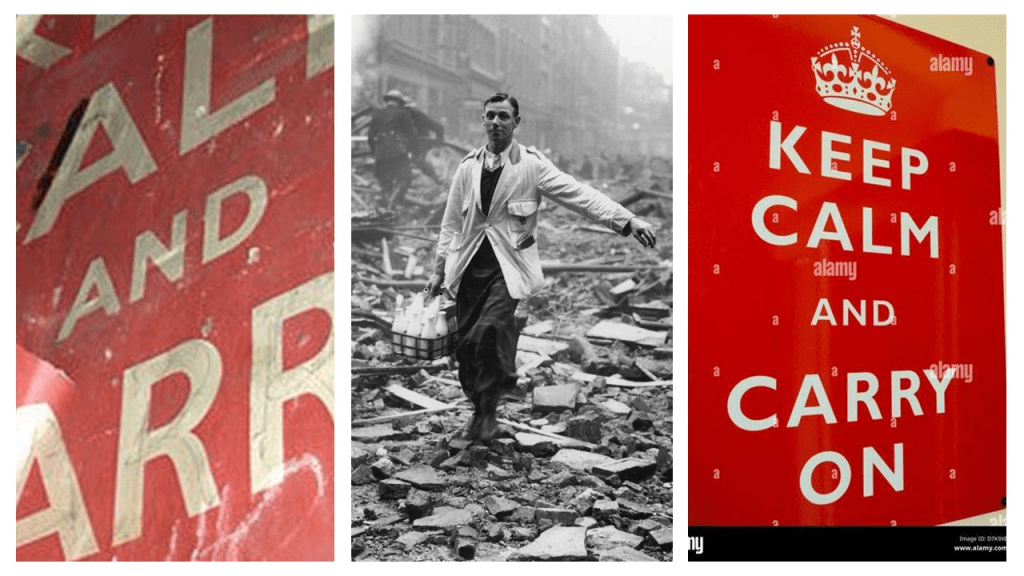
We can just ‘stay calm and carry on‘ as the old saying from the European Second World War advised or try more actively to reshape things, following either or both the forces of our conscious and unconscious motivation. Indeed perhaps ‘staying calm and carrying on’ is itself not the passive thing it seems but an expressed action that maintains the belief and evidence that, in major things, life will continue in its old and established patterns and the status quo of our past lives be vindicated. Indeed the truth about the famous second World War poster carrying this slogan, which had to be pulped (all 42,000 copies though one at least was found in order to be popularised by Barter Books, a famous second-hand bookshop in the old Alnwick Station building in Northumbria) because war-time populations, especially the working-class found it ‘patronising’ and politically suspect. The true story, as told by historian Lucy Worsley for the BBC, can be found on the web here: https://www.bbc.com/reel/video/p09vd955/the-extraordinary-story-behind-britain-s-most-famous-slogan.
Nowadays, we are less likely to stay calm, though we carry on still. Instead, we fill our time (but not to fulfilment and the distinction in meanings is important) with games and entertainment in which we are, from degrees from total to most-of-the-time, passive to our fate as a population, and perhaps even as individuals, That tendency is even made fun of by the Carry On comedy team of the 1950s and after, although the tendency of the films was to venerate what it saw as working-class values without the politics, or with the latter replaced by smutty comedy. The film Carry On Regardless of 1961 took the rise from the fact of rising unemployment, labour exchanges and economic depression by employment of class-based humour.

I think I refer to Broderick because his prose best illustrates how human responses to uncertainty often tend to rely on the ‘rituals’, as he calls them, of ‘everyday life’, those signals that, though all is not well, we still survive and ‘carry on’. The aim of a pastime is not just to ‘pass time’ but to give it meaning and significance, even if one that cannot endure beyond its moment. However, observing game-players for a long time has always given me (an inveterate hater of them) food for thought about how a passion for ideologies that see selfishness, the use of subterfuge and deceit, and competition as the basis for all life – Social Darwinism if you like – is inculcated in them (children and adults). We bring our children up to values that concern me in precisely that way. Similarly we may inculcate a view that passivity before things is a necessary attitude even under conditions of political exclusion or oppression.
I have often thought that human activity must aim for more than just passing the time but a use of the energies which they excite, and which otherwise fill with anxiety and despondent depression. Here is how Broderick describes that in that central Irish plain bog-land, wherein doing nothing is worse even than perhaps playing a game for Lucy as she awaits discovery of her lifestyle by the wider world, and that of Paddy and Ward, with all their complex political, social and sexual enmeshment in all of the issues of the times: ‘The hours drifted into one another. Hours and days blurred by rain; yet strangely magnified by tension’.
Tension and stress are a marker that ‘our time and our times’ are literally capable of becoming the material of a modern Waste Land (its meaning in T.S. Eliot’s poem of that name), a place where the shout ‘Hurry up, people, it’s time’ they used in public houses with regulated licensing laws after the Government regulation brought in in the War and carried on in recovery and through rationing, is our version of the carpe diem theme: ‘Gather ye rosebuds while ye may / For Time is still a’flying’ (the last quoted from memory so possibly inaccurate).
I find personally speaking that I cannot easily use TV quiz shows or ‘soaps’ to fill time without excess of tension accumulating. Reading does help because reading actively demands of the brain , if one reads intensely as I prefer. Even writing blogs has this role. Even if they may get neither me nor the world further on any meaningful path of activity or change (they may not even be read), they do enable the growth of some kind of learning and application to living that is more than pragmatic, functional and about ‘carrying on’ in the status quo. Perhaps they have a downside, because they are solitary and may lose people to your care and friendship because they deny the supposed ‘simple’ pleasures, but by now in my life, I don’t think I know what else to do. And loss – that you have to deal with anyway 😥😭😪.
With Love
Steve
 Steve_Bamlett_blog