What details of your life could you pay more attention to?

I think the idea of paying attention to your life down to each detail is problematic. Were it possible to attend consciously to each detail of my life, I would still not be in control of these details since so often they are details formed in the cusp of interaction with another or others, not all of whom I will be aware to have occurred or be occurring. In fact in life, we rub against each other often silently and without intention or foresight, some interactions being barely noticed. Many of these relate to our sometimes unnoticed responses to others rather than initiated actions done towards them. Sometimes that response is a failure to notice the other or to pay them the attention of which they have signalled need but that remained unseen and unfelt beneath the carapace of our hardened self.
But you can beat yourself up unnecessarily in this respect of course. That may be because another issue in this question is that, sometimes, the felt need to pay attention to detail in our own circumscribed lives is at base a desire to control and regulate that overreaches anyone ‘s capacity. Such control may anyway be undesirable, as Oedipus’ found. Creon, his power -hungry brother, tells him at the end of Oedipus’ Tyrannos to no longer ‘seek to control’ but just leave Thebes and his family. Oedipus’ wanders away alone into exile, without eyes to see, possessions or title, and having left behind his children to their own devices.
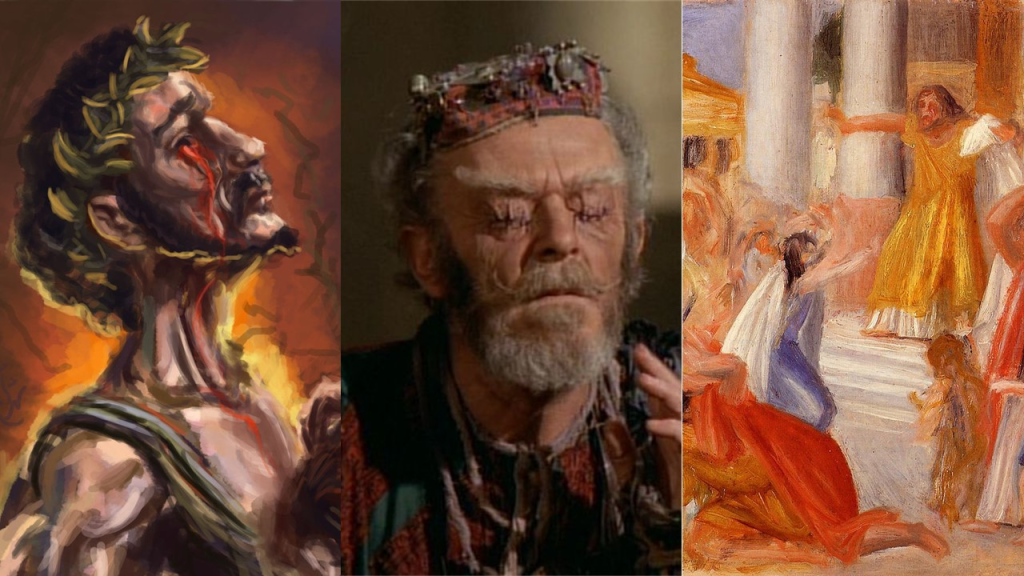
I am not saying that the wish to control and regulate more of the detail in one’s life is either positive or negative ethically. Whether it is either ethical or unethical is a matter relating to too many variables, not all of which are even immediately evident. What matters more perhaps is that such control and minute regulation is a desire for the impossible and perhaps a delusion of power we do not ever possess. The detail of my life is not all under my control, neither in the origins of my range of possible behaviours where these are in part determined by past accidents of life and social order, but also those dependent on the biopsychosocial systems they act within to make them possible responses or not. Most details of our life after all are not intentional but accidental to the operation of such systems in our past, even genetic systems perhaps, and operative in the present and actively contributing to all our futures.
Oedipus’ is our example yet again. He is deluded into believing that his fate was what could and would be the sole means of control and regulation not only his own life but that of all his family and the city state of which he believed himself the only central factor. Oedipus’ importance, however, was never produced through his intentions about his hoped-for destiny but the accidents which attended his fate: of being discovered when left to die as a baby, meeting his fiery angry father on a crossroads in a way that leads to the father’s death, marrying a woman he only later discovers to be his mother. His resolution of those accidents is self-burial at Colonus, amongst the deified and living immortals of memory. It is a place where control might be exacted over human lives but subterraneously (or subconsciously) and as if you yourself had become the immortal source of the Fate of others.
It took the advent and example of medieval monarchs and Italian Renaissance princes to refine the model of the man exerting total control of every detail of their self-presentation. They were not all men of course for no-one was better at this than Elizabeth I, who even used her sexual nature and circumstances as Virgin Queen to political and ideological effect. The arch example was the stereotype in Tudor and Stuart drama of the Machiavel, based loosely on the ideas of Machiavelli’s The Prince. Machiavelli’s notion of how power politics needed to be conducted fed easily into the morality play demons of the remains of the Medieval Church. These men were conceived as near devils rampant with sexual and political hunger and guile, the best example in Shakespeare being the ‘Bastard’ Edmund in King Lear. No-one in drama pays more attention to the need to control his self-presentation and politically prompted relationships as this narcissistic dominator and natural predator.
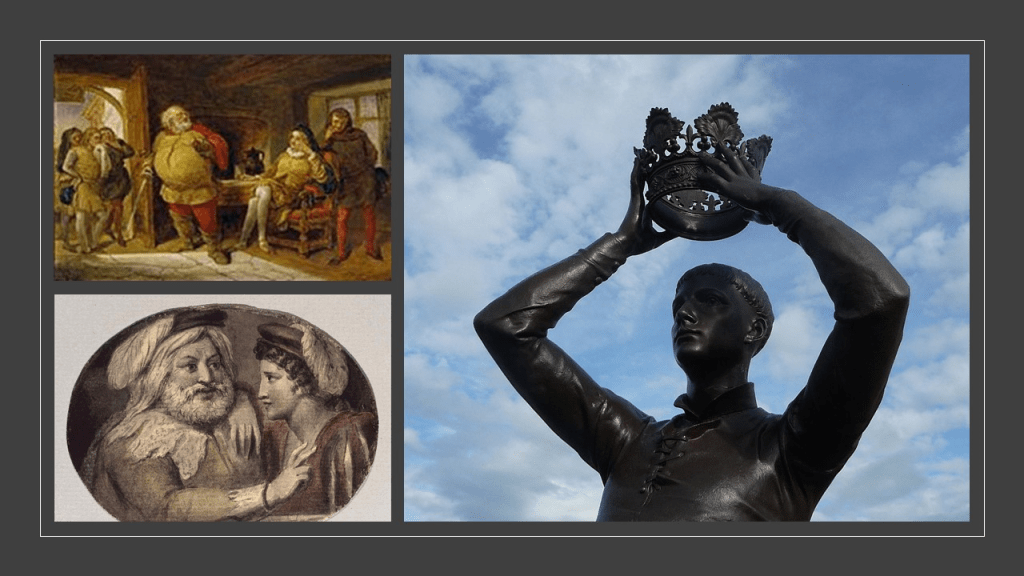
But Shakespeare’s greatest Machiavel is not superficially an evil character nor one bound to fall foul of any readiness to condemn him ethically. It is Prince Hal, who in 1 Henry IV is a rapscallion committed to the love of the roguish Falstaff . But all this is appearance and political power play based on clever ideology, to appear as a person with the same interests as those in the lower orders in order to later control them the better:
Yet herein will I imitate the sun,
Who doth permit the base contagious clouds
To smother up his beauty from the world,
That when he please again to be himself,
Being wanted, he may be more wondered at
By breaking through the foul and ugly mists
Of vapours that did seem to strangle him.
…By so much shall I falsify men’s hopes;
And like bright metal on a sullen ground,
My reformation, glitt’ring o’er my fault,
Shall show more goodly and attract more eyes
Than that which hath no foil to set it off.
I’ll so offend to make offence a skill,
Redeeming time when men think least I will.
(I.ii.173–195)
Hal is, isn’t he, in truth, a nasty piece of manipulation, secret plotting and narcissism, just more enduringly attractive than Edmund because he claims he will use power for the good and clothes it in religious and moral terms. He still preens himself before the eyes of women, and men, making them love him whilst considering them ‘base’, only in order to get power and domination over them. He, on his own admission, imitates, falsifies and acts a role for effect as Edmund does.
He does succeed however to become King Henry V and to be thought a good and godly king, maintaining an image in ‘men’s eyes’ till the end, successful even as a historic king in the legendary list of the kings of English history. This is so much the case that, as with all narcissists big and small, he leaves a trail of carnage in his wake, whether in the lists of the dead at Agincourt or in the Civil Wars of the Roses he leaves behind him for Henry VI. Even at Agincourt he charms men to their fate, to death that is, by an appearance of the same common touch to ‘base’ men while still sending them to their death to feed his vanity:

For forth he goes and visits all his host.
Bids them good morrow with a modest smile
And calls them brothers, friends and countrymen.
Upon his royal face there is no note
How dread an army hath enrounded him;
Nor doth he dedicate one jot of colour
Unto the weary and all-watched night,
But freshly looks and over-bears attaint
With cheerful semblance and sweet majesty;
That every wretch, pining and pale before,
Beholding him, plucks comfort from his looks:
A largess universal like the sun
His liberal eye doth give to every one,
Thawing cold fear, that mean and gentle all,
Behold, as may unworthiness define,
A little touch of Harry in the night.(Henry V, Act 4, Scene 1, lls. 3ff.)
This is still a ‘semblance’ that we see here in the person of Henry and he is still imitating the sun. The almost perfect abuse of power lies in showing weaker and less powerful men that he loves them, however ‘unworthy’ they be, by the sensuous ‘little touch of Harry in the night’. Narcissistic controllers of every detail that gives power over men will recognise the plot here. Give me the attention I need and come to me by night. As I said to my husband, in recognition if jokingly of this fact, that given our current age the touch of any king (for so bold gay men call themselves these days) in the night is welcome, whether Tom, Dick, or Harry. Lol.
The control and regulation of detail then is not what I am after – being myself no master of illusion as King Hal, or even a failed one like Edmund. The truth is that, though Oedipus’ was a more celebrated king in Western European culture, his faults are not those of a Machiavel for in the terms of every kind of control and regulation he could have exerted he fails, even if he is good at riddles. And he illustrates better than any other model of human response the fact that it is not the attempt to control events or regulate self that matters but dealing with things when they happen. This is the whole point of Oedipus’ at Colonus which, though it is a play not necessarily from the same trilogy as the Oedipus’ Tyrannos before mentioned although still written by Sophocles, shows how Oedipus’ matures to accept the accidents of life and makes some good choices at the end.
A long winded explanation yes but I wanted to argue an extreme case against today’s prompt, and a twofold one:
- 1. To look for detail to change or modify or even just observe more closely in one’s life traps you into either a delusion of more power than it is possible to have over self and worse a desire to be a manipulator and narcissist. One can sail through life as the latter and even achieve success but that only works if you accept and embrace the fact that you leave carnage in other people’s lives behind you.
- 2. What we need to pay attention to are the details that get thrown up in our relationships and dealings with others; accidents that we can respond to for good or ill. It is best to be alert for them – responding in a way that avoids harm to self and others and perhaps increases the chance of the better welfare of all being more likely than not.
Oedipus’ dies at Colonus with a wish for general good on his lips having stood up to Creon and his own son Polyneices in their peculiar desires to have fostered their own wish for kingly power in Thebes against all contenders. Oedipus knows that he can stay where he is, enjoy the good company of daughters, that unlike his sons, have not abused him in the interests of manipulating a path to power in Thebes, and have instead just loved and cared for him. He knows the last accident he will face is the means of his own passage from life about which neither he nor anyone else will ever know what happens, and his last wishes guard that secret, even from his daughters.
His last acts are entirely to the benefit of Theseus, and with him to the benefit of Athens. What Oedipus has done is give up action and plotting of his future in the interests of revering only those things which show by the selflessness of their public behaviour that they are most likely to aim for universal good. This is done by accident in the play, but probably by ideological intent in the hands of an Athenian aristocratic senator like Sophocles, this aligns with the hegemony of Athens over other city states including Corinth and Thebes, both once represented by Oedipus as the figurehead:
You must not be amazed, 1330
Oedipus to Theseus in Sophocles ‘Oedipus at Colonus’: http://johnstoniatexts.x10host.com/sophocles/oedipusatcolonushtml.html
my friend, that I keep talking for so long [1120]
to these children, so suddenly restored.
For I know that my present joy in them
I owe entirely to you. You saved them—
you and no one else. And may gods grant
to you and to this land what I would wish,
for among all those living on the earth
only here with you have I encountered
men of piety and just character
who tell no lies. I know that about you, 1340
and I pay tribute to your qualities
with these words of mine. Everything I have
I have because of you and no one else.
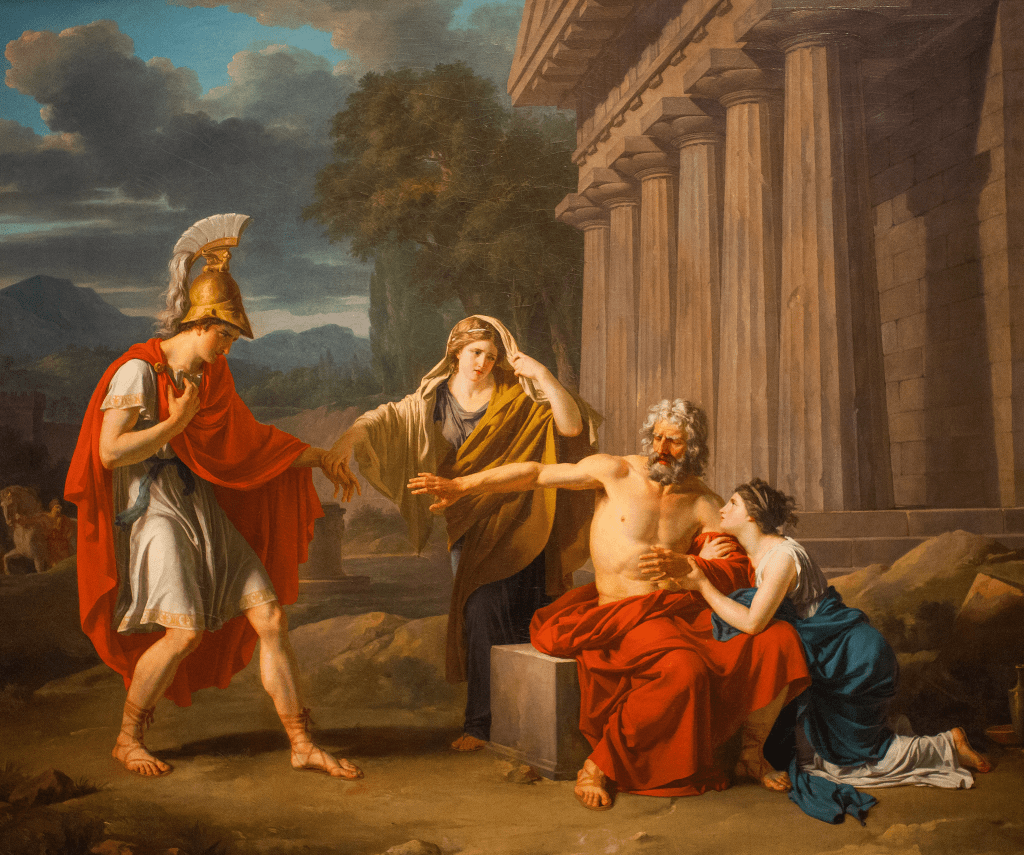
Oedipus at Colonus, Photograph Thomas Hawk, Flickr, Available at:https://www.worldhistory.org/Oedipus_at_Colonus/
Hence, I do not intend to pay more attention to details of my life but to attend to events as they come to me, as alertly as I can, so that I respond well to accidents in my interaction with others and the environment. The aim is for my response to these accidents to be aligned to a way that takes into account the details of the persons, their relationships and the balance of interests of everyone involved in that interaction. In that way ethics is possible. In that way narcissism and the imposition of selfish will avoided, at least to the optimal point possible.
All my love and best wishes
Steve
 Steve_Bamlett_blog