In what ways does hard work make you feel fulfilled?
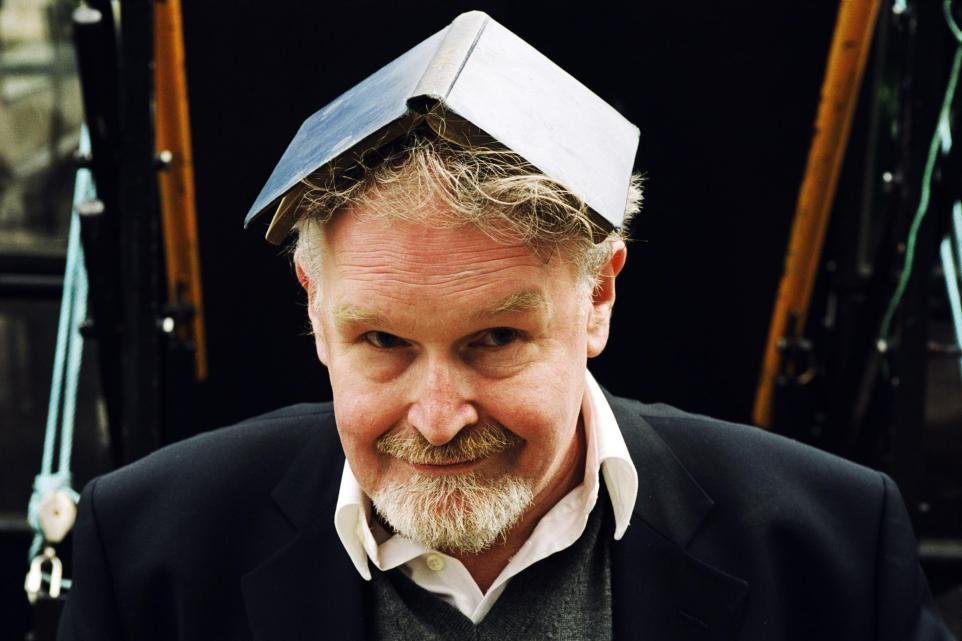
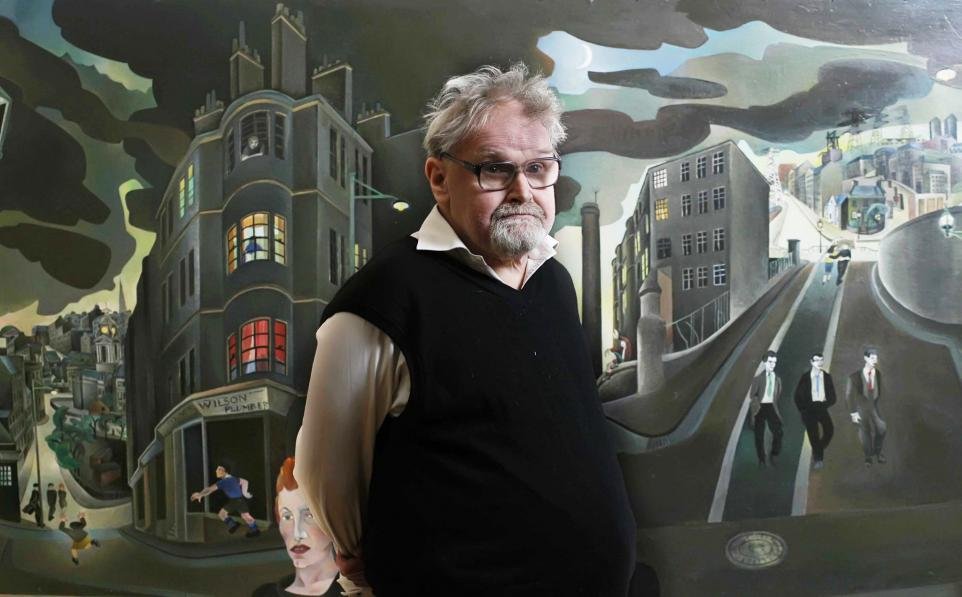
Alasdair Gray quoted Canadian poet Dennis Leigh when he used the phrase in my title. On the outer wall of the Holyrood building of the Scottish parliament it appears as a monumental word art work and its authorship is attributed to him alone. He spent much time re-attributing the phrase to Leigh thereafter, but he certainly believed he had infused it with meaning as a statement that explained why he was both a socialist and a nationalist.
For Gray the phrase was about reasserting the significance of work as something we do for the common good of all, with the implication that work aimed at other non-collective purposes was not only an expression of the interests of the rich alone and directed only at their own benefit but was also divorced from its true function. It was also a kind of betrayal of the self as something definable only in the cooperative and shared experience of a wider humanity.
Asked to explain the phrase he wrote:
All should be glad to live where we can be good for others because our work helps them. The essential do-gooders in any nation work to provide food, clothes, and necessary transport. They build our houses and roads, mend the plumbing, empty our middens, ….
I grew up believing, with my dad and his friends, that doctors, teachers and Labour politicians were the noblest works of God – doctors worked to reduce pain, teachers to spread knowledge, Labour politicians to reduce poverty and increase social equality.
Alasdair Gray’s text was written originally in The Scottish Herald and available there behind a paywall, you can access it free at : https://www.thenational.scot/politics/18137079.alasdair-gray-work-live-early-days-better-nation/
What Gray expresses here is a view many will want to call naive; essentially the view that work is making things and providing services in the common interest and in the common good, as in the case of the manual workers he cites first here. It is a view that gets more problematic he thinks among the classes he terms ‘professional’. Here, no longer do people do what seems indicated by their work title, serving interests quite other than those Gray associated with them as a child and which he inherited from his father’s belief in the progressive political meaning of the development of the building-blocks of liberal Socialism.
These building blocks had themselves been built up over a long period, and as the result of very hard work and struggle to achieve a fairer distribution of the forces that make possible the maintenance of a good life for all: the NHS, education for all (each free at the point of delivery) and Labour politicians.
The association of work to the ideals of the early Labour movement (in civil as well as civic society, in trade unions, co-operatives, direct action groups and credit unions as well as a parliamentary party) is itself invoked here – an association inseparable from notions of dignity and pride in the common and public good and not selfish and private self-interest. Gray saved his special contempt for the ways in which the trajectory of the professionalisation of these vocations he mentions as once being seen as the ‘noblest of all’ (doctors who ‘worked to reduce pain’; teachers who worked ‘to spread knowledge’, and Labour politicians who worked ‘to reduce poverty and increase social equality’) became equated with the absorption of them into work done largely in the self-interest of the worker or the special and elite working group named.
All of them seemed, he thinks, to buy into the definitions of bourgeois business-defined work that emphasised hierarchy and the commodity value of goods and services in those jobs of work. Of course that feels naive, and perhaps it is – but there is a fundamental truth behind it about the nature of work as an expression of humanity, equivalent or greater (as sages in the Victorian era like Carlyle and Ruskin felt) to that of art, literature and philosophy. This idea was even represented in the famous painting of those very sages – standing observing work from the viewer’s right of the painting – by Ford Madox Brown called Work (and see-able at Manchester Art Gallery)
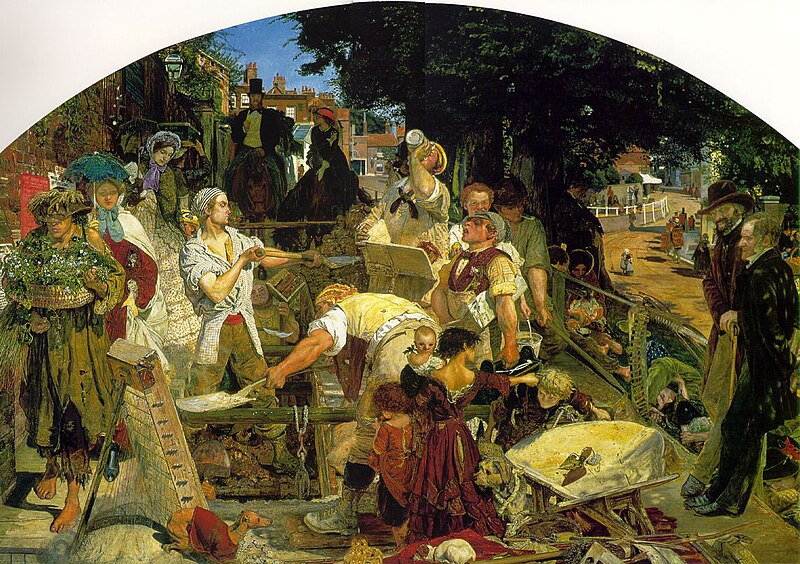
Work (1852–1865) by Ford Madox Brown – http://www.artchive.com/artchive/B/brown/brown_work.jpg.html, Public Domain, https://commons.wikimedia.org/w/index.php?curid=4454264
There is a reason that work is idealised here with associations of family and community that links directly to the roots of British socialism, in a way that is missing from some Soviet realist versions of the concept, for it includes women’s domestic labour in the maintenance of families as well as that muscle-bound masculine version that is centre-stage, and it somewhat satirises the ease of life of those rich enough to evade work.
If you work as in the ‘early days of a better nation’, you express the goodness of work in the building of commonality, which is what Leigh (how Gray spells it in his article though some writers write Lee) meant by a ‘better nation’ – one where oppression has been, it was thought, left behind, as Canada seemed to Scottish and Irish emigrants, or had been vanquished preferably peacefully via the transformation of the state into one focused on welfare not the protection of the property of the rich. Gray had little time though for Parliamentary routes to socialism alone in his later life, and was perhaps more tempted than he knew by the anarchist direct action politics of his friend and literary colleague, James Kelman.
My own feeling currently matches this. I have felt dispirited by a training course in Green politics that insisted on the lessons of commodity advertising utility and process over the building of levers for intellectual and bodily change of our environments, needs and receptiveness, especially of the view quoted therein that (from my notes) of ‘getting our people into local council decision-making positions’ (for people once they have power and seek acceptance from peers at their ‘professional’ level are too often unworthy of trust or lacking in efficacy). True, these people are heroes, but most parties have them (though I doubt this is so of the Tories) and largely they over-compromise or shift their focus to the trivial (of the pot holes in the road order or fair deals for ‘motorists’) in order to survive in power.
When work fulfills it is because it delivers change, whose significance builds anew rather than sustains a status quo. i tried to talk about this in terms of my own life in an earlier blog at this address: https://livesteven.com/2023/09/29/work-from-which-you-learned-grew-as-a-person-and-gained-personal-fulfillment-used-once-to-exist-here-are-3-examples-from-my-past-career/ .
This matters more in teaching and health work than I explore in that past piece in political terms because both good teaching and good health interventions reshape the self rather than return us to failed past models of it. And models that are new must emphasise both the multiplicity and adaptability of selves to communal purpose, to relationships in which we serve each other not ourselves alone. And that means allowing each of us a diversity that is internally adaptive and externally welcoming to otherness.
Moreover, if that is a new nation, where even ‘clearing our middens’ is seen as work of value and not merely work to which we alienate the souls of others in our service because we deserve it from them. For in that new nation we would both do and receive the work. Of course the term ‘as if’ is important too in the Leigh phrase in the title, for no work achieves its goal apart from being imagined as a contribution to a larger goal that involves all of us. That’s because, if we saw how really little difference each of us ultimately makes in the last analysis, we would despair. And I do sometimes!
With love
Steve


Nice and detailed article
LikeLike