


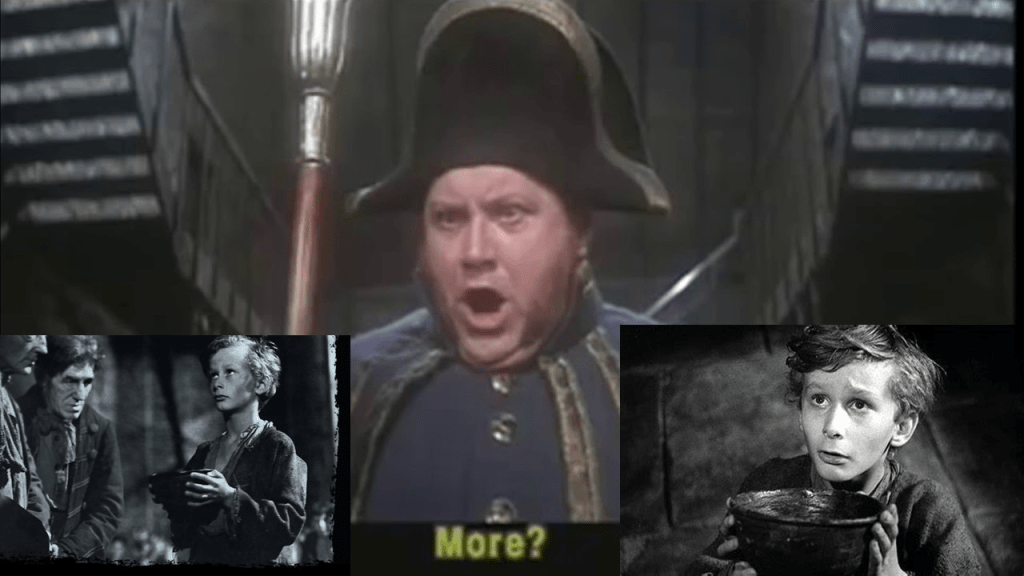
It horrified Bumble the Beadle when Oliver asked for ‘More’. The very word turned his face to burning coals; his heart, so hard for so long, crumbled as if for a moment it were becoming ash and falling away. But return it did to its ancient, petrified state: the kind of fear that is as like a stone as may be, unyielding and hating that which challenged it. For even a stone must hate to face the scratchy fact of the ancient grit and ooze of soft sludge of which it was once made and even now, as compounded into self-satisfaction as his heart was, the fleshy ease of its softer carapace made up for the hardness it sheltered with a stark reminder of its hated infant state of all-too-yielding-softness. The poor, the needy – they bring it on themselves. ‘They all want a piece of me’, he thought, as his fingers slipped under his ample jacket and squeezed his own nipple hard, taking with it an ample grasp of his doughy flesh.
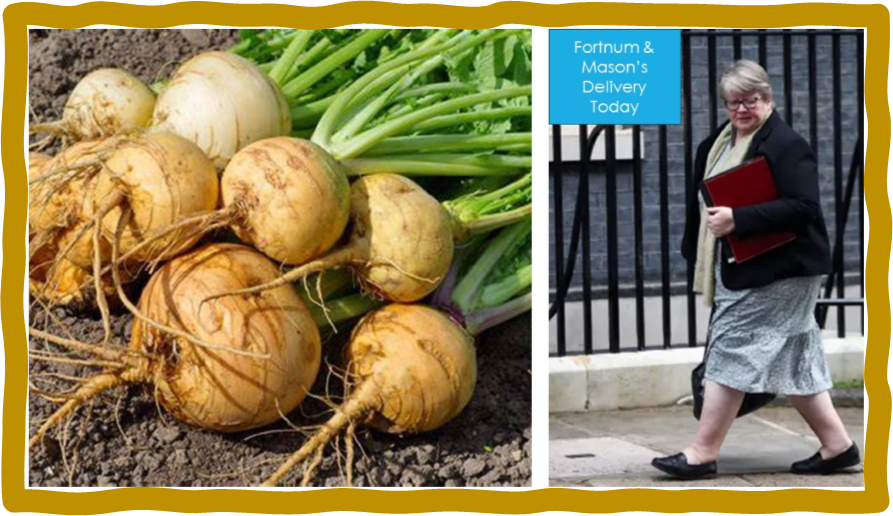
Nowadays, authority takes a different tack and cannot be so easily represented in a parochial tyrant like Bumble. Oppression now is not represented with that characterising burst of fleshly pride in its own ample proportions. It isn’t to be seen feasting its own vanity on the visible degradation of others – picking off their poor and visible bones the remnants of meat now refined by its experience of starvation, and of having less than one needs; being, well, just LESS than others. The modern Bumble has joined a gym and gone on an expensive diet regime, all overseen by a personal trainer, and if over-tempted by its resources, can afford to vomit the excess into some waste-pipe or other. When oppression speaks now it preaches austerity for all – with a jolly reminder that ‘we’re are all in this together, aren’t we’. That all sounded so different in the mouth of Winston Churchill, who (unlike the oily public-school boy David Cameron) always seemed somewhat of a Bumble – the Blenheim Estate holdings notwithstanding. Nevertheless even under Sunak, the Few still manage to live sumptuously, having besides the convenience of an otherwise impoverished Many to service them, in one way or another. And for them – those marginal people – Less is More, after all. Turnips are, as Theresa Coffey once said, very nutritious when you can’t afford the Fortnum and Mason’s daily hamper on which she still gluts or has the belief in her right to do so unashamed.
The rallying call of austerity is, and always was – ‘Less is More’. And that remains the hardened belief (hard indeed as the heart with which it associates) of authorities in many domains – even in art and literature. You can have too much richness of painterly sfumato and overlay of paint; too much scraping off and reapplication with wet and dry overlay of brushstroke, too much of sumptuous and delightful language at the level of sentence structure or arcane vocabulary, and too much colour or imagery (so much so we reduce colourful or image-inlaid writing to one colour only in naming it– a purple passage). But, at base, it is advice most often that, however deep it lies in the core beliefs of people who may not have to live the fact of having less than others, that is offered to those who in the eyes of the already privileged, need to have their expectations of themselves or their capacities for exploration reduced. Remember Goneril and Regan to their father, King Lear (now no longer a king – his occupation gone – and old to boot and hence ripe to accept dependence on his children) , in Act 2, Scene 4 of the play, as they together make sweeping cuts in the army that service him because he no longer needs them, in their view:
Goneril. Hear, me, my lord.
What need you five-and-twenty, ten, or five,
To follow in a house where twice so many
Have a command to tend you?Regan. What need one?
Lear. O, reason not the need! Our basest beggars Are in the poorest thing superfluous.
Allow not nature more than nature needs,
Man’s life is cheap as beast’s. Thou art a lady:
If only to go warm were gorgeous,
Why, nature needs not what thou gorgeous wear’st
Which scarcely keeps thee warm. But, for true need-
You heavens, give me that patience, patience I need!
You see me here, you gods, a poor old man,
As full of grief as age; wretched in both.
In effect, the Queens who were once simply Lear’s daughters say ‘less is more, father, for you have all your needs maintained without the cost of a huge retinue of your own. And why expect a surplus to your actual need – a need that it is now up to newer authorities than yours to assess’. Younger, more competent authorities than yours, they imply. To which Lear insists that he does not wish to see himself so cheaply defined or evaluated, that he too wishes to gild the lily, adorn the plain fact, in the interests of his self-respect.
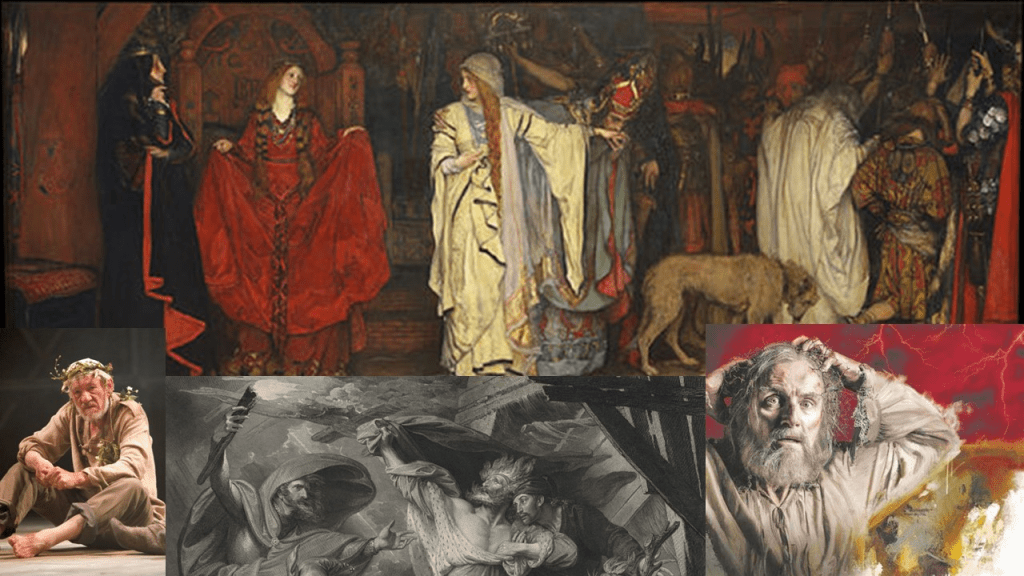
‘Less is more’ is, after all, merely an idiom – even a cliché – and it is used to advise others more than to assess how our own personal need should be met (as Lear says to his daughters – the clothes you wear barely qualify as merely meeting your needs (and may not even do that so skimpily is your body covered up). Likewise, it is a cliché that is used too much I think by teachers of art and writing, who shy from writing themselves. They can easily advise avoidance of the richness of which language is capable. Meanwhile readers think of Shakespeare and Milton, who always write best when they write of and with excess of linguistic device, however ethically critical they are of the excess they describe in their works. Milton’s Satan and the Serpent into which he metamorphoses are a case in point. Language here is rich and excessive not spare and restrained.
But we are told never to overdo what you are doing and be smart (to ‘reason the need’) with as few resources as is possible to get by with, whilst in art we use less, such as a few simple strokes of paint in a drawing like Rembrandt (but that isn’t exactly true of him either, especially as a painter in oils) or in literature spare but telling words, like Ernest Hemingway, in order to achieve more, the effect of an effort of restraint and editing that will be achieved in your work or your art. The phrase was, it is thought, perhaps first used of art by Robert Browning in his poem about the artist Andrea del Sarto, talking about his art to his gorgeously and extravagantly dressed wife as she prepares to go out – without him and perhaps with a man more ample in many ways; less pale from being wont to shy from the sun and life, ‘Quietly, quietly, the evening through’. Let’s talk, he says to her of those other men who call themselves artists, and command all the respect and love of women (and men) even his wife. Those other men:
Who strive – you don’t know how the others strive
To paint a little thing like that you smeared
Carelessly passing with your robes afloat,-
Yet do much less, so much less, Someone says,
(I know his name, no matter) – so much less!
Well, less is more, Lucrezia.
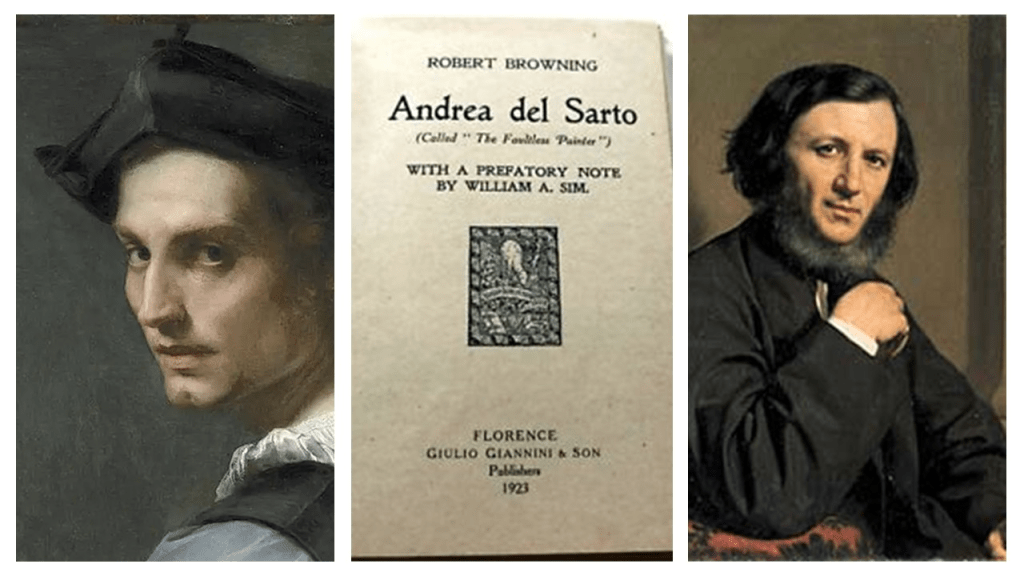
Browning’s Andrea never achieves the self-efficacy to which he aspires. He thinks he does more than other artists, but does he therefore achieve less? For instance, the young man waiting outside gets Lucrezia (for tonight at the least) and Andrea fails in the amorous object of keeping Lucrezia at home with him. Lucrezia is a good name. She is Lucre – the show of ill-got wealth, and careless with its plenty, especially of the gorgeous fabrics in her robes: such riches aggrandize even the most apparently careless movement, never caring enough to share if it can supply the surplus it needs of itself looking more (more gorgeous, more alluring , more desirable) than itself when unadorned, just as in the case of Goneril and Regan in their father’s eyes. We cannot know what Browning intends here – except we know that del Sarto’s monologue lives in the gorgeous excess of its words and the hard work of its attempted persuasion though it fails to win Lucrezia. Andrea del Sarto, as a poem of Browning’s creation, is a rich and fulsome work – however little and lesser the man seems in any test of either virility or engagement with real human beings as opposed to the simulacra of figurative art.
The point however is that less is NOT more, other than in very specific situations where what is adjudged is the appearance of less visible or obvious effects not the reality of something being lesser than it could be, because MORE work has been applied to making the poem or picture work best and that has meant making the apparent effort put into it seem LESS, as an offshoot of achieving MORE artistic effect. MORE is MORE work and achieves MORE aesthetically. In the phrase ‘More is Less’, LESS is a mere illusion even when applied to art and literature. In politics it is a convenient lie rather than JUST being an illusion – its aim is to make people with LESS (money, power, authority or status) feel better about themselves so that their awareness of unjust distributions, and oppressive structures, of dominance do not threaten the governing FEW, who already have MORE (much MORE) than the MANY, with their own overthrow.
Thus, I think we need to think that what we need more of is a question that has two sides. We need MORE of what at the moment we have too little, LESS than we need to meet our needs even those like the old man in Lear for continued respect for past service or endurance. We need LESS of that of which we have excess, and which does us NO good because it is in excess of any identifiable need, however fanciful the need. In that case we want and need MORE re-distributive capacity. Again that is in King Lear, but the old man has to go mad to achieve the wisdom.
Poor naked wretches, wheresoe’er you are,
That bide the pelting of this pitiless storm,
How shall your houseless heads and unfed sides,
Your loop’d and window’d raggedness, defend you
From seasons such as these? O, I have ta’en
Too little care of this! Take physic, pomp;
Expose thyself to feel what wretches feel,
That thou mayst shake the superflux to them,
And show the heavens more just.

And if the heavens need more of anything, it is not just to be shown MORE just but to BE MORE JUST. And, taken all in all isn’t that what we ALL need more of: an awareness and active application of the principles and practice of JUSTICE, that ethical being which makes us MORE than selfish policies and systems attempt to persuade us to think we are. We are people who want MORE for MORE people, including MORE of what matters to sustain our life on this planet as a cooperative and collaborative force rather a divided and fragmented bundle of fractious selves, each wanting MORE than each other.
Love
Steve
 Steve_Bamlett_blog