‘It seems very stupid to miss a piece of wood and yet I do’.[1] Can anyone, even a horse called Diego whose consciousness is imagined in this statement, ever convince us that it is possible to love someone ‘absolutely and forever’? A reflection on the driving ideas in Rose Tremain (2023) Absolutely and Forever London, Chatto & Windus.
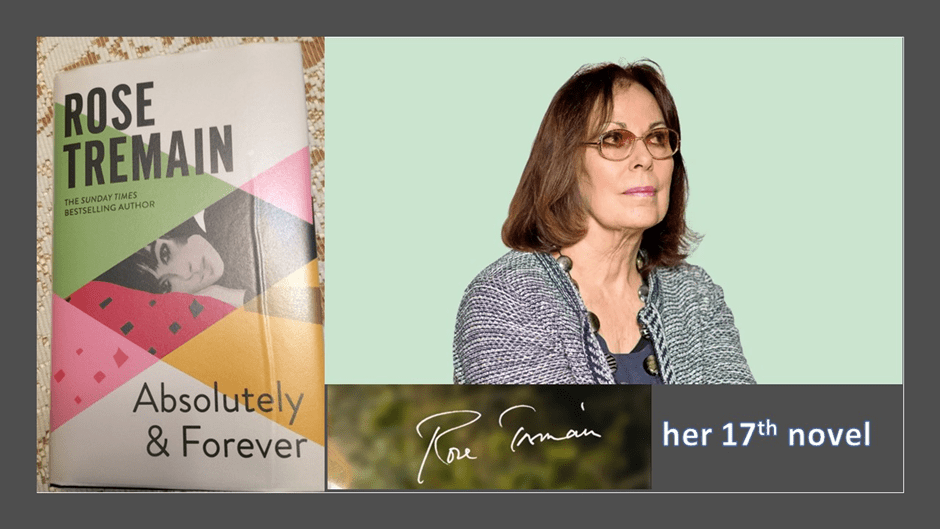
You never quite feel comfortable in the presence of the writerly consciousness of Rose Tremain. I read her novels every time they are published and I have decided over that long period that they do indeed vary in their quality, but in the odd combination of both total immersion in characters at their best in which you truly believe and a kind of ironic distance from their consciousness she does not vary. It is tremendously effective, making her novels, whatever else they are, seem as if they are being scanned by a deeply sceptical critical consciousness that has an almost satirical effect. Hence people think and feel things in these novels that you believe to be totally authentic, whilst someone simultaneously, perhaps even someone who is also intrinsic to the character, holds them to account for being somewhat over-dramatic or in some way false. Very early in her storytelling Marianne tells us that she is possibly named after the sister with ‘sensibility’ in Jane Austen’s Sense and Sensibility, and though as a man she enacts a role in a school dramatisation of Anne Radcliffe’s The Mysteries of Udolpho, tying her inevitably, if ironically, to the fanciful Catherine in Austen’s Northanger Abbey.[2]
The critical distance from Marianne in this novel, which may be in part also introjected so that her potentially deceptive showy sensibility can be seen for what it is into the character, of Marianne is that of her mother, Lavender, for whom talk of romance is so much ‘rot’. The novel starts with that very duality being, as it were inbred, but creating a distance between the critical and rational sense (the inner Sense and Sensibility’s Elinor of this novel) and its ever core of suffering (and slightly silly) romanticism:
When I was fifteen, I told my mother that I was in love with a boy called Simon Hurst and she said to me, ‘Nobody falls in love at your age, Marianne. What they get are “crushes” on people. You’ve just manufactured a little crush on Simon’.[3]
I think the reader gets continually caught between the cold critical gaze upon Marianne and a need to believe in her and her version of romantic love that endures ‘absolutely and forever’, a phrase that occurs more than once in the novel and not just from her (but thereon hangs a spoiler), and is renascent through various accidents throughout the life-course, even up to the point that she insists: “That ‘forever’ thing. Lots of people don’t believe it, but I know that it’s true’.[4] This from a woman who will enjoy a shadow career as secretary and secret advisor to a newspaper ‘agony aunt’ who deals mainly with ‘questions of abandonment and / or male violence’.[5]
Now, I think Tremain is often badly reviewed because she is a woman and because she is thought to write ‘women’s novels’, something like I think what George Eliot called ‘Silly Novels by Lady Novelists’, in the way only a woman committed to the intellect of women, as Eliot was can say and she says it in much the same way as Mary Wollstonecraft does. Thus Lucy Atkins finds here mainly a ‘coming-of-age’ novel, which it is reductive of its effects and affects, but not quite as much as her final sentence, about the novel’s handling of Marianne’s consciousness about the meaning of ‘first love’: ‘None of this is earth-shattering, but at its best the novel is witty, thoughtful and humane, offering delicate and thoughtful pleasures’.[6] Rachel Cooke is less patronising but again sees it as a coming -of-age novel that is ‘charming and wry’ with a ‘fizzy, seductive surface’. Of course under that surface Cooke sees deeper things but not that deep – and I think that too is unfair, though she does her best for Tremain’s sales figures, for deep under that surface (but how deep) we learn:
about love and hope, and the fact that wearing a skin-tight leather thong may induce multiple spontaneous orgasms – and having told you so, I can’t fathom the reason why you wouldn’t rush straight out to buy it.[7]
Rachel Cooke does pick up some less obvious themes in the novel but tells us remarkably little about them, for I think that, in particular the fact that the novel makes becoming an irresolvable problem is why it isn’t a coming-of-age novel. Nevertheless, any account of the novel needs to be aware of them. The list goes as follows: ‘the fog of low-grade depression; the puzzle of how one might escape the preordained circumstances of one’s life; the problem of becoming’.[8] Later I want to talk about becoming in relation to the human dilemmas of the novel as they apply to all of its characters/ Again though I will have to resist exposing dramatic ‘reveals’ at the end of the book that would spoil the pleasure of book for yet-to-be-readers, as it would have done my pleasure and delight. But with this writer what people miss, as they sometimes do with Jane Austen, is the razor-sharp critical intelligence about what it means to be human and profess human emotions. As for the latter point, I think this is why Marianne Clifford becomes a children’s writer working out in her fiction her obsession apparently with the consciousness of animals, and particularly horses, in relation to their consciousness and feeling for human beings, especially ones that incidentally, and perhaps without any such intention, inflict damage upon them. However, I think that this is only the apparent not the real interest, which in truth is with herself and herself alone.
At the heart of that obsession is the comic sentence, even in its context, I use in the title of my blog. Below I give the fuller paragraph, an italicised quotation of a piece of Marianne’s children’s novel about the Argentinian horse Diego. Diego is so named by an unnamed ‘boy’, who raises the horse with care and attention until he abandons him for unstated reasons chained inside a wooden shed (thus replicating her own story as something dumped by a man). Diego escapes but only by tearing out his chain which he must carry around with him as a burden and which chafes and cuts his skin, making a Christ-like hole in his side. Marianne projecting her own abandonment thus and the painful burden to her, and her alone, mimes Diego thinking thus, of the physical damage done to his body by the splintered wood, once his new owners cure his physical wounds but not the clinging on to the mental pain of his prior attachment:
The piece of wood was the last bit of proof that I’d ever belonged to the boy and it hurt me and made a wound in my side, but now I miss it. It seems very stupid to miss a piece of wood and yet I do.[9]
A satire of how to present the fact that we feel that we suffer for love and still to love that suffering could not be more clearly present, though Marianne does not seem here or elsewhere to see either satire or irony in this situation. Diego calls himself ‘stupid’ but then so does Marianne say she has been made ‘totally stupid’ from the first page of the novella.[10] This is another example of Tremain’s unsettling tone regarding the presentation of the concept of total and enduring love, about which the novel forever circles. It is forever asking the same questions: can an animal feel love or abandonment, or someone as distant from you as another school (a boy’s school) or France, or your mother and your father playing alligator and crocodile, or maybe even a Yeti (Marianne’s nickname to Hugo – the man on the rebound whom she will marry) or a lump of hard coal or a disease (Anthracite and Anthrax are Hugo’s nicknames from Marianne). But the tough question is the one about horses (and hence the reason for imagining Diego), which Marianne asks herself ‘first’ (as she herself tells us) when Hugo Forster-Pellisier’s horse, Morning Sun, is being led around by a stable boy: “How much can horses think?”
Her ongoing thoughts about ‘the subject of horse consciousness’ are posed so trivially – thoughts of possible death jostling against the mere excitement of thinking ‘all the trees will be cheering’ at their ‘wild gallop’ – that their end-stopping by the necessities of starting a horse race is a relief from the ‘rot’. [11] But they, of course, are not the subjective consciousness that matters here, for it is Marianne’s alone. From this fist thought Diego is birthed, and his story is, from the start, with its inbuilt need to be only accessible version of the story in his book is Marianne to a T, as she indeed tells us implicitly while pretending to imagine Diego as an ‘other’, a unique voice.
I wanted to tell the story from Diego’s point of view. I thought some of my readers might complain that horses can’t think in actual words, so can’t be narrators of stories, but I imagined telling them that one of the things I didn’t like in some of the novels I read was when everybody who’s speaking sounds exactly the same, so you don’t know who’s feeling what. I would say that in my little book, you would know all the time that you were in Diego’s consciousness because of how he spoke and thought, in a way that was unique to him, s you would never feel confused and think it was a human person speaking; all you would care about would be Diego’s horse destiny.[12]
Diego’s ‘horse destiny’ is so clearly a thin allegory of Marianne’s romantic version of how she wants her ‘destiny’ (fulfilled in thin tragedy) to be that this ought to be comic, but isn’t quite, though the absurdity of her wish to make him become a fine writer, the ‘Charles Dickens of the equine world’ are surely risible.[13] The confusion needs to remain. And horses are invoked at key moments in the novel, especially in relation to Marianne’s romantic destiny, tied to all its possible love objects, other than Simon Hurst.
First there is Petronella Macintyre (it can’t go unnoticed that Marianne does relish making her an emblem of her shorter name, ‘Pet’, and thus yet another animal in th making) who is sublimated very quickly into the ‘horse I loved’ who is ‘a black filly called Mirabelle’, who no-one ‘else was allowed to ride because, as Marianne claims, ‘Mirabelle and I had a kind of affinity and she reciprocated my love’.[14] Pet’s body is sensed as a lover’s is (‘the heaviness of her arm holding me close’) within pages.[15] Even just before marrying Hugo she imagines a kind of elopement of her and the baby she is to have with Pet to Scotland, in which Marianne says, “I wish I was a horse”.[16] Pet now a severe sociologist, who seems (as people did in those heady days) think this was akin to becoming a practicing social worker, even informally, puts a quick stop to Marianne thinking it might work well ‘to go to bed together’ with her, by urging her (as social workers too were once wont to do) to put ‘something significant in your life, … Not me. I’m not the answer’.[17]
And horses too link complexly with Hugo and become a sexual come-on between them, their scent associated with Je Reviens, Mummy’s favourite perfume. Their essence is that of romantic climax: ‘the fret and the beauty of them and the sense of something colossal about to happen’.[18] It shouldn’t be forgotten that Hugo is to become fascinating too because of the size of his ‘todger’ (his name for it) which ‘like the rest of him, was rather large and this largeness I’d always found quite surprising and quite exciting’.[19]
This sexualised characteristic of Marianne is barely a hidden feature and a brief affair with a Julian Templeman is stopped when her capacity as a good rider is questioned, yet we have to play games with how this relates to her firm conviction that she is fundamentally a romantic attached to ideas of love and death. It does however queer her thoughts about becoming a wife and mother like her own Mummy. Pet indeed warns her of ‘becoming like your mother, doing nothing with your time, being kept by a man.’[20] And perhaps the most fearsome illustration of all this is attached to the feral sense of ‘riding’ horses. One of the consciousnesses after all that Marianne resists attachment to is that of her unborn baby and she mourns looking like a ‘pregnant ruin’.[21] Despite her tragic romanticism she knows: ‘Grief can make people revolting and that’s a naked fact’.[22]
When Marianne chooses to go on a holiday devoted to horses with Hugo two months or less before her baby is due it is with the pall of thinking of the prospect of married life with Hugo and the joy that riding has for her even with her pregnant ‘belly squished in towards the horse’s neck’. The thought of the baby’s advent, perhaps even a whole family of ‘two kids, flying a box kite,’ precedes her forgetting her and the baby’s vulnerability at seven months pregnant and precedes the fall that will ensure that not only does she lose this baby but all chance of another, though of course she could not know that. Meanwhile she dreams of Simon Hurst ‘lying naked on top of me, naked from the waist down, with his erect penis coated in my blood,…’.
After which drama the words ‘Poor Hugo’, who awakes her to hear Simon’s name on her lips, seem insufficient and a thing shaded with artifice just as when she feels that there is consolation in a ‘cream silk christening gown’ never being taken out of its box ‘to dress a living child’. [23] Of course, we need to add, as Pet would, why should a woman give her working life (a life that Hugo even fails to respect as work, that of a children’s book author) up for marriage and babies. It is the subterranean statement of all this that reflects badly on Marianne not the wish itself for a life free of male control pursued as a woman’s right for independence. Anyway, at this point her dreamed alternative is still conventional marriage, but with Simon Hurst. And that future is not available to her and, as we might learn, is not likely to be. Perhaps what Rose Tremain does not respect in her narrator, for I think this is indeed the case, is her insistence on her own low expectations for her own womanhood, and the failure to embrace the man in herself she enacts in Udolpho. Her obsession with Simon’s French wife, Solange of whom she invents a ‘composite picture’, tends towards her possible knowledge not only of French existential philosophers but of the fact that in ‘bed, she might have sexual tricks that have never entered my consciousness’.[24]
The context of all this has I think much to do with French existential philosophers of whom both Solange and Simon Hurst’s Indian best school-friend are thought to be well-versed. The novel itself has its epigram from one of them, Simone de Beauvoir, and both she and her lover Jean-Paul Sartre are imagined many times in the novel. In his despair, after failing Oxford entrance, Simon embraces Sartre’s ‘Philosophy of Nothingness’: ‘Le néant’, ‘existential nihilism’, and yearns to drink with him on the Left Bank in the company too of de Beauvoir.[25] But Pet too, you will remember thinks Marianne in danger of ‘doing nothing with your time’.[26] Nothingness is the very opposite of the world of everyone else in the novel, even Pet, and Hugo in particular is shown as obsessively submerged in a world of ‘things’ and ‘thinginess’. Paris to him is a place to find precisely this thinginess: ‘niche objects’ that you can no longer find’ in London.[27] We see him early on and are reminded about that by the narrator amidst the flurry of ‘discovering random things’ in Cornwall that will lead to a career in antiques to ‘see him through his life and keep him from despair’, unlike Simon or Marianne’s supposed ideal.[28]
It is this tendency to nothingness that prevents either Simon or Marianne truly becoming the writer the writer they both want to be, though Marianne makes her start with Diego, even though he is but a shadow of herself. And ‘becoming’ is as Jennifer Anna Gosetti-Ferencei says in the Abstract to her chapter on existentialist and phenomenological thinkers the basis of that philosophy’s conception of the self. She says in summary that, despite any divergences: ‘… existentialist thinkers tend to agree on a few core ideas concerning the self, including its nature as activity, as relational, as a process of becoming, and as the basis for choice or commitment’.[29] No doubt any remnant of this view of self that can be found in this novel relates ultimately to how to judge Marianne as an intellectual agent of a kind of progressive selfhood but it need not be a rigorously held view, and, as far as I can see applies only to the progress that Marianne’s selfhood makes in becoming a writer, a thing that Simon Hurst wants to but to which he never finds enough commitment. It is, of course also applied to the mere act of continuing to live, not lying down to die or commit suicide. This is the motivation of Simon in attempting to meet with Satre and de Beauvoir in Paris (and actually ending up in a conventional marriage with no prospects). This is not exactly so for Marianne. Indeed when Simon fails Oxford entrance exams she compare herself to him. It is not that this is a coming-of-age novel, it is an act of decisive and chosen becoming-of-age, a determination to become something and not nothing, that was probably she thinks the case for Aeschylus too. Dying by suicide with Simon has, she thinks as a schoolgirl still, has advantages. The first she thinks of ‘is never having to understand the plays of Aeschylus’ but that is a merely conventional thought for a very young student with access to privileged education and culture but not so:
‘never trying to figure out how Aeschylus came to become what he became, nor how I and Simon would become whatever we were still hoping to become when all the sorrow had faded. Becoming was just too hard.[30]
No doubt this is how schoolchildren constructed the existential challenge and its angst in those days (my days after all), one does not make a commitment to be (or ‘not to be’ either) but to ‘become’. Pet systematises all this as the meaning of sociology for her as a ‘study of how things are and how they were and how they might ideally become in human society’, but note this is not a vehicle for angst-ridden commitments but scheduled and systematic life-strategies and it is not about nihilism ( Sartre’s ‘Philosophy of Nothingness’: ‘Le néant’ as we mentioned before) but, as Marianne says (for Pet to agree) ‘a study of Everything’. It too, as Pet’s statement above also says ;a study of things’: it is very thingy and in no way merely the challenge of nothingness that makes us commit to become a thing with other things and to continue choosing ‘to putting [things] right’.[31] It is another way of becoming less faced by despair, and I would say it represents Marianne’s choice of life model in the event rather than Simon’s, about which no one can know how it will end, with its ‘That’s All Folks’ sign.[32]
The telling dynamic of the novel’s ideas is, as I have said, the choice to become a writer (as presumably Aeschylus did too).Hugo belittles this in Marianne (it is the sign of his refusal after much hope on our part) to grow, taunting her with his view that her ‘thing about the Argentinian horse’ was perhaps not possible to call ‘“work” exactly’ but perhaps ‘fantasy’, not a ‘thing’ at all.[33] This though Marianne does not challenge in him but merely moves herself on. After all, she has been thinking about this problem of becoming a writer since schooldays, around the only writer figures she knew then, Shakespeare and Charles Dickens, when Simon first tells her that ‘what I’d like to do with my life: become a writer’. Marianne feels challenged by this bald statement because:
I couldn’t imagine how writers underwent becoming. The writers we mainly studied at school were Shakespeare and Dickens and it never occurred to me that there had been a time in their lives when they had to become what they eventually were. …
…. …,I was able to imagine Simon crouched over a typewriter in some isolated room crammed with books and sheets of paper. … What I couldn’t figure out was what he was actually going to write about or how his words even got onto a page that had started out completely empty and blank’.[34]
For, as Marianne will get to know you have to have some THING to write about. Pet is dismissive of Simon ‘attempting to become a writer’: “Attempting? Writers either are writers, or they’re not. So what’s the para gon trying to write about?’[35] But Marianne silently takes this in and thinks better for herself. For she knows that as well something to write about, they also need some THING to write with, things not provided by a Philosophy of NOTHINGNESS. They are provided by the contingencies not part of that philosophy like a job that offers you a typewriter ion which to type and the competency taught in a secretarial school. When Simon first informs of his philosophical attachment to nothingness, she hears in the next room, the school secretary, ‘Veitch in her office bashing away on the huge old typewriter’. Men however, even ones like Hugo with his definite attachment to old things, doesn’t recognise the one, a heavy old Adler, that Marianne takes from her work at the newspaper, as a thing at all: ‘What’s that’.[36]

A tale of an abandoned horse, named Diego by a boy to whom Diego hopes he belongs, tied by a chain to splintered wood needs an Adler to realise it as a story. But it’s a start to becoming a writer.
Later, challenged by Pet’s words about Simon, Marianne does ‘something which surprised me’ (my italics). She takes out the Adler and decides to write about an abandoned horse, Diego (‘the only Argentinian name I knew’).[37] And that, after all is what becoming is – doing something unexpected and persevering, however abnormal think the thing you are doing is. In one etymology, the name Diego is thought to derive from the Greek for learning. And though Marianne often fails to understand to understand the consciousness of others without merely casting herself and her situation into those others. But sometimes that might be because the aim for people set by their social groups is merely to pretend to self-satisfaction for they dare not reflect themselves to critique that might engender change. She reflects on this when she discovers in her secretarial school and in the Picasso café bar on the Kings Road, a new ‘species of creature’, about whom she:
… kept wondering what their trick had been, to become the people that they were now, with such a love of themselves and of the present moment. I knew that I envied them. It looked to me as though they never had their hearts broken, never yearned for things that were lost.[38]
I am I have to say a Tremain fan and perhaps that is because I know how I became so, with the bravery of the first novel of hers that I read Sacred Country, a gender queer book that is quite extraordinary and was written in 1992. Her view of the self was prescient in a way feminism was once allowed to be without paying primary reference to a version of biology that is itself a stereotype. I enjoyed this new book, partly though for reasons I have held myself back from saying. LOL.
With love
Steve
[1] Rose Tremain (2023: 180) Absolutely and Forever London, Chatto & Windus
[2] Ibid: 22, 25 respectively
[3] ibid: 3
[4] Ibid: 174. If you care about spoilers the reference to miss is that on ibid: 172. But you are safe with those about Marianne on ibid: 18, 70, 174, if you are only looking for the evidence for my point.
[5] Rose Tremain op.cit: 101
[6] Lucy Atkins ‘Absolutely & Forever by Rose Tremain review – a lost first love’ In The Guardian (Wed 20 Sep 2023 09.00 BST) Available at: https://www.theguardian.com/books/2023/sep/20/absolutely-forever-by-rose-tremain-review-a-lost-first-love
[7] Rachel Cooke (2023) ‘Absolutely & Forever by Rose Tremain review – high style and bittersweet yearning’ in The Guardian (Mon 11 Sep 2023 07.00 BST) available at: https://www.theguardian.com/books/2023/sep/11/absolutely-forever-by-rose-tremain-review-high-style-and-bittersweet-yearning
[8] Ibid.
[9] Rose Tremain op.cit: 180
[10] Ibid: 3
[11] Ibid: 82f.
[12] Ibid: 125
[13] Ibid: 127
[14] Ibid: 47f.
[15] Ibid 51
[16] Ibid: 91f.
[17] Ibid: 123f. For the hilarious bit on what ‘sociologists do’ see ibid: 91
[18] Ibid: 81
[19] Ibid: 94
[20] Ibid: 122
[21] Ibid: 104
[22] Ibid: 61
[23] Ibid: 112 – 117
[24] Ibid: 106
[25] Ibid: 30
[26] Ibid: 122
[27] Ibid: 126
[28] Ibid: 79
[29] Jennifer Anna Gosetti-Ferencei (2020) On Being and Becoming: An Existentialist Approach to Life On Being and Becoming: An Existentialist Approach to Life Oxford, Oxford University Press. This from Abstract to Chapter 6 available at: https://academic.oup.com/book/33452/chapter-abstract/287722413?redirectedFrom=fulltext
[30] Rose Tremain op. cit: 27
[31] Ibid: 90f.
[32] Ibid: 113
[33] Ibid: 179
[34] Ibid: 18f.
[35] Ibid: 122
[36] Ibid: 109
[37] Ibid: 124
[38] Ibid: 57
 Steve_Bamlett_blog