Which topics would you like to be more informed about?

The TV Series of Ragnarök (Netflix)
On Norwegian TV it made sense to call a series Ragnarök that was based on a community on the fjords that learn the hard and irreversible way the effects of climate change, and environmental / ecological degradation on them directly. To wish to know more about that path to the edge of the END of the Wold is surely our most pressing issue. But the point I think we need to get close to first is the meaning of being ‘informed’. We tend to think of it as the name for the passage of data to us – often news about an event or happening – that we store away in ‘information files’ (either ones in filing cabinets or as memories) for use (or not)! But I love the word for other reasons – in the sense I like to use it, we are truly only in-formed, when we are formed from within – often deep inside – by what we hear, see and our imagined conception of it. I think of the word, possibly as a result of being taught by A.S. Byatt (who always used the word in this deeper sense), as using the deep roots of the Proto-Indo-European term ‘en’. ‘En/In’ is a word whose associative senses I have recently had awakened by thinking about the work of a great poet of ‘green’ thinking Zaffar Kunial (for my blog on Kunial’s England’s Green and its basis in this etymology see this link).
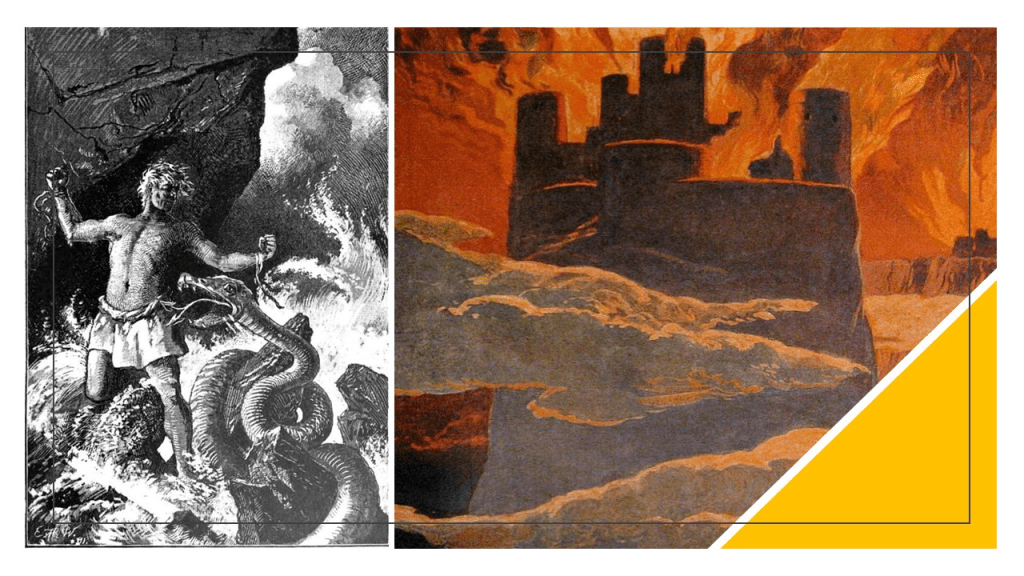
Loki awakes freed and the devastation at the world’s end begins (by Ernst Hermann Walther (1851/1858-1945). – Möbius, Hermine (1897). Deutsche Götter- und Heldensagen. A. Köhler, Leipzig. Between pp. 130 and 131. Digitized version from Google Books., Public Domain, https://en.wikipedia.org/w/index.php?curid=20082669). In the end the whole world and its corrupted ideals (Valhalla) burn (by Emil Doepler – Doepler, Emil. ca. 1905. Walhall, die Götterwelt der Germanen. Martin Oldenbourg, Berlin. Page 57. Photographed and cropped by User:Haukurth., Public Domain, https://commons.wikimedia.org/w/index.php?curid=5208618
But we fail ourselves if we merely use information about climate change, global ecological metamorphoses or the extinction of species in the face of the degradation of their habitats as data with which to write an essay or file a report. We even miss in that case some of the associated or collateral damage. Simon Schama, for instance (see note 1 below), insists, that is not just species extinction we should fear but also the arrival of new – or, as is more likely revivified, viral life-forms of which Coronavirus may or may not be one. If we are to write, let’s write a piece as aware of the threat as a book like Simon Schama’s Foreign Bodies, writing as an historian and A.S. Byatt’s novella Ragnarok, based on the imagination of the doomed ecosystem we inhabit. She mythologises the fate of that ecosystem (in order to more deeply inform us) in the story of Yggdrasil, the Life-Tree (see The Guardian’s review at last link).
These books show us that ideas, linked to complex affects or emotions, need to form us, and start from within – inside our brain yes – but in full communion with that organs visceral interconnections. Truly we need to feel it in our gut – for that motivates and for what else are all those neurons clustered around stomachs.
Hence I don’t intend to repeat the issues from ‘the science’, which (and rightly) that hero, Greta Thunberg, advises Governments to consult. Rishi Sunak has recently shown us that politicians, with their eye on other agendas related to the power dynamics of complex not-quite (and never will be with our current electoral system) democracies, that the ‘facts’ can be turned to any argument, in the face of knowledge held by the educated, that somehow one of the richest and most entitled men of the world, Rupert Murdoch, calls élites. Meanwhile opposition Party leaders can blame the near-win of Uxbridge from the Tories on a green policy (ULEZ) and the rare green commitment of a principled politician in their ranks, the current Mayor of London. What I sincerely want is for me, and the consciousness of groups, to be truly in-formed by issues of ecological ‘apocalypse’ and the imagination of their significance in global terms – including their significance to the poorest parts of the globe, who will be eco-destruction’s first casualties and victims. And this perhaps needs us to respect myths as much as facts. At the end of Ragnarok: The End of the Gods, Byatt says, brilliantly and with as much passion as at her very finest:
Myths are often unsatisfactory, even tormenting. They puzzle and haunt the mind that encounters them, They shape different parts of the world inside our heads, and they shape them not as pleasures, but as encounters with the inapprehensible.
A.S. Byatt (2011: 161) ‘Ragnarok: The End of the Gods’ Edinburgh, London.
It is at this level – an encounter with the otherwise inapprehensible – that we need to be more informed about the certainties of global ecological disaster implied in what we know already, even now in direct experience and observation as well as scientific prediction, if the human race is not to end in brutal top-down governance of resources for the benefit of the Few not the Many. In the little space those dinosaurs I call the Few survive, in their ignorance and selfishness, they too will find it all ends for those self-assumed ‘Gods’ they think they are as well.
Love
Steve
- For Simon Schama’s assertions and evidence on the link to viral revival in the face of ecological change, see Simon Schama (2023:1-19) Foreign Bodies: Pandemics, Vaccines and the Health of Nations London, Simon & Schuster.
 Steve_Bamlett_blog
2 thoughts on “Is Ragnarök on its way? It is but if we ‘knew’ that and were fully informed by that knowledge, we would be urging Governments to act – and now!”