What would your life be like without music?
The sound of the concord or discord of the world are only unheard in the cold of a tomb. There is no life where music does not happen, for the nervous system is attuned to the to a range of sounds that align with feelings of security such as the harmonious gurgling of a contented baby unthreatened by abuse, and soothed by the care to themselves that is manifest in their environment. But there are alternatives to such harmonies, like the jagged edges of a domestic row, at worst domestic violence. The dangerous dissonant rhythms of anger and violence threatens the baby and points it toward a contribution to this disharmony in its own overwhelmed reactivity. Their non-articulated and sometimes unclassifiable sounds are distinct. They are the sounds of overwhelmed discomfort, that disappear attachment psychology tells us only when the feeling of either secure attachment or enduring inexplicable separation anxiety has been thoroughly internalised as cognitions compact of petrified and difficult to regulate or change cognition and affect combined. None of this is not music ( I want that double negative – it is the discord inside concord of rhythm and repetition): all of it is music but such a dissonant stormy congregation of sound over a passage of time that yields no sense of safety.
And to expect security from music is often the distinction between the person who classifies themselves as a music lover, as being dependent on music from the ones who respect it most as something that surprises them unsought, with joy or fear. Yet, people turn to the quotation I use in my title, from the opening of Act V, Scene 1 of Shakespeare’s The Merchant of Venice often to validate a notion that music is the signal of human trustworthiness. But hear the context from the whole speech ending:
The man that hath no music in himself,
Nor is not moved with concord of sweet sounds,
Is fit for treasons, stratagems and spoils;
The motions of his spirit are dull as night
And his affections dark as Erebus:
Let no such man be trusted. Mark the music.
The speech is by Lorenzo who has been left in charge of a grand aristocratic house with his affianced partner, Jessica, a girl ripped from her father and the Jewish community and ripe for Christian conversion. In a wonderful production I saw (blog available at this link) by the Watford Palace Theatre (which I saw on tour in Manchester), Lorenzo was played as a Nazi SS official attached to an oppressive and racist state that favoured the rich and entitled. The meanings that emerged were therefore honed to the use of a rhetoric of music to praise the maintenance of the order of the status quo.
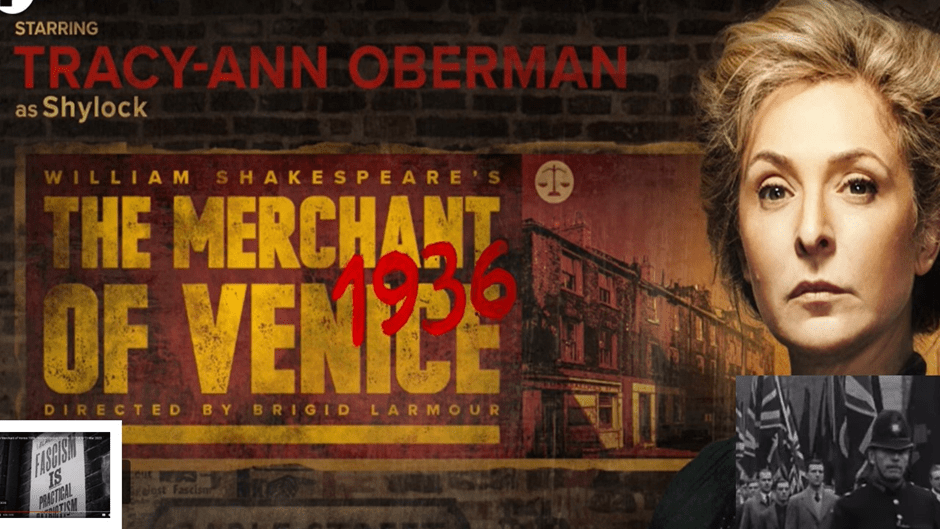
The stand against order by ‘treasons, stratagems, and spoils’ is a self-interested one in the mind of such an entitled man in which art joins religion and the state in the alienation of political threat, even justified political resistance. Hence this production ended with a female Shylock defending her community in a representation of the Cable Street Rising, that brought disempowered Jews and others from the political margins, including the working clas of the East End against Fascism. And if you look further back in Lorenzo’s speech, see how music is dragooned into the service of an hierarchical established order, in which even the smallest must accept their role as a part of a secure political whole represented as unheard music.
There’s not the smallest orb which thou behold’st
But in his motion like an angel sings,
Still quiring to the young-eyed cherubins;
Such harmony is in immortal souls;
But whilst this muddy vesture of decay
Doth grossly close it in, we cannot hear it.
So, let’s not invoke Lorenzo without differentiating him from the great artist of discord, Shakespeare, who organised order in his plays in ways that show how cruel the suppressions it involves: even that of Falstaff by Prince Hal, one he becomes intent to rule with rigour against all disorder as Henry V.
In the twentieth century, music is no longer married to concord, especially the suspicious concord that accepts injustice as inevitable, whether that be in classical genres or in more popular forms, where discord finds beauty as in a Jimi Hendrix riff. But it still tends to be joined to a search for security from any threat, including the inevitable ones that change in the name of justice to the marginalised that brings. Hence, we walk down streets where young people are locked between invisible headphones playing a music you are not MEANT to hear, one that keeps them isolated from the intrusion of any otherness unknown to them.
Perhaps the ‘concord of sweet sounds’ is no longer the definition of trustworthiness. Instead, it is the fact that some persons are not to be trusted because they can’t help but hear music in the environment of persons, animals and the globe but that it is one that compels action. Action may be just standing back, paradoxically from the absorbing sound of the status quo, and urging to collective responsibility for non-exclusive songs and symphonies. Such people don’t make you feel safe. How could they? Political change, that is real change, costs. Otherwise, it is fallacious as is the present Sunak Tory Government stance on safeguarding a sustainable environment is fallacious and focused on actually sustaining its opposite; a society rooted in greed and the cash nexus.
I do not see myself as such a hero. I wish, as I say to myself often. But I know that music is not something I seek out so much as finding it always there, but not always comfortable or soothing. Attuned to such music see what a politically orientated art brings out of even classical pieces, such as the music in Tchaikovsky’s Swan Lake, as interpreted by Matthew Bourne (see below for link to blog) finding in it a far from sweet personal political statement. Sometimes music grabs and soothes me, such moments are necessary but they are only a movement in a larger symphony whose Ode to Joy is yet to come.
However, that will only be, as even Beethoven can be believed to hope, in a fairer world. And Wagner. Well. His music is yet to be understood outside of its capture by Heidegger and Hitler. Nietzsche was a start in understanding but it became end-stopped in his distinction in it between the cruel Apollonian harmony and the hopeful discord brought about by the Dionysian music of resistance to orders that oppress the many and the marginalised. Valhalla may still yet have to burn in this Wagner.
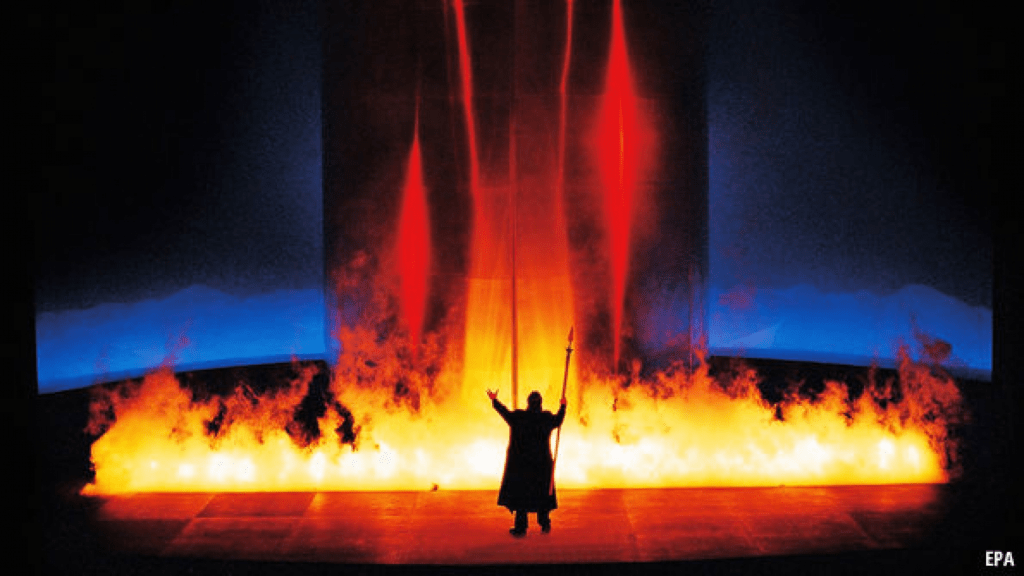
Have fun with your world of sounds though. We all deserve that.
With love
Steven
Matthew Bourne Swan Lake blog at: https://livesteven.com/2023/09/14/in-2018-lewis-segal-wrote-in-the-los-angeles-times-of-matthew-bournes-swan-lake-and-praised-the-members-of-the-swan-corps-feathered-bare-chested-virtuosos-whose-sense-of-menace/.
 Steve_Bamlett_blog