Name the professional athletes you respect the most and why.
At last, I thought, the daily prompt question setters at Word Press have set a question I cannot turn to my own purposes neither politically nor personally. Maybe however, I am underplaying the extremely weird connectivity of the synapses controlling links in my memory and association. As I gave in to non-response, I read on in the book I am relaxing with at night. Made this year into a documentary film in the USA but not, I think, available here yet, the book is by Mark Griffin’s, written in 2018, and called: All That Heaven Allows: A Biography of Rock Hudson. Now I am no great fan of Rock but, of course, he represents a major fact in LGBTQI+ history and the history of the AIDS as a disease that was throughout its history over-represented as a ‘young gay male’s’ disease. Rock Hudson’s story began to turn the story of that major world health epidemic that, once used entirely as a means of denigrating our rich interlaced communities and denying the intersection of those communities with women, black and brown people and elders, to name only a few marginalised groups denied attention in this respect (and, more importantly, denied health care). I do intend to blog again on that book together with a review of Giant (also starring James Dean of course, of whom Rock was intensely jealous – perhaps for many reasons), a film important in his, and our community’s, history and which was not completed when Dean was killed in a car crash.
As I read though I came across a story I had not before encountered, partly because my knowledge of the era was too sketchy, outside of Tennessee Williams and some of the great USA queer male novelists and painters. Told in a chapter called ‘Strange Bedfellows’, it tells of the scandal that almost destroyed a number of careers, including Hudson’s and centred on an athlete, a former wrestler as a young man whose fame increased as a wrestling promoter and as a sponsor for Jimmy Carter. His name was James or Jim Barnett (born June 9, 1924 and died in September 18, 2004).
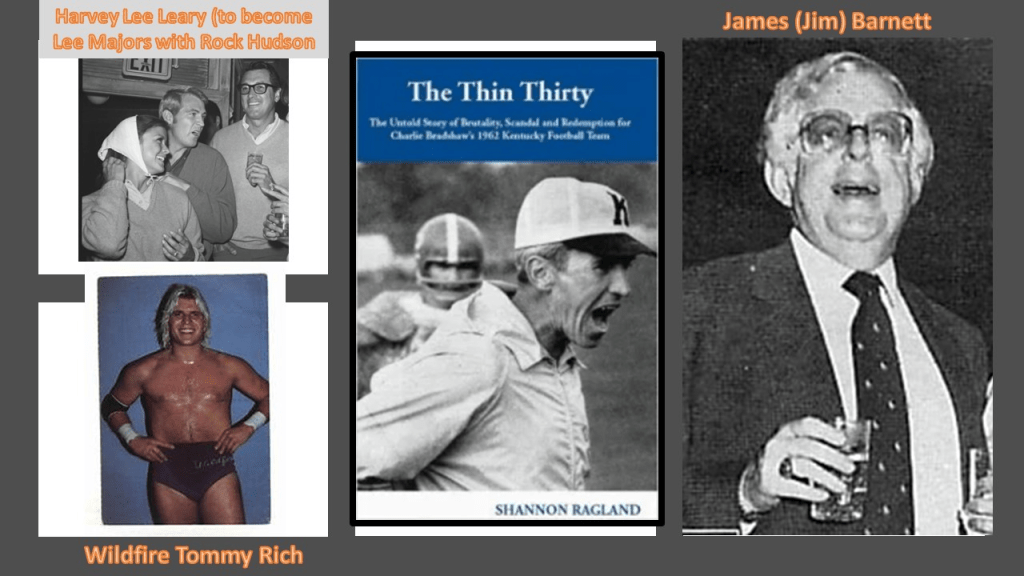
A collage can tell many stories and none of which make me feel that Barnett was particularly worthy of great public respect. The rather oily Wildfire Tommy Rich (as pictured), it was rumoured, won international fame not entirely for his wrestling prowess but perhaps for a ‘brief fling’ with Barnett (see his wrestling prowess but perhaps for a ‘brief fling’ with Barnett – see https://ringthedamnbell.wordpress.com/2016/12/07/jim-barnett-once-the-most-powerful-man-in-pro-wrestling/). It was the contention of Shannon Ragland, in the book The Thin Thirty also shown in the collage (with thanks again to the blog cited immediately above), that Barnett promoted men and recruited others, such as the Kentucky Wildcats Football Team involved in this scandal who could be persuaded to sleep with him or the famous people he invited to parties, organised between him and his long-term partner, Lonnie Winter, that may have also involved a gay couple who ran a gay club (Kentucky State’s first) called The Gilded Cage in Lexington. Mark Griffin tells us, as others do of his generally highly educated approach to his business, of Barnett’s general culture. Griffin says Barnett was ‘a rare individual who could discuss headlocks and choke holds as knowledgeably as he could expound on Picasso and Mozart’.[1]
What Mark Griffin makes clear is just how much of the story as told in various versions then and now depended on rumour rather than established fact, and though this has to be expected in relation to oppressed minority events of whatever kind, even romantic coupling, it also shows that gay athletes are caught in the terrible vice-like grip (but I don’t mean moral vice) of being the objects of criminal and civil policy and public ethics. That is because the male athlete represents the most developed examples of masculine physique, whose purpose ideologically in many cultures was to be an icon of fatherhood, authority and virility (though a highly covert version of that whose desirability to other men is coded in with its secreted nature). On the other hand the male ‘homosexual’ is typed as a moral, and perhaps even physically embodied, degeneracy that threatens the male deal and its function in reproducing a patriarchal society. The stories about Jim Barnett and Lonnie focused on their selection of vulnerable (because impoverished and powerless) working class boys: “boys of meager means or ones that seemed … conflicted’, as Ragland says.[1] This is not unlike the stereotype at the same period in British history which posed a queer quisling middle class posing a threat to an essentially sexually, and otherwise, ‘conservative’ working and under class. See my blog at this link.
And gay athletes remain the target of such rumour, sometimes fired by the disadvantage of powerless males but sometimes an expression of powerful male heteronormativity directed at queer people, whose former power is seen as an expression of the social danger they represent as bad role models for young men at least, or, as rumoured predators of younger male flesh. I could name contemporary examples but I won’t, for to name living people thus would give credence to the mechanisms by which heteronormativity becomes the situation of hegemony in psycho-sexual matters.
I am not saying that there is no truth in the fact that there is an element of corruption in the story of Jim Barnett, but I do query its meaning, for the entrainment of the young by doubtful means of recruitment is not confined to the ways in which young queer men become older and wiser queer men, nor is the relationship necessarily one of ‘corruption’. For older queer men all have been younger and have experienced the fact that their exclusion is more often a barrier to progress, or an incentive to ‘pass’ where possible as ‘other’ than they ‘know’ themselves. When Rock Hudson met Harvey Lee Yeary, a footballer from Eastern Kentucky described as ‘(h)andsome, blond Lee, six feet tall and a football star’, as one fan magazine described him, and helped smooth his path to the acting career of the Lee Majors he became, there was as much a corrective here to the path to riches of queer young men as a story of sexual favours.[3]
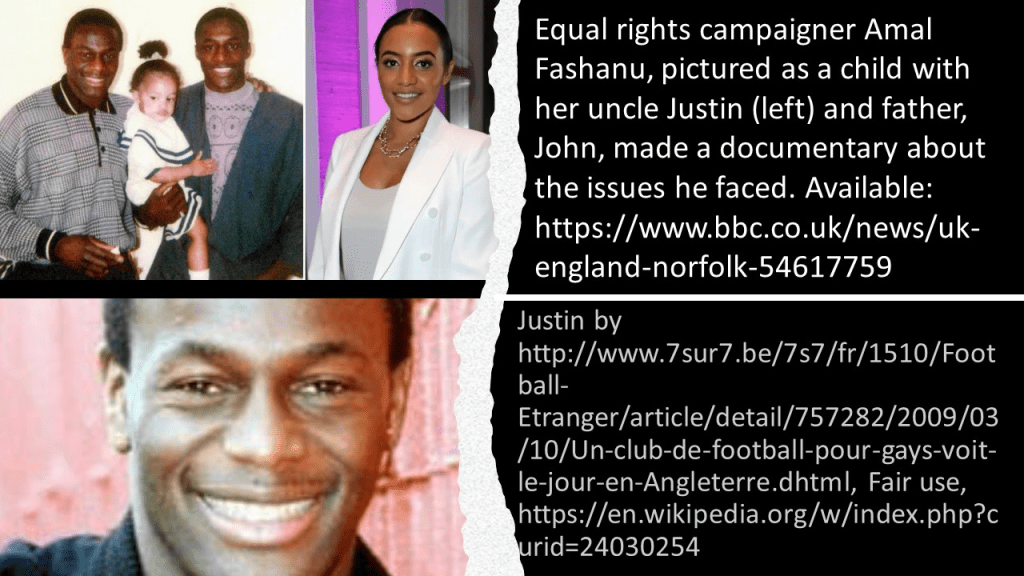
Into this specific issue I am not qualified to make a judgement and I would never be an apologist for the fact that entitled wealthy white queer men can be predatory oppressors of those with less social power and capital, for whatever reason of social marginalisation. It may be Jim Barnett was one such but I am certain this is not the case with the contemporary living queer athletes I have in mind but will not name as requested, because each has had to fight slurs of the worst kind used against them. Some like Justin Fashanu are dead too , having paid the price of being open and receiving instead the imposition of fictions of assault (at the age of 37 he had sex he described as consensual with a 17 year old man – a person with clear capacity of refusal – who accused him of taking non-consensual advantage). The evidence seems to be with Justin these days as his brother John has insisted. Yet do we escape slurs when, however up and coming we may be, we fall foul of the symbolic order.
Discussion welcome!
[1] Mark Griffin (2018: 230) All That Heaven Allows: A Biography of Rock Hudson New York, London, Toronto & Sydney, HarperCollins.
[2] Ibid: 231
[3] Ibid: 245
 Steve_Bamlett_blog
3 thoughts on “Why you still don’t ‘out’ the athletes who identify as LGBTQI+ but still have to ‘respect them most’. To emphasise that I name no living athlete, even those who have dared openly living as gay or queer.”