If you had to give up one word that you use regularly, what would it be?
One may not be such an authority on how even just you use even one word of which you think you are master. Hear out this debate, one that ought to matter a lot in the discussion of languages and their uses.
“When I use a word,’ Humpty Dumpty said in rather a scornful tone, ‘it means just what I choose it to mean — neither more nor less.’
’The question is,’ said Alice, ‘whether you can make words mean so many different things.’
’The question is,’ said Humpty Dumpty, ‘which is to be master — that’s all.
Lewis Carroll, Through the Looking Glass
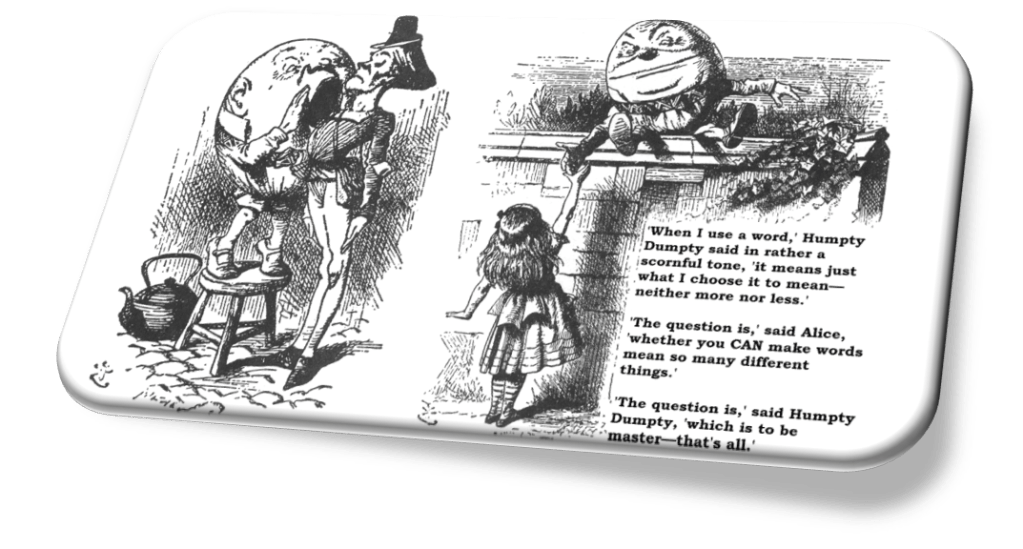
Carroll prided himself on mastery of symbolic logic, and his pride in his powers may well be one reason for picking on Humpty Dumpty’s refusal to bow to accepted, conventional and unitary meaning in words. Clearly, you could not ask him to eradicate one word he used regularly, for that would make the word ‘master’ rather than himself as the originator, maintainer and guardian of the meaning he uses to impress others with his precision.
On the other hand if a word can mean anything you want it to mean out of a range of many, reliance on ‘one word’ is an impossibility for surely another word will easily fulfill its former. After all, perhaps we only miss a word if it is just a ‘word’. What matters is the ‘matter’, the contention we want to establish, our meaning. Shakespeare was obsessed with the question, ‘What’s the matter?’. If you don’t believe me, read and watch Othello again. He reprised the theme in terms of a contrast between words and two meanings of matter: meaning either substance, content or ‘meaning’, like Humpty Dumpty, or the basis of a discussion or argument, in Hamlet.
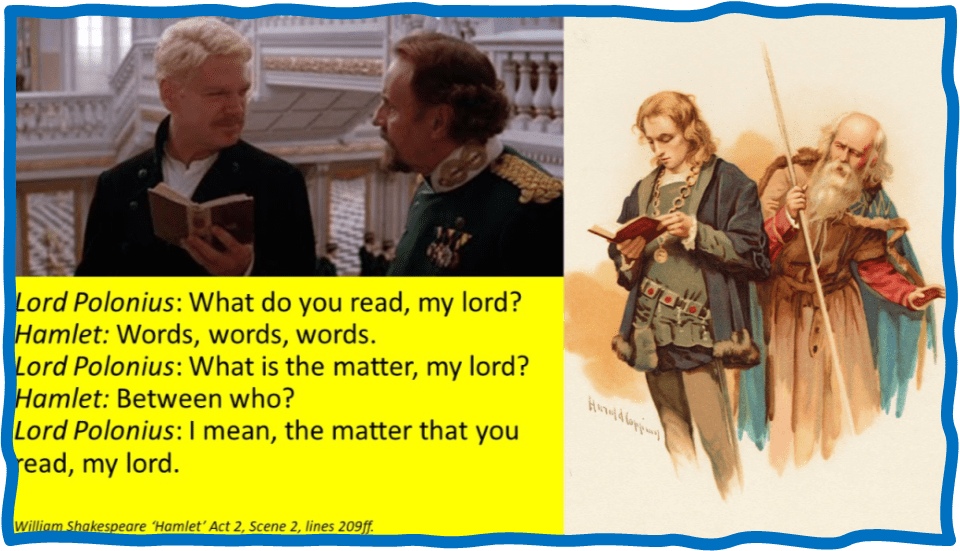
Lord Polonius: What do you read, my lord?
Hamlet: Words, words, words.
Lord Polonius: What is the matter, my lord?
Hamlet: Between who?
Lord Polonius: I mean, the matter that you read, my lord.William Shakespeare ‘Hamlet’ Act 2, Scene 2, lines 209ff.
It is a very cunning scene, this one. It appears to mean two things by ‘matter’ when it distinguishes it from ‘words’ in the book he reads. In one sense it refers to the meaning or content of the words, in another to the contention or argument of a piece – as it most often does in Othello, where a ‘matter’ is often a dispute to be settled. But it also suggests that ‘words’ are secondary to the ‘matter’ in either of those senses of ‘matter’, words do not matter as much as we might think, for meaning is all that matters. And, if this is so, does it matter if we lose one word that we use regularly for it can be substituted for by another. Moreover, it might also mean that why lose the word at all since its meaning is not fixed but varies by context and intention.
But perhaps meaning is not the whole of the matter for language serves lots of purposes. If we had to lose a word perhaps it should be one that rarely has a straightforward meaning and that perhaps does not function as ‘meaning’ in our talk. When I first thought of a word to eradicate it was the word ‘honest’ in the phrase ‘to be honest’, for it is massively overused and really strikes to the heart of someone who believes in openness in most affairs of the world as much as I do. But the phrase is used mainly as what Roman Jakobson called the phatic function of language (the other functions he identified were the ‘referential, emotive, poetic, conative, and metalingual’. Here is the Oxford Reference Dictionary (online) on that matter:
The phatic function is the part of communication which keeps open the line of communication itself; it is the means by which two or more speakers reassure themselves that not only are they being listened to, but they are also being understood. It is in this sense a part of communication that is separate from the exchange of meaning; it is, as it were, without content of its own. Examples include such common phrases as ‘are you with me?’, ‘do you know what I mean?’ and so on.
Now when we say ‘to be honest’ we are precisely trying to re-establish communication on a level that allows us to be challenged – in that sense it is a phrase with a metalingual function too (the boundaries between these functions is not as clear as people sometimes expect). We may use it to excuse material or language that we believe to be too conflictual, shameful or controversial, over-direct or gritty in its expression. To be honest (see how I use it here for instance), we don’t at all expect it to be taken as an authoritative statement which the word ‘honest’ might otherwise betoken. We are certainly not saying that that we have lied to you heretofore and am suddenly talking about things I consider true. In fact, we are opening ourselves to be challenged – asking that people contradict us but with the same personable manner by which we might establish truth cooperatively. We use it precisely to achieve what Humpty Dumpty and Alice (or Polonius or Hamlet) cannot achieve which is mutual understanding based on building shared codes. For all these conversationalists are obsessed by establishing themselves as authorities – not only over language (the ostensible matter of contention) but also each other.
’The question is,’ said Alice, ‘whether you can make words mean so many different things.’
’The question is,’ said Humpty Dumpty, ‘which is to be master — that’s all’.
But is it ‘all’. The purpose of speech in this conversation is to establish who is right INDIVIDUALLY between the conversationalist NOT to establish meaning CO-OPERATIVELY. People often critiqued Jürgen Habermas for his notion of the ideal speech situation, although given its name the criticism of it as too idealistic hardly washes. Later Habermas changed the terms of the debate (dropping the ‘ideal’ for instance as a word he used too regularly no doubt) and spoke of speech as enacting ‘performative contradiction’, if it is to establish some kind of consensual function in meaning-making. For me ‘to be honest’ attempts to perform that function, although, as with all phrases, it is used lazily too as a ‘filler’, a set of time-consuming words allowing a speaker to plan their next statement. But isn’t this too a means of building conversation that matters. To be honest, if I use that phrase I wish my speech partner to query my statement. Treat it kindly yes, and with respect that I am trying to say at least something pertinent (as Alice and Humpty, Polonius and Hamlet don’t) and to come back with something else that may equally struggle to be authoritative but does establish that we are in shared ball-park of meaning-making.
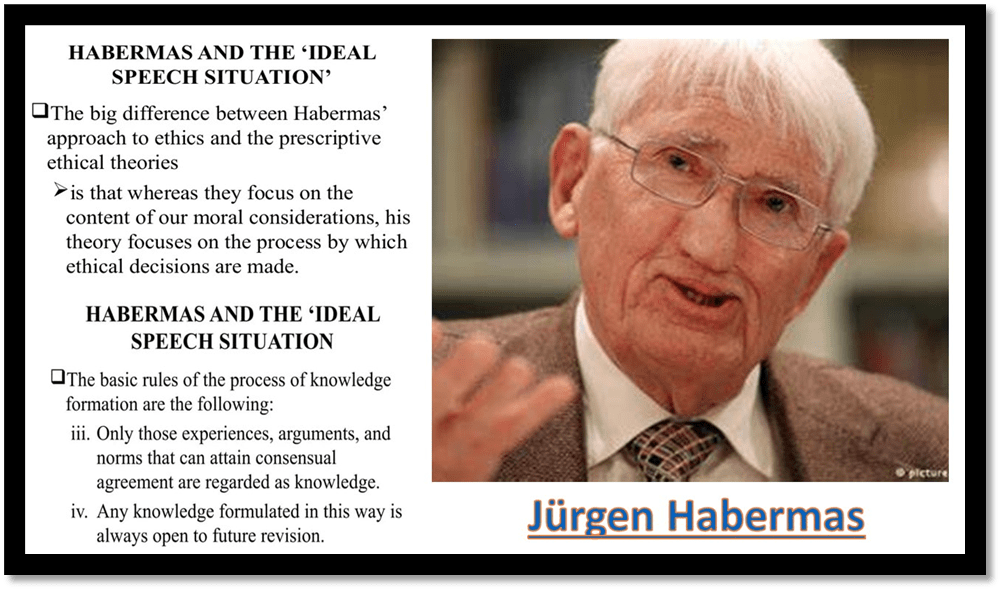
Of course, the problem with all ‘free-speech’ theories is that they may appear, and often do, ignore the structural inequalities built into speech situations – including the unequal power assumed by structurally dominant classes and groups over the marginalised, but it is difficult to sustain democracy without some basis of shared arena of speech. And that may mean that we do not limit the words that can be used except when they are used to classify a person against which no appeal can be registered, such as the use of stereotyping nouns. Certainly phatic words and words where mastery over and unity of meaning are inconsequential or less important than the aim of shared meaning-making cannot be banned. Honest and ‘to be honest’ stay, then.
If I had to abandon one word used by people younger than myself it might be ‘boss’ or ‘master’ in my old-fashioned case, for I do not want to establish relationships of dominance in conversation, for to do so is an endgame, even if you are the ‘boss’ yourself. Look at Humpty Dumpty shouting in the young man’s ear from the vantage point of a standing on a stool. It is a very uncomfortable role that of the always-and-forever expert. I do not want a master-slave dialogue but an emancipatory dialogue where a third-term will break conflict and move forward in a progressive direction. The trouble with right-wing free speech models is that the eradicate the ‘expert’ and ‘mentor’ relationship only to substitute for first-the-post meanings to be established, throwing the learning out with temporary inequalities of values, knowledge and skills that moves things on: truly the baby out with the bathwater. Let’s not be tied to ‘words, words, words’ but to always want things to matter and let words suggest ways forward, but they can only do so cooperatively in phrases, sentences, paragraphs, texts and with shifts of speakers and listeners. When we embody words we do so not as individual HUMPTY but a social group, although we may find that ‘we never put Humpty together again’, for he was split and cracked asunder by his determination to substitute a seat of authority for the will be one among the many horses and the persons with communal interests.
Love Steve
 Steve_Bamlett_blog