An update based on actually seeing the exhibition of Yayoi Kusama at Factory International Manchester on Tuesday 4th July at 11.15 a.m., as part of a selection of the items from the Manchester International Festival.
The original blog available at this link.
It could not have been a worse morning. Suddenly deep in a low cycle of depressive pain, I really did not want to face the day and was making the same kind of mistakes that follow from dyspraxia I make on many such days as a result of depressions that appear to give me two left hands and a tendency to drop things, but especially memory for recent things. I lose things that lead to stressful searches. No wonder people find me a trial! Lol. After walking around Alexandria park under-dressed and feeling very cold but nevertheless invigorated, possibly because of the behaviour of Daisy, our dog who rolls on her back with her legs kicking in the air every 200b yards of the walk. Even Old Father Time would force a smile. By 10 we got the number 85 bus to town, dropping off at Portland Street. What did I find though as we disembarked but that I had brought the tickets for tonight’s Festival event (a play at the Royal Exchange Theatre), probably because I prepared the papers in the earlier dyspraxia and memory lapse cycles. Still, Geoff tried to reassure me, we had time to consult box office.
Renewed in hope, I set my Google Maps app for the 15-minute walk yet to do to the new Aviva Studios built newly for this Festival. But as a result of the newness, these studios were nor marked on city signposts, and other markers were good only in the perfection of their absence (or inaccuracy). Hence it took ages to find this place. We eventually followed another lost soul who went exactly the same wrong way as we had done (hence I don’t feel as much to blame). We arrived to it. Only partly ‘finished’ the building was set amidst ongoing building as if part of the fun would be identifying random health and safety risks on the way. Now with very little time to go set yourselves to go to the ticket office, following directions from the exhibition book area worker, who informed the official catalogue was unfortunately not ready for the exhibition opening but that I could pay for one as long as I was prepared to collect it from them at their building. Could they post it? No? These directions too to the ticket office were wrong. She pointed us to an empty orange stall. I informed her of this, and she sought a manager who told her the box office was situated outside the building till the intended was equipped with booking equipment.
Time was passing. We went outside and found a wooden booth tucked away without sign-posts. Having explained my predicament, they told me they could not print replacement tickets because the machine was broken. As a result, they emailed me copies of my tickets and we proceeded to the door to be informed we had to return in 30 minutes and queue. After a coffee from an equally ill-equipped coffee bar with an appalling system for informing customers their coffee was ready. It being now 11.15 we queued, which took ages for the queue that fortunately we were not in, because their scanning machine was broken or unusable by the volunteer. None of this helped, though the depression kept at bay, possible hounded lout of house by anxiety. LOL.
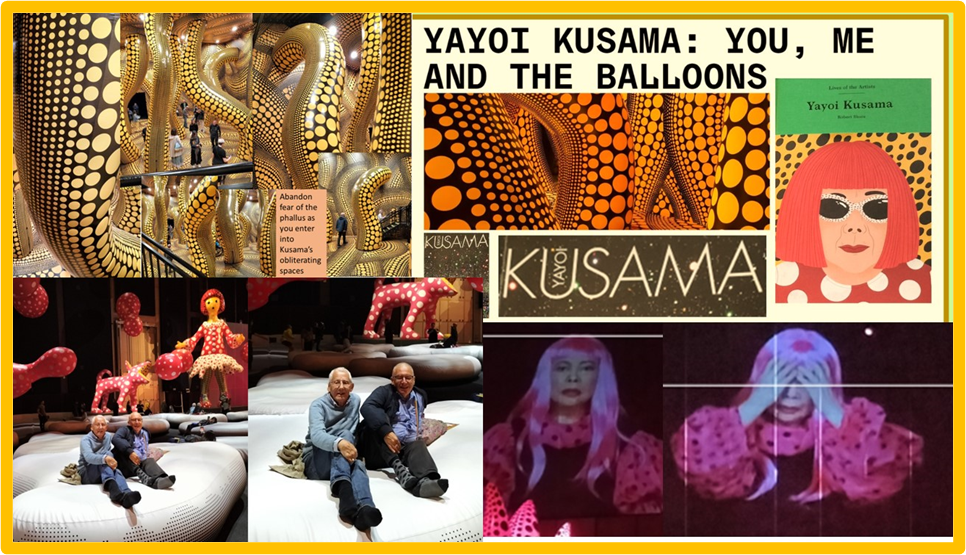
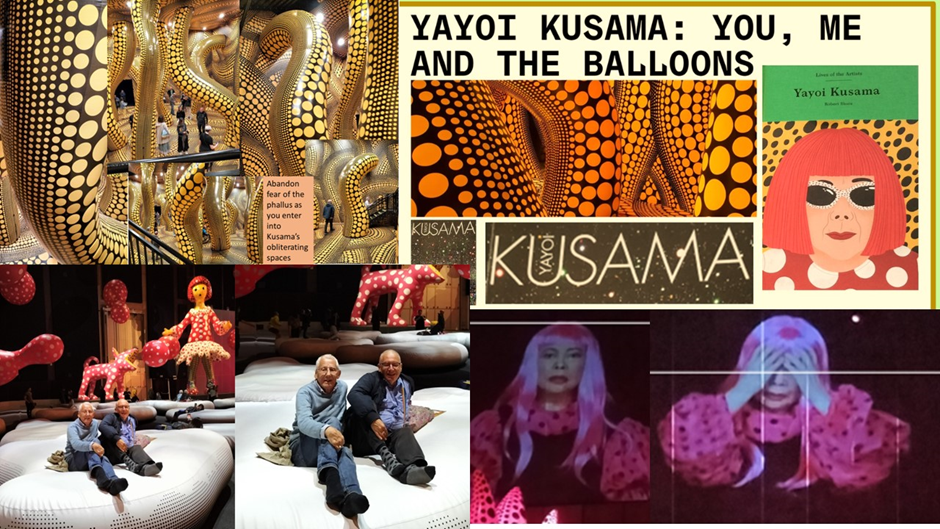
But then we went up the stairs to enter the exhibition, which was in itself an installation that created a lobby space with internal aisles between enormous balloon rising in a cylindrical spiral or curved over us in faux arches as if we were in the home of huge snakes, or deformed phalli of huge variation, which the brief free catalogue merely describes as ‘biomorphic forms’ suggestive of snakes, eel or fantastic worms. Another suggestion in this document is that represent the ‘neural pathways in the brain’ but I find them too solid to represent this phenomenon myself.

Views of the space containing The Hope of the Polka Dots Buried in Infinity will Eternally Cover the Universe (2019) Mixed media installation, Approx 12m. high.
What does matter is the feeling of entry by immersion in the fantasy of another – a fantasy that is somewhat unruly and challenges the safety of our own space as we navigate them. You walk through the aisles between them to mount a stairway offering some freedom from the oppression of their height tower over you, only to look like things rising from below to get you and perhaps harm you. From there you step onto a raised platform above the main exhibition hall. From there, there would be much to describe were I to allow myself to work through the exhibition for any reader who chances upon this blog. That is not my intention at all. Moreover, I think I would prefer here to merely show perhaps the chart of the exhibition from the free brief catalogue and to otherwise talk about both general impressions of sections of the exhibition. That too would fit better with the state of my own understanding of the artist, which is very much that of a beginner, as I explain in the first blog relating to it.
But there is another reason for so doing, for these works change in their nature depending very much on your perspective upon them. This is not just because of the effects of differential scaling and apparent volume of each exhibit produced by the visitor’s shifting perspectives they move above, beath and around works but the other works visible from that perspective, such that the whole environmental context of the work changes in front of us. It is important then that you enter the hall from an elevated gallery landing, whose wall below you, you will find on descent, is a mirror reflecting back the interior space. I will say more about this soon.
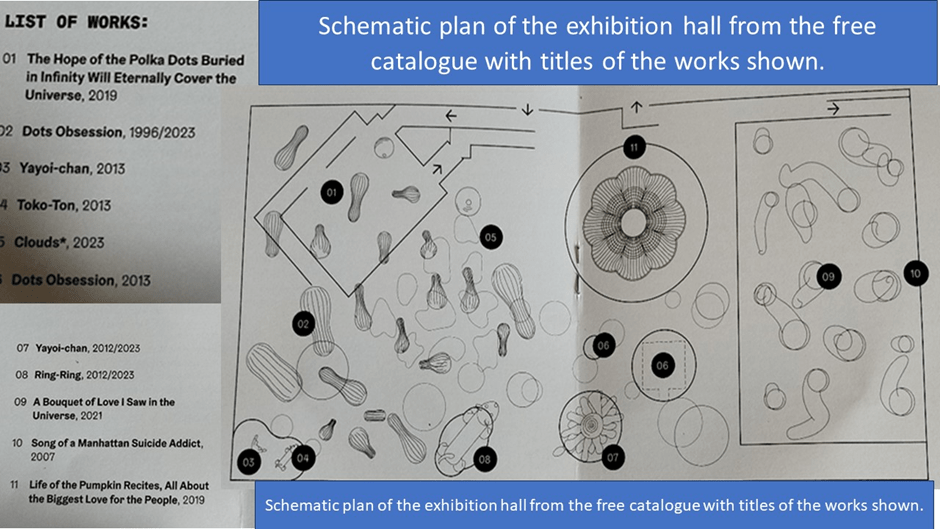
But first I think we should note that from this elevation, the visitor is level with a film showing Kusama herself reading repetitively her Song of a Manhattan Suicide Addict. The lyrics of the poem (though they were read in Japanese and only accessible, in the logic of written language at least in the exhibition captions and guide, comments on the imagery of the exhibition as a whole. It connects to the reflection of the unusual symbol-ridden language of dreams and psychosis in ways that insist on their truth in retaliation against norms promised by medication that even aim in their self-aggrandising promises only to dull the effects of truths forced upon the person labelled psychotic or neurotic. This by the way is how the lyrics of the poem in Japanese translates, as cited in the brief programme:

I spoke above of these words being inaccessible ‘in the logic of written language’. What I mean by this is that there are other forms of access that strike the heart and soul: the chant-like auditory content with an insistent heartbeat rhythm and the body language of Kusama, miming the paradoxes of sight or sightlessness, visionary or vision-lessness, sensational or sensation-lessness and feeling or emptiness ways of apprehending truths in mental imagery, things of which good readers of Emily Dickinson’s art are constantly confronted. I try to capture this at the level of the facial and gestural in the contrasting pictures below:

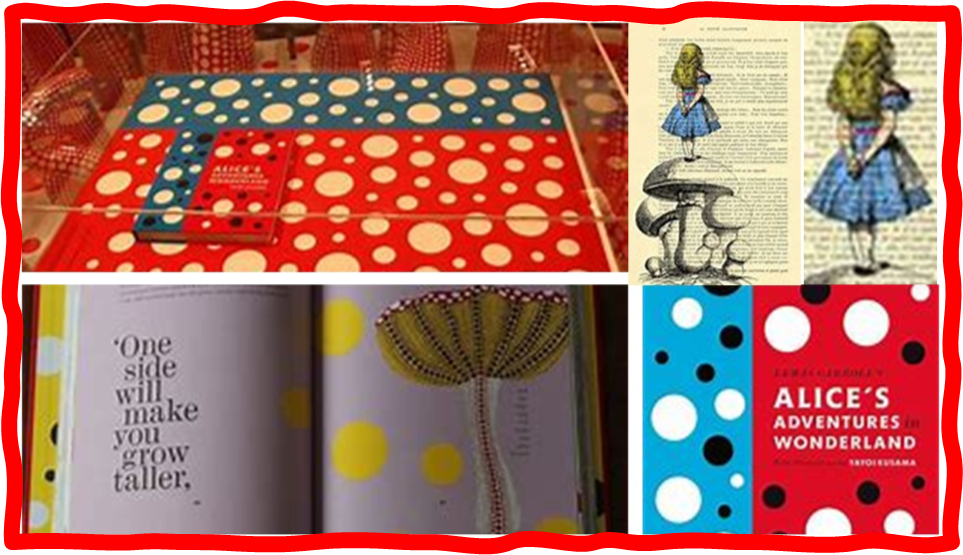
Only moments of seeing or not seeing here. But which, after all, is which. And in front of these the biomorphic and abstract three-dimensional forms (a ball for the latter, are coved with the same obliterating and blending polka dots in Kusama’s dress. By these she enacts that sense of ‘obliteration’ so associated with her – escape into a fearful infinity of repetitive simple form that is also soothes and lulls to some level of psychic unconsciousness where pain is not absent but irrelevant, coloured like the flow of flow of internal blood below a skin surface. And there is Kusama, an older lady (she makes this film again and again for different exhibitions to manifest her aging in time) dressed like Alice-in-Wonderland, She called herself ‘the modern Alice in Wonderland’ for her illustrated edition of the book and in front of her Alice sculpture in Central Park, New York:
Me, Kusama, mad as a hatter, and my troupe of nude dancers. How about taking a trip with me …. Alice was the grandmother of Hippies. When she was low, Alice was the first to take pills to make her high.[1]
It won’t have escaped your attention that Kusama exploited the idea of being made ‘high’ with elevation, either standing on top of something or by growing enormously tall, that allows one to look down on any world presented to you and to enjoy the absurdities of perspective and relative size transformations involved. And that I think is the purpose of the gallery, offering a view down on the visitors already grounded in order to see how diminutive they are relative to Kusama fantasy, and how diminutive you will be when you thus descend. The relative scale of the sculptures only matters here as much as the point of view from which they are seen, a necessarily mobile one from such a large landing with different sides and visual access to different parts of the hall below.
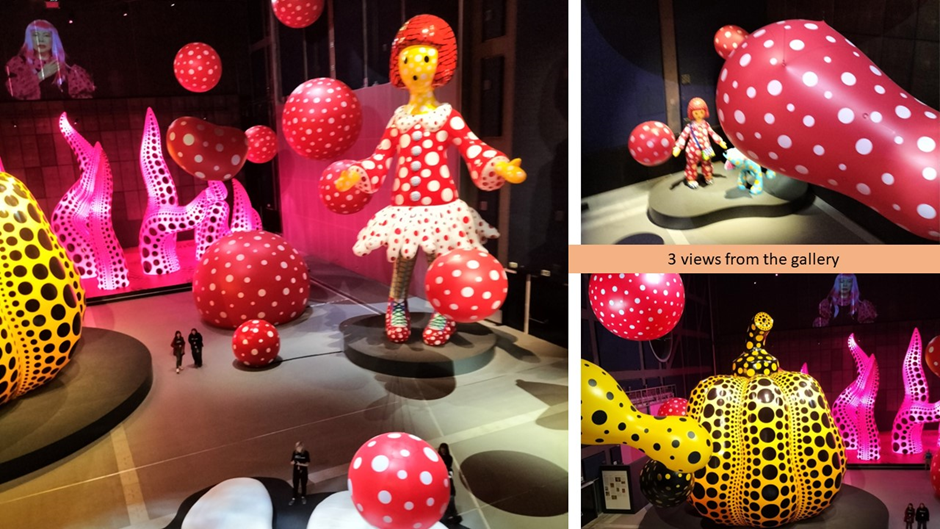
Scale matters but isolating an image, such as in a picture viewer in a mobile phone (often the majority access to sculpture these days reduces it, as I think is clear in the pictures below. The ones on left and right are from the floor of the hall. You can see the scale of the Yayoi-Chan (2.6 m.) and Toko-Ton (1.3 m.) dog and self-portrait girl statues because my husband Geoff was persuaded to stand in front of them – you have no idea of the gigantic size of the second self-portrait Yayoi-Chan (7 m.). from a camera shot, compared to the vision from above and relative to the ‘tiny’ human visitors.
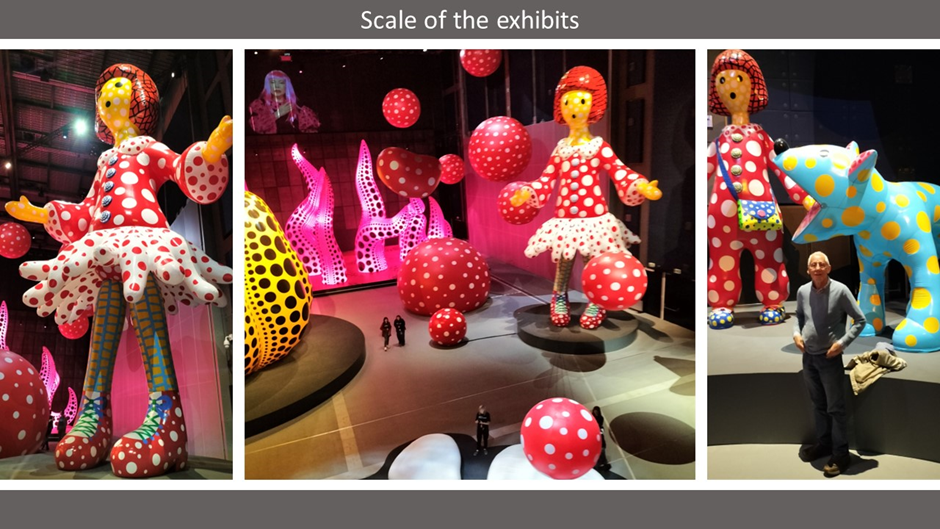
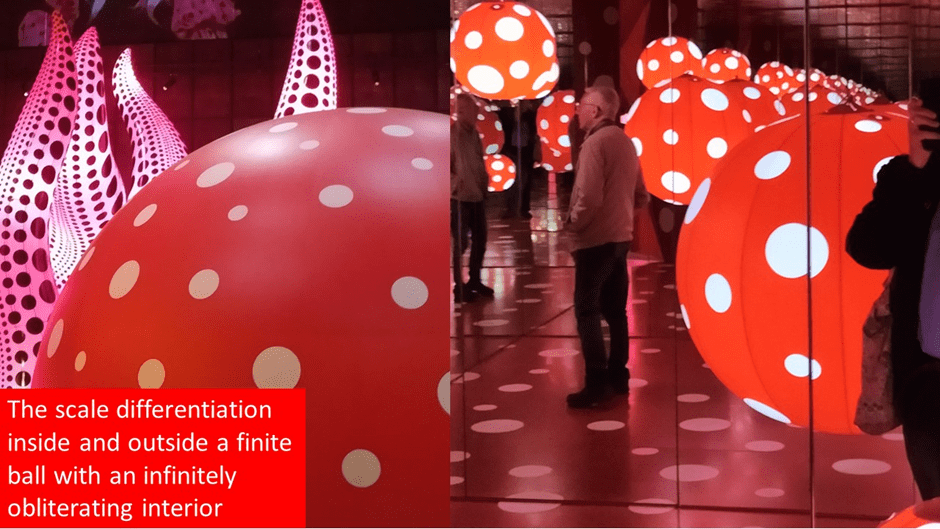
And all the sexual imagery is here. The dress is a flower-vagina made up of numerous phallic projectiles, but all this androgyny is obliterated in polka dot reversals. And in view from above or below is important, so is the difference of perspectives of outside and inside, where both yield to effects of both perspective and repetitive reflection. This idea is central to Kusama’s view of infinity as a necessary illusion of the finite. You see it in the larger fragment of Dots Obsession (2013), whereon entering the huge ball inflatable submerges you into its interior dots as a conceptual reflex from those without outside it), infinitely repeated through circumambient mirrors.
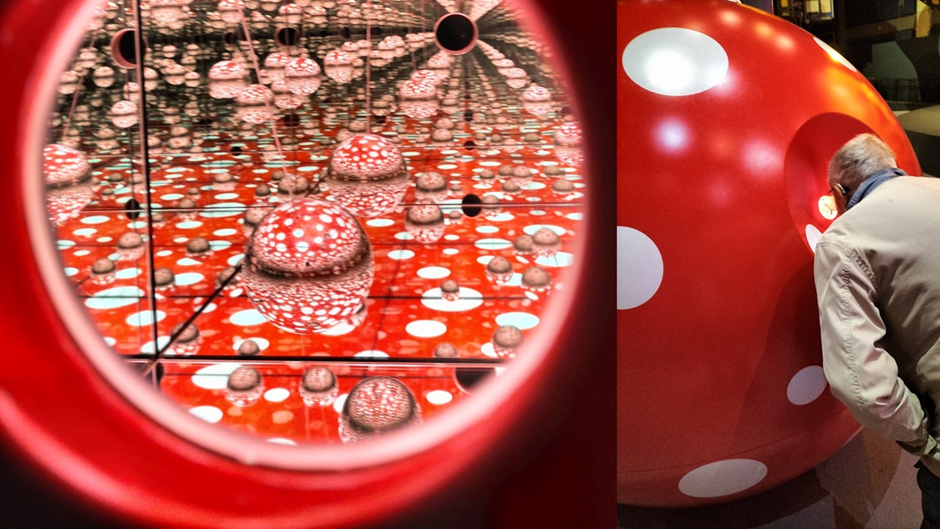
Even more telling is the smaller second section of the sculpture – an identical but smaller ball but accessed only by a small orifice in which infinity is reproduced. In the picture Geoff is looking in the hole. And the first part of the collage is what he sees.
There would be more to say about pumpkin icons and the wonderful tentacular biomorphs of A Bouquet of Love I Saw in the Universe but sometimes you just allow awe to take over.

Ndevertheless, despite the fact that I am a overthinking serious boy largely, I did join in the fun when it came to the new work for this exhibition, vinyl inflatables called Clouds (2023). They lie on a mat which marks a territory one can ONLY enter unshod (someone comes to tell you so). Then ou can climd and lie and be reflected in the wall-mirror behind you and think trivial thought like: ‘I bet I look fat in this photo the kind volunteer is taking of husband and me”. And I do and I am. Dieting now. Peerhaps we all becoome CONSUMED by appearance as Kusama insists.

How difficult to end a visit like this. It was glorious. I returned to yet another disaster on this Manchester trip on getting back to our flat at Range Road by Alexandra Park, but I coped because the Clouds had dissolved the morning/mourning anguish. Of the disaster, more in the proem to my revie of untitled f*ck m*ss s**gon play which is to follow. I hope I see some of you then. See the exhibition by the view. Just ignore the arts administrative chaos all around it.
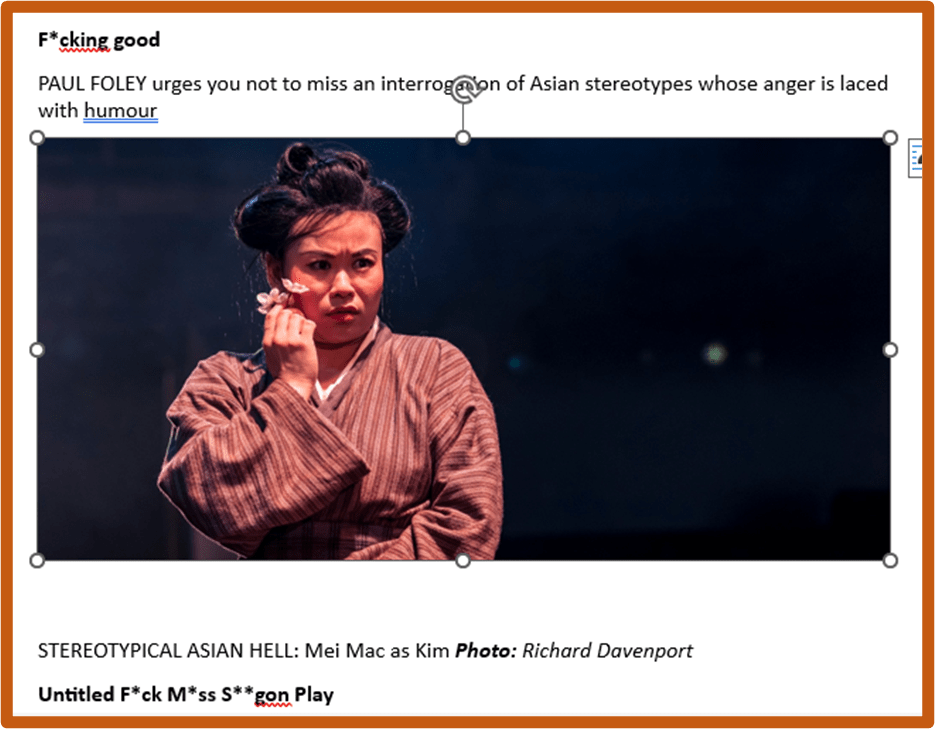
The Morning Star review of the play (my blog to follow when done).
All my love
Steve
[1] Kusama self-cited in Yayoi Kusama [trans Ralph McCarthy] (2013 paperback ed.: 129) Infinity Net: The Autobiography of Yayoi Kusama London, Tate Publishing. Thanks to Joanne who gifted this book to me.
 Steve_Bamlett_blog
8 thoughts on “An update based on actually seeing the exhibition of Yayoi Kusama at Factory International Manchester on Tuesday 4th July at 11.15 a.m., as part of a selection of the items from the Manchester International Festival.”