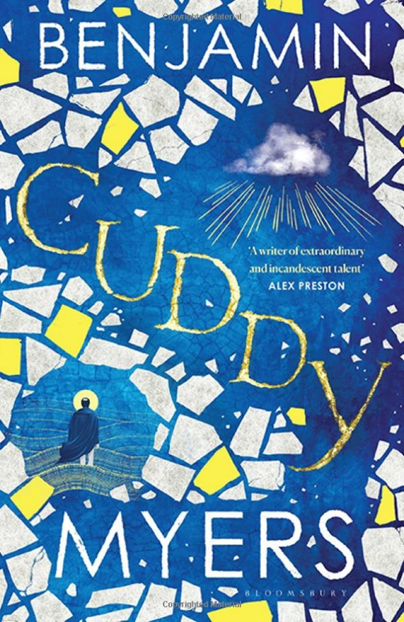
‘Let. History. Lie. /… he looked right at me, he looked through me, he looked beyond me and into all the centuries that would follow from this moment. And he spoke./ “Let his story lie.” …/.’ This blog examines the discomforting experience of reading Benjamin Myers (2023) ‘Cuddy’.
‘Let. History. Lie. /… he looked right at me, he looked through me, he looked beyond me and into all the centuries that would follow from this moment. And he spoke./ “Let his story lie.” …/ This last entry, I confess is a lie.’[1] This blog examines the discomforting experience of reading Benjamin Myers (2023) Cuddy London & Dublin, Bloomsbury Circus. It is a work that insists, in my view, that both the persistence of stories of immaculate and uncorruptible lives and ambitious art, in stone or text, suggests an uncomfortable truth. That truth is that the human attempt to realise ideals beyond time and change, such as a viable undivided community and a settled life is little more than a set of lies. We sing of eternity and togetherness only to truly speak in underlying whispers of emptiness, loneliness and persistently wandering and restless minds as ALL THERE IS.
In Waterstone’s in the City of Durham on Saddler Street there is a confident notice overhanging a pile of copies of Benjamin Myers’ novel Cuddy saying that the management of the stores feel that this book should be a main contender, and possible winner, of this year’s Booker Prize. And the novel certainly puts Durham on the map for the first time perhaps for some as well as being an innovative and moving read. It does for the character Professor Forbes Fawcett-Black III, an Oxford history professor in the third ‘Book’ (set in 1827) of the novel, a story which Fawcett-Black narrates in the role and manner of the narrator of a M.R. James horror story, whose main contact beforehand with Durham may have been Smollett’s description of the city in The Expedition of Humphry Clinker, which makes up the epigram of this ‘Book III’ section: ‘a confused heap of stones and brick’. Fawcett-Black knows the Peloponnese better than he knows the North of England and the ruined streets of dead Mystras (another fortified Palace on a hill) better than inhabited living Durham.
Likewise the history student Evelyn (Evie) in Book IV set in 2019 tells us of another Southern middle-class myth of the city: her friends in sixth form thought that she ‘was nuts applying to come to Durham – they reckoned it was a second-rate Oxbridge – but what do they know? It’s a hotbed of living history round here’. And the stereotypes well known to inhabitants of the city don’t stop there for Durham has long been used to being misunderstood, as being merely a cathedral and/or a prison; its ‘notorious HMP Durham’ makes the whole city notorious likewise; ‘a Who’s Who of English rotters’. Thus says the master mason rebuilding the parapets of its towers. Seen from the Cathedral tower that same prison is an ‘an enclosed space’ contrasted with the ‘total freedom’ of feeling a chilling winter wind at this built altitude.[2] This contrast of prison and cathedral is a false one however when seen from the perspective of the deliberately neglected dying Scottish teenage prisoners of Crowell’s Scottish wars (a fact of the once decommissioned Cathedral’s history that was recently unearthed) and is brought to life again in a brief play within the novel. In the play a voiceover (V/O) narrator is the Cathedral itself: ‘Cathedral (Voiceover): Thirty hundred bodies barred in; all of them Scots, my exits barricaded. … call me a coffin, a mausoleum for the many’.[3]
The motif of the enclosing spaces of cells set in open landscapes and coffins within coffins –underground enclosures, and secret doors will, of course, be part of the many stories told in this book, wherein abuse, rape and murder all play a part in the history of a settlement – the building of a ‘queer community’. I take that characterisation of community from the novel itself and it still intrigues me, for (as with all Myers’ novels) there is a strong interest in liminal sex/gender and class categories all in interplay. It is a novel wherein the portrayal of interactions of all kinds– not least in the central motif in the chronologically early stories of the novel about exclusive communities of men, haunted by feminine presence. This interest questions and queries (and sometimes queers – not always in a way positively presented) his pictures of relationships between the sex/gender of his characters. This community both is, and is more than (for the boundaries of the definition keep shifting), the haliwerfolc (the people of the holy man) whose history it traces. However, he is not using the term ‘queer community’ of the community of seventeenth-century monks whose secret ‘rutting’ with each other becomes the explanation for why there is so much garlic (and there is) growing on the mound on which the Cathedral weightily and dominatingly sits: ‘if a brother comes back smelling of the old garlic then he has been up to no good in the garlic patch with another brother’.[4] It is ‘queer’ because it is a shifting thing, hard to define. The twisted jealousy of one of the brothers of the monastery in the seventeenth century (an unpleasant characterisation if there ever was one) is of ‘that fiend Brother Barnabus (sic.) … the trunk and hips and haunch of him, as round and soft as a lady’). The way otherness is described (here by a woman who falls in love with a stonemason from the cathedral ready to accept her murder of her impotent but vicious soldier husband) is at the nexus of how socio-sexual conflict involves such boundaries.[5]
But the term ‘queer community is used in the quotation I gave above of the early haliwerfolc; those brothers who carried the corpse of St. Cuthbert from Lindisfarne via circuitous trans-Pennine peregrinations to its eventual unsettled rest in Durham – forever to be exhumed. Here is the instance as told by Ediva, the orphan girl attached to the community. She says of them, as the near their eventual resting place:
‘… these men of the cloth – these half-mad men drunk on devotion – idle for a day or two in a great green vale that no one has a strong memory of and appears on no maps in our imaginations. … Dandelion clocks take flight to remind that time is nothing but another notch on stripped bone-white bough, and the only certainty is the setting sun. In these moments a kind of lull befalls our queer community and a brief sense of peace prevails. The evening reaches to enfold us. To hold us. To remind that even the most wild and roaming mind seeks stillness’.[6]
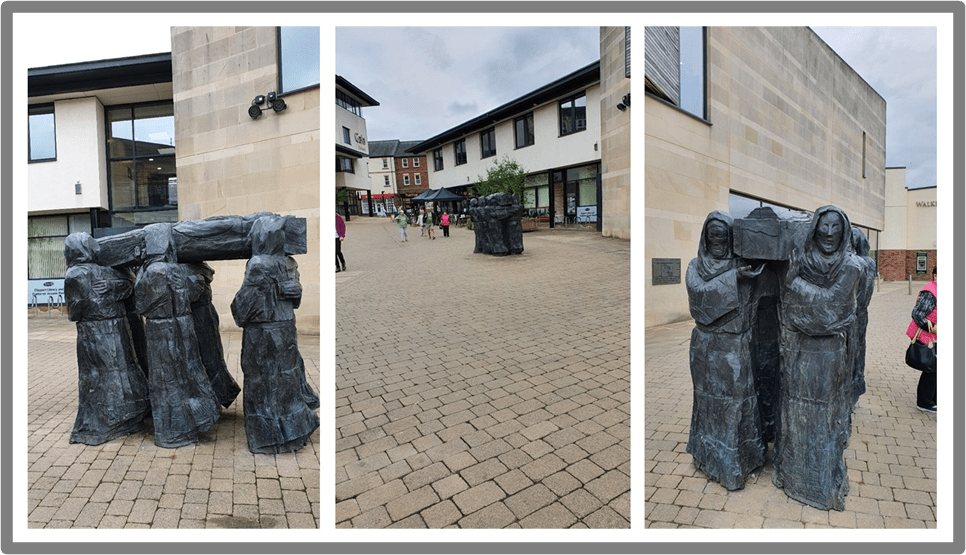
This lyrical evocation (and there is more of it) has a kind of ‘et in Arcadia ego’ feel to it, as in the scything scenes of The Offing, where death makes its presence felt in the midst of life and is the only metaphor for a settled state in the passages of time (with all the weight of Freud’s death-wish state (or Thanatos wherein anxious neurons seek a resting-state that might not exist other than in extinction). This need to rest contains a claim to something like an enduring reality. If the only certainty is the ‘setting sun’, the harbinger of all endings, then we can only temporarily be held in an illusion of such final settlement. Settlement is the dream of being held, or contained (the thing Cuddy constantly longs for and cannot promise to his 2019 namesake Michael Cuthbert when his mother dies) and which Cuddy himself seeks in walled up cells on Farne Island. The state of restless wandering forms the basis of Durham’s best, perhaps only, piece of communal public art – the rest are the fantasies of coal-mine owner’s aristocratic leanings – which Evie finds that Michael Cuthbert, who has lived in Durham all his short uneducated life, does not know, The Journey. The work still lives now where she describes it to be:
Evie continues to enthuse about Cuthbert, life on Lindisfarne and the haliwerfolk, and is surprised when he expresses ignorance about the sculpture of the famous wandering community down near the theatre on Millennium Square.[7]
Evie, of course, a philological historian in preparation with a fascination in ‘the changing language of history’, modernises the spelling of haliwerfolc, even in her recorded speech. This is just one of the instances wherein Michael deepens his own sexualised fantasies about her, although, to all intents and purposes she is, as she suspects (and thinks ‘would be fair’ as a judgement of her) ‘utterly pretentious’.[8] Although I think Myers really believes that Michael needs to gain some self-respect and realise how transitory a phenomenon is the ‘here today gone tomorrow’ upwardly mobile Evie), the point is that the community which unsatisfactorily holds them is queer because it has an almost dreamlike liminal identity, not recognised as representing a real way of life by conventional society. And that is how the cathedral seems as a worksite to Michael Cuthbert, a place where masons pay respect to ancient crafts, oversized scones, and supramundane freedoms upon the building’s stone towers. This is so unlike the world of exploited employment agency working – the only ‘community’ really left to us by Blatcherism – or illegal dangerous asbestos stripping as the only resources for a living, except the prison to which his father is constantly returned, found by a young archangelic Michael Cuthbertus in 2019.
Generally speaking, however, I think some of the political ironies in the representation of Northern British history may get missed from the novel and that is certainly true of the reviews I have read. Although these are generally positive they tend to sentimentalise what is not so in the novel. Hephzibah Anderson in The Observer tends to sentimentalise that history, using words like ‘local’ and ‘alternative’ in ways that (unintentionally) diminish the project (for Michael is not the cipher seen here: his naïveté is part of his and his nation’s tragedy of wasted young working-class lives:
In the hands of local novelist Benjamin Myers, the afterlife of St Cuthbert’s legend – and indeed of his mortal remains, …. It makes room for poetry and reams of quotations from diverse sources, as well as prose that adopts the viewpoints of stonemasons and brewers, cooks and academics, making for a vibrant alternative history of the region. / As Michael comes to realise, he too is part of never-ending history, ‘one more link in a chain of people … a continuum’. (my italics).[9]
Myers is I believe, despite his preference for Northern themes, more than a ‘local’ novelist and his sense of history is not the sentimentalised continuum picked out of the novel’s statements (which are legion and hydra-headed) about history or, of male individual characters in it, his story. It is not about lively democratic alternatives to history that the novelist speaks but of the importance of the multiplicity and duplicity of the making of stories and histories (hence the many quotations from things that portend and fictionalise history from Bede to Magnus Magnusson).
Nina Allen in The Guardian picks out, like Anderson, the interconnectedness in this novel between its multiple ‘Books’ and the inset stories and characters of these books, spelling it out as one ‘of the many pleasures of Cuddy’ that ‘lies in spotting the multitude of links between the chapters’:
There is always an owl-eyed youth, a provider of victuals and seer of visions, a bad monk and a violent man, their prominence ebbing and flowing from story to story. Always and throughout there is the voice of Cuddy, speaking to them in dreams, borne on the wind and in the sound of the sea, passed down the generations through the memories and cherished relics of those who went before.
But better than that is Allan’s perception of something more urgent in this novel that has ‘far more to say about who we are as a nation, where we came from and where we are headed than any number of more self-consciously political “state of England” novels’. Characterising the approach as ‘his elliptical approach to history and those who make it, and his willingness to take on complex material that retains its mystery even as it compels further discussion’ is a good way of beginning a journey regarding this novel that is a journey I want to go on too.[10]
In a sense, that journey starts for me in the connectedness but also in the fractures between parts of the novel that recall each other, where motifs take on very different associations and meanings and create very different interpretations of both life stories, stories of community and nation-or-region-building, particularly my favourite resonance – the ‘owl-eyed boy’ (of which more later). Thus Scum Gertie is a prostitute in seventeenth-century Durham but Gertrude is the manager of the Undercroft tea-shop in the Durham Cathedral of 2019. Chadwick is a fleeting appearance of a honking ‘soprano no more’ in the boys choir at Durham in the mid nineteenth-century but an illegal entrepreneur in 2019, making financially-motivated use of boys badly served by jobs centres and employment agencies. Men called Bishop (as one might expect of a Durham novel) are various things to various ages and persons, but start off with the lascivious and female child-baiting Bishop Aldhun in the medieval story.[11] History and ‘his story’ (or even her story) do not fall into a binary of a mainline version and its alternative then but multiply as disconnectedly as they are connected by the same names and character types. Even in the missed quotations from ‘historical’ accounts in this novel, we can never be sure that, for instance, Magnusson’s ‘the monk and priest Boisil’ is exactly the same personage as Margaret Gibbs ‘Prior Boswell’ (though of course we are meant to see him vaguely behind the variations of the ‘tellings’ about him in the quoted sources that constitute some of the book’s chapters) or whether Boswell/Boisil was a John the Baptist (‘Ecce servus Dei!’) to Cuthbert, or the person who communicated the plague to him.[12]
The quest for a true, or even an alternative, history (or other kind of account) then of any phenomenon often requires us to ‘settle’ on one account, rather than a multiplicity of them. And this may be true of stories told of the most modest of settlements such as those Southern English hamlets and ancient geological sites which form the basis of storytelling around ‘crop circle’ phenomena in Myers’ recent The Perfect Golden Circle. Human beings seem to require both settlement and foundation to justify their stories, whether about themselves or their communities, perhaps even their regions and nations. Yet that ‘queer community’ of the original haliwerfolc find the only constant certainty in their lives is the ‘setting sun’, the harbinger of deaths and other endings. Rejected by Evelyn (as he must see it as she chooses career over the fascination of his ‘striking eyes’) Michael Cuthbert too becomes a man to whom Cuddy whispers in order to allow him to accept, and participate in, perhaps with the help of a pillow, the ‘mercy’ which is the inevitable death of his mother following on the gradual dissolution of her flesh as it becomes to feel to him ‘wet almost, greasy’ in its passing. Cuddy’s voice, heard to all those who are truly haliwerfolc, takes the role of intercessor for what becomes for Michael the most important decision of his life in determining the meaning of his humanity and kindness to others: ‘Decisions are ours alone to be made. That’s another thing that defines us as human: the choices we make in the moment. … Mercy is not a sin’.[13]
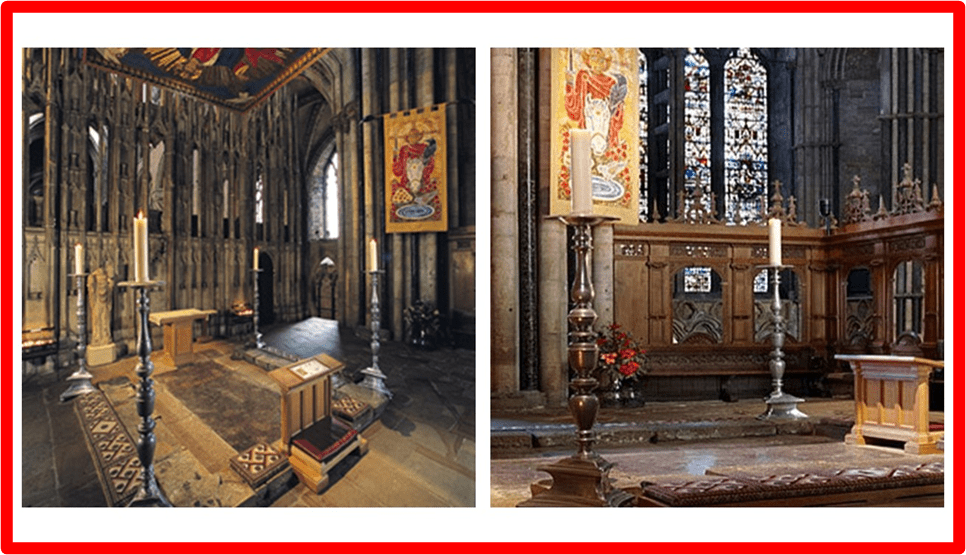
St Cuthbert’s Shrine, Durham Cathedral
I have said before how the term haliwerfolc has boundaries which shift in size, volume and porousness in allowing access and egress. The term invites orphans to become part of it: from Ediva and the Owl-Boy in Book 1 (for Ediva just becomes Cuddy’s child’ without transactions of either flesh or money)[14], to the young initiates to monastic life led as one’s ‘young charge’ should be by their holy mentor and ‘father’ (but not led as Barnabus leads his young man ‘through the hidden doorway into another England, one of sweats and secrets’), the teenage Scots brought there from Cromwell’s Scottish war to be systematically starved and secretly buried, the choirboys of the nineteenth century church-school and the uneasy and unsettled mix of students and townsfolk that make the modern Durham. No settlement in truth is really a settlement in perpetuity and we have to remember that this is still a Brexit novel, conscious throughout of the fact that hybridity rather than purity is the truth of identities of any kind – regional or national. It will be a necessity to accept ‘a sense of otherness’ to accept ourselves as in part the other. This is surely the point of Fawcett-Black’s experience of the ghosts of the original haliwerfolc which he feels, apparent European cosmopolitan though he is, exposed to as ‘something’ about which one cannot be precise for it involves that ‘sense of otherness’ we cited earlier, and which some critics blame Myers for as being overworked pastiche of M.R. James (to me it is a very exact parody):
But then I awoke suddenly, stirred by what I perceived to be the sound of voices. When I opened my eyes …, I heard nothing but somehow felt quite certain of those voices – the echoes of whispered voices I should say – were still about the place. The whispers were words from a vocabulary I did not understand, a bastard tongue that appeared to make sense to the unseen speakers, but not to me, your impartial witness.
These last names he understands to be half-heard versions of the Anglo-Saxon names of the haliwerfolc some 25 pages later in the novel (though of course we as readers know them well from Book 1). They are the men who, in the story told by his Durham clerical hosts, ‘gave their lives to ensure safe passage and that Cuthbert’s body should remain undisturbed’.[16] Far from being aliens, these are the originals of the community of Durham in emergence saving bodies from Viking rape and pillage and the defining symbolic body of Cuddy to boot (however we always do need, it seems, a foreign enemy like the Danes to hate with their ‘bastard tongue’ and uncanny ways).
Cuthbert himself is an odd centre on which to base definition of the circle of a ‘community’ however, for we are variously told that he preferred a lonely cell to company, an enclosed space to space that is open and too public, though he was still, as the Reverend Frayne says, ‘more than a modest man who lived a hermetic life’.
Quite the opposite in fact. He travelled widely and was able to find common ground with people from all echelons of society; from Anglo-Saxon kings to the poorest of Borderland peasants; from monks to men of ill-repute, …
Cuddy spoke to everyone who listened to his very human voice regardless of class, moral or even human status, since his communion too was with ‘birds of the air and mammals of the moor’.[17] It is why he talks to Ediva and the Owl-Boy most, and eventually to that final avatar of the owl-boy with ‘big eyes’ like ‘a rabbit’s or an owls’. Meanwhile communities of knowledge and skills have become exclusive communities. Evelyn or Evie is clearly a version of Ediva who could talk best to the Owl-Boy in Book 1. Evie speaks to Michael Cuthbert, the Durham ‘daft lad’ – and about the history of language itself and on the same page as our last citation – in such a way that he is ‘overwhelmed by information and a conversation that he wants to be a part of but whose reference points and unfamiliar old words are too far-flung, too academic’.[18]Yet again the haliwerfolc are divided and have a different history and interpretation thereof between town and gown here but between the Catholic Church of St. Cuthbert’s and the Protestant Cathedral in the nineteenth century (in this novel at least and which leads to the only exhumation of Cuddy we actually see in the novel) over the evidence allowable for the incorruptibility of Cuddy’s body. Folk can be divided that is over how they see, understand, talk about and behave the very same phenomenon, especiall the most contested notion of what a ‘community’ actually is.
Hence the importance of what the haliwerfolc tell the Oxford Professor in his experience of otherness. They, and especially the Owl Boy, tell him the words I use, in part only, in my title:
‘Let. History. Lie.
The lad looked different. His hellish face was a skull held beneath skin as thin and pale as parchment, his eyes as wide and dark as the sockets that held them. They spoke of emptiness. Suggested eternity.
He raised one arm as if in benediction and he looked right at me, he looked through me, he looked beyond me and into all the centuries that would follow from this moment. And he spoke.
“Let his story lie.”
And everything became black.
This last entry, I confess, is a lie. It was not written on the evening of the excavation on May 17 but was instead constructed piecemeal from the shattered mind of an unwell man over the intervening weeks that followed a nervous collapse, from which I am told I might never fully recover.[19]
What does it mean to ‘Let History Lie’ (under any form of transcription or punctuation)’. In fact it varies by circumstance. It could mean that we let what we know of history rest, free from disturbances such as the disturbances about to happen to the corpse of Cuddy. In extension it might suggest that the ‘rest in peace’ state in which history lies may be as extreme as death, where certain things (we sometimes sloppily think) don’t change. They do change in that state, of course. Real corpses decay, ground becomes disturbed by other activity including changes of belief and action, in wars in particular and dramatically. Alternatively it could suggest we let history lie prone as does a person on a bed prepared for or actually sleeping.
But the key ambiguity is that what we allow to rest is our discovery that what a person calls history can be no more than a ‘lie’. Is it a lie to say Cuddy’s body rested uncorrupted – the original haliwerfolc never lifted the lid of the body’s coffin to check we are told. Ediva in a poem in which she seems to inhabit the place of the dead Cuddy after his death, in the novel’s mythology, narrates a vision of Durham Cathedral being built out of the disturbance of her/his sleep:
The most obvious meaning is that we allow stories the latitude not to be tested for their absolute truth; that we allow it to contain ‘lies’ as well as ‘truths’. In effect the content of the chapters with quotations from books thought of as history shows that written history has always had that facility, sometimes excused as differing interpretation or that kind of social cognition we call a ‘worldview’ or an ideology. It is moreover bound into early descriptions of narrative literature such as those of Sir Philip Sidney – who states so well the belief that we need allowance for the greater truth that may lie behind ‘lies’.[21]
All of those meanings are resurrected in Evelyn’s boring and half-heard explanations to Michael of the narrative of continual exhumations of Cuthbert. Having told him about the last one (‘round about 1900, I think’) she concludes: ‘At least since then history has been left to lie’. Although the saying appears innocent enough, in her ongoing elaboration of the significance of all this she cites ‘a perennial dilemma faced by historians the world over: who to believe?’ Her own conclusion from this is, I think, where Myers must sit in his own thinking though he rightly shows it to be a bloodless and cold belief in its formulation by Evie: ‘I always think that history sits in the spaces between the differing accounts and, really, our job is to stop it falling through the cracks’.[22] Thus, even modern historiography has to ‘let history lie’ to accumulate accounts so that the cracks between them are clearly visible. I say that Myers would find this use of history cold for it does not take into account that the reason we have lies in history is to birth great symbols of things in which we need to believe. The owl-eyed boy seen by Fawcett-Black had eyes that ‘spoke of emptiness’, yet they were the way, perhaps the only way, in which Fawcett-Black (an atheist) could have suggested to him ‘eternity’ and ideas that might outlast the earthy body. And this is true not only of history telling of multiple intersecting lives but ‘his story’, the story of the individual caught between ideals and realities, beliefs in community and love against their negations as meaningless and horrific visions of Hell.
Moreover, telling ‘his story’ allows for each male character in Myers a due a store of ‘lies’ (of ‘semi-fictions’ if people are to see their lives as significant. In The Perfect Golden Circle the ex-serviceman who fought in the Falklands War, Calvert, sees that his co-worker in corn circle matters, Redbone, can be forgiven for seeing his role in a fight with police over the breaking up of a gathering at Stonehenge as equivalent to his battles in South Georgia. Myers narrates Calver’s thinking thus: ‘he lets Redbone relive his past glories once more, reasoning that all people are comprised entirely of their revisited formative experiences and elaborated stories, even if some choose to keep them buried in the catacombs of memory’ (my italics).[23] And if this is true of Redbone, how much more so of Saint Cuthbert who has not just ‘a semi-fictionalised personal history’ as Redbone has but a semi-fictional repertoire of narratives following him with elements of his meaning invested in each of them, such as the story of the incorruptibility of his body, or of him being the foundation of a true community of haliwerfolc. Every man, however illiterate, may leave their mark on stone, as does the seventeenth-century Francis Rolfe, only for his ‘sigil’ to be read by later masons.[24] Even archaeology, one of the skills of Fawcett-Black, is says a Durham cleric to him is ‘unearthing objects, and then walking backwards through epochs in order to tell stories behind them’. Treading such tortuous paths, like many others trod through the mound of Dunholm on which the Cathedral stands, must lead to many a misstep.[25] But the point is that we tell stories to birth ideals and/or maintain them; such as a belief in the love that sustains communities and of enduring values, whatever the actions of passing time.
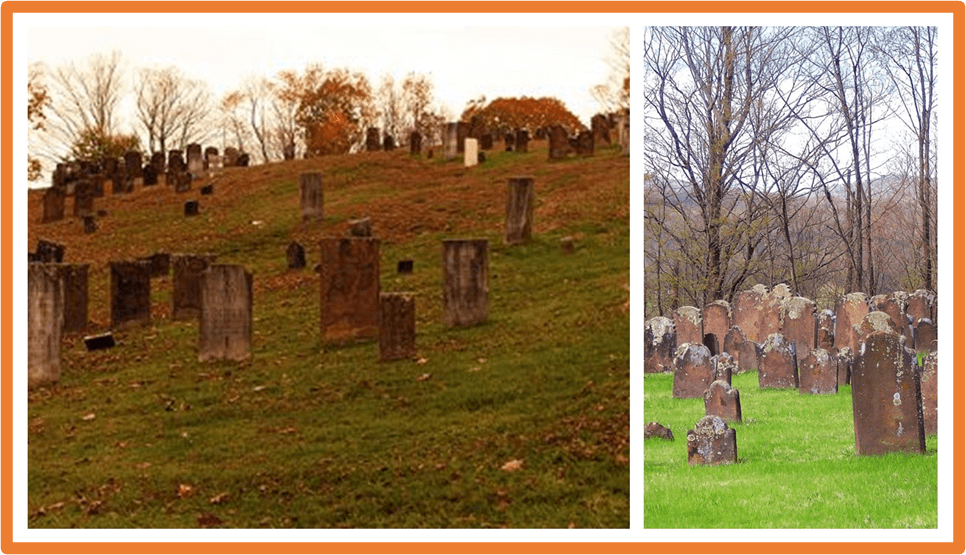
Durham cemeteries
In my title I say that though we may sing songs of the eternal and sustainable hold of good when we speak, like the Owl-Eyed Boy in the eyes of Fawcett-Black only speaks, of ‘underlying whispers of emptiness, loneliness and persistently wandering and restless minds’. This is a grim truth just as mortality itself is a grim truth and the novel ends with both a loss of a sustaining romance for Michael Cuthbert as well as a death. But sustained by the voice of Cuddy life begins to have potential through the grimness, even if not an absolute and joyful ending. But the ‘wandering and restless mind’ that is Michael on his return home wanders physically from the hubbub of life in the city to ‘tombstones’. But herein there is hope – but only in the presence of death, where life springs from death but is not at all vampiric as in the worst Transylvanian horrors of Fawcett-Black.
The city’s old graveyard comes alive at night too. Here, amongst death, life blooms in the folded creases of darkness. Sometimes young couples lie on the cold flat headstones that have fallen from their soft soil beds, clinging half-naked to each other as if resisting the gravitational pull, ….
The whole passage is rich. It is too about ongoing history – procreative sex here not falling between the cracks into the same death underlying the tombstones – but it is also about the hopeless drunk with his ‘beer bottle or phone in one hand and spraying penis in the other’ or the women who squat to urinate and whose stream of pee, the sign of their current life, fills ‘the neat lines of the engraved names, the birth dates and the death dates’. In these latter examples excretion underlines and fills up the text of history and promises that these women who giggle as they pee are still a community and still a sign of hope in ‘common’ people, whatever the ambitions of ambitious over-educated individuals like Evelyn. In brief, whatever it is, there is an ongoing history for Michael Cuthbert but its course must take the rough with the smooth, embrace the fact that ‘his story’ may not bear a clear lesson to all like his namesake saint but will matter, for the truth is, this novel says, neither did Cuddy’s life bear a clear lesson but, for the sake of hope, we will continue to ‘let history lie’.
Hence my conclusion isn’t a gloomy one though it, like everything else, lives only in death. There isn’t much more, after all, for art to do but to make life worth living by showing fictions that enhance its value whilst we see the cracks between its texts and art objects through which we might fall. The only thing that might stop us from meaningless lives is if we consciously lie to each other rather than let lies pass with history, and indeed be part of living history – for that, after all, IS LIFE!
6 thoughts on “‘Let. History. Lie. /… he looked right at me, he looked through me, he looked beyond me and into all the centuries that would follow from this moment. And he spoke./ “Let his story lie.” …/.’ This blog examines the discomforting experience of reading Benjamin Myers (2023) ‘Cuddy’.”




 Steve_Bamlett_blog
6 thoughts on “‘Let. History. Lie. /… he looked right at me, he looked through me, he looked beyond me and into all the centuries that would follow from this moment. And he spoke./ “Let his story lie.” …/.’ This blog examines the discomforting experience of reading Benjamin Myers (2023) ‘Cuddy’.”