Artworks ‘are coagulations of the time their creators spent making them. They offer us a particular quality of time’s passing, and ask for our time in response. But how much time? …’.[1] Truth-telling in spite of the academic conventions: a case study of how to do this in Joe Moshenska’s (2021) Making Darkness Light: The Lives and Times of John Milton London, Basic Books (John Murray Press).
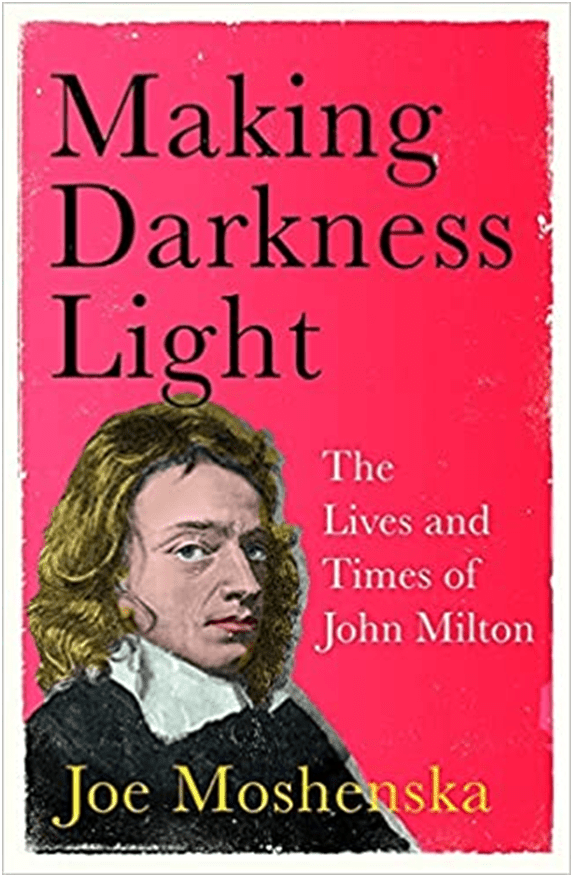
Milton has not always invited writing that drops far outside the confines of the most conventional forms of academic discourse, even when the level of argument is clearly that of an open and clear mind as in the recent case of Nicholas McDowell, whom I have blogged on earlier this year (see the link to this blog here). But Joe Moshenska’s apple does fall far from the wood of the academic tree and does so by embracing a method of research and writing that emphasises the importance not only of the influences that came from Milton’s own past and the poet’s present influences but the ways in which we read the poem whether we are professional academics or not at times well after its inception and regardless of any intention the poet may or may not have had. It’s writing that ‘studiously’ ignores the taboos of ‘readers’ (if indeed they can be called that) who wish to considered as purely objective. Moshenska notes that, as far as he is concerned, it is difficult, if not impossible, to read Milton at all without asking ‘weirder, less respectable’ questions that are unanswerable but still insistent.[2] These are the very questions the academy treats as transgressive when asked by learners under their care (or otherwise since respect isn’t always a trait of the learned for learners) and which to the professional academic indicate the naivety of such learners:
Because these questions cannot be answered, because they cannot even be asked without seeming to transgress upon the mystery of the creative act itself, learning to read properly – seriously, professionally – often means learning not to ask them. But I do keep asking them, and I’ve come to believe that one job of art in general, a job Milton’s poetry performs upon me with particular intensity, is to encourage us to indulge in impossible questionings and wild imaginings of this sort.[3]
The questions Moshenska enacts himself asking in this passage are mainly along the lines of what it must feel like to believe that you are the kind of person you make claim to be: such as a genuinely ‘divinely inspired’ poet with a direct channel of communication to God and/or his angels. But the questions that impact upon me are those which Moshenka asks about how Milton’s experience of basic elements in the creative process, usually ignored by scholars. These include the question of how the poet engineered the processes of time such that the reader experience not only the meaning of the poem as a whole but acknowledge the genuine experience (quantitatively and qualitatively) of the time in and with which a reading takes – including its moments when we experience its length as tedium as well as those in which we are genuinely excited and transported, at speed as it were, by its tempo. No one who has read Paradise Lost will not have experienced both these kinds of moments in which pace matters to the experience and meanings elaborated. A sense of time passing too they will have found that sometimes lapses into something better described by that useful word in art criticism ‘longueurs‘.
Moreover, Moshenska asks, as it were, why, outside of his professional duty to read the classical texts of the literature in English he teaches at Oxford University, he should CHOOSE to ‘spend longer in the company of a given writer who matters to us, to return to his or her writings repeatedly and over a long period of time’. His guess is, in relation to himself as a reader, that he needs to accept that his own sense of himself and the temporal rhythms of action and reflection that animate that self are directly transformed, translated and (especially in the way Milton uses the term)[4] transported into another place and space by that reading experience and re-experience.
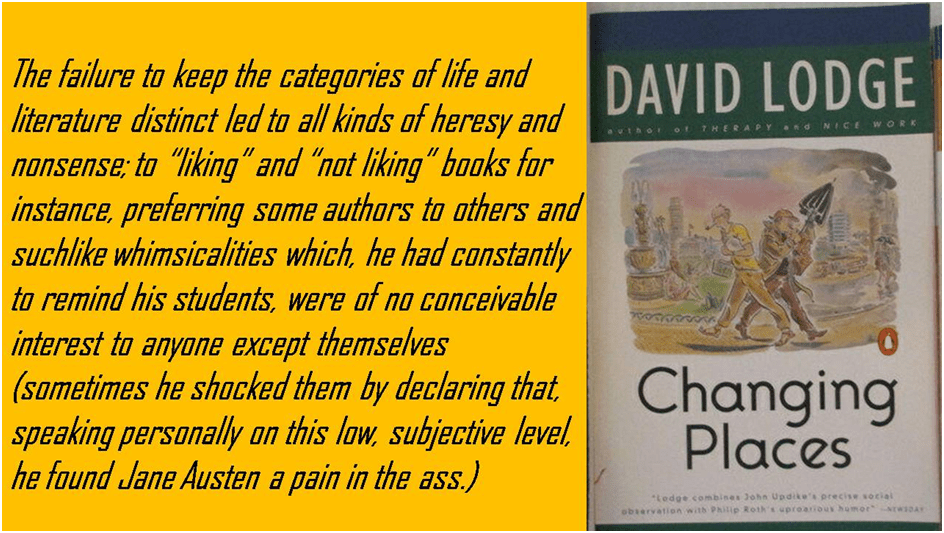
This feels the mark of a genuine social commentary on the nature of the modern academy in which the teaching of native literatures is given prominence. It contrasts, in my experiential application of reading Moshenska, literary professionals I have encountered professionally (and otherwise): first, those who genuinely read because they want to, and second; those that read because it is the requirement of their not inconsiderable salary and tenure. David Lodge shows the difference perhaps between those persons in Changing Places, the best of the early campus novels. However it was illustrated for me in the way one colleague of mine, when I taught in higher education, expressed his distaste at another colleague. The latter was, in fact, though this was unknown to the former, my favourite teaching colleague and dear friend now lost in time. His sin that he ‘wasted time’ by rereading each Dickens novel every time he taught it. It is a trait I needed no encouragement to adopt.
And I love Moshenska’s decision to discuss Milton’s life and time in terms of its plural potential understandings – his ‘lives and times’ (in the plural note) as he says in his title. This involves, as we shall see later, treating the interaction of lives of reader and writer as a particularly complicated rhythmic knot – where the phenomenological rhythms of a writer’s life and time and those of a reader’s life and times knit together with their differences and similarities simultaneously exposed: it is ‘whether I like it or not, entangled within the whole of my life’.[5] Thus how does a secular reader with origins in the Jewish faith and Diaspora culture interact with a man thought to be England’s key Christian author, despite ‘his deeply idiosyncratic version of Christianity’.[6] And despite the, we should also add, ‘the question of his [Milton’s](disputed) antisemitism’.[7] And there are questions of class and the rhythms through which working class children, (or those from other cultures marginalised by formal education such as Irish ancestry of his friend and erstwhile teacher, Sean) adopt for themselves the highly educated rhythmic experiments involved in Milton’s peculiarly idiosyncratic and learned ‘music’ as a poet – imported and adapted from the poets of other languages and equally remote (even to him) erudition.
If we’d both ended up loving, studying, and teaching English literature, we both did so from a shared sense that its traditions were not straightforwardly or unthinkingly ours, by virtue of our differing backgrounds and beliefs.[8]
The point about how, for many of those marginalised, classic literary texts are received as not our own but the possession of an entitled class that has controlled educational conventions so much that it CAN read these masters of a ‘tradition’ felt to be theirs ‘straightforwardly and unthinkingly’. I wonder if such ‘reading’ can truly be called reading. Thinking of my own experience, I remember experiencing this difficult portal to Milton’s greatness: indeed I got to him and a hunger to read him very belatedly and despite being ‘taught’ his poetry and his classical forebears in Latin literature at an English state grammar school. And this approach too allows Moshenska to be much more intelligent and open to genderqueer and other queer readings of Milton, of which I commented in an earlier blog were so difficult of approach for more conventional scholarly biographers dealing with ‘facts’, without further thought about what facts are. Of Nicholas McDowell, I said:
It’s difficult to miss the sneer in the note [by McDowell] that other critics ‘have preferred to assume’ the meaning of femininity in the way Milton was perceived. It is a sign of what Drew Daniel in 2018 called a ‘clash of civilizations’ between Milton Studies and Queer Studies. [9]
Moschenka’s analysis of how Milton acquired the rhythms of ‘controlled eloquent maleness’ from various sources, such as those of the profession of music, the rhythms of money acquisition and investment in capitalist economies and from that act considered at the time to be of the essence of the education of boys, birching, is surely more masterly than anything I have ever read about the acquisition of a complex gender identity that is only falsely called ‘normative’.[10] This is, especially for boys, by the mechanism of corporal punishment once used to control the ability to adopt and enact femininity too which was also (and paradoxically) required by elite education (even authorised as such by Cicero of all persons and authorities). This is a thing we see in Miltons ‘lives and times’, reserved for boys alone as it was. in St. Paul’s School which was attended by the young poet.[11]
His ability to include Queer Studies too in this remit shows the comprehensiveness of the approach and Moshenska has an intelligent grasp of why Eve Kosofsky Sedgwick matters as a literary and social critic. His interpretation of Milton favouring the role of the Domina (Lady) in education is stronger than, and as scholarly as, McDowell’s and comes from as sound a reading of the literary texts and the seventeenth century context of pedagogic thought.[12]
We also need to take note of the beautifully complex reading of Milton’s especial relationship to his dearest male friend, Charles Diodati as ‘a Pellegrini belleza, a foreign or roving beauty’. It is one of the best in this book,[13] if we exclude the wondrous treatment of exactly what is monumental if anything about Paradise Lost and Samson Agonistes. It certainly puts into the shade many other critical and biographical tomes on Milton – so often dry to the point of sterile rigidity. Seeing this poem in terms of the work of Proust and further elaborations on the latter by poet and classicist Anne Carson, emboldens his move into seeing how perhaps Milton and Diodati were not enacting an early version of what would later in history be called latent homosexual love. In fact, he explains, they were manifesting how such seventeenth century scholarly men might have ‘played with the nature of their shared love in a manner that was daring and veiled behind learned allusions, making its tone difficult to decode – which may have been part of the point’.[14]
This reading of the life materials helps this critical biographer to take up again how we should read the role of Orpheus in Lycidas, as if were the most central of texts for understanding the role of modern queer theory. It helps Moshenska establish critical reading aware of the complex layers of allegory and iconography as a tool of any biographer who is alert to finding consciously ‘queer possibilities’ in the texture of lives as he dismantles rather than an easily dismissed hidden queer identity. The strategy of dismissal is that based in lazy assumptions, he says, in some biographers who appear to believe:
‘… that the conventions of friendship are enough to explain away …’ (the notion of a ‘gay Milton’), ‘…. to prevent us from even considering it. This leaves heterosexuality as the norm that must be assumed and does not need to be argued for; a lazy, and limiting way to think. …. To assume that Milton’s friendship with Diodati either must or must not have had a sexual element because it was uniquely intense is to assume, falsely, that we know what sexuality and friendship are when we encounter them, and that we can always distinguish between them’.[15]
The culprits to which he points are legion – too many to name individual examples. Behind this amazingly strong passage of intervention into understanding the limits of biography lies the strength of Moshenska’s reinvention not only of lives of Milton but the act of writing biography itself, especially when writing of masters of either oracular or ordered aesthetic rhythmic passages made up of words. Perhaps Milton used words simultaneously in both ways as if there were one or more Miltons, Moshenska posits. What is clear is that an imagined disembodied ‘voice-over’ or writing on ‘a black screen’ based on ‘bare facts’ alone will never do to make readable biography.[16] For the Milton we need to emerge from lives (meaning here biographies) has to have a body from which the creative act of making words or transmitting prophecies in political and aesthetic life proceeds. I need this anyway – else why would I spend time reading the sometimes resistant and resistible prose and verse of Milton at all.
James Parker writing for The Atlantic rather reduces the achievement of this biography by making it into an exemplum of dealing with the multiplicities in personal role brought about by polarised times, such as seventeenth century revolutionary England. He writes thus in his irreverent prose:
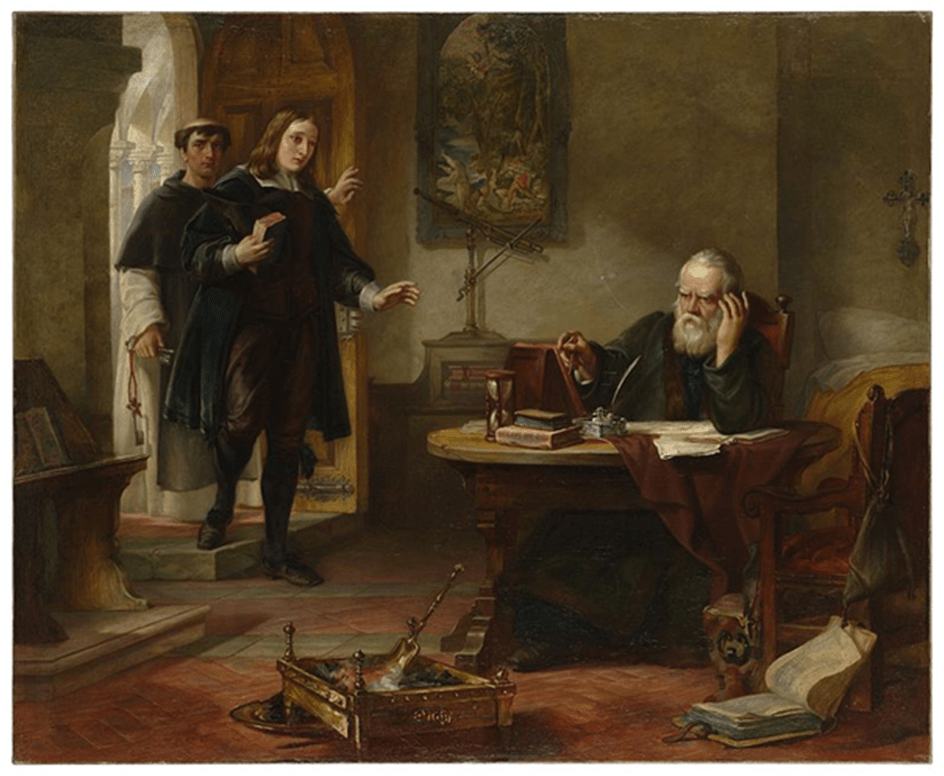
Moshenska, in 11 chapters, gives us 11 ways of looking at Milton, from the brilliant son of a musician father to the travelling polyglot (he visits Galileo in Tuscany) to the theological crank to the ferocious propagandist pamphleteer to the blind man sitting in his house, reeling off the staves of his great poem. His times were, to put it mildly, rather polarized: He was 36 when Oliver Cromwell smashed the forces of King Charles at the Battle of Naseby. Milton, as a radical Protestant and a republican, was on Cromwell’s side. It’s an item worth remembering about the English that they once chopped their own king’s head off; John Milton was very much in favour of said head-chopping. His 1649 tract The Tenure of Kings and Magistrates proclaimed the lawfulness of trying and putting to death “a Tyrant, or wicked King.” It was published shortly after Charles’s execution in London, by which time Milton was well on his way to a post in the new republican government: secretary for foreign tongues to the Council of State.[17]
Yes but … I want to say … Moshenska does bring these eleven persona together through the use of important memes for how lives happen and intersect with each other and the specificity of their times, including revolutionary England in the seventeenth century. One such meme is that of ‘rhythm’ as a means of understanding the ordering of time, space and discontinuities in things thought initially to be separable. Moshenska elaborates this concept both in terms of the handling of words in larger units or passages of time, such as lengthy poems, but also ‘the way in which a life unfolds and the fact that this unfolding is never smooth, even, or regular’.[18] Indeed the concept of rhythm is elaborated to cover how we read Milton – prose, verse and life – but also the knitting together of lives and times across history which constitute readings of Milton’s rich offerings, even the book Making Darkness Light Itself.
Roberta Klimt in Literary Review captures this point in her review of this book that she starts by telling us, ‘is not a conventional biography’. Her description of the book is clinically correct unlike Parker’s fanciful sci-fi one and identifies the justification of writing in a novel way using a metaphor not used by Milton himself – ‘rhythm’ – but oft used of Milton (by Gerard Manley Hopkins for instance) in Milton’s notion of the ’transformative effects of literature’: ‘not merely metaphorical but metaphysical and bodily too’.[19] But I call it ‘clinically’ correct because critics in literary journalism cling to notions of objectivity in biography despite their appreciation of Moshenska’s radical methodology in biography. And part of that methodology is rooted in an even deeper rejection of binary oppositions like male and female, straight or gay, prophet or poet, prose or verse – and so on – than you find even in queer theory because it is so rooted in phenomenological recreation of why time seems to us, and seemed to Milton with a difference of course, to be an inbuilt series of layered interacting narratives rather than a sequence of repeated sameness (he uses here the distinction in Frank Kermode’s The Sense of an Ending: we hear time’s ‘tick-tock’ (a beginning and an ending not the ‘tick … tick … tick’ of ‘actual’ time.[20]

Below we hear the author, interviewed by Ryan Asmussen, elaborating on the central problem of seeing the making of the poetry, and indeed its transition into political position-making and prophecy, as paramount and not reducible to facts that occur in series:
… there’s something so counterintuitive about the idea of these poems emerging from this very ‘other’ state of consciousness since we all know Milton as the stern, forbidding, hyper-masculine, canonical control-freak. But, actually, the whole Paradise Lost enterprise seems to have been predicated upon twilight states of the mind that hover between full awareness and total passivity, of Milton being taken over from without. At the beginning of the book, I call him a scholar and a prophet. We have Milton the scholar, the one who knows everything, has the information at his fingertips, reaches out for it and there it is. We also have Milton the prophet who receives things that are happening to him, coming to him from somewhere. This is someone for whom writing involves this extraordinary alterational interplay of mental states. In a certain way, he needs to be destabilized in order to write what he wants to write.[21]
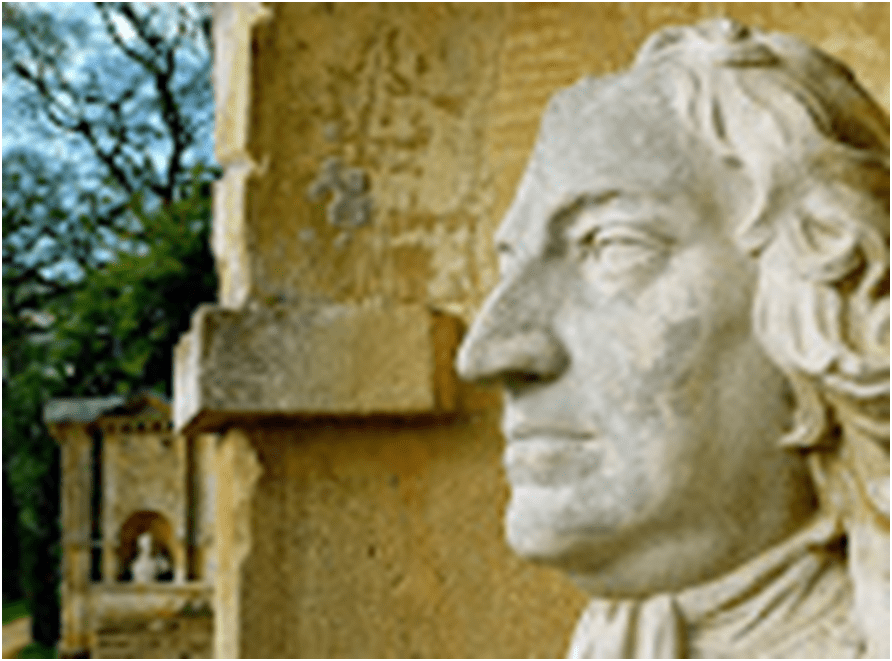
This expresses the point so well in the very simple limpid prose at which Moshenska excels – Milton could not be readable if he were only the canonical ‘Monument’ that literary historical biography sometimes makes him, but he is that ‘forbidding, hyper-masculine, canonical control-freak’ as well and is irreducible in either manifestation. The aim of Moschenka’s book is to look below the ‘weak witness’ of his name provided by ‘hallowed relics’ as Milton himself spoke of Shakespeare in 1630.[22] For relics and monuments freeze the conception of a person in the repertoires of ideas available at the time, whilst reading and re-reading a poet or prose-writer allows for constant revision of why the reading matters to its readers and to others who read ABOUT him when those readers become critical writers. In face the subject is not the different persons or conceptions of persons standing in for Milton as Parker seems to suggest but the nature of Time itself. Hence that tremendous first chapter on Milton’s On Time that points out so beautifully that the poem ‘gestures not just towards Heaven and eternity but also towards the clanking jerky mechanisms of clocks as they existed in Milton’s lifetime’: the plummet clock.[23]
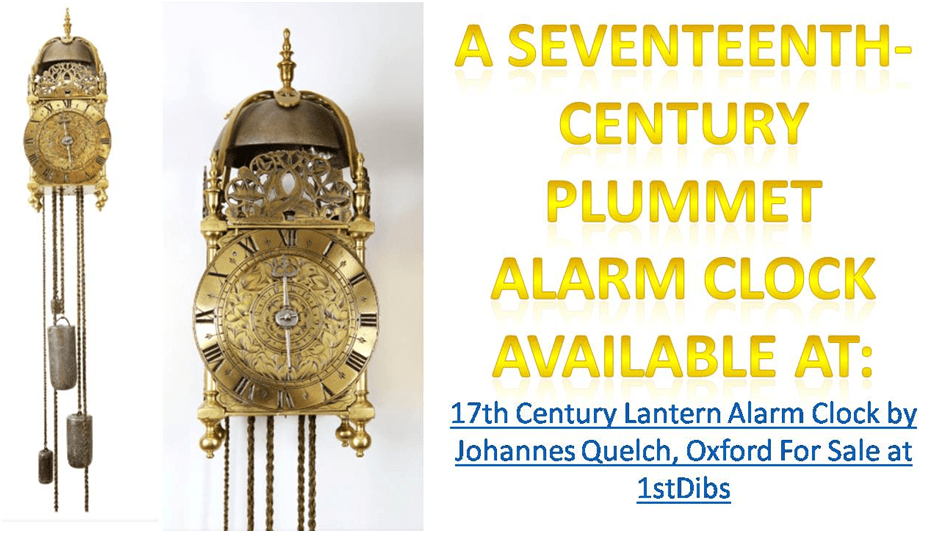
Likewise the beautiful analyses of the Nativity Ode of the shifts of tense and starting temporal perspective:
Time is out of joint from the very start of the Nativity Ode, shifting and unsettled. ‘It was Winter wild,’ the poem proper begins, ‘While the Heav’n-born-child, / All meanly wrapped in the rude manger lies’. It was winter and yet the child lies in the manger: why not lay? Why mix present and past in this subtle way?[24]
And rhythm itself distributes time in different ways using not only direct references to time in the symbols and grammar of the writing but in matters of pace and tone too. Not least is this true of the rhythms of the birch beating the recalcitrant boy who refuses to learn his masculine authority from a model of such – a behaviour which Milton reproduced as a teacher also. This contributed largely Moshenska argues in order to form the model of ‘controlled eloquent maleness’ he identified with sometimes.[25]
‘What interests me Is that the same schoolroom exercises’ (the reading aloud of poems in female voices for instance) ‘that were designed to knot together the rhythms of a confident male self constantly required that boys become other people, including women: that they broke down the boundaries of who they were and allowed themselves to be taken over by other voices, other rhythms, other kinds of being’.[26]
This lands us directly into the other central meme of Moshenska’s reading which is ‘in-betweenness’: a quality mediating all binaries or single categories of being such as masculinity and politics.
He seems to want on the one hand to flee towards clarity, the clarity of clear divisions and distinctions, the clarity of Apocalypse that would bring the in-between time to an end; but he is also drawn to the in-between, led to dwell delightedly in the realm of uncertainty, the neither here nor there, the not yet.[27]
Moshenska goes to some trouble to establish the complexity of Milton’s grasp of the meaning and feel of femininity for instance and to complicate Milton’s misogyny, which he says: ‘like other forms of hatred, involves the soldering together of a strange bundle of incoherent beliefs and assumptions while treating them as a logical and natural whole’.[28] Hence the complexity of the unfallen Eve, despite the nastiness with which women’s sexual being is described in that odd allegoric character, Sin, in Paradise Lost. And herein too lies Milton’s sense that beliefs one once had, of one’s appropriateness to a spouse for instance, must change when circumstances change and cannot be regulated by the state. Indeed, even the state must change when it fails to meet the expectations one has of it, and such an attitude to divorce will also justify regicide in the pursuit of the individual happiness of the well-meaning many.
‘He who marries’ he wrote, ‘intends as little to conspire his own ruine, as he that swears Allegiance: and as a whole people is in proportion to an ill government, so is one man to an ill marriage.’ A people, it seems, might divorce themselves from a tyrant.[29]
All of these positions combine his take on his personal life (his right to divorce Mary Powell) knotted to the rhythms of a complex national politics and the kind of self required to survive it and the rhythms of great poems and self-representation of the political times in the making, referring in particular to that great but now under-rated work Reason of Church Government:
What we sense in these tracts … (includes) his conviction first displayed in the Nativity Ode and ‘Lycidas’, that creating a poem was a way of recreating himself: that the poet is a maker in this double sense, a maker of the world without and the self within.[30]
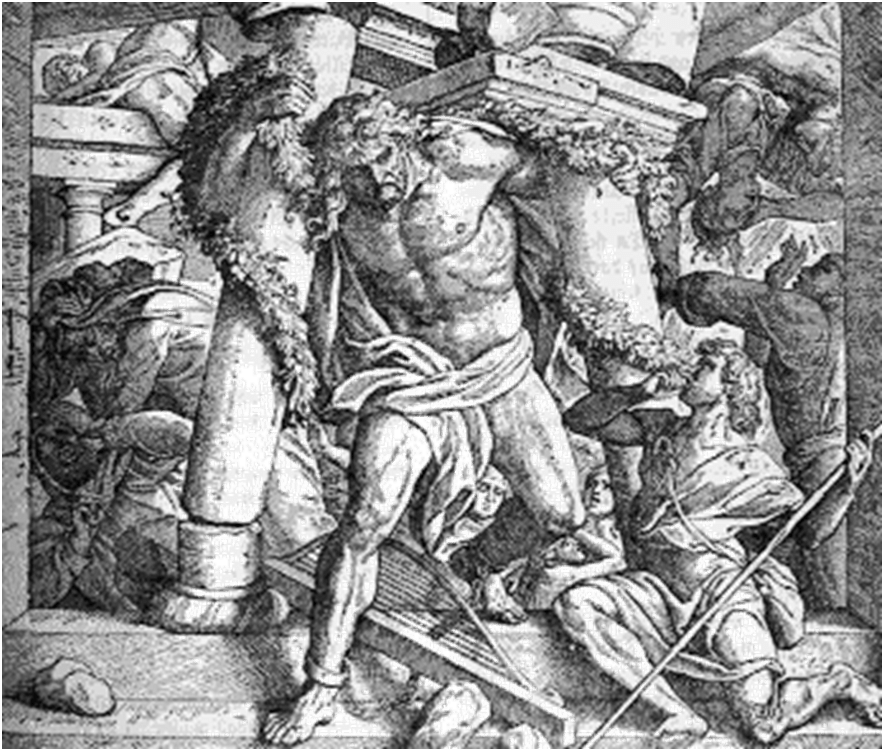
And this is brilliantly too the case in Samson Agonistes as Moshenska sees it. It is easy to see Milton as justifying a general destruction of all that he does not like and brands as alien or ‘Philistine’ in Samson, yet surely this view cannot be justified in the name of fairness to others, especially those innocent of the political machinations that make the feast of Dagon a symbol of restored Stuart monarchy. On the one hand Milton appears to justify Samson’s generalised act of violence which brings down the whole moral order because it is perceived as ‘backward and alien’, like the Restored monarchy.[31] On the other hand Milton never justifies Samson’s violence as truly divinely inspired and the reader is left to decide between ‘a desire for open thought and imagination, and an opposing impulse to limit, restrict, exclude, and violently castigate. … justifying almost anything to himself if he deeply believed it to be right’, even mass-murder. The reader is, that is, left free to decide whether Samson is an exemplum of self-righteous moral knowledge (a prophet) or a poet’s creation demanding external judgement on a more complex moral scale.
This is a strong and beautiful book. It will repay many re-readings alongside the poems themselves and will increase the tolerance for Milton in ways some criticism does not. Indeed the latter often leads us to abandon reading Milton and a belief that we know already all that he has to offer. I think we do not know that. Read it if you love Milton or read it if you have for long just tolerated Milton’s reputation because of his placement in the canon. The latter may change their mind.
All the best,
Steve
[1] Joe Moshenska’s (2021: 49) Making Darkness Light: The Lives and Times of John Milton London, Basic Books (John Murray Press).
[2] Ibid: 9
[3] Ibid: 10
[4] ‘Thoughts, whither have ye led me, with what sweet / Compulsion thus transported to forget / What hither brought us, hate, not love, nor hope / Of paradise for hell, hope here to taste / Of pleasure, but all pleasure to destroy, / Save what is in destroying, other joy / To me is lost.’ Satan in Paradise Lost Book IX lines 473 – 479.
[5] Moschenska op. cit.: 11
[6] ibid: 16
[7] Ibid: 23
[8] Ibid: 88
[9] D. Daniel (2018: 69) ‘Dagon as Queer Assemblage: Effeminacy and Terror in Samson Agonistes’, in Orvis, op.cit. but also available as a free download at: https://core.ac.uk/download/pdf/268672135.pdf. As cited in my blog on McDowell, available with quotation referred to here at: REVISED VERSION: ‘For if we look on the nature of elemental and mixed things, we know they cannot suffer any change of one kind or quality into another without the struggle of contrarieties’. Understanding the life of John Milton (up to 1642) through the lens of Nicholas McDowell’s (2021) ‘Poet of Revolution’ – Steve_Bamlett_blog (home.blog)
[10] Moschenska op.cit.: Chapter 2, 78f (money) and education (92).
[11] Ibid 91ff.
[12] Ibid: 99f on the meaning of a boy’s classical education into the meaning of what it means to embody the feminine too, provided it is regulated and controlled.
[13] Ibid: 197
[14] Ibid: 199
[15] Ibid: 201f
[16] Ibid: 6
[17] James Parker (2021) ‘Rewriting the Book of Genesis ’in The Atlantic (online) [DECEMBER 20, 2021] Available at: Review: ‘Making Darkness Light,’ by Joe Moschenska – The Atlantic
[18] Moschenska op.cit.: 30
[19] Roberta Klimt (2021: 32f.) ‘Paradise Reimagined’ in Literary Review ((Issue 501, Oct. 2021), 32-33.
[20] Moschenska op.cit.: 46
[21] RYAN ASMUSSEN (2021) ‘The Radical Potential of Milton in “Making Darkness Light”: An Interview with Joe Moschenska’ in The Chicago Review of Books (online) [DECEMBER 14, 2021] Available at: The Radical Potential of Milton in “Making Darkness Light”: An Interview with Joe Moschenska – Chicago Review of Books (chireviewofbooks.com)
[22] Moschenska op.cit.: 24 citing Milton’s sonnet on Shakespeare published in 1632.
[23] Ibid; 39
[24] Ibid: 117
[25] Ibid: 92
[26] Ibid: 100
[27] Ibid: 119f.
[28] Ibid: 300
[29] Ibid: 306
[30] Ibid: 296
[31] Ibid: 385
 Steve_Bamlett_blog

7 thoughts on “Artworks ‘are coagulations of the time their creators spent making them. They offer us a particular quality of time’s passing, and ask for our time in response. But how much time? …’. Truth-telling in spite of the academic conventions: a case study of how to do this in Joe Moshenska’s (2021) ‘Making Darkness Light: The Lives and Times of John Milton’”