Watching Prince in Purple Rain – a blog. Paying a debt to a friend who introduced me to this artist.

It simply amazes me that I have watched and enjoyed Purple Rain and even more so that I want to write about it. For this film is a long way from the status of an iconic queer film, the usual reason motivating my writing. Moreover, its representations of masculinity, though playful are not aimed at a gay audience, though that might be possible to argue about the gigolo character in Under a Cherry Moon, which takes the male pout to regions of availability that somewhat belie the storyline and characterisation of the character played by Prince as a magnetic draw to rich heterosexual women.
It even further surprises me that the suggestion of a queer theme has a history in this film, as evidenced perhaps by Cynthia Rose’s review of it in 1984:
Suggestions of homosexuality – a persistent rumour surrounding Prince – also abound. The Kid feels for his mother, yet is impotent to defend her against his father; rival Morris Day conducts a jive Abbott and Costello routine with his sidekick Jerome (who at one point disposes of an importunate woman into a dustbin for Day).[1]
It is fairly clear that no-one could have written this paragraph in the present day and that it is about someone very distant from the proud queerness of an alternative sexuality. The supposed hints seen by Rose are part of the machinery of male gay stereotype – lifted largely from the medical and cod-psychoanalytic aetiologies of medicalised homosexuality, which justified its tolerance of the type by its reduction of male sexual attraction to other males to aetiologies of family pathology – men so in love with their mothers they could only envisage sex with other men if not with that one woman. It is possible moreover that the enabling of a misogynistic stereotype of the relationship between the Morris Day character and Jerome is precisely meant to contrast with the rougher but sexually motivated love-hate relationship between the Kid and women.

This is especially so the cycles of humiliation and sought dominance in the power-plays with female lead Apollonia Kotero. It is she who is being pointed out for humiliation in the still below. Yet it is also a symbol of the manner in which the Kid can see into his audience and expose their latent need to want him despite themselves and despite the transformation of their desire, almost certainly the case with the Morris Day character, of their sexual attraction to him to projected loathing and wish to kick this troublesome proof of their unownable passion into the long grass where it might stay invisible.
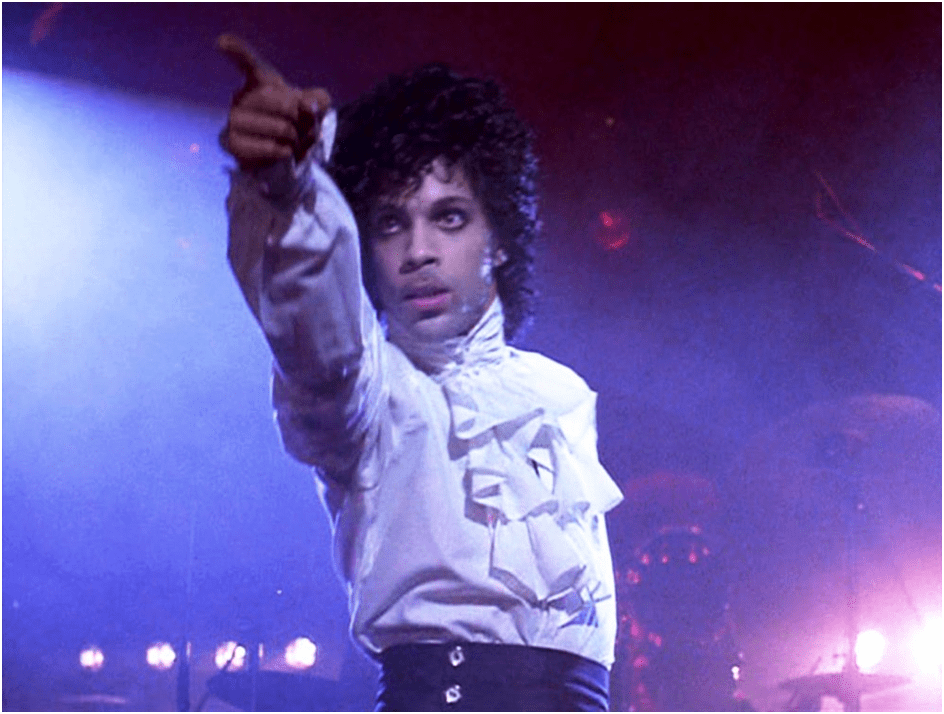
As Rose points out transitions in the drama, and notably those between fictive but semi-autobiographical romance and the highly charged eroticism of his music are often engineered by use of the ‘omnipresent scooter’: ‘Unlike most ‘music films’, and more like successful film musicals of old, Purple Rain also shifts easily between ‘drama’ and musical performance – albeit with some help from the Kid’s omnipresent scooter’.[3] This scooter (the word itself reminiscent of Mods culture in Britain of the 1960s) is a potent symbol of the means by which the Kid both dominates and transports (literally and metaphorically) the singer and rival band leader, Apollonia. It is used in the film’s publicity (see the poster near the blog heading), bearing a potent heterosexual rather than hermaphroditic symbol on its gleaming frontage.
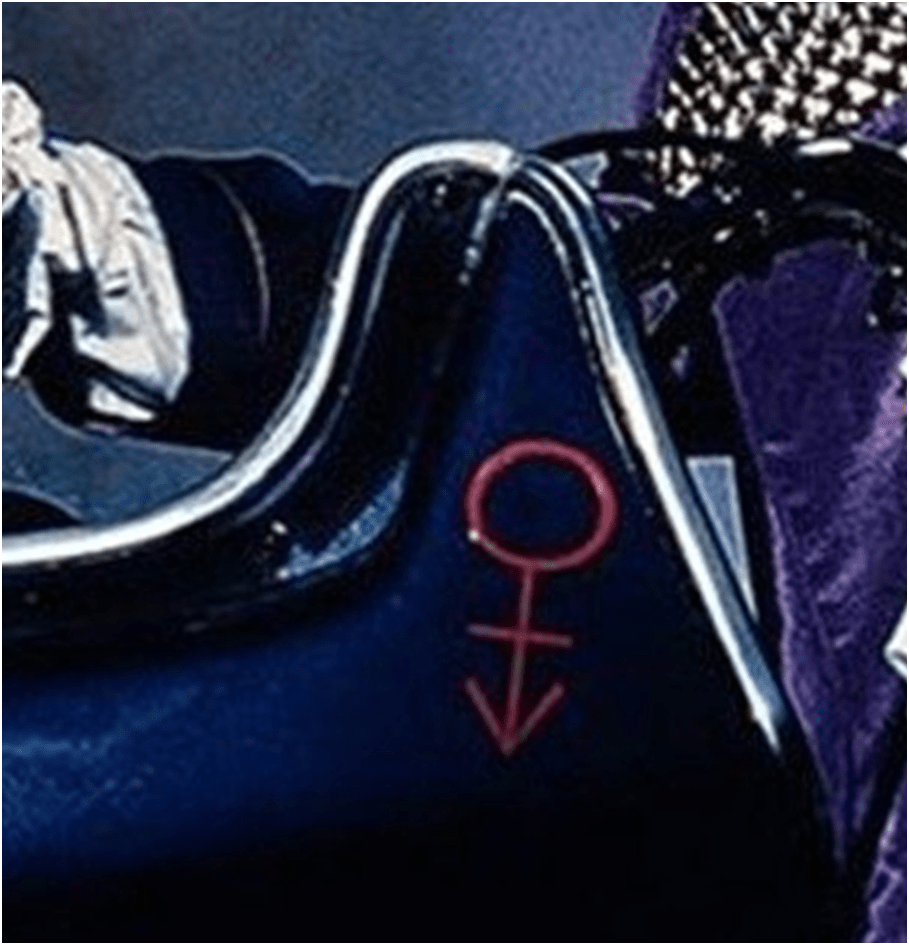
The poster gives away a lot of the plot. Apollonia must descend from her pretended dominance to Prince to sit behind him on this scooter. The classic scene is the Kid’s formal humiliation of her by getting her to bathe naked in front of him in the icy waters of the wrong lake before drying her off behind him on the noisily performative masculine thrust of his wheel-spinning scooter. Even the lesbian characters from Prince’s band – in reality as well as fiction – are utilised to mimic Prince’s dominant phallic identity in the film. One mimes oral sex in front of him on the stage. It is a bold shot.
Of course the sexual politics are more dynamic than this and the misogynism of the Kid in the early film is merely one of the unattractive traits that he loses as he realises the need to abandon the narcissism of his earlier musical persona. The key symbol of this change is his realisation that his fictive father, based as Rose notes on Prince’s own real and equally abusive father, was abusive largely because he attempted to live the lie of extreme phallic independence as both a musician and man. He refused to allow his son to know that he wrote his songs down so that he could play at extreme independence of resources and others. Only when he discovers his father’s written music does he realise that he should be listening to music shared with him by others. And, in the fiction of the film, Purple Rain, as a musical track, is based on beginnings penned by the two female numbers of his band.
Of course that is a fiction and it is clear that the finished song in the movie has very much been made Prince’s own, as in the non-fiction of the film it probably was. Moreover, the film makes its greatest success not this track but, as Rose says, When Doves Cry.
Considered critically, though, all the film’s best features are encapsulated in the montage which accompanies the When Doves Cry number – which also happens to be the video trailer that has been used to get those record crowds into the cinema.[4]
As Justin, the best critic of Prince amongst my friends says – the film continually plays with the notion that the Kid must not downplay. This notion is that the greatness without which he as a character and the achieved artist in his moral metamorphosis during the film could not exist nor triumph without this heroic artist-hero. The supreme artist (formerly known as Prince, one might say) of the songs and persona building is always evident and the sine qua non of the art of not only its hero, but its villains and sometimes rivals (even one of those is Apollonia).
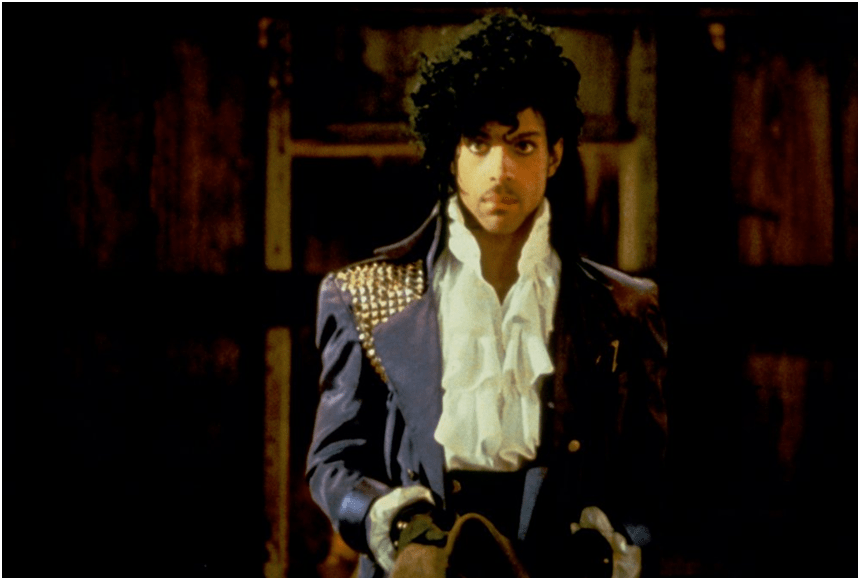
And the thing which holds us in this film, as in Under the Cherry Moon, is the playlist of original music, like the score of an opera with some stunning arias I thought, and the way in which Prince ties this to the visual fascination he creates around the imagery he creates with his beautiful body and face. It is like passion incarnated. As I say I am surprised I write this but pleased because I can’t get the imagery and beauty of the film out of me otherwise – and this despite the often wooden nature of the dialogue and its delivery. One lives with the latter because of the music, the bold narrative arc of self-discovery and the loveliness of the man, though I felt nothing her to encourage queer identification. Nothing at all.

All the best,
Steve
[1] Cynthia Rose (2016, original text from Oct. 1984) ‘From our archives: Purple Rain, reviewed: Minneapolis local legend Prince brings his musical mythology to the masses. From the BFI Monthly Film Bulletin in Sight and Sound, October 1984 available at: Purple Rain, reviewed by Cynthia Rose | Monthly Film Bulletin | Sight & Sound | BFI
[2] Ibid.
[3] ibid
[4] ibid
 Steve_Bamlett_blog
3 thoughts on “Watching Prince in ‘Purple Rain’ – a blog. Paying a debt to a friend who introduced me to this artist.”