Visiting Manchester – Highlights. Wednesday 8th to Saturday 11th December.
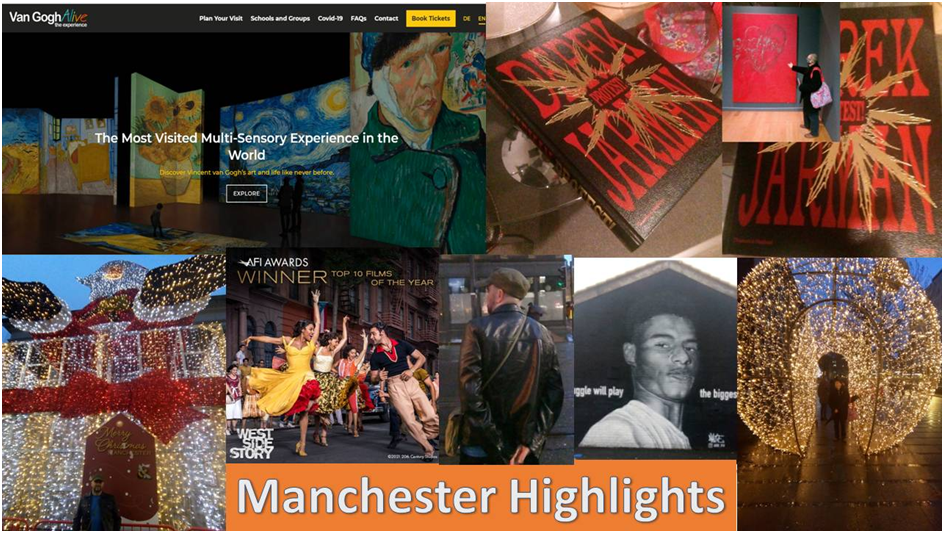
It is enough to see a friend but to see him in a vibrant city full of light, however commercialised, good food and history was special. This blog won’t feature many pictures of Justin because he is notoriously camera-shy, but keen eyes might pick him out. The main art events I have already covered in earlier blogs – on the wonderful Jarman retrospective exhibition at the Manchester City Art Gallery and the Grande Exhibition multi-sensory Van Gogh show at the Piazza in MediaCity in Salford. There are links to those blogs over their names in the last sentence.
However visiting a city is more than its planned events, especially when guided by someone who knows that city well but is yet open enough to see things residents notoriously fail to see because of their habituation to their own city. For instance, I was entranced to come across when we visited the HOME arts centre to see Steven Spielberg’s West Side Story on its first day (of which a little more later) to come across the statue of Engels that was the focus of a favourite (by me at least) piece of socialist art, the film Ceremony, which charted the journey of the statue from its residence in a dump-site in Eastern Europe after the fall of Communism to its location in Manchester and inauguration by Maxime Peake amongst others in celebration of the radical working-class history of Manchester since the Peterloo massacre.
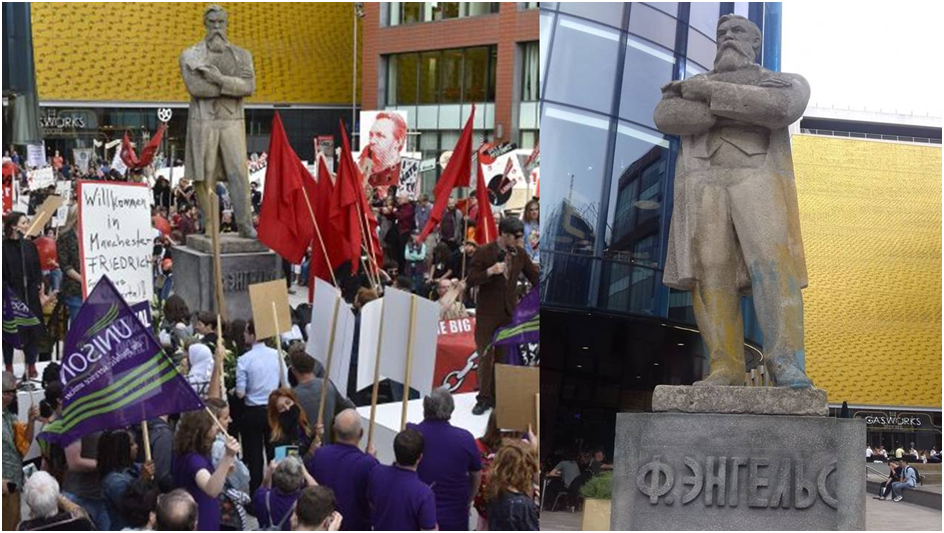
Maxime Peake speaks in this film of how much has changed in Manchester, although the review in The World Socialist Web Site (okay not the most unbiased of reviews) says of the glass-fronted rebuild site in which the statue sits outfacing Pizza Express, as well as having HOME on its side, can still be seen as a site of class struggle:
Ceremony includes an interview with a woman from Lifeshare—a charity recently based in Dantzic Street’s old Mission Street school in Angel Meadow. Every weekend for the past 25 years, Lifeshare has provided breakfast for up to 125 homeless people, as well as other meals. They have been evicted recently from their premises, in a deal between the Labour Party-run Manchester City Council and international property developer, Far East Consortium, to make way for a £200 million luxury residential development of 754 homes.
In Engels’ time Angel Meadow was known as Irish Town, whose “houses were never repaired, filthy, with damp, unclean cellar dwellings; the lanes are neither paved nor supplied with sewers.” [Engels, ibid]
As of writing the council have offered Lifeshare no alternative accommodation–the homeless are banished from Angel Meadow. [1]
Now I can hear genuine, if dispirited, socialists, perhaps even our wonderful Justin, telling me softly and gently (for these are kind people – when they are not preserving personal power and leadership ambition) now that the housing issues are much more complex than can be accounted for by one single-issue voluntary sector voice like Lifeshare. I agree reluctantly. What I want though is a continuation of the debate and the struggle it embodies: a refusal to bow to voices that pretend that, because the electoral system is the way the right holds on to power, the left is doomed to parry its principles, and that is what the ‘restoration’ of Engels to Manchester means for me – the preservation of alternative voices to ensure that democracy is direct and relevant to an inclusive agenda that doesn’t constantly mirror the need to marginalise those not fitted to the status quo. So to see Engels was a treat for me totally unexpected.
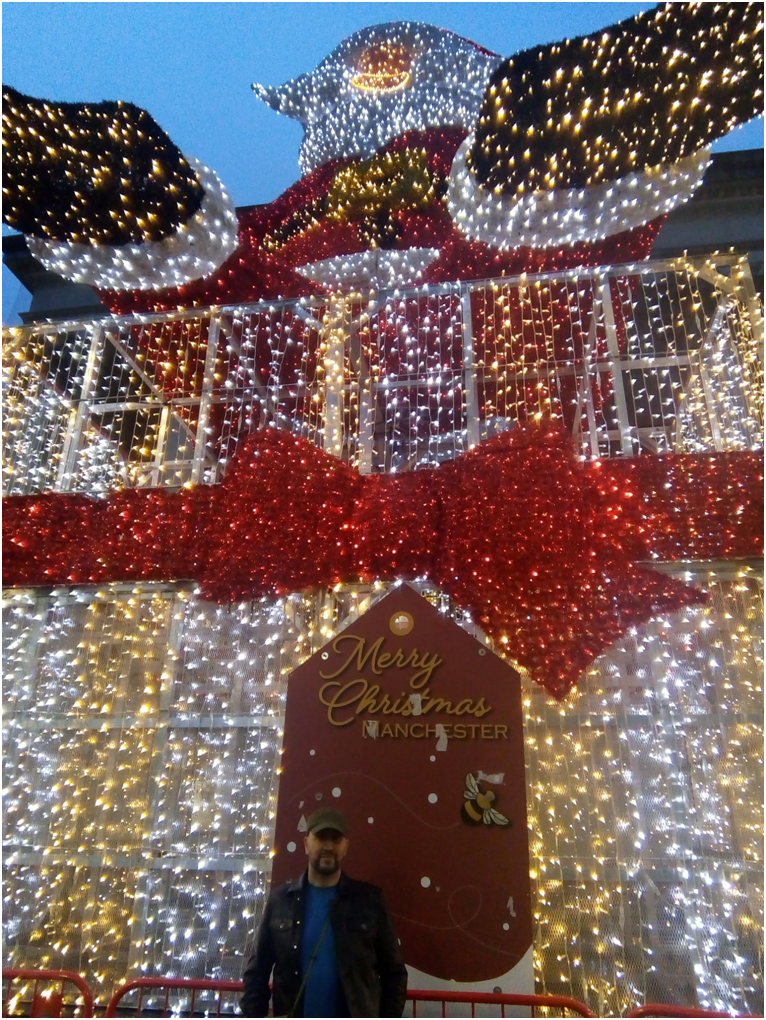
But so was the lighted facade of Christmas Manchester, no matter the commodity fetishism it actually embodies – a huge lit Santa sat on a gift box or an arcade of light in a main square in the city, even the dangling baubles of Canal Street. These too are special. For me the latter recalls that tremendous TV breakthrough Queer As Folk, a genuine contribution to honesty about queer relationships and their developmental accidents in modern urban life – not identities but possibilities.

Those possibilities have their political edge and history too like those celebrated by the first Manchester Jarman Exhibition, Queer, in 1993, and now recalled by this year’s postponed but now a ‘happening’ opening in Manchester City Gallery. I have referred to my own blog on this above.
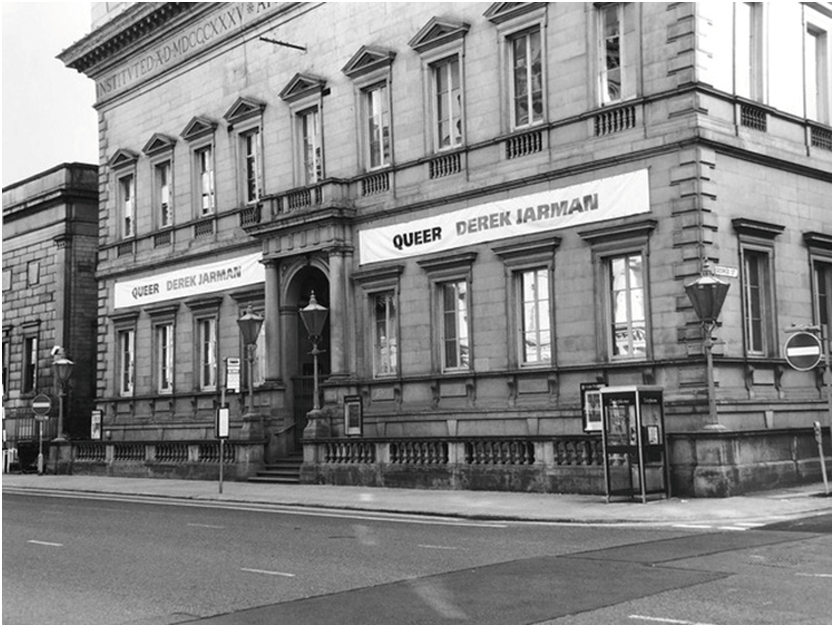
There is something so bold and uncompromising about that 1993 banner. But to return to the metamorphosis of commodity fetishism in the presence of friendship. Lights are more beautiful when they radiate a friend, whose warmth and openness is already well known to you in letters. But in body and spirit all that means much more though you may struggle to see Justin in this photograph.
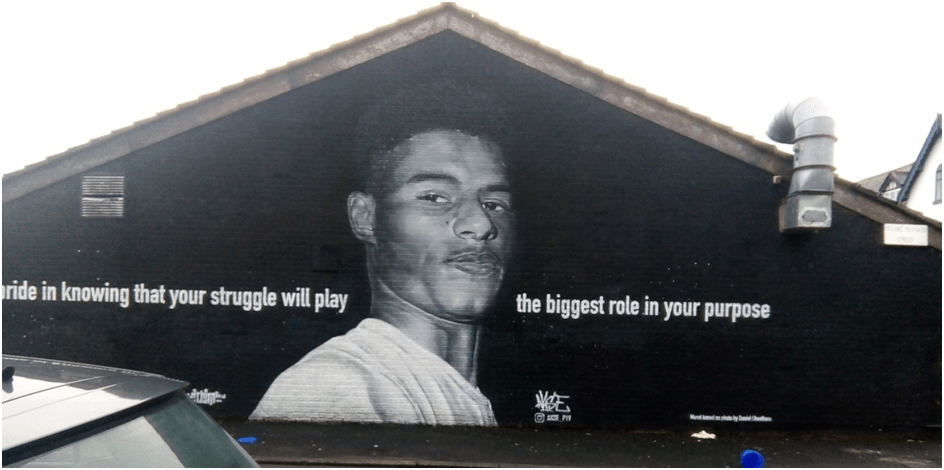
But “less of the hagiography”, I hear our friend say – ever the realist whether on socialism or friendship. LOL. Hard to do when, on dropping him off his home we see the wonderful mural of arcus Rashford in walking distance from him in search of a coffee. It is a mural that became even recently a site of struggle too – about both child poverty and how and why black lives matter. That it sites struggle both in terms of struggle to attain and win through to human value is inspiring still.
When blockbuster films emerge they often suppress struggle so it was great to see that Spiel and Tony Kushner tried to revive a little of it for their remake of West Side Story, although true to say I might have loved this film anyway for the sheer brilliance of its cinematography, choreography and bedazzle. But its confrontation of gender, even there – in the constant reference to the choreography (disturbingly beautiful) of male violence and desperately ugly when men Rita Morena in character says ‘she saw grow up’ turn into RAPISTS. This is a powerful scene – difficult to watch. The recent international scandal over the greater emphasis in Spielberg / Kushner version, slight as it remains, of the trans theme in the original concerning the character of a trans man facing exclusion by his male peers is based on more underplayed material than ought to be the case. This element should, iun my view, have been stronger given the power of the lobby in journalism, the populist arts and academia and the maintained grotesque parody of feminism that links itself to an outmoded over-simple and teleological version of the science of ‘biological sex’. But it is a beautiful film that does more than just entertain, not least in the dances that seem based on a good understanding of the contradictions of masculinity and the role of gangs in bridging such contradictions: ‘Once you’re a Jet you’re a Jet’. Of course, what else could one be?

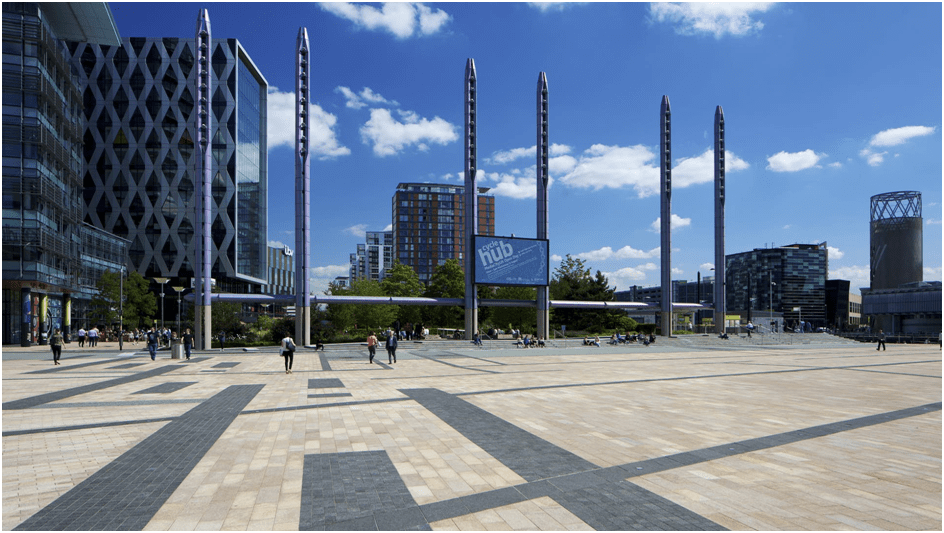
Otherwise we walked and took busses and trams. We saw Van Gogh at the Piazza in Media City, Salford Quays (see photograph below) with new eyes aided by technology and Justin, as I have already said in a blog specific to that event.
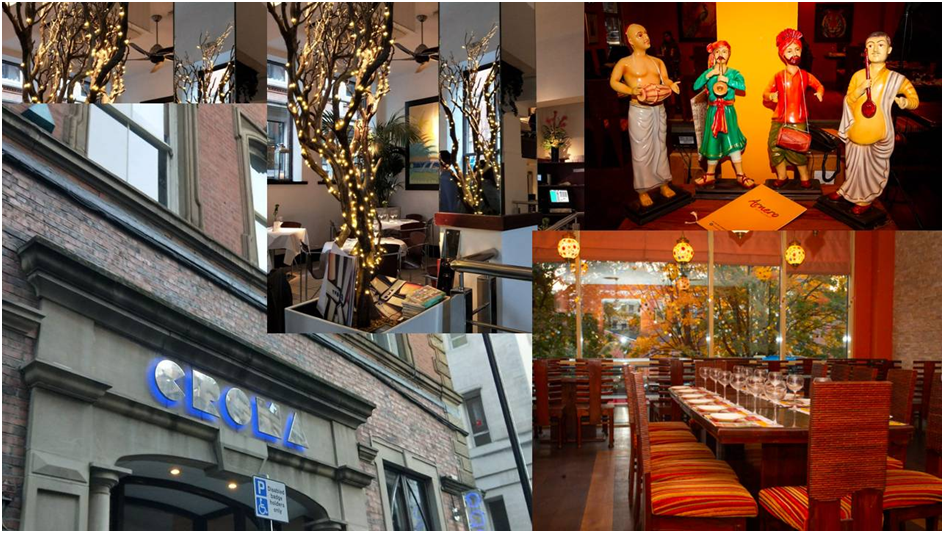
But we also went to some fun restaurants, such as the Arnero on Sackville Street and the Croma on Clarence Street. Fancy a collage of dining venues?
Thank you so much Justin for sharing your Manchester with us and even more for extending it for us to things you might not have done without your ability to host an event in a persons-specific way for your guests. It was enjoyable. When can we do it again?
All the best,
Steve
[1] <em>Ceremony</em>: The journey of a statue of Friedrich Engels from Ukraine to Manchester – World Socialist Web Site (wsws.org)
 Steve_Bamlett_blog
One thought on “Visiting Manchester”