‘They narrate fragments of a psychic life we cannot reassemble for ourselves. It is hard, sometimes impossible, to figure out what kind of life Freud is painting slices of’.[1] This is a blog on a visit to the Tate Liverpool, on Thursday 30th September 2021. The primary purpose was to see a retrospective exhibition Lucian Freud: Real Lives.
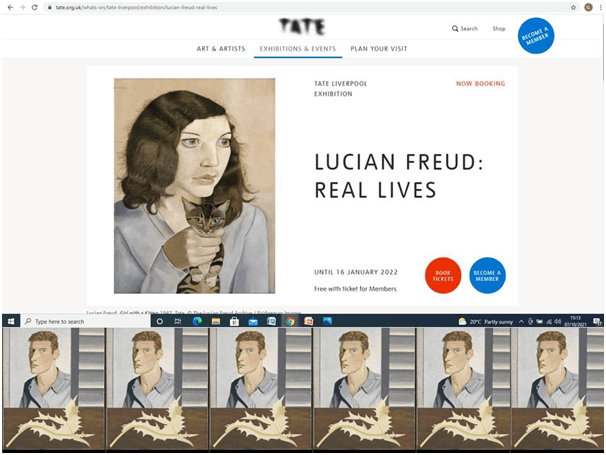
For much more see: https://www.tate.org.uk/art/artists/lucian-freud-1120
Visiting the Tate Liverpool is less an experience than it used to be under former Tate directors. It was then used for major exhibitions over several rooms. I’m thinking of a tremendous Léger exhibition. In 2012 there was even one on Lewis Carroll I saw there which was interesting rather than modish, as the much over praised current Victoria and Albert Carroll exhibition is in London especially. However, after seeing (over only two facing rooms) two exhibitions on Louise Bourgeois (I’ve already blogged on this – follow link) and Lucian Freud, I’m inclined to agree with WALDEMAR JANUSZCZAK’s view that there is much to say about short and selective exhibitions where an over-used and patently untrue idiom can be revived for good purpose: ‘Proof, then, that in Freud, as in most things, less is more’.[2]
But nevertheless, there is a hint of something lacking in this exhibition’s rationale and for me that stands out most in the chosen title: ‘Real Lives’. I think this is because our sense of ‘culture’ currently, one that pretends to be democratic, relies so much on a notion that ‘real’ people are something other entirely than what the invented characters in a work of art are. For this reason, although I am aware I am asserting rather than arguing the premise, we often lose from the picture how much of what makes us feel to be a ‘real person’ is actually sourced by imagination working in co-operation with contingent elements of a world delivered directly to our senses and wrongly (in my opinion at least, thought of as having a merely ‘factual’ existence.
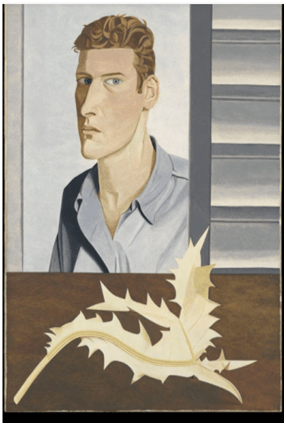
And these shaping effects can proceed from the imagination of either the person who attempts to imitate or ‘act out’ a model of what they see as their ‘real life’ – being prickly like a thistle, for instance[3] – or the person seeing and interpreting behaviours of the observed person which the former process has produced. It is too bold and plays to so much intellectual laziness to pretend that Freud’s primary interest is the reality of his sitters, at least as long as we see ‘reality’ as something easily accessible and immediate, as opposed to the world of ideas, emotions and imagination. One of the favourite quotations from Freud is this, I think from 1974, but I do not know the full source: ‘I work from the people that interest me, and that I care about, in rooms that I live in and know. I use the people to invent my pictures, and I can work more freely when they are there’.[4] Nowhere does this quotation validate that people serve him as a source of access to their ‘real lives’; indeed, they said to be at service to his ‘invention’ of a picture that contains them in an imaginative construct of his own.
I think Freud chose not to name his sitters for bigger reasons than a kind of prurience about their privacy and his own. Yet it comforts us as we try to explain the effects of these paintings as the remnant of an affective relationship that that can be recovered, in part at least, from his biography. This is the assumption I think of the Liverpool artist, Alice Lenkiewicz’s raw online review of the exhibition which exploits her stated puzzling speculation about the paintings of a man who was once a friend of her father’s. Yet there is no real basis for her statement that: ‘The more intense relationships Freud had with people the more interested he was in painting his sitters’.[5] Explanations like this have substituted interest in the life of an artist and their models (especially when these are friends, associates, lover and wider family, as in Freud’s case) for an authentic response to the art itself. These explanations defer our engagement with an artist’s work in the hope of the future revelation of some currently unknown intention, awaiting ever newer biographical research: they are examples of the intentional fallacy writ large. There was less temptation to this recourse in the earlier reception of Freud and this is why I take the citation in my title from that period and the then renowned art critic, Robert Hughes. Here is a longer passage from the essay from which I take my title – I italicise the latter (in the place where italics are not usually expected) in what follows because it contains my main point.
The strangeness of Freud’s paintings comes in large part from the circumstances of their making: they bypass decorum while preserving respect. … . They narrate fragments of a psychic life we cannot reassemble for ourselves. It is hard, sometimes impossible, to figure out what kind of life Freud is painting slices of. Who is the muscular, red-haired youth splayed à la caraudine on the couch in Naked man with rat, 1977-8, his face reflecting an anxious vacuity, his hand raised as though to ward off the painter’s eye? And why is the rodent’s tail draped over his thigh, so amiably close to his thick cock? … [6]
And the painting examined by Hughes (now in a Western Australian gallery) gives the lie to Lenkiewicz’s comment because, since 2016, we know the identity of this model, courtesy of Robin Cawdron-Stewart of Sotheby’s.[7] It was Raymond Jones, a man linked to Freud merely as an art collector who bought his painting of George Dyer (Francis Bacon’s working class lover) hardly the most ‘intense’ of relationships, although a model for other queer related painting including my personal favourite, Naked Man With His Friend. However, neither painting is in this exhibition. A drawing of Freud’s however given to Jones shows that the decision to make the rat and ‘thick cock’ proximate was integral to the painting.
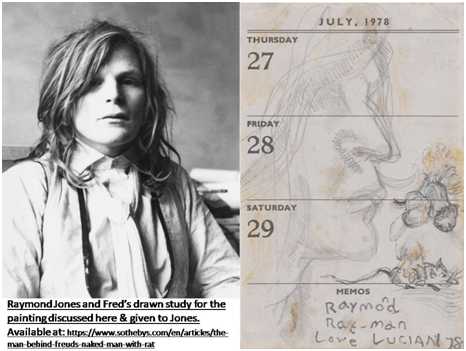
Possibly the more biographical information we gain about the model for a painting otherwise known as merely ‘man’ or ‘woman’, the more we seek answers in an autobiographical intention. But we impose this intention. And this can be harmful to understanding, for Freud clearly avoided picturing some very intense relationships, such as that with Adrian Ryan, and possibly, Bacon.
Alice Lenkiewicz is, I believe, a stronger critic when she talks not as her father’s daughter with that distant relationship to Freud’s circle, but as an artist herself. This comment for instance in her review gave me food for thought for developing my own idea of the real significance, for me at least, of this exhibition:
There seems to be two ways that Freud looks at his sitters. I noticed there was a semi-fictional view of them where he distorts their features and turns them almost into what I felt looked like illustrations from a children’s book of fairytales that had then been enlarged and then there is this more raw and fleshy realist side to his work. It’s quite an unusual trait in an artist. I have not seen many artists jump from realism to what almost seems like surrealism within their life drawings.
That’s a brilliant painterly perception that stands a log way distant from traditional history of art perspectives, whilst using them appropriately. Rather than label these painting as surrealist or realistic portraits of embodied naked subjects with pets, since they weren’t the sitter’s pets usually but supplied by Freud, she describes what she sees as a viewer with an artist’s perspective. And she is remarkably accurate here. This naïf description so well describes, for instance, those early paintings of Freud’s first wife, the daughter of Jacob Epstein, Kitty Garner. These paintings were deliberately proto-allegoric, without any key to the allegories involved as in the surrealist painting generally, and known as Girl in a white dress 1947, Girl in a dark jacket, 1947, Girl with a kitten, 1947, Girl with Roses 1947-8, Girl with leaves, 1948.
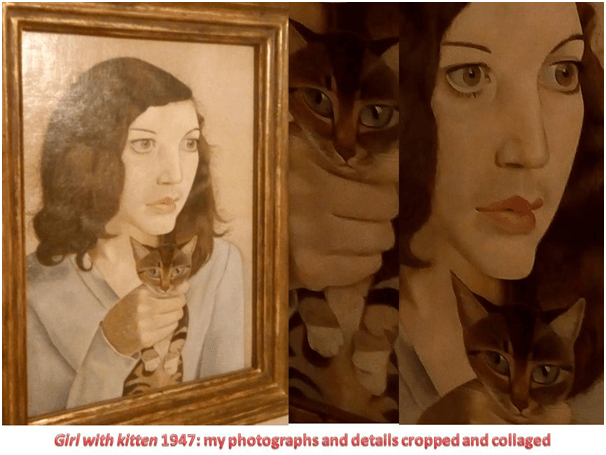
Only the third of this list appears in Tate Liverpool currently (above) and it is the best known of them all, not least because it is often read as containing Freud’s attitude to Kitty as a murderous and self-loathing creature, for she appears to be strangling a kitty/kitten, although such readings are hinted at by the Tate’s description rather than stated:
In this closely cropped composition, in which she is pictured against a beige wall, Garman holds a kitten by its neck in a tense grip, her knuckles especially prominent, seeming to half-strangle the animal without concern. Given that Garman was generally known as Kitty (a short form of Kathleen as well as a familiar term for a kitten), her treatment of the cat raises – and consciously leaves entirely unresolved – questions about her self-image. Garman stares into the middle distance with a pensive expression, while the kitten looks directly at the viewer.[8]
The important thing to note from my point of view is that to treat these paintings as merely indicative of Freud’s view of women and female sexuality, is to get only half the story, important as that story is. For here, I think Hughes take is much more accurate. The viewer is left not with a distinct and immediate readable meaning from this painting but rather that it narrates ‘fragments of a psychic life we cannot reassemble for ourselves. It is hard, sometimes impossible, to figure out what kind of life Freud is painting slices of. [9] I would go further and say that Freud feels the psychic life of this painting is no clearer than the meaning of a de Chirico is immediately or indeed his own more clearly allegorical work, such as the Narcissus, which is also in this exhibition:
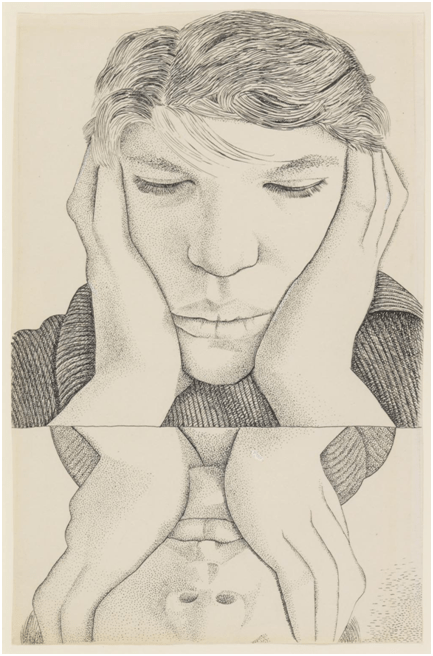
For better than anyone else, Lucian Freud knew that the meaning of the ‘psychic life’ of a narcissist, male or female, was heavily contested and not attributable only to explanations given by his grandfather, Sigmund Freud, in On Narcissism. Indeed I think Lucian continued to puzzle throughout his life, in almost certainly a way that owed a great deal to Surrealism (Salvador Dali too was investigating Narcissism after Freud) as well as the more often cited ‘New Objectivity’ movement, about his grandfather Freud’s pronouncements without necessarily endorsing them at all. In that sense, he made his life’s work the enactment of a case study like that written of Leonardo by Sigmund.
The signs that we interpret in the girl picture are particularly those of the eyes (of both cat and ‘girl’ with the various relation to the viewer’s gaze), the animal-human relationship and the gesture of bodily grasp and possession. In that sense Lenkiewicz is correct to cite in her review, Freud’s statement: ‘You ask why I’m fascinated by the human figure? As a human animal, I am interested in some of my fellow animals: in their minds and bodies’.[10] I would argue however, that this question still remains an open one and not easily resolvable by simplistic allegories applied to Freud’s very queer relationships (also still open for scrutiny for us despite authority dubiously offered by so many) with both women and men.
To see Naked Portrait (of 1972-3) is interesting because we know now how Freud approached his subjects and the brutality that involved from Celia Paul’s account in her recent memoir of her experience of being painted as Naked Girl with an Egg, in the ’autumn of 1980’.
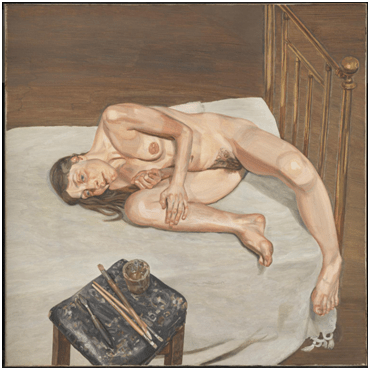
When he came to my breasts, I felt his scrutiny intensify. I felt exposed and hated the feeling. I cried throughout these sessions. He tried to comfort me by telling me how much I pleased him. But I didn’t believe him, because the evidence of what he really felt was on the easel in front of me. He decided to change the cover on the bed to a black cloth, so that the whiteness of my flesh would stand out more strikingly.[11]
The brutality of this process as it is described by this sensitive sitter strikes immediately and ought to make us look again at Naked Portrait, which is, I believe, modelled by daughter, Bella, who no doubt received similar instruction, even down to cupping her breast with a hand, which Paul describes as given to her because ‘the way the skin of my breast rumpled under the touch of my hand’ was ‘what attracted him’.[12] The control of design in the interests of the artist then links both the more ‘fairytale’ and fleshly portraits and I take it this is why palette and brushes form an important part of Naked Portrait. Both Bella and Paul, and another lover Suzy Boyt and her son, Kai, were arduously modelled to form the impressive Large Interior W11 (after Watteau) dated 1981 – 1983. The models are subjected entirely to a design that remains surreal:
The whole theme seems to be about complicated erotic cross-purposes. The painting is full of yearning. … It appealed to Lucian because of his own complicated love life and the undercurrent of jealousy that I think he needed …[13]
That Paul reads the painting as an externalisation of the painter’s sexuality is fair enough given her subjection to it, but when we return to the other manner of painting by Freud mentioned by Lenkiewicz and named as his ‘raw and fleshy realist side’. For this ‘raw and fleshy realist’ mode is, in truth, is as ‘painterly’ a construct as the imaginative assembly of figures in imaginative compositions, however ‘fairytale’ they may be in conception. The real difference is that this ‘side’ is far less dependent on the pure line as its formative unit, depending on shading and less dependent on optic vision and much more on haptic vision, the sense of touch coming through the eyes but realised in the bodily senses as a form of proprioception. Sebastian Smee brilliantly summarised this passage from dependence on outer to inner eye, if with rather less psychologist’s jargon, in 2019:
The young Freud’s portrait subjects were largely unnamed. Their exaggeratedly large, glistening eyes [my note: think of both kitty and her kitten above] became, as time went on, less liquid and intense, and in fact dead-eyed and quite often asleep, as if defended against the cliché that the eyes in a portrait should be ‘a window into the soul’. Freud talked instead of wanting to treat their heads as if they were ‘just another limb’… these heavily incrusted paintings were to be experienced as rich accumulations of highly specific but anonymous intimacy, of fiercely particularized ordinariness and vulnerability, patiently scrutinised over weeks, months and sometimes years.[14]
This can be seen in ways particular to each medium in companion drawing and painting of Kai Boyt, considered by Freud as his stepson:
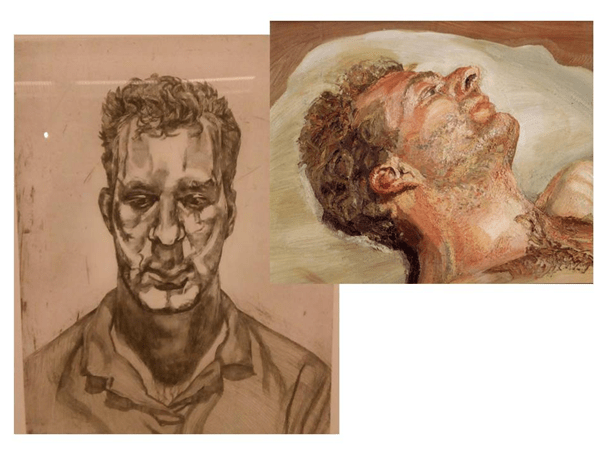
What is done by cross-hatching in the drawing (heavily influenced by the method of Rembrandt I’d guess) is done by the ‘encrusted’ (as Smee calls it) impasto used in the oil and here influenced particularly by late Titian. We can see the latter if we consider detail of the Kai oil painting.
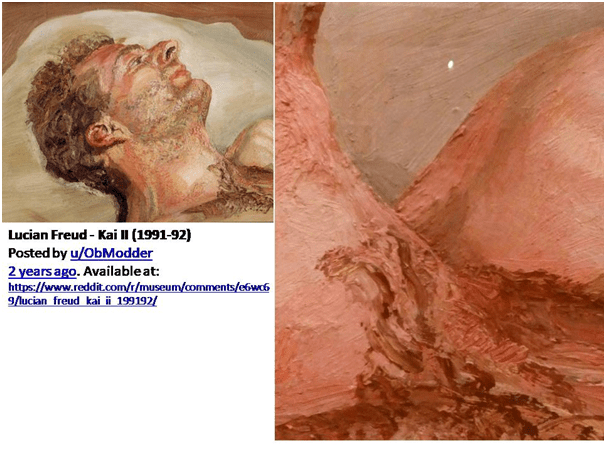
The photograph of the impasto effect is my own. It shows the simplicity of the marks which reproduce the effect of layers of hair, skin and fat that make up middle-aged male skin and it is felt in the heaviness of the brush-strokes and dabs of paint. For a clearer example look at how Freud constructs his own penis in Painter Working, Reflection (1993) – use the link to see a copy of that painting.
If the head is ‘just another limb’, likes those of Eli, Freud’s whippet, so is the male phallus and this is surely the case with David Dawson, Freud’s long-term assistant and model, but himself a photographic artist, whom in common with most men who accepted they must pose naked do not record the arduous and painful process of sitting for Freud as painfully as Paul does – but then this has much to do with male introjection of a supposed hardness to being seen. Impasto works in both case to suggest variations of thickness, vulnerability and blindness of the feel of layers of aging skin.
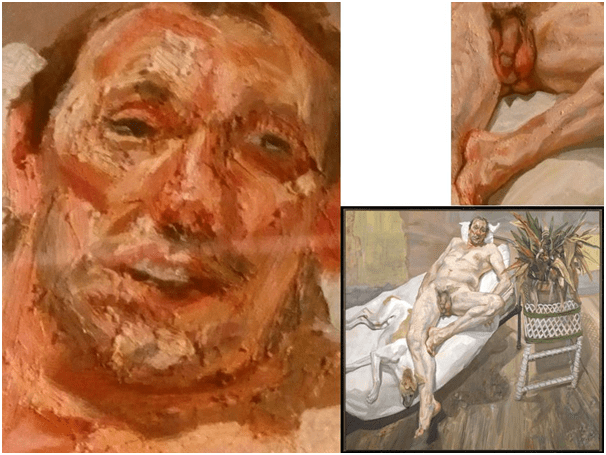
Of course the very best illustrations are those of Leigh Bowery, a man known for the flamboyance with which he covered his naked skin with flamboyant drag and make-up. The smoothness of the skin in David Dawson’s respectful photograph of him shows how this self-belief can be respected. But not Freud, who uses his impasto to suggest Bowery is in the process not only of aging but of dying – he openly spoke of his health as a victim of AIDS at a time when this was a death sentence.
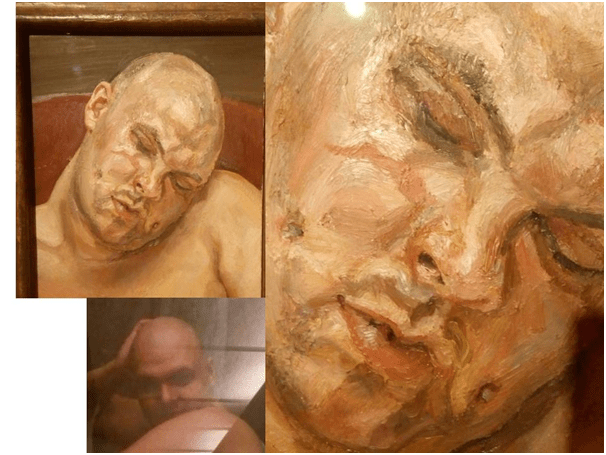
Look at those indentations in the cheek skin of Bowery’s sleeping face, deeply unconscious as if in death – which seem encrusted in the way sick skin may be. Bowery is turned into mere body in the sense not only of life but that of death. I find this painful although Bowery, it appears never spoke of this. It does not mean however that he did not feel as used as did Celia Paul, Bella and Kai Boyt, as fancily and effeminately clothed as a boy and naked as man. I tend to think Fran Yeoman hints at this in her review for ‘Northern Soul’ (online):
Another change of pace comes with the David Dawson photographs of Freud’s studio which, along with a well-constructed audio guide, offer an insight into the realities of the artist’s working life. These prints also offer glimpses of what isn’t in this exhibition. In the background of one photograph is the monumental work Leigh Under the Skylight, whereas visitors here get only a relatively modest painting of performance artist and regular Freud sitter, Leigh Bowery.[15]
Under the Skylight is monumental in that it actually turns Bowery into a satire of classical statuary but, as a portrait the ‘relatively modest’ painting is as near as perfect a painting of the link of art to the immortality of dead subjects as you can get. Please go on see this exhibition before it finishes early next year.
All the best
Steve
[1] Robert Hughes (1987: 21) ‘On Lucian Freud’ in The British Council & Robert Hughes Lucian Freud: paintings (the catalogue of the 1987 exhibition at the South Bank Centre organised by Andrea Rose) London, The British Council and Thames & Hudson Ltd.
[2] Lucian Freud at Tate Liverpool review — the naked truth is revealed – Waldemar Januszczak
[3] William Feaver (2019: 241)Te lives of Lucian Freud: Youth 1922-68 London, Bloomsbury publishing says Man with A thistle (see text above) is ‘an account of what it felt like to find mannerisms cramping one’s determination’.
[4] Freud cited by Christies (2017) ‘Lot Essay’ written for the sale of the drawing of Kai by Freud by Christies Available at: https://www.christies.com/en/lot/lot-6098246 This drawing is in this exhibition.
[5] Alice Lenkiewicz (2021) ‘A review of Lucian Freud: Real Lives In Focus Tate Liverpool’ in artlyst.com –Available at: https://www.artlyst.com/reviews/lucian-freud-real-lives-focus-tate-liverpool-alice-lenkiewicz/
[6] Robert Hughes op.cit: 21
[7] Robin Cawdron-Stewart (2016) ‘The Man Behind Freud’s Naked Man With Rat’ on Sotheby’s (online) (Sept. 22, 2016) Available at: https://www.sothebys.com/en/articles/the-man-behind-freuds-naked-man-with-rat
[8] Tate (online) available at: https://www.tate.org.uk/art/artworks/freud-girl-with-a-kitten-t12617
[9] Robert Hughes (1987: 21) ‘On Lucian Freud’ in The British Council & Robert Hughes Lucian Freud: paintings (the catalogue of the 1987 exhibition at the South Bank Centre organised by Andrea Rose) London, The British Council and Thames & Hudson Ltd.
[10] Lucian Freud cited Alice Lenkiewicz op.cit.
[11] Celia Paul (2019: 96f.) Self-Portrait London, Jonathan Cape. See my blog on this wonderful book by following this link.
[12] Ibid: 96.
[13] Ibid: 105
[14] Sebasian Smee (2019: 46)’The Anarchic Idea of coming from nowhere’ in The Royal Academy (Peter Strawbridge (ed.)) Lucian Freud: The Self-Portraits London & Boston, The Royal Academy & Museum of Fine Arts, Boston. 41 – 50.
[15] Fran Yeoman (2021) Review of Lucian Freud- Real Lives at Tate Liverpool in Northern Soul (online) September 12, 2021 Art, Arts . Available at: Northern Soul Review: Lucian Freud – Real Lives, Tate Liverpool


8 thoughts on “LIVERPOOL VISIT 4: ‘They narrate fragments of a psychic life we cannot reassemble for ourselves. It is hard, sometimes impossible, to figure out what kind of life Freud is painting slices of’.[1] This is a blog on a visit to the Tate Liverpool, on Thursday 30th September 2021. The primary purpose was to see a retrospective exhibition ‘Lucian Freud: Real Lives’.”