‘…: He came each to avoid the eyes of everyone who wanted him … . The gossips said he refused to sleep with people because he had a small penis – the leprosy of homosexuals – but this explanation was mundane: He wanted to keep this life in the realm of the perfect, the ideal. He wanted to be desired, not possessed, for in remaining desired, he remained, like the figure on the Grecian urn, forever pursued’.[1] Reflecting on art and penis size in ‘dick lit’ with a focus on Andrew Holleran’s (1979) Dancer from The Dance London, Jonathan Cape Ltd.

The republication of 2019 with the McMillan blurb and my old copy of the novel in first British ed.
First of all it would be worth defining and justifying the term ‘dick lit’ that I use in my title. To be fair I use it mainly because it forms a ‘feminine rhyme’ (that terrible old sexist label is used ironically) with the term ‘Chick Lit’, which might be accorded status as a genre in writing because Wikipedia has an item on it (see link if you want more). But it isn’t generally accepted term in either popular literary talk or that on queer novels, as isn’t Ferro’s term, according to Holleran below, ‘gay litter’. However, it is apt for my purpose, which is to identify a kind of tradition in male queer writing marked by a value system that cohered around the male phallus but not probably covered by the politicised term phallocentrism, probably synonymous for most part with the writers known under the label, The Violet Quill.[2] :
…, I think what Robert Ferro used to call “gay litter” has gone through several stages: the gay flowering, the opening up, followed by gay bookstores, gay sections in mainstream bookstores, and big advances for gay books—and then the publishers’ realization that this was not the big market they thought it might be (those huge advances given to writers on gay subjects that did not pan out)—and then the David Leavitt Period, the new generation who blended gay and straight characters (what Felice called “dickless lit”) and who did not want to be reduced to being “gay” writers, …[3]
I cite this because of Holleran’s use of the inventive term ‘dickless lit’ (originally derived from Felice Picano he says) for the period characterised by the earnest novels of David Leavitt and others like him. In his view this was the way in which Leavitt and others distinguished the content of their novels from those of The Violet Quill writers who preceded them. It is interesting that Holleran sees their protest, in practical terms, in relation to the presence or absence of ‘dick’, since this is not how, according to David Bergman’s study, Leavitt himself poses the difference. Admittedly Leavitt believes that the effect Dancer from the Dance on young gay men was baneful: he cites a friend saying to him that, ‘it’s the first gay book most young American men read, and I can’t think of another that’s done as much damage’. Yet the damage is not done by the concentration on the penis as the measure of effective and affective sexual identity for gay men but by their ‘voyeuristic fixation with beauty’.[4]
These youth were scarred (and Leavitt uses himself as an example) because the novels taught that ‘only the most exceptionally beautiful gay men were entitled to erotic fulfilment’.[5] But this objection, although it may apply to Picano’s central characters who are the cynosure of a lustful gay gaze in novels like The Lure and The Book of Lies, would really be hard to press into service for Dancer from the Dance. For though both the beauty of Sutherland, a drag queen, and Malone, a ‘circuit queen’ are repeatedly reported, that is far from the only, or indeed main, criteria for the selection of sexual partners in the world of this novel. What I argue is the case is that males from these novels often become represented entirely through ‘cock’ and the size thereof.
Andrew McMillan, a great queer artist and cultural hero in my opinion, spoke highly of Andrew Holleran’s Dancer From The Dance in 2019 on its republication with a preface by Alan Hollinghurst. He ends his review thus by referring to where in one:
… moment of dazzling oration by Sutherland in Dancer from the Dance sees him turn to the subject of politics: “We live, after all, in perilous times of complete philosophic sterility, we live in a rude and dangerous time in which there are no values to speak to and one can cling to only concrete things – such as cock.”
It’s a speech worthy of any politician in 2019. I’d vote for his or her party, and these two books would be the best manifesto on which to build a platform of queer love and self-acceptance, and ensure the foundations of our community are not further eroded.[6]
Now Dancer from the Dance has often invited people, like Leavitt, to summarise its real or probable (as in McMillan’s case) effects, whether political or developmental, on themselves. Whilst McMillan sees some resonance between Holleran’s New York in 1978 and Britain in 2019, Les Fabian Brathwaite says that in 2018 ‘re-reading it, I felt invisible, whereas it once made me feel truly seen’. For the latter this in in large part because of its concentration on exclusive rich white WASPy desires in which the racist ‘fetishization of Latino men’ is a large feature.[7] And Braithwaite might have added, but he doesn’t, that the fetishization of Latino men in the book has it’s root for its small Fire Island Pines character set of a ‘lie’ of which Sutherland tries to disabuse Malone that, ‘all Puerto Ricans have big cocks’.[8] Myths such as these are analysed by Franz Fanon in Black Skin, White Masks as a means of translating white sexual desire (or fear) of the otherness of black men into a reduction of them to their penis, in either case eradicating their validity as persons first and foremost.[9] That this happens to Puerto Ricans in the novel hardly needs further illustration but it also is a means of reducing all men to that appendage as a measure of their worth. Hence the citation in my title, which, again has a racial tinge. It applies to a man known as the ‘most beautiful Oriental’. I will give a longer version of the quotation here, which starts by arguing that, despite his allure, he was:
‘… in fact chaste, as the handmaidens of Dionysus were: He came each night to avoid the eyes of everyone who wanted him … . The gossips said he refused to sleep with people because he had a small penis – the leprosy of homosexuals – but this explanation was mundane: He wanted to keep this life in the realm of the perfect, the ideal. He wanted to be desired, not possessed, for in remaining desired, he remained, like the figure on the Grecian urn, forever pursued’.

Terracotta Nolan neck-amphora (jar), ca. 470–460 B.C., Attributed to the Achilles Painter, On view at The Metro polytan Museum of Art, New York, Fifth Avenue in Gallery 159, Obverse, Eos (the goddess of the dawn) pursuing Tithonos. Available at: https://www.metmuseum.org/art/collection/search/251933 Of course this is the pursuit of a man by a female god but you get the point.
The intention of this blog is to eventually turn again to this piece for what it says about the representation of gay life and the role of art therein and I promise any reader (should there be such) that the prominence of Keats’ Ode On A Grecian Urn in this passage will not go unnoticed in the long term. But for now take on board that elaboration of the meaning of a ‘small penis’ as ‘the leprosy of homosexuals’. There is a later example in a list of ‘circuit queens’ who frequent the bath houses which includes the deliciously named ‘Randy Renfrew (whose penis was so small no one would go to bed with him)’.[10] Of course penis size is one of many features that I wont to call superficial, but which I can’t because their essential attractiveness is probably imprinted in a queer man of my age and history. These corresponding features are described in the story of how Malone decided to improve the look of his body: ‘For if anything is prized in the homosexual subculture than a handsome face, or a large cock, it is the well-defined athletic body’.[11] Elsewhere the narrator quotes Sutherland saying that there ‘were only two requirements for social success with those queens ….: a perfect knowledge of French and a big dick’.[12]
There is no doubt that the ubiquity of the standard set by penis size was understood by other Violet Quill readers and writers. By 1985 George Whitmore could makes the concentration on male sexual equipment almost a means of exposing the emptiness of male relationship focused solely on this. In an important sexual encounter in The Confessions of Danny Slocum analysed by David Bergman, the eponymous hero, Danny, describes his lover as holding Danny’s ‘cock in his soft brown hand – like the gearshift on a car’. Bergman says this passage turns the penis into to ‘an implement for controlling an energy that is directed elsewhere, a mechanical instrument that is manipulated but not enjoyed’.[13] In the same novel Danny reveals he has read Dancer from the Dance, taking from that experience a lesson based on the very passage I have used in my title: ‘I’m reading this new novel in which a character says that men with small cocks are the lepers of the gay world’.[14] At this point I feel that queer writers and readers, of which I am one of the latter, need to examine carefully how representations of gay men by themselves in terms of this standard of human value stand in terms of our wish to see ourselves represented. I cannot be so sanguine as Andrew McMillan was in 2019, because I think this is as an issue about sex/gender as a subject implicating men of very different identifications of the orientation of the sexual and amative desires.
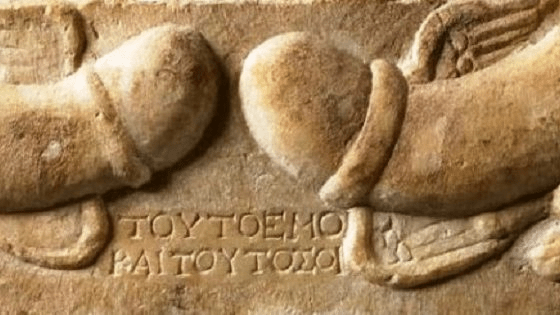
ΤΟΥΤΟ ΕΜΟΙ ΚΑΙ ΤΟΥΤΟ ΣΟΙ (this for me and this for you). 1st c.BC,Delos Archaeological Museum. Available at: https://www.mykonosgreece.com/the-phallus-phallos-in-ancient-greece/
Men who have sex with other men may be socialised into sex/gender roles that show little or no variation from the phallocentrism that defines male sexual activity in many contexts. In my own view the use of a standard of penis size is more deeply rooted than in queer male cultures and, in some ways, is on the ebb in favour of a more diverse sense of potential male sexual or amative experience. At least, I personally hope so, though I recognise the old horny Adam too in myself. And, in the final analysis, I remain unconvinced that Holleran feels that his novel stands as a political manifesto in the statement of any of its characters in the way McMillan says it might be, especially in the belief that we, as a queer community, at least the male identifying section of it will gain if our values ‘cling to only concrete things – such as cock’, in Sutherland’s words.
And I think generally very literary aware queer readers might take more seriously the constant echoes in Holleran of the art he considers the finest, especially in its title, which derives from the final stanza (and line) of Yeats’ poem Among School Children.[15] If we remind ourselves of that poem, another direction into Holleran’s novel is pointed towards quite directly, which still develops diverse queer themes, if not only those confined to unreflective sexual interaction. It may however reflect on another thing – reflective sexual interaction.
Labour is blossoming or dancing where
The body is not bruised to pleasure soul,
Nor beauty born out of its own despair,
Nor blear-eyed wisdom out of midnight oil.
O chestnut tree, great rooted blossomer,
Are you the leaf, the blossom or the bole?
O body swayed to music, O brightening glance,
How can we know the dancer from the dance?

Uploaded by Marilia Velardi, Serpentine Dance (1891) Portrait of Loïe Fuller, by Frederick Glasier, 1902. Available at: https://www.pinterest.co.uk/pin/817473769832172707/
The point of that final line is that the very finest art (and this line is often referred to the vision of Loie Fuller as a dancer: the producer of an art work wherein the artist’s and her body conjoint are a seamless part of the artwork. Yeats imagines an art that redeems the wastage of body in the labour of producing the art in the epiphany represented by the artwork – that manifestation of an essential wholeness of form and content that is just beautiful. Now dancing in Dancer from the Dance is itself a kind of artwork that is not, as Les Fabian Braithwaite mistakenly argues it is, about dancing with the one you love (or are having sex with since the represented culture does not differentiate these states of interaction) but about the building of beautiful queer interactions between males regardless of sex. For Holleran’s narrator that fundamental interaction between males is the decidedly non-sexual one between Sutherland and Malone:
… that is when we first saw Malone with Sutherland. … Now of all the bonds between homosexual friends, none was greater than that between the friends who danced together. The friend you danced with when you had no lover, was the most important person in your life; and for people who went without lovers for years, that was all they had. It was a continuing bond and that is what Malone and Sutherland were for years, starting that fall: two friends who danced with one another.[16]
In a novel that practices and achieves faux beauty in some of its sentence structures (I will illustrate later but the ones about the ‘Oriental’ young man above are an example, the beauty here is very authentic and built upon an insistence of the meaning of friendship bonds over and above other ones. In it ‘Malone and Sutherland’ by a repetition of that conjunct naming of them become one entity – the ‘dancer’ inseparable from the dance.
I would argue that the point of Holleran’s art is precisely that and it is one quite distinct from that of his narrator and the friend to whom they write. The latter writes in the letters prefacing the novel: ‘Your novel might serve a historical purpose – if only because the young queens nowadays are utterly indistinguishable from straight boys. The twenty-year olds are completely calm about being gay, they do not consider themselves doomed’. I think, but call me old-fashioned, that Holleran calls out here on behalf of those new young people who are reasserting queer identity. Only a line before that last quotation Holleran identifies these as gay liberation ‘activists’, ‘who want the world to believe not only that Gay is Good but Gay is Better’. [17]

Available at: https://www.iglta.org/Events/Gay-Pride-Calendar
The art praised by the novel’s narrator is of an extremely ‘precious’ variety peddled to the elites who make up the character set of the novel, being white, middle-class, attracted to what is other than themselves -by sheer boredom. These people have a political life, whatever the beauty of their friendships that is politically vacant enough to be called cruel, as we see when Sutherland berates a beggar because the latter is ‘just hungry for food’, whilst they are hungry for that which benefits an elite blessed with ‘charm, taste, a curious mind’.[18] Debates about art run through the novel, including from the manqué novelist, John Shaeffer, who falls in love and lust with Malone, who discusses theories of art with Malone based on the sayings of T.S. Eliot.[19] Stuffed with classical references the art of the Fire Island Pines set is actually ‘worshipping Priapus under the summer moon’, in which a romantic art setting is the better foil for the big dick that we see referred to more only elsewhere in this most priapic of novels – at least in the talk it contains. Sometimes this theme runs into a kind of self-pastiche as when Sutherland, after sitting ‘all afternoon hoping to receive the stigmata’, says to Malone of the life of Fire Island Pines:
“It’s not like Plato, is it?” he said, taking down a volume of the Symposium from his bookshelf. “It’s not like Ortega y Gasset, or even Proust, is it?” “or, for that matter, Stendahl. It’s so hopelessly ordinary …[20]
Although often quoted, an important passage at the end of the novel, actually shows us that we need to beware adopting the values of Sutherland, Malone and the sad gay lives, defined by cock size, they actually represent and hope for a better future outside this set of elite men who might constitute a very low number of people indeed and are in way representative of queer life and its future potential. In that sense I feel a novel much like Picano’s Like People In History may underlie the one we read. It is a subtle art masked by poor players on a tawdry erection of a stage. At the end of the novel a letter referring to a Gay Pride Rally says of themselves by one of them
‘…, do you realize what a tiny fraction of the mass of homosexuals we were? That day we marched to Central Park and found ourselves in a sea of humanity, … . … there were tons of men in that city who weren’t on the circuit, who didn’t dance, didn’t cruise, didn’t fall in love with Malone, who stayed at home and went to the country in the summer. We never saw them’.
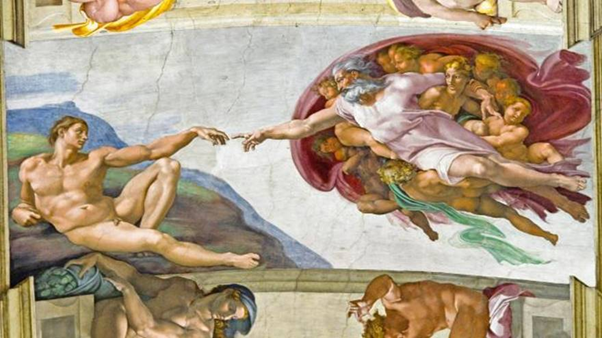
Art reaching out on the Sistine Chapel Roof. Available at: http://www.trwelling.org/Da%20Vinci%20and%20the%20Sistine%20Chapel.htm
The people in this novel are its surface art – ironic and beautifully undermined by history – without then failing to respect those beautiful, if sad, persons. For Malone and Sutherland are beautiful people tragically damaged by lost access to an open world because of historical contingencies that are on the way to be being mended, but which are not yet, even in 2021.
At least I think that’s the case. If we trace the novel back down the layers of its means of representing reality, we find something quite beautiful – the live of friends-who-are-queer for each other regardless of the value system that prizes cock size before the content of soul, body and mind conjoined. If we think of the quotation from my title again we can see that there was always a purpose in that reference to both Greek art and Keats. Art, good and bad, helps us contemplate in stillness what is mad, bad or sad but also definitively beautiful. But good art is that which leads us and forward.
Feedback welcome
Love Steve
[1] Holleran (1968: 43)
[2] For more on The Violet Quill see accompanying blogs, mainly on Felice Picano: https://stevebamlett.home.blog/2021/04/16/a-ridiculous-farrago-supposedly-linking-various-allegedly-important-moments-of-homosexual-history-of-the-past-century-period-w/ ; and https://stevebamlett.home.blog/2021/05/04/you-have-to-begin-there-with-the-oppression-to-understand-why-the-gay-subculture-is-the-way-it-is-otherwise-your-book-is-going-to-be-another-crock-of-academic-shit-felice-picano-o/
[3] Andrew Holleran quoted from David Bergman (2021) ‘The Violet Quill Club, 40 Years On’ in The Gay and Lesbian Review Worldwide (January-February 2021). Available at: https://glreview.org/article/the-violet-quill-club-40-years-on/
[4] Leavitt cited in David Bergman (2004: Location 679) The Violet Hour: The Violet Quill and the Making of Gay Culture New York & Chichester, Columbia University Press. Kindle ed. cited.
[5] ibid: Location 672
[6] Andrew McMillan (2019) ‘Dancer from the Dance by Andrew Holleran; Out of the Shadows by Walt Odets – review: A psychologist’s study of gay men and a cult 70s novel reveal the experiences of different generations’ in The Guardian Mon 17 Jun 2019 07.00 BST Available at: https://www.theguardian.com/books/2019/jun/17/dancer-from-dance-andrew-holleran-out-of-shadows-walt-odets-review
[7] Les Fabian Brathwaite ‘What It Means to Be a Gay Man Who Is Free: Reflecting on Dancer From the Dance.’ in Out Magazine (Online) for AUGUST 07 2018 12:32 PM EDT. Available at: https://www.out.com/art-books/2018/8/07/being-gay-man-who-free-reflecting-dancer-dance
[8] Holleran (1969: 54)
[9] I will support this statement by a reference to a rather risqué source: A ‘grade-saving’ webpage on the book for lazy scholars. It shows at the least that I am not inventing, or looking to an abstruse outlying critical outlier, this reading of chapter 6 of the Fanon book: https://www.gradesaver.com/black-skin-white-masks/study-guide/summary-chapter-6
[10] Holleran (1969: 166)
[11] ibid: 177
[12] ibid: 19
[13] Bergman (2004: Location 4243)
[14] The Confessions of Danny Slocum cited in Bergman (2004: Location 4259)
[15] It’s worth remembering that amongst the gifts Sutherland gives to Malone on first becoming his friend and mentor is a ‘first edition of Yeats’ (Holleran [1979: 151])
[16] Holleran (1989: 111)
[17] ibid: 15
[18] ibid: 174
[19] ibid: 184
[20] ibid: 108
 Steve_Bamlett_blog
30 thoughts on “‘…: He came each night to avoid the eyes of everyone who wanted him … . The gossips said he refused to sleep with people because he had a small penis – the leprosy of homosexuals – …’ . Reflecting on art and penis size in ‘dick lit’ with a focus on Andrew Holleran’s (1979) ‘Dancer from The Dance’”