‘But even when Housman was trying to be as disagreeable as possible, it’s difficult not to agree with some of his observations. … . …, if the wider tone of his oration was designed to get up the noses of those in his audience, it seems to have worked: either F.R. Leavis or I.A. Richards was “reported to say that it would take more than twelve years to undo the harm [Housman had] done in an hour, an anecdote Housman was pleased to record and repeat’.[1] What our current Poet Laureate is and what he is not. Reflecting on Simon Armitage (2021) A Vertical Art: Oxford Lectures London, Faber & Faber Ltd.
For other Armitage based blogs of mine see list at end.
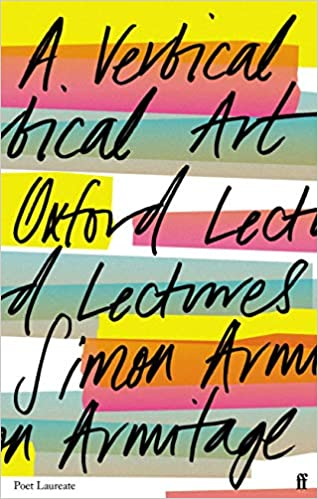
The front cover
Whilst he is clear about the deliberate refusal of A.E. Housman to be nice to the literary and academic establishment, Simon Armitage obviously not only finds that he may agree with Housman sometimes but that he rather enjoys the discomfiture of that establishment in the hands of a poet who dared to be somewhat a lone wolf. The underlying burden of the transcribed and edited lectures in A Vertical Art is surely that there is something rather inappropriate in this poet, Simon Armitage that is, standing at a lectern and honouring an institution to which his own attitude is somewhat ambivalent at best – and more often openly rather antagonistic. There is a kind of resigned irony in his pointed description of tracking down the poet Aracelis Girmay ‘to an address at an American college (admittedly something of a given with US-based poets)’.[2] There is a slyness in the style here since it is in no way difficult to track down this poet. She has her own website. The deflationary effect in the sentence of using her as an example (in a parenthesis) of the tendencies of poetry to drift to the arms of educational establishments is surely unfair. It almost advertises a view that there is NOT much more to say of poets of Girmay’s type qua poets.
Of the danger of poetry becoming a scion of the universities and retreating from the pursuit of the ‘fascination of what’s difficult’ (in W.B Yeats terms) in the task of a professional poetry proud to hold that name I have no argument with Armitage. He refines his arguments in a latter lecture where he lists (it’s a binary of lists with rather fuzzy boundaries between its categoric statements) the advantages and disadvantages of the role of the university in a poet’s life, career and writing. Of course at the time of writing, Armitage was attached contractually to quite a few universities. Universities provide a secure financial base he reminds us.[3] It also feeds poets with dialogue with an audience so perpetually young that it is constantly renewing ideas and assumptions and they provide poets with the armature of administrative, business and collateral enterprise expansion that has never quite been part of the role before, if we exclude the substitute his daughters provided for Milton.[4] The list of disadvantages is shorter but more definitive and even pokes itself into the advantages but is best represented by this plea: ‘… it’s essential that poetry is capable of making itself heard beyond the university circuit; … ‘.[5] He goes on to list a state of the potential supporting audience list, although it feels to me an audience limited by the present organs of what used to be called ‘middlebrow’ culture.
The absence of poetry in the world of many people comparative to its prominence for a relatively comfortable few is a constant peril. That a tenured, academic class is aimed at here comes across better in asides which are far-ranging in their consequences. For Armitage often makes it sound as if the profession of poetry is being debased by its modes of current residence. Of poetry’s expansion into the universities, using the evidence of a USA based initiative in which he himself took part, the Association of Writers and Writing Programs (or AWP) he can say that it is:

… as a portrait of poetry-as-industry in a state of over-production and the living proof, if it were needed, that far more people are interested in writing the stuff than they are in reading it.[6]
There could be no more damning statement than this that poetry which aspires to an end that is fulfilled only by writing is a dead end, and no more heartfelt plea for the cultivation of the role of readers of poetry. Hard as it may be to read for those who see the facilitation of poetic expression, sometimes just for themselves, as an end in itself it is a necessary truth for a time. And in this respect Armitage is very like A.E. Housman, marking a role for what he calls the ‘informed reader’ free of any dogma from the Universities, whether it be of the AWP or the Scrutiny Group of F.R. Leavis and associates.[7]
This is not to say that I don’t find material in Armitage that shows him absorbing some of the worst behaviours of academic ‘teaching’. As someone at the edge of that world I used to grit my teeth every time I heard the opening phrase in the mouth of academics talking freely: ‘If I hear one more student say ….’. It is a lazy way of feeling comfortable in one’s assumed superiority as a group to those less well educated than oneself and a means of othering them so that they and their vulgar popular thinking is distanced from you. However, hear Armitage in one of his (no. 23 in point of fact) ninety-five theses (after the example of Luther): ‘… if I hear one more student say something is ‘very meta’, I’m going to take a bite out of the desk’.[8] Is this playful or incorporated – take your choice? Armitage wears his ironies like a cloak.
Having said this about Armitage (attached to Leeds, Sheffield, Oxford in England and many other universities in the USA) about universities, we also have to remember that he also has not much time for the kinds of accommodation poetry finds outside the walls of universities either. People like myself who fill my retired time blogging must feel with me that they have beem fingered by scorn under this satirical review that goes alongside Armitage’s uncommitted side-swipe at Girmay already cited.
The Internet created, and goes on creating, a silicon revolution in poetry. … latterly it has been a self-referencing cosmos, a beginning and an end and a middle as well, justifying itself to itself by virtue of itself. Hence Alt lit, a movement that flourishes via websites, blogs, forums, vlogs and film clips, populated by poets, readers and critics whose very identities are sometimes online constructs.[9]
Available at: https://mediablog.prnewswire.com/2018/05/07/blog-profiles-poetry-blogs/
In so far as this is a critique of the digital revolution it bears with it nothing new. It is another attempt to brand every aspect of a complex phenomenon with an over-simple characterisation that infers both artificiality and, more importantly, lack of authority in those students of whom he despairs hearing more about the ‘meta’ nature of modern cultures:
I haven’t been able to determine whether Alt Lit is a serious and coherent poetic school or just a few computer-literate graffiti artists with too much bandwidth at their disposal, suffering from the burden of free choice in the twilight of Western decadence, goofing around in their dorm after a few joints.[10]
Comparisons of alternative characterisations of a thing as this as extreme in their binary nature as this are rarely attempts at a balance to which they pretend syntactically. I think Armitage would be the first to admit this, being addicted (in such readings as I have seen) to a fairly dry and detached humour and a somewhat perplexed attitude to modernity. I think the burden of writerly authority, such as that of a Poet Laureate and university poet contracted just to be himself as a poet which is the role of the Oxford Chair, falls in this sentence on support for the second of these two alternative portraits of Alt Lit, one that rather over-characterises all manifestations of a new direction in the production of poetry on the internet as over-facile. And this too (with a decided attempt to make an exception in the case of Kae Tempest) applies to movements he lumps in with modern changes within the domain of poetic production such as ‘performance poetry’. Moreover what he says is that, apart from Kae’s case, the defining note is that ‘some of what is vocalised is facile … the cheap gags, the vacuous ‘life-affirming’ statements, the soliciting of an instant response, and the over-emoted serving of already over-egged puddings’.[11]
So if the atmosphere inside the universities is too rarefied for that to constitute an audience that facilitates in poetry a truly public voice, outside the university the demon Demos rolls in the slime of the over-facile and the suet stodge of overdone puddings. And the overweening theme of this book is precisely the space between the polarised conditions under which poetry of inferior value is produced. At one pole is the limited audience of the self-claimed intelligentsia which produces the conditions for a poetry of ‘obscurity’, at the other an easy ‘facility’ with words, often with music, that passes for poetry.
The main illustration of the latter lies in a lecture on the case for considering the lyrics of Bob Dylan’s songs as ‘poetry’ in chapter 5 entitled ‘We Need to Talk about Robert: Bob Dylan and the Nobel Prize for Literature’.[12] There is a tremendous moment in this lecture when Armitage takes on Christopher Ricks’ championship of the finesse of ‘poetry’ of Dylan lyrics in his book Dylan’s Visions of Sin. Now Ricks is a mighty champion of writing that is under attack – most notably he was responsible for maintaining the reputation of John Milton when that poet was under full-scale attack by T.S. Eliot and later by F.R. Leavis.[13] His edition of the poems of Tennyson likewise reinstated that later poet as a writer of great weight. In both cases the care that each took to use language precisely and for specific ends is Ricks’ line of defence.
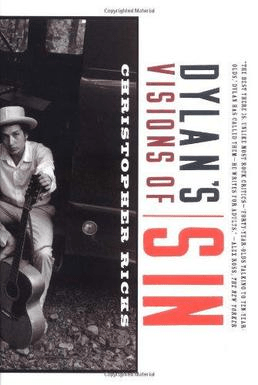
By Christopher Ricks – Ecco Press website, Fair use, https://en.wikipedia.org/w/index.php?curid=51990067 Available at: https://en.wikipedia.org/wiki/Dylan%27s_Visions_of_Sin#/media/File:Cover_of_first_edition_of_Dylan’s_Visions_of_Sin.jpg
In the case of Dylan however the tables are turned by Armitage. Ricks is critiqued precisely because he praises Dylan’s skills in the use of language in ways for which Armitage, talking as a professional poet against an academic critic, finds deeply lacking in linguistic and literary precision and competence. For instance, though Ricks argues that ‘not a word is wasted’ to defend Dylan’s use of language in The Lonesome Death of Hattie Carroll Armitage attacks the latter’s use of words like ‘rich’ and ‘poor’ that ‘are placeholders at best, crying out to be sacrificed for syllables that bear more weight, or carry more load’. From there Armitage takes issue with nearly every statement that Ricks makes in support of this lyric to find the academic support of, and the lyric itself in large degree, extremely facile and (unhelpfully) politically contradictory:
littered with errors – or at least strewn with chances for improvement – and I deem it a mistake to credit Dylan with the kind if finely honed poetic sensibilities and control of language that literature would normally expect of its decorated practitioners.[14]
So if some public voices use language in ways that are demonstrably facile in the eyes of those who speak for literary practitioners of ‘finely honed poetic sensibilities and control of language’, others fail by not respecting the fact that language remains a medium for relatively clear communication between writer and reader. These poets have retreated to the academy and to specialised audiences and have been thus aided to forget that:
… no matter what control poets attempt to exert on the page, ownership of and power over any text rests ultimately with the reader, and readers are largely unpredictable in their responses. It’s an anxiety that has encouraged some poets to back away from direct intentionality and to treat language as being wholly enigmatic – like music or colour. in doing so, they have aimed for response and effect, rather than comprehension and understanding … .[15]
One early practitioner that has abandoned the reader for the delights of the enigmatic and obscure in language was Geoffrey Hill, who, as a former Oxford Professor of Poetry, comes in for much ironic commentary throughout: ‘So, not God himself, but not far removed – …’. Thus starts a wonderful sentence that vituperatively undermines Hill’s elitism as a poet.[16] Another recipient of Armitage’s finely barbed but beautifully organised undermining of the unnecessary use of obscurity in poetry is Sinéad Morrissey. He says of the ‘more recherché moments’ of two of her poems (and these he outlines in some detail), ‘what is their purpose’? Amongst the many possible suggestions he makes these in the passage following this set of linked subordinate question stand out:
Is there a belief on the part of the poet that the references [to arcane objects of knowledge] are explained through context? Or an assumption that a twenty-first century poem will not just be casually read, but studied and analysed? is intrigue the aim? Are we being educated here/ Do opaque allusions operate as a form of entry qualification or club membership, by which the ignorant and uninformed are kept outside the door? And what value do we assign to those moments in a poem we don’t properly understand – … . [17]
That tendency is, he has already argued, in T.S. Eliot by 1922 and The Waste Land where the explanatory notes (‘a paperchase in their own right, leading to more unanswered questions’) : to wit, they explain very little of the obscure they address and if they did, needed supplementing by references to equally arcane passages within themselves of reference to knowledge and educational advantage held by very few people.[18] Now, before it is said, it is worth remembering that the case is intended to be nuanced, at least in ways that allow poets who might possibly, for some people, come into the category of the Obscure or the Facile but who Armitage personally admires to form exceptions like Kae Tempest. Amongst the academic poets (I think she is allowed room because her speciality is not, as in Sinéad Morrissey’s case, ‘Creative Writing’ but Ancient Literature is Anne Carson. I was pleased about this for she is, with Armitage, one of my favourite poets. Of the ‘deep perspicacity’ of her luscious work Autobiography of Red he says:

By Anne Carson – https://covers.openlibrary.org/b/id/225443-L.jpg, Fair use, https://en.wikipedia.org/w/index.php?curid=58665557 Available at: https://en.wikipedia.org/wiki/Autobiography_of_Red#/media/File:Autobiography_of_Red.jpg
… with its proemium and testimonia, with its multiple perspectives, shadow narratives, classical references, framing devices, roman numerals, mock interviews, italics, quotes, appendices, subheadings and fragments might sound like an unapproachable proposition, but at no point will the thoughtful reader say, ‘I don’t understand what she means’.
I love Carson’s poem (and her poetry, plays, novels and graphic novels generally) but obviously come across many readers he would not classify as ‘thoughtful’ who do not even wish to rise to the challenges of this great work. Even that sentence with its playful listing of the components in which different kinds of difficulty in understanding what is meant can be produced may be intended to throw the reader or listener to these lectures into some kind of ambivalence about what they are hearing. It reminds me of his lecture on the use of LISTS in poetry elsewhere. In that chapter, lists can be just ‘taking full opportunity of the cataloguing opportunities available’ as he says is the case with Edmund Spenser’s ‘second book of “Two Cantos of Mutabilitie (sic.)”’; a kind of facile ‘marking time’ for a professional poet.[19] In contrast he argues, a list in Whitman is an index of democratic intent and ‘inclusivity’: ‘his itemisation becoming litany, incantation, heartbeat, breath; the writing itself not just life-affirming, but life-forming – …’.[20] In critical writing like Armitage’s best, and I include the above quotation therein, it is sign of how the best representations of life strain our demand to know more than out version of normalcy, even if that means the challenge of older forms breaking their usual paradigmatic uses, which Carson always does.[21]
Of obscurity in poetry proper, Armitage is quite clear that it constitutes an elitist attack on the reader not brought up in the old forms of education that were far from inclusive and betrays the profession of writing and even the human purpose of communication, especially in language:
Language is the greatest tool ever devised by the human brain; obscurity is a betrayal of its expert and exquisite functionality – and to be opaque in poetry, either deliberately or unconsciously. is to take this most precious and precise of instruments and use it as a delivery mechanism for white noise or pepper spray.[22]
The reference to ‘pepper spray’ is telling. Elitist poetry is an act akin to an exclusive order in the governance of society maintaining its rights over the ‘many’ by force if necessary just as P.B. Shelley shows us to be the case in The Mask of Anarchy. Alternatively to turn poetry and its inherited formal qualities into a vehicle for the facile, or ‘cliché-ridden and sentimental’, as Armitage’s solicitor does in the first lecture as an aside between charging a lot for minimal work, is equally bad.[23] And that too is a kind of political vandalism posing as revolution (somewhat like the bourgeois French Revolution) by an elite, now addressed in Oxford as it leaves the meeting of the Bullingdon Club:
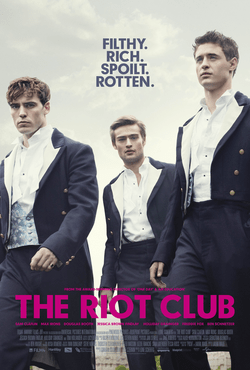
The film based on The Bullingdon Club’s reputation
… form provided mystery in poetry. It brought ritual and ceremony to writing, without which writing was prose. So a new type of mystery had to be developed to replace form’s complex and enigmatic effects, and it emerged as concealment: concealment of meaning, concealment of motive, concealment of reference, concealment of reason. … The hidden codes in poetry – once the preserve of unspoken line breaks, subconscious structures and indefinable musicality – were replaced by withheld knowledge, suppressed information and camouflaged intent.[24]
And the collateral damage of that movement into obscurity was to the people who had once gained much from the ‘mere’ act of reading and sharing the complex mystery of form with professional poets now feeling they too could and should be poets – and ending up spilling out clichés and wallowing in sentiment. Wasn’t the rest just for the clever boys in the universities and not for us, who merely want to know how to celebrate the life of all of us in ways poetry no longer provides. Although, of course, A.E. Housman thought he did provide that, intent on dismissing the whole of eighteenth century versifying ‘because cleverness got in the way’.[25]
And despite the apparently ‘arcane’ feel of Hardy, ‘writing in a language of which he was the last surviving speaker, and to which only he was entitled’ his poetry five wonderful lines of his poetry communicates directly to the emotions but using all of the technical prowess available to him including:
… the orchestrated emotional intelligence of the diction, the syntax, the grammar, the symbolism, the cadencing, the ordering of ideas, the physicalisation on the page, the rhymes and the puns …[26]
To celebrate accessibility and inclusivity is the most politically democratic of celebrations but to deny the professional a rich toolset is equally undemocratic – as if ‘more’ really did mean ‘less’ which it does not, it means LESS. Poetry is not meant to evade meaning and communication and be ‘like, ambiguous’ and ‘meta’, as he quotes Scarlet and Josh in his writing class (poor Scarlet and Josh!). In poetry ‘ambiguity is a controlled technique …, being the managed balancing of two or more describable positions’.[27] Only very foolish poets decide their quality depends on only avoiding the over-facility of sentiment by being obscure and inaccessible to anyone but any but an elite audience or even just ‘yourself’. The ‘key question’ is ‘who are you writing for’? [28] To be professional is to create, by a careful managing of expectations in your relationship to readers, ‘the dew point where difficulty meets understanding, or where considered thought condenses into considered language’: somewhere in ‘the optimal zone between the obscure and the obvious’, ‘the pretentious and the prosaic’.[29] And the best median of all as a quality of all the best poetry is that midway between the ‘international’ and the ‘local’, qualities that might sing even in Marsden somewhere outside Huddersfield where Armitage was born and returned. But he didn’t not return without baggage as his Marsden poems show.

National Trust photo of Blue skies over Pule Hill, Marsden Estate. Available from: https://www.nationaltrust.org.uk/marsden-moor-estate
Reading this book has been a journey of discovery for me (poor blogger that I am – so ‘Simon says’ of us all) and one that ought to take Armitage’s assertion that ‘this is just a Way of talking about some of my favourite poems’ with a pinch of salt.[30] In some ways Armitage is A.E. Housman returned to us – genial in his look and manner of song but severe in his judgements and ironic exposures of the supposedly great. Lots of wonderful poets are illuminated – Thom Gunn, Elizabeth Bishop and Hardy (so beautifully Hardy) for instance – but Armitage is not a Yorkshireman for nothing – he ‘speaks as he finds’ and his codes (of ironic distance for instance sometimes feel more like getting ‘up the nose of his’ (Oxford) ‘audience’.
Yours Steve
For other Armitage based blogs of mine see:
1. On the poet reading at Todmorden festival: https://stevebamlett.home.blog/2019/11/03/simon-armitage-reads-at-the-todmorden-book-festival-the-todmorden-hippodrome-friday-1st-november-2019/
2. On the Marsden poems – the truly ‘local’ in poetry – see below also on this term: https://stevebamlett.home.blog/2020/03/25/snow-snow-snow-is-how-the-snow-speaks-is-how-the-page-reads-1-in-simon-armitages-2020-magnetic-field-the-marsden-poems/
3. On ‘The Accompanied’ : https://stevebamlett.home.blog/2019/12/07/594/
4. Briefly – ‘On Considering The Poppy’: https://stevebamlett.home.blog/2021/05/10/ww1-heroism-through-film-and-art-exercise-on-considering-the-poppy-featuring-simon-armitage-reading-his-own-poetry/
[1] Armitage (2021: 201f.)
[2] ibid: 23
[3] ibid: 280, 282f.
[4] respectively for these ideas see ibid: 283 and 287.
[5] ibid: 291
[6] ibid: 281
[7] Also in ibid: 291
[8] ibid: 309
[9] ibid: 20
[10] ibid: 20
[11] ibid : 18
[12] ibid: 113 – 138
[13] In a study of MILTON contributed to Essays and Studies of The English Association, Oxford University Press, 1936, entitled ‘A note on the verse of Milton’, Eliot says: “While it must be admitted that Milton is a very great poet indeed, it is something of a puzzle to decide in what his greatness consists. On analysis, the marks against him appear both more numerous and more significant than the marks to his credit”. From https://pages.mtu.edu/~rlstrick/rsvtxt/eliot.htm
[14] Armitage (2021: 127)
[15] ibid: 255
[16] ibid: 89
[17] ibid: 261
[18] ibid: 248f.
[19] ibid: 69f.
[20] ibid: 81f.
[21] See my blog on a recent Carson work (another coming shortly on her new graphic novel) available at: https://stevebamlett.home.blog/2020/06/24/says-he-cant-believe-how-much-i-look-like-her-%ce%b5%cf%8a%ce%b4%cf%89%ce%bb%ce%bf%ce%bd-reflecting-on-anne-carsons-2019-norma-jeane-baker-of-troy-london-ob/
[22] Armitage (2021: 273)
[23] ibid: 2
[24] ibid: 254
[25] ibid: 202
[26] ibid: 214
[27] ibid: 308f.
[28] ibid: 304
[29] ibid: 304f.
[30] ibid: ix
 Steve_Bamlett_blog


3 thoughts on “‘ …, if the wider tone of [A.E. Housman’s] oration was designed to get up the noses of those in his audience, it seems to have worked …’ What our current Poet Laureate is and what he is not. Reflecting on Simon Armitage (2021) ‘A Vertical Art: Oxford Lectures’ London, Faber & Faber Ltd.”