Blog Version: Draft text and final submission for assignment (200-400 words) for Assignment 1 for Futurelearn Course ‘What Is A Mind?: University of Cape Town’.
For this assignment we are asking you to produce a short piece of writing (200-400 words) on how one might probe whether something has a mind or not. After you have submitted your text, you will receive feedback from another learner.
UNCORRECTED DRAFT
- First describe something you are familiar with that conceivably may have a mind.
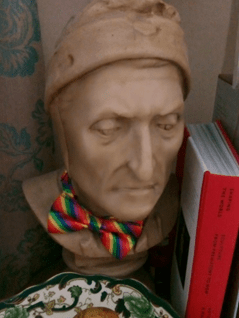
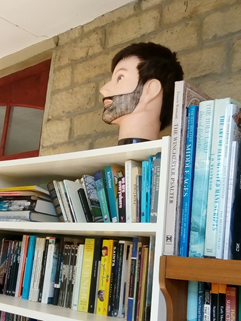
I want to take my passion for eccentric variations of bust portraits that I use to decorate our house. I have selected two of very different kinds. One is a facsimile of a museum bust of Dante, dressed by me ages ago as it appears in the picture (with a LGBTQ+ Pride bow-tie some years ago) and a hairdresser’s model of a young unidentified and stereotyped young man in the conservatory. In the blog version of this piece you will find photographs. One portrait bears features associate with a once living medieval Italian poet in the manner of a death-mask. Hence the eyes are angled downwards as in death and non-awareness of the viewer. In contrast the young man is pert, and looks straight ahead, If the viewer moves their angle and position of vision they could feel as if they were engaged with, or trying to be, the young man’s eyes.. The hairdresser’s model has stereotyped and obviously artificial features in colour – eyes, lips, beard and hair. The Dante is coloured only by the material it is copied in, except for the Pride bow I attached. This was ironic because Dante depicts men who love other men as running barefoot across hot sand in a lower rung of Hell, even his old teacher whom he meets there.
- Describe a response or behaviour that you expect a mind should display.
You expect engagement between your eyes and the object – with the eyes as you imagine them to be represented, if at all, You imagine the feelings that the figure has about its present state but especially about itself, you as viewer and the interaction between ‘yourselves’. I am sticking with subjectivity here but issues of agency and the other factors would matter also.
- Now consider how you might test your assumptions. You can consider scenarios and any experience you have had.
There are no scientific tests and much would depend on relationships in which I might project both feelings and behaviour into the object, from knowledge from elsewhere in the case of figures representing real biographies such as that of Dante, imagination, past experience of like objects or desire. Sometimes I can solidify the projection as in the rainbow bowtie which takes revenge on Dante’s homophobia but also projects beliefs about how people change in history and interaction. The less that can be known, the more that can be introjected as in the dummy head. And introjected feeling and actions (like the eyes follow me or engage me) can be felt to be projected back into me.
- Finally describe how you would go about deciding whether the thing you are testing has a mind based on this. Even commenting on how difficult this is to do, would be sufficient. Note we are certainly not expecting you to perform an experiment on anything, rather limit this to your own past experiences or your imagination.
I would decide he question on the basis of an attempt to describe the feelings and actions and attribute them to some sources and influences. These could be memories of obtaining knowledge, the processes I have undergone in learning how to interact with others, especially resistant communicators, when I worked and values relating to the discrimination of person and object. My suspicion is that most would be traceable to somewhere in myself – even though some were difficult to access.
Text for submission.
I have a passion for eccentric bust portraits. I have selected two: one a facsimile bust of Dante (with a LGBTQ+ Pride bow-tie added by me some years ago) and a hairdresser’s model of a young unidentifiable man in the conservatory. In the blog version find photographs. One portrait bears features associated with a medieval Italian poet in the manner of a death-mask. The eyes are angled downwards as in death and non-awareness (or evasion) of the viewer. The young man appears perter, looking straight ahead. If the viewer moves their viewing position they could feel as if they were attempting engagement with his eyes. The latter has stereotyped, obviously artificial coloured features – eyes, lips, beard and hair. Dante is coloured only by the material he’s copied in, except for the Pride bow.[1]
You expect engagement between your eyes and the object imitative of a man – with the eyes as you imagine them represented. You imagine the feelings that the figure has about its present state but especially about itself, you as viewer and the interaction between ‘yourselves’. I stick with subjectivity here but issues of agency etc. also matter.
Testing its ‘mindedness’ depends on relationships in which I might project both feelings and behaviour into the object. These might originate from knowledge in the case of figures representing real biographies such as Dante, imagination, past experience of like objects or desire. Sometimes I solidify projection as in the rainbow bowtie which takes revenge on Dante’s homophobia but also project beliefs about how people change in history and interaction. The less that can be known, the more that can be introjected as in the dummy head. And introjected feeling and actions (like the eyes follow me or engage me) can be felt to be projected back into me.
I’d decide he question by describing the feelings and actions I suspect and attributing them to some knowable source. These could be memories of obtaining knowledge, processes I have undergone in learning how to interact with others, especially resistant communicators, in work, and values relating to the discrimination of person and object. My suspicion is that most would be traceable to somewhere in myself – even though some were difficult to access.
400 words
[1] This was ironic because Dante depicts men who love other men as running barefoot across hot sand in a lower rung of Hell, even his old teacher whom he meets there.

