‘ … “She thinks she’s Isabel fucking Archer. But she doesn’t know what it’s like round here. …”’.[1] ‘She joined me on the roof, standing right beside me, and we watched the work on the Krishna statue up ahead. … “Who’s Isabel Archer?” I said. Radhika crossed her arms loosely and exhaled, and I felt her shoulder touch mine. “A clever girl in a novel. Ends up – Why?”/ …/ …”It’s an idea, you know. You should read. It’ll help you pass the time.”/ …/ Suddenly she waved her paint roller at me. “That washed up teacher. Has he been talking to you?2/ I stopped painting. “Who?”/ “He likes his books and whatnot. Probably wanks over James. …”/ “Who’s James?”/ “Long hair. Beard. Middling height. Fat cheeks.”/ “James?”/ ….’.[2] How women end up in male novels. A new masterpiece by Sunjeev Sahota (2021) China Room, London, Harvill Secker.

A writer who uses extended jokes about other writers, like the one I partially – if still necessarily at length – cite in my title, knows they are attempting their own breakthrough masterpiece and must sustain analogies to the writing and reading of such works throughout. This is especially the case when we joke entirely without solemnity and some sexual by-play about a writer known as ‘The Master’ a long time before Colm Tóibín made that the title of his own novel about Henry James. James’ novel Portrait Of A Lady (1888) is acknowledged as his own masterpiece in which the central consciousness, or ‘point of view’ in E.M. Forster’s terminology, of Isabel dominates. Isabel Archer has long been recognised as intended to provide for the novel the ‘“architecture of consciousness” that projects important aspects of her creator’s attitude’: especially attitudes towards the role of art of the highest ‘style’ in a materialistic world that strains even to be interesting, let alone stylish.[3] If we extend a quotation from the novel cited in Matthew Guillen’s 2002 article on James’ novel to make that very point we can see that the grotesque wastrel Osmond exploits Isabel’s consciousness as if she were an accomplished artist, of recognised stature, painting him. It will be her job not only to perceive but also appreciate and validate the fact of Osmond’s ‘style’ and like the jobbing novelist ‘publish it to the world’. For Osmond really has nothing to show for himself in the matter of achievement of anything that is not both ‘easy’ and ‘rapid’, even the ability to drink more beer than other over-privileged youths.
But his triumphs were, some of them, now too old; others had been too easy. The present one had been less arduous than might have been expected, but had been easy — that is had been rapid — only because he had made an altogether exceptional effort, a greater effort than he had believed it in him to make. The desire to have something or other to show for his “parts” — to show somehow or other — had been the dream of his youth; but as the years went on the conditions attached to any marked proof of rarity had affected him more and more as gross and detestable; like the swallowing of mugs of beer to advertise what one could “stand.” If an anonymous drawing on a museum wall had been conscious and watchful it might have known this peculiar pleasure of being at last and all of a sudden identified — as from the hand of a great master — by the so high and so unnoticed fact of style. His “style” was what the girl had discovered with a little help; and now, beside herself enjoying it, she should publish it to the world without his having any of the trouble. She should do the thing FOR him, and he would not have waited in vain.[4]
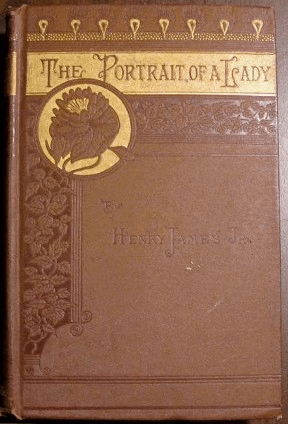
There is a vast irony in Radhika being cast as Isabel Archer by Tanbir Singh, the retired English teacher, because Radhika does everything she can in order not to ‘end up’ as Isabel does. But ‘end up’ she does the creature of Osmond, other characters like Ralph Touchett (who watch her career unfold, as if she were an object for the curious of the art of human career building, set into animation) and James himself. What is clear from the sparse and brilliant dialogue between Radhikha and S, the narrator of that contemporary part of the narrative in which she appears, is that for her Isabel Archer is an object of male surveillance whom everyone wants to control for their own pleasure – one reason why Radhika thinks Singh ‘probably wanks over James’.
And Radhika is not to be set up merely by men as an image to ‘wank over’, whether that be a literal or metaphoric form of that activity. Her goals will be her own just as she will determine her own behaviour, even though every aspect of her life contains men who try and control her. This allows us to see that female characters in this novel work complexly within a system controlled by males – even in novels written by men. Sunjeev Sahota is not modelling himself on James in featuring at least two prominent women in this novel – he is more cautious to expose men to the gaze of women who challenge the conditions imposed by male authority at every level, even that of the authorship of novels. In China Room there are two narratives that hold characters from two periods of time whom are connected by family but in ways that are never elaborated. One of the time settings of the novel is just prior to the political independence and partition of India, the other from a nearer contemporary time. It is the second narrative – told in a sequence of fragments with unnumbered chapters and inserted into the main narrative – that contains Dr. Radhika Chaturvedi.
But Radhika’s life in S’s narrative is also a mirror to that of the central conscientious of the third person narrative that is the dominant story of the novel and whose events and settings are continually recalled by this second (S’s) narrative. That consciousness is that of Mehar, who unlike the highly literate medical doctor who uses her feminism to defend herself strategically against arrant sexism in her society and life, is ‘illiterate’.[5] But this does not mean that in accepting narration by Sahota that she is not able to query the generalisation of male authority. The first line of the novel is about power in gendered institutions such as the family and marriage and the covert resistance women might show in small areas of behaviour: ‘Mehar is not so obedient a fifteen-year-old that she won’t try to uncover which of the three brothers is her husband’.[6]
Much of the opening of the novel is a persistent uncovering of patriarchal power where the voice of the narrator is often too the point of view, heavily hidden as such resistance might be in a fifteen year old girl (or even in older women) that unpacks the sources of male power such that a young girl does not become subjected to its more potentially violent force. Illustrating this is the scene of her first sexual act with the husband, whomshe only sees in the dark and whom is not differentiated from the other two men, his brothers, who are equally installed as her master.
“Undress,” he says, not unkindly, but with the contingent kindness of a husband who knows he will be obeyed. She tries to trap his voice inside her head, to parse its deep grain, its surprising hoarseness. … . …, and then he bears down like something come to swallow her whole, until she can’t even see the darkness on either side of him and fears that she really is inside his chest. …[7]
There is something so remarkably precise about how power and any resistance to power is experienced subjectively in this remarkable writing. We will see the word ‘kind’ for instance used again after the sexual act where both man and woman show their trapped feelings inside a house where you are advised to say, as Mehar does, “Everyone is very kind,” lest kindness turn to some other force used against her. As her husband, with name still unrevealed says afterwards, “It’s never been a kind house before”.[8] The concept of ‘contingent kindness’ is a brilliant one – it is a kindness entirely dependent on expectations that the norms of institutions and formal gender relations will be met. Yet the metaphors of the writing show Mehar fighting back – trapping the voice of her husband to examine it ‘inside her head’ and trying to understand it whilst succumbing to a power so forceful it feels as if it consumes her like a snake does its prey till she is ‘inside his chest’. It is a prose about how you experience and handle power and about the dangers involved in resisting it as well as the necessity of doing so. For Mehar otherwise will only be passive to her sexual taking by a man, not actively able to understand what its motivations and drives are – social and economic drives as well as sexual ones. For it is helpful since it offers a minimum of control if women can ‘parse’ male behaviour, illiterate though they may be and hence the strength of the word ‘parse’ here for an illiterate woman. A woman does this might understand the limits of her safety and the degree of obedience – which is also the theme after all of that first chapter from sentence one (already cited above): ‘He is neither rough nor gentle. A little frenetic perhaps, because all three brothers want a child, a child that must be a boy’.[9]
Nowhere have I seen the force of patriarchal norms so powerfully expressed, on the behaviour of both women AND men, than in this sentence. The boy or the primacy of the wants of boys, even though unborn as yet, drives what intimacy feels like for both partners here. It is a subtle articulation of what it really is like to be subject to power where the narrator is not, like James, using his voice as yet another constraint on his female characters. If you return to the piece of James I quote above we see the very roots of Isabel’s subjectivity controlled by men, including the narrational voice used by Henry James, without her even having a hint of the need for caution in observing what happens to her under their authoritative surveillance. Sahota on the other hand utilises a narrative voice that shares Mehar’s caution – and helps her, for instance, to identify the ‘contingent kindness’ to young girls that she must both seem to praise and know how to have appropriate suspicion of in her society. Of course it will not help her. Patriarchy in pre-Partition India would not have allowed her to have a voice that could triumph, except in the turning about of the myths of her life by S and Radhika.
The contrasting time of these narratives in which women have a role where their ability to resist male authority varies is constantly but only silently drawn to our readerly attention. From the roof of his uncle’s farm S and Radhika watch the rebuilding of the statue of Krishna – in that very section in which Radhika is compared to Isabel Archer. As the narratives intersect, we learn, but 45 pages after we have been shown Radhika seeing it being rebuilt, that Mehar learns from Suraj that the statue had been destroyed when ‘the Mussulmans had retaliated’ against the attempt of Sikhs and Hindus to create a Muslim ghetto, which the former called ‘a Mohammedan-only quarter of the city’.[10] The incident is used to show that same play of authority, even dialectic perhaps, between the point of view of both central male and female in this ‘romantic’ (if I may call it that) sub-plot. It’s a submerged struggle in which the female protagonist can infantilise the viewpoint of a man trying to impose on her a view of her limitations as female child. he may put on the cloak of a socially validated male authority but she rejects his view, even that she is more fond of sweet things than he, as might be expected of a young woman by a traditional male.
‘It’s no longer there?’ Mehar says, incredulous. ‘Lord Krishna’s statue?’
‘I wish you wouldn’t say “Lord”. It’s painted stone.
‘It’s what it represents. And I’ll say what I like.’
He reminds himself she is barely sixteen. The impertinence will go. … [He changes the subject to guavas and why she, being pregnant should eat more of them, whilst eating one himself.]
‘Such a child,’ she says. ‘I don’t know anyone who likes them as much as you.’
‘Have some. You need to be eating more now.’
She shakes her head, ‘Too sweet.’
‘For the baby, then. Don’t let him miss out.’
The conversation here, as in earlier examples demonstrates word games played by men that belittle women but in which Sahota gives Mehar’s voice full sway and self-authority, despite the fact that she is meant to be finally silenced. Of course she is silenced (except in our readerly consciousness of her continuing resistance to male advice – or at least I feel that), by the mere mention that her duty is to the unborn child, who everyone assumes to be male (‘him’) though no-one knows for sure. Is it really only the sound of wasps that Mehar struggles to be free from in the following paragraph: ‘Even once she is free from them all, she can still feel them covering her, hear their frantic drilling’.[11]
The wonderful strength in this book is, I’d argue, that Mehar’s perspective on events is as radical as that of Radhika in the consciousness that emerges from the narration, even from the very start of the novel, whilst never being articulated except in coded forms of resistance. As she becomes more aware that she is marrying into a family in which the choice of a ‘specific man doesn’t matter’, she learns that there is for women a lesson to be learnt about the fact that all men are the same in terms of their monopoly on authoritative choice. This may sometimes be an illusion since it is the principle of patriarchy that chooses for both men and women – a point the novel underlines by having patriarchal authority in this novel defended more by a strong woman, Mai, than by her three sons whom she nearly successfully manipulates in the name of their dead father. Mehar worries about which man will take her but also shares with the narrator a consciousness that such worry is without purpose since how she ‘ends up’ (a phrase used by Radhika showing how Isabel Archer is manipulated in her novel) is not in her prerogative.
Mehar … tried not to worry. Her mother was right: what difference would it make? It was not as if she’d be able to reject the boy, or say No thank you, …. .
On the wedding day itself no one in the family knew for sure who she’d ended up with. Mehar was shrouded from head to foot …. She couldn’t walk, talk or hear, and neither was she expected to. …
Now my issue is that the brilliance of this is not merely that it shows the oppression of women in this particular society but that it mounts a statement of that oppression as the first step towards resistance to it. Ostensibly it is the narrator who says that she is ‘not expected to’ perform the minimal actions that would demonstrate her agency. Hoewever, the very craft of the novel ensures we hear here Mehar’s own ‘point of view’ and thus a subterranean agency can be manifested and performed in consciousness though it cannot be dramatically performed in words or action, except surreptitiously. I think we know Mehar’s consciousness underlies this narrative precisely because of the stress on ‘covering’ her over in shrouds and veils, even the veil of a language she is not able to own but male characters, including narrators, can.
A favourite section of this novel deals precisely with that – how traditional clothes gifted as a means of symbolising wifehood, and subservience can be silently, if not openly, rejected by Mehar. It is a section about a ‘scarlet chunni’ bought by the family in which she is intended by her parents to marry.
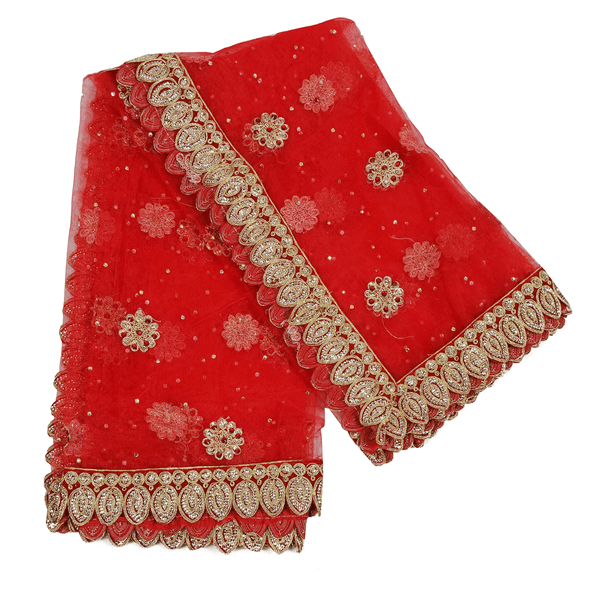
The woman unknotted her cloth bag smartly, with her long fingers and longer palms, and lifted out a heavy-looking scarlet chunni, all sequined lozenges and gold tasselled trim.. Mehar reached across and touched the tassels, which felt creepily ticklish. The man laughed too loudly. His eyes were very red.
‘She likes it … It’s for you, you know.’
Mehar wanted to protest, to say that he was mistaken, that she found it revolting and didn’t want it at all, but she had the feeling she’d been caught in something too big, …
Again the brilliance of this is that it codes protest in forms that remain silent, shared only by Mehar and the narrator as one consciousness momentarily. What they both also share is a knowledge of the systemic patriarchal sexism that is, of course and true to historical evidence, perceived as ‘something too big’ for this young girl to combat – at least yet.
These themes may be commonplace – I can’t say. I find them less convincing when they are insisted upon as in the readings of Mehar’s story implicit in a conversation between Tanbir Singh and Radhika witnessed by S. Yet the issues are not oversimplified even then. After all it is the most sexist of the characters, Tanbir Singh, who voices it most obviously: ‘… “It’s different for women, isn’t it? They have no choice in where they go. they grow up in a prison and then get married into one” …’.
But he says that inside the China Room, once that room lived in by the three interchangeable wives – Mehar, Gurleen and Harbans – but now inhabited by a man, S. And he says it in order to lay a claim on Radhika over that of S. He is contradicted by Radhika in ways that show that patriarchy does not lie in obvious symbols and issues. And the overall effect is that S, before he can ever think of himself loving and living with Radhika, must reflect on Mehar’s life:
I wandered over to my room and held its bars. A woman, my great-grandmother, had been locked in here. … I peered through the bars and imagined Mehar sitting on the other side, and I wondered what her life might have been’.[12]
That what comes out of this novel is only what an oppressed woman’s life ‘might have been’ may seem too uncommitted to challenge patriarchy. I think I disagree. It is true that patriarchy simplifies history and reduces the evidence that women did stand against it, pretending to a consensus amongst women themselves in favour of patriarchy that just did not exist. Hence a project in feminist writing is to search out resistant women from the past. But wonderful as this can be, it does not cover the experience of women whose resistance was as real but failed to get articulated precisely because of the very real power of patriarchy to successfully oppress. I think Mehar’s story is one such. It is why I think the novel speaks out of a background of different kinds of resistance – like that against British rule in the background of Mehar’s story.[13] But it draws no easy conclusions and hence will leave some readers unsatisfied. For me, it is a novel exploring how to honourably represent the lives of oppressed women, without making them seem to have failed because they make no breakthrough. So many women did not.
I hope this novel is Booker longlisted at the least. It is a triumph of technical power as a novel – of the handling of dialogue as well as guiding narrative modes – third and first person. I love it though monstrously sad. Or is that me (so often monstrously sad)?
Yours Steve
[1] Sunjeev Sahota (2021: 162) China Room, London, Harvill Secker.
[2] ibid: 163f.
[3] Elisabeth Sabiston (1986) cited in Matthew Guillen (2002)“On Being and Becoming Isabel Archer. The Architectonic of Jamesian Method”, in Revue française d’études américaines, vol. no. 92, no. 2, pp. 112-127. Available in: https://www.cairn.info/revue-francaise-d-etudes-americaines-2002-2-page-112.htm
[4] Portrait of A Lady, by Henry James (1881), VOLUME 2 CHAPTER XXIX. Available at: http://www.victorianlondon.org/etexts/james/portrait-0029.shtml
[5] Sahota op. cit.: 158
[6] ibid: 1
[7] ibid: 3
[8] ibid: 4
[9] ibid: 3
[10] ibid: 210
[11] ibid: 210f.
[12] ibid: 206
[13] See ibid: 36, 78, 116.
 Steve_Bamlett_blog
3 thoughts on “‘ … “She thinks she’s Isabel fucking Archer”. How women ‘end up’ in male novels. A new masterpiece by Sunjeev Sahota (2021) ‘China Room’”