Reading the evidence on sex, gender and sexual practices. ‘”L’amore masculino is solely a work of virtue, which joins males together …” [Epigram to Chapter 5 from] Gian Paolo Lomazzo Il libro dei sogni (1568)’ .[1] Michael Rocke (1996) Forbidden Friendships: Homosexuality and Male Culture in Renaissance Florence. New York and Oxford, Oxford University Press (referencing to Kindle Ed.).
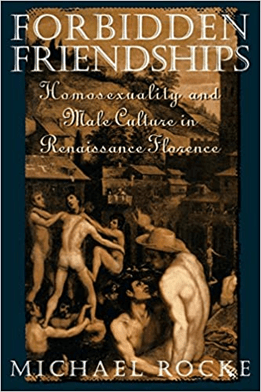
Michael Rocke’s major publication of 1996 is a really important one in the study of gender and sexuality, and of homosexuality. But it is only of the latter if we understand it as the description of a sexual practice not of a personal or even social identity, and in this case only a practice between men. It is a really important work in the data mining needed to understand the intersectional queer history and power, especially the complexity of power relations in sexual and homosexual practices. It is impossible to make glib statements about such things after reading this book. These statements happen both in support of histories of gay liberation or increasingly in the foundation myths of movements such as the misnamed biological-binary orientated ‘radical feminism’ and its poor deluded servant, the GLB Alliance.
In the first instance the history of the liberation of ‘gay identity’, itself a highly contested and modern entity, can only seem linear and to fit interpretive models of history (that we sometimes name as Whig models) in the very short duration of history from the nineteenth century, and then not without major nuance, in that, for instance, it seems blind to the tolerance of straight men to sexual practices that were not in any way exclusive or necessary to the definition of ‘practicing’ (as the parlance was to become) homosexuals in the mid twentieth century, as is clear, for instance in the art of Christopher Wood, Keith Vaughan, and John Minton. It’s there too in the novels of Martin Goff, especially The Plaster Fabric (whose dustjacket was designed by John Minton) which focused on the definition of masculinity active in London guardsmen and sailors.[2]
In the second the tendency to ignore modern biological research, such as the work of the feminist biologist Anne Fausto-Sterling, that is not based on the grossest kind of positivism is also compounded too often by similar evasion of best practice in academic history. Michael Rocke, in my opinion, has written a monumental work that illustrates that the examination of even single practices in the application of the human body in sexual practice rests on important historical power shifts in which symbolic interpretation of sex/gender are crucial. These power shifts are complexly configured across political, economic and social (as well as psychosexual) domains and cannot he shows be understood within notions of the myths of a biological binary. Reducing gender differences to binaries finds little or no support here, except as itself an ideology based on how the power of the phallus is both symbolised and distributed across categories like variations of how stages of life are interpreted in relation to male aging and, sometimes, class and political status.
My interest in Rocke’s wonderful and scholarly book grew as I read it, despite the apparent narrowness of its focus. Its significance is that it is clear that only a nuanced understanding would be able to understood the sexual practice known as sodomy, or penetrative anal sex. Indeed the acts which could be labelled sodomy also varied, to include the modern medical category, fellatio, but not always. It always depended on how and why sodomy was being singled out in discourse. This book has made me re-evaluate some important interests in the way in which for instance the male nude enters art historical discourse, especially in helping me see (although I am not sure I will blog again on this in order to spell out why this is the case) the superiority of Patricia Lee Rubin’s book on the variations of meaning of the anus in Renaissance art to other discussions of the Renaissance nude.

However, even in this serious book, there are things missing and a failure to use Rocke’s findings to examine the assumptions of the history of art – a discipline, in my view, uniquely founded on unexamined assumptions. For instance she discusses the painting used on Rocke’s dustjacket and illustrating it’s possible themes as a frontispiece to the book as a whole. It is a painting by Domenico Crespi, known as Passignano.
Rubin, in discussing this painting, is also in mild dispute with evidence from court protocols (of the Office of the Night set up in Florence in 1432) used by Rocke.[3] Rocke attempts to establish here and elsewhere that sodomy was an intrinsic part of local male culture, especially amongst sixteenth century young men. She says assertively:
… it is not about sodomy or sexual acts. In its entirety it is a vista of healthy, naked or nearly naked men, mostly young, enjoying physical activity. In that sense, the painting is about masculine pleasure and the pleasure of beholding masculinity, recalling the fun days by the Arno.[4]
Rubin has already described the painting as, ‘a unique (or uniquely surviving) example of an open celebration of male-male love …’.[5] After contradicting Rocke, but without mentioning his name in her written text explicitly, Rubin goes on to focus on the sole evidence, since she cannot attribute anything to the conventions of the pastoral as a genre in painting, that the painting is of a love tryst which concentrates on the ‘couple’ (a rather loaded term in itself in this context) ‘in the foreground’. Having determined that the artist has drawn them in a ‘circuit of intimacy’, she says, further foregrounding the centrality of a ‘couple’ in love rather than more generalised male behaviours, she says: ‘The beauty of their relationship is represented by the beauty of their forms. …’. In the text she goes on to elaborate these forms in terms of possible reference to other formal qualities that Passignano might have taken from cognate but better known artists. However, it seems to me that Rubin goes out of her way in doing so in ignoring other evidence, which is not necessarily pointing to a love relationship even if it is a sexual one. Thus her own descriptive language does a lot of interpretive work – describing the ‘interlacing of the lovers’ arms’. Such a choice of lexis illustrates an observer’s interpretation rather than an established fact in the content of the painting, even if such a thing were possible, that these men are lovers or are ‘courting’.[6] Here is that painting so that you may follow Rubin’s argument from the ‘evidence’ she selects from it.
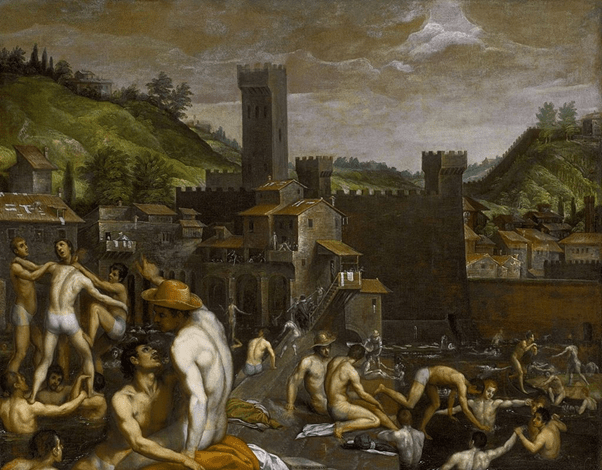
Look carefully at the painting. Amongst the counter-evidence for instance if it passes as such, we might note that the young male in a hat, from the ‘couple’ Rubin isolates from an otherwise entirely group orientated set of scenarios, is pointing into the distance, as if saying that he is intent on leaving to go somewhere else. Perhaps he is pointing to that place. Is it to the older female figure foreshortened on the distant high balcony – his mother perhaps. Perhaps he is aiming to go hunting in the hills alternatively. These potential scenarios might make the other man’s apparent passion, and, perhaps, the virtual lock he has got on his on his partner’s hand, a means of persuasion and restraint of the boy from this intention to return home or go to some other assignation rather than one of romantic ‘interlacing’ or ‘intimacy’. Mine is, of course, as subjective an interpretation as Rubin’s but is no more, nor no less, ‘evidence’, even though it lacks the conventional reference (to other artistic visual forms) Rubin uses to give it intradisciplinary authority. In contrast to either possibility, though Rocke does not argue a case about the painting himself, the contextual information he discusses gives room for wider possible interpretations than Rubin’s concentration primarily on romantic love of which sex is an expression.
A much richer reading of the Passignano painting in my eyes, for reasons I will give shortly, is that this painting interrogates the nature of homosociality as Eve Kosofsky Sedgwick names it. Nils Hammarén and Thomas Johansson argue in a 2014 paper that we need a much richer definition of the homosociality than that which was current from Kosofsky Sedwick’s use of it onwards. The abstract to their paper is an excellent summary of the original definition and the refinements of it that they propose and which matter to us (and, perhaps, Passignano).
The concept of homosociality describes and defines social bonds between persons of the same sex. It is, for example, frequently used in studies on men and masculinities, there defined as a mechanism and social dynamic that explains the maintenance of hegemonic masculinity. However, this common and somewhat overexploited use of the concept to refer to how men, through their relations to other men, uphold and maintain patriarchy tends to simplify and reduce homosociality to an almost descriptive term – one used to point at how men tend to bond, build closed teams, and defend their privileges and positions. … We will introduce a distinction between vertical/hierarchical and horizontal homosociality. Hierarchical homosociality is similar to and has previously been described as a means of strengthening power and of creating close bonds between men and between women to maintain and defend hegemony. Horizontal homosociality, however, is used to point toward more inclusive relations between, for example, men that are based on emotional closeness, intimacy, and a nonprofitable form of friendship. Relating this distinction to the concept of and discussion on hegemonic masculinity, we will reconstruct and develop a more dynamic view on homosociality.[7]
The meaning of male-male homosociality is queried by the fact itself of sodomy as Rocke, makes clear whether it be represented in crude physical terms or not. Antagonism to sodomy as a practice in Florence started under Medici rule, although perhaps in reaction to the ideological service it was put to on behalf of theocratic republicanism by radical clerics. Girolamo Savonarola used his preaching analysis of the practice amongst Florentine men to hint that it was, as it were, a reflection of the libertarian reputation of Lorenzo the Magnificent. But there are no clear binaries between the hegemony of the Medici regimes, before and after the Florentine Republic, and the Republic itself. What Rocke’s painstaking quantitative and qualitative analysis suggests is that, rather than reflect the political institutions of either government, it reflects growing conflicts between generations of men which attach themselves to symbolic material relating to the nature of male homosocial behaviour.
The Passignano painting, after all, is a painting in which young males (giovani) play with hierarchies and their dissolution. At the same time as playing, they build close relationships within their body (a body of young men) and between their bodies. Playing with highs and lows, building towers, processing up ramps or making circles in the water of which one young man attempts to become the centre are all ludic versions of power games. What these games exclude since this is now 1600 and the turn of the century is seriously older men: those who might be filling senior positions in government, whether in Republic or Principate. This then becomes in potential a painting about generational politics in which the weapons are those based in revisions of what it means to be a man – hence the fact that status through clothes is invisible and attachments can be socially vertical as well as horizontal in terms of class. It is a provocative painting looked at through a proper social-historical lens and is obviously, to me at least, about contested notions of masculinity. Some of the notions don’t get literally represented except by virtue of their exclusion. However, whilst absent from the superficies of the painting of an almost entirely naked world in which differences of rank, class and status between men are difficult to read, they would be still very present in the world of its viewing audience. This is not least because amongst the latter neither nudity nor lack of internal differentiations will be the case.
This painting, and experience of it, is not then about just the pleasure of looking at and being men or indeed the advent of new relationship types (though these possibilities are far from being excluded from the content of the interactions shown, but the power of young men to change things merely by being young men and in a collective form. The painting can be seen as a promise or a threat depending on the generation to which the viewer is socially identified. As Rocke makes clear it is giovani that successfully resists the theocracy of Savonarola and the tightening of the role of the Office of the Night first set up by the Medici.
Popular opposition frustrated the adoption of the friar’s most rabid demands: lax enforcement limited the effect of the laws; and, remarkably, for the first time in Florence – perhaps the first time in Christian Europe – groups of men, mainly youths, are found defiantly challenging attempts to repress sodomy. The armed gangs of lower-class youths, …, who in 1494 ostentatiously showed off their boyfriends around the city were soon followed by groups of their social betters who militantly championed their right to illicit pleasures.
He goes on to comment on a quotation from a government official after an anti-Savonarolan riot in 1497 – collected by the Italian historian, Simone Filipepi: ‘Thank God, now we can sodomize’. He argues that this illustrates:
the resentment that many Florentines must have borne toward Savonarola for his role in curbing their pursuit of sodomy, not merely a profligate “vice” but an integral part of local male culture.[8]

The point here is that Rocke’s focus on sodomy allows us to see that it could become a symbol not in definition of a ‘sexual identity’ or ‘the homosexual’ but part of the material around which definitions of masculinity are contested. This is about local male culture in a much wider sense. Of course, Rocke’ can be criticised because of the partiality of his sample – the cases are all ones brought for policing of public behaviour and / or (when they got that far) judicial examination. The accounts given inherently contain bias because they are accusations against the people who have become cases which might be motivated by numerous causes, that are not all admitted. Yet good historians discuss the limitations of their evidence and find a way of reading it that mitigates against the problems inherent in it and Rocke is a meticulous historian – refusing to substitute modern conceptions, such as ‘gay identity’ or ‘homosexual subculture’ for a search of the meanings of the evidence in its own time.
In our own culture, it has become common to imagine sexuality largely in terms of a polar opposition between heterosexuality and homosexuality. most people are thought to fall more or less neatly into either one category or the other, but even the alternative “bisexuality” derives its sense from its hybrid position somewhere between these two extremes.[9]
Interestingly the demise of the Office of the Night was based not on any other reason than that the administration of Florence became afraid that the evidence generated from the Office of the Night gave the impression of widespread sodomy in Florence and hurt the city’s reputation and, in particular the reputation of its men. We have come into the realm of the institutional control not primarily of behaviour but of the visibility of the behaviour, presumably because repression of actual behaviours is more problematic. And this takes me back to why sodomy might be so contested at that time. It was, as Rocke makes clear, possible, since the evidence is that the ‘passive’ role in sodomy was largely taken by adolescents up to the point they themselves matured and that this, ‘actually permitted all mature men to engage in sex with boys without jeopardizing their “manly” gender identity’.[10] By 1542 Rocke shows that the practice of the judicial system had begun to codify the ‘long standing abhorrence of adult male passivity’.[11] but the age differentiation and developmental rationale is crucial and Niccolò Machiavelli is urged by his adult male friends not to be too severe upon an adolescent son, Lodovico, who ‘growls in the ear, goes to bed together’, with another boy.[12]
Under Savonarola from 1496 not only were boys described as agents who ‘allowed themselves to be sodomized’ (the analogies with blaming the female victims of rape for their rape is clear here) but this also led to more consistently severe punishment. They also, moreover, became the focus of a moral crusade and were enrolled from the age of 6 to 20 or so into groups meant to reform young men as a whole social body. The object of attack was not, in the first instance, sodomy itself but on the supposed ‘feminisation of young boys’ by a concentration on clothing and appearance, as fulminated against by the preacher Bernadino. Savonarola instituted guidance on how male hair is worn, the adoption of ‘less seductive clothing’ and training to ‘say no’ to letting ‘themselves be sodomized’. As Rocke says the aim of ‘the Piagnone battle against sodomy’ – largely targeted at the passive partner and not the active penetrative adult male, who could therefore consider himself still a man even if a wicked one – ‘was equally an attack on gender ambiguity’: Savonarola himself fulminating against his perception that there, “is no distinction between the sexes or anything else”.[13]
I suppose my point is that the history of art too often presumes to generalise about queer history in ways that appear entirely anachronistic to anyone with knowledge of the contexts presumably used. There is still point to Rocke’s simple warning against those who take up cudgels on either side of debates of whether an artist is gay or not.[14] The point is not to apply modern categories but to accept that the attempt to render sex a fixed biological binary simply neglects that even sex binaries are continually in contest and fluid. Rocke feels just about right here:
Although often interpreted in the anachronistic light of modern experience, the homoerotic inclinations (alleged or well confirmed) of Donatello, Leonardo da Vinci, Sandro Botticelli, Michelangelo, and Bevenuto Cellini are by now well know, … [I]n the broader social context of sodomy in Florence the experiences, fancied or real, of these prominent artists were probably little different from those of thousands of other, less famous men.[15]
Vasari, for instance, does refer to the fact that when the youth of Florence cheered the painter Giovanbattisti Bazzi on after his horse won a race, they used the ‘filthy name’ by which he was commonly used, ‘Sodoma’: but Vasari’s interest was in the way this name, and its interpretation and evaluation by them, riled up the older generation of those in political control: vecchi uomini da bene (“old notables”).[16] My own interest in Rocke’s book therefore remains one in which we do not create unspoken parameters to categories and hence my preference to the term ‘queer’ to ‘gay’. This is because heteronormativity is not based at all times on the same norms but that power dynamics, especially those which are used to control norms always validate the powerful in any status quo whilst pretending they are independent of politics.

And this is particular the case with gender binaries, which police not only females to ensure their effective subordination across a range of issues and mitigate any effects of its access to power but also males who challenge the integrity of the binary sex distinction itself. We can help ourselves not to think too simplistically about queer history by reading this great book again. Yet will it be read. The word ‘sodomy’ itself will militate against that. Suddenly even good feminist academics like Patricia Rubin, suddenly decide that it cannot be involved in discourse safely or without being obvious, as if representation in cultural artefacts like Passignano’s painting weren’t precisely about hiding the obvious whilst allowing its muted or sublimated expression: ‘… it is not about sodomy or sexual acts’ but ‘a vista of healthy, naked or nearly naked men, mostly young, enjoying physical activity’.[17] Is that not a kind of hiding the full complexity of human behaviour and shifts of meaning of all gendered ‘physical activity’ in the interests of one’s reputation as a respected expert in the history of art? Just a thought!
All the best
Steve
[1] Rocke (1996: Location 3501).
[2] The Minton jacket is illustrated and discussed in : https://stevebamlett.home.blog/2021/03/09/not-made-with-hands-a-shaggy-dog-shaped-reflection-on-the-limits-of-curation-as-a-model-of-historical-knowledge-a-queer-problem-in-the-history-of-art-based-on-reading-the-human-touch-making/
[3] For a summary see the review of Rocke’s book available here: https://igfculturewatch.com/1998/05/28/homosexuality-in-renaissance-florence/
[4] P.L. Rubin (2018: 109) Seen From Behind: Perspectives on the Male Body and Renaissance Art New Haven & London, Yale University Press
[5] Rubin op.cit.: 107
[6] ibid: 109
[7] Nils Hammarén and Thomas Johansson (2014) ‘Homosociality: In Between Power and Intimacy’ in SAGE Open January-March 2014: 1–11 © The Author(s) 2014 DOI: 10.1177/2158244013518057. Available at: https://journals.sagepub.com/doi/pdf/10.1177/2158244013518057
[8] Rocke op.cit.: Location 4597.
[9] ibid: Location 291
[10] ibid: Location 354
[11] ibid: Location 2498
[12] cited ibid: 2696
[13] ibid: Location 4935”
[14] . Andrew Graham Dixon’s 2011 biography, for instance, waxes almost apoplectic in the desire to save Caravaggio from that label – a very strange mission indeed.
[15] Rocke op. cit.: Location 3310
[16] ibid: Location 5406
[17] P.L. Rubin (2018: 109) Seen From Behind: Perspectives on the Male Body and Renaissance Art New Haven & London, Yale University Press
 Steve_Bamlett_blog


8 thoughts on “Reading the evidence on sex, gender and sexual practices. ‘”L’amore masculino is solely a work of virtue, which joins males together …” [Epigram to Chapter 5 from] Gian Paolo Lomazzo Il libro dei sogni (1568)’ .[1] Michael Rocke (1996) ‘Forbidden Friendships: Homosexuality and Male Culture in Renaissance Florence’.”