‘Bacon never publicly concealed his homosexuality. … Bacon did not flaunt his homosexuality in his painting, either, though he made no deliberate effort to conceal it. Homosexuality per se was rarely his subject’.[1] The problem of categorising queer sexuality for the writer who must ‘not appear homosexual’ and possibly is not.[2] A problem in an otherwise great biography: Mark Stevens and Annalyn Swan (2021) Francis Bacon: Revelations London, William Collins
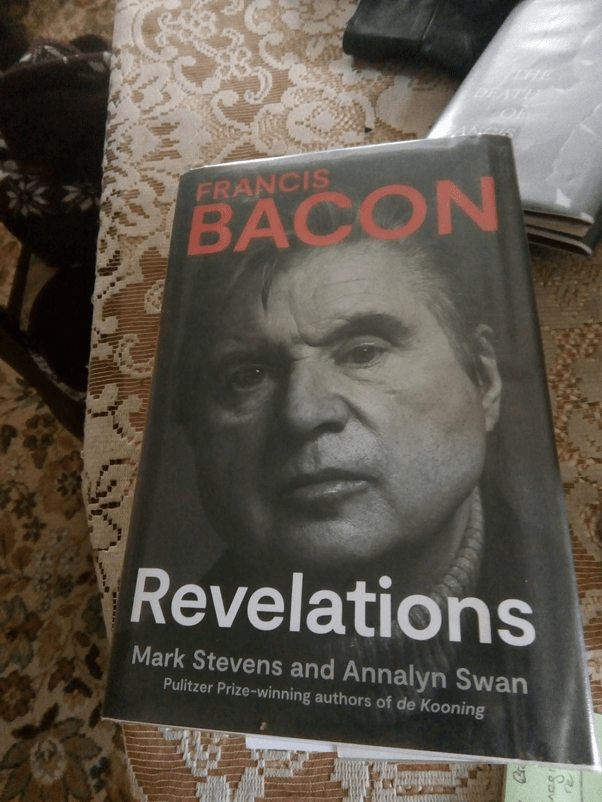
I am writing this blog because, having just read a wonderfully professional new biography of Francis Bacon, I have become much more sure that biographies of great creative artists who either or both loved or had sex with men is a tricky business. It must however not appear to be problematic to the biographer since if it is to be asserted biographers feel, rightly in some ways after all, that ‘being homosexual’ is or is not a ‘fact’ of an artist’s life not merely a perception or impression. Indeed a brilliant recent biographer of Lucian Freud, William Feaver, is scrupulous about this very point, as I said in a blog on its publication, and so carefully so that I would not see his biography as falling into the same traps as does this one of Bacon.
Given this unstated assumption that homosexuality must be evidenced in any biography or other witness to a life, it is still difficult sometimes thus to fully state such evidence because ‘being a homosexual’ is not necessarily obvious to the eyes of observers, sometimes for a number of reasons. Indeed, in some cases ‘being homosexual’ is not even marked by any single act of behaviour; thus, for instance in this biography, poet Thomas Blackburn, whom, having fallen in love with and before their short relationship ended, ‘sodomised’ Bacon remains classified as ‘a handsome heterosexual man’. This is presumably because Blackburn classified himself in this way.[3] Other men, like Peter Lacy, George Dyer and John Edwards are characterised as people who, although they did ‘not appear homosexual’ and, for that reason, became apparently more attractive to ‘homosexuals’ like Francis Bacon, are however thus classified. [4]
Were these acknowledged male lovers of Francis Bacon homosexual as they certainly were queer (or some way from the social norm in their sexual choices)? In fact questions hang over categorising some of these men in the biography’s handling of them, especially George Dyer. I find the following example, for instance, offensive in a number of ways:
Dyer wasn’t obviously homosexual, but he could be accommodating: cockneys famously lived by their wits. Terry Miles thought George’s homosexuality “came about by being in prison and having the usual”.[5]
The refusal to move in this case from not being ‘obviously homosexual’ to the established fact that George lived the life of a contemporary metropolitan ‘homosexual’ of celebrity seems to lie in the fact that more than one stereotype can be called forth to explain his behaviour. That they were ‘homosexual’ is never questioned in the same way when he text deals with Peter Lacy and John Edwards. Was George merely being ‘accommodating’, as working class men from the East End (here disguised as ‘cockneys’) are reputed to be or was he as ‘homosexual’ as were Peter and John underneath the appearance of not being so. A defence of the ‘reasoning’ here may be based on the fact that the authors are merely reporting the point of view of George’s sexual behaviour of the semi-criminal working class men who are, at this point of the book, the authors’ witnesses to the evidence. Nevertheless, in my view it hardly exonerates an author’s care with evidence to blame the limited perspectives of his sources, if that is indeed what happens in these sentences.
For me, these instances raise a larger question about the conceptual validity of labels like ‘homosexual’ in biography. For ‘homosexual’, unlike the term, ‘queer’, makes ontological claims about the person to whom it is applied that are often difficult to sustain. If Dyer could be proven to be merely ‘accommodating’ or if his sexual life with Bacon could also to be proven to be a result of habituation to his experience of exclusively male prisons would that mean he was not strictly speaking ‘homosexual’? This concern with the aetiology of homosexuality is merely one reflection of considering love or sex between men as an abnormality or deviation. Providing support for such a grotesque conclusion is precisely what I would charge the authors of this book of being careless enough to allow. I want to note here, however, that I don’t believe that either I or the authors themselves see this book as, even if subtly, homophobic. It is merely that their methodology as biographers of a queer artist facilitates such conclusions whether intended or not.
If, for instance, we take the case of men where the fact that their sexual love of men is unproven or inconclusive, it is clear that that conclusion requires a higher standard of evidence than the assumption of heterosexuality even when it is clear that there are reasons, such as contemporary legal and reputational repercussions, why queer men might minimise the degree of evidence of their sexuality. This is the case with Walt Whitman. This case is brilliantly argued by Mark Doty.[6] In a blog on his Whitman ‘biography’ I say that Doty:
…shows that the queer scholar or reader of poems achieves insight into the queer content of art only by contesting an ever-present homophobic censor within the products of homonormative cultural institutions. Examples of such might be academic or cultural press guardians in society, or internal to persons, their introjection into our psychological core beliefs, even those of the artist themselves. The role of this censor, external or internal, is to deny the existence of the queer past or past queer people:
“there is often a gatekeeper, representing a straight present, who will labor (sic.) to invalidate the historical fact of queer lives”.[7]

Now, as regards Bacon himself, Stevens and Swan do not deny, as on the other hand of Whitman many of the latter’s biographers do, that Bacon was undeniably queer. This would run counter to nearly everything Bacon said, or allowed to be said by others, of himself. However, most older queer readers, amongst whom I recognise myself, would find it difficult not to find the manner of expressing Bacon’s ‘homosexuality’, and not just by choice of this medicalised terminology, offensive.
Let’s take a sentence I quote in my title: ‘Bacon never publicly concealed his homosexuality. … Bacon did not flaunt his homosexuality in his painting, either …’. Now, in a book about, and entitled, ‘Revelations’ of a person’s life ‘flaunting’ is a fairly extreme word to describe an act of revealing one’s sexuality to others or as an antonym to concealing, yet ‘flaunting’ is a word that has bedevilled discourse of homosexuality for a long time as a means of giving negative colouring to the act gay men and lesbians call ‘coming out’. David Lick and other academic social-psychology colleagues have argued that, ‘gender-atypical appearances common among sexual minority individuals arouse negative evaluations’ that cluster around the idea of ‘minorities’ who flaunt that ‘fact’.[8] This appears to be how these authors use this word too when describing Dorothy Todd, the lesbian editor of Vogue magazine, and more egregiously ‘the legendary cross-dresser’ Quentin Crisp whom ‘flaunted his homosexuality, and yet his mother never seemed to notice’.[9]
I am aware of course that it may be argued that being sensitive to the attitudes conveyed by one’s lexical choices at the level of each sentence is putting too much on a biographer, but I don’t think so myself. There are other places where issues of attitudes that are revealed and masked simultaneously matter much more in this biography that claims to be about the genesis of masking motifs in Bacon’s visual art as an engine of revelation. Even when the authors make this claim they express the issue as a product, or partially as a product to be fair to them, of the desires of an inferable construct of a type (more strictly a stereotype). For instance, in an attempt to distinguish Bacon’s motivations from ideology, they characterise his attack ‘on convention’ or ‘the fraudulent constructs of civilized life’ as in part:
… for a homosexual who disliked closets, a tigerish, paradoxical, and sometimes comic joy to be found in tearing off masks, shattering norms, and breaking constraints.[10]
It may be that this represents a moment of less than disciplined logic but to me it creates deep problems about the ontological claims made by the term ‘homosexual’, to say nothing of how and where we are asked to imagine this construct in the form of one such ‘who disliked closets’, which posits another being we could call the ‘homosexual who liked closets’. Now in as much as this is not a ridiculous statement it could have described a part of the psychology of any queer man during the period of their enforced social, legal and ethical marginalisation. At base, the expression here pretend the aetiology of behaviour lies in the personality of the ‘homosexual’.
In fact both closets and responses to them are complex cognitive and emotional responses not to a ‘tigerish’ disposition in the responder but a real oppressive force within their socially constructed situations. These include the toughest constraints – those of criminal law and punishment – but also of the force of social-psychological norms that police behaviour and that get expressed in symbols such as walls, enclosures, the wrappings of clothing and the rigidity of masks, including those moulded as expressions in the living flesh or the sound made flesh in a scream of hatred, agony or hate encased in words. For me, the reduction of Bacon, often a task willingly engaged in by Bacon himself, to a playful child expressing his animal self and its frank destructive urges playfully is yet another playful collusion of a present that does not need to, unless it chooses to do, collude with an ever-present conservative impulse to the oppression of unconventional desire. And thus, despite a great biography otherwise, Stevens and Swan need to brought to the bar of critical examination of attitudes in themselves that they have failed to challenge.
There is in the biography of course an awareness that the proximity of queer behaviour to other constructs other than those of a bourgeois society against which Bacon rebelled. They include constructs such as the personality of the criminal or financially available working class (as if Lombroso might have been corrected about the genetic aetiology of such behaviour). Undoubtedlt though these authors tend to psychologize and, I would say, pathologise queer men rather than understand the link of behaviour and person as involving also a complex interaction with cognition and emotion created in large part by the social situation of homosexuals in the 1940s and 1950s. Such a tendency in authors merely throws away any serious consideration of a more psychologically vulnerable man like John Minton (or indeed of the whole range of emotional resilience in working class gay men too of the period – or boys of whom I was one) who ‘went to Soho almost nightly, often with sailors in hand, and he burned painfully bright’.[11] The latter’s choice of suicide as a response to oppression was not uncommon for young gay men (whatever the need to reduce its aetiology to the neurosis of a sensitive man), as it still is not. But even in emotionally more resilient men like Bacon turns human desire into the expression of a divided personality rather than of a group of people whose emotional lives are ‘queer’ to heteronormative, or even contemporary homonormative, standards:
… he was attracted to the “rough trade” homosexual bars in London that appealed both to gentlemen and to young toughs. A one-night stand with a sailor could be meaningless in a meaningful way: despairing, cruel, cathartic. … he could find a moment’s clarity in the sometimes violent serendipity of the night.[12]
The personality issues of this instance (and wherever else the book deals with the frequent occurrence of sadism or masochism in sexual activity) conflates so many issues in a psychological paradigm for explaining great art as a function of the artist’s psychology. Even when the biography allows for the effect of Bacon’s reading Aeschylus’ tragedies, it is clear that the dynamism and meanings of a Bacon painting is an occulted psychological, even if the psychology is existential. There is room for all of this but conflating artistic issues with the psychosocial and political without examining the complex interactions involved is not one I personally value or one that will challenge the values of a society which invests primarily in control of its members.
Now this biography is more ambiguous about these issues than I might be giving the impression so far. It is important to remember that I have no issue with the intentions of the authors with regard to a serious take on how the emotional lives of queer men are sometimes constructed in rigid social cognitions, or ideology as I prefer to call it. In speaking of the unconventional triangulations of relationships in the Bacon circle they say that, ‘homosexuals who grew up painfully constrained’ and valued more ’emotional freedom’ more than those not thus raised.[13] This is a useful approach. Similarly the authors can typify the oppressive sexual ideologies of some of the most dominant male white Abstract Expressionists (there were black and female Abstract Expressionists) of the United States in their powerfully institutionalised hold on the values of global art during the 1960s and 1970s as, ‘abstruse theorizing and macho posturing’. They go on to use Max Kozloff’s judgement, in writing to David Sylvester about the USA response to Bacon’s Guggenheim retrospective, to amplify this theory and posture as based in ‘a strong anti-homosexual feeling’.[14]
But I won’t insist constantly on demonstrating that there is flexibility and good intention in these authors on the notion of queer lives. It is still necessary to look at things we have to find (ought to find) disturbing in their implicit view of the meaning of those lives – in art and life both. For instance, where in the following quotation does the association of ‘his homosexual world’, whatever that might mean, with ‘Instability, exhibitionism and extreme situations’ get clinched, and why are these things assumed to be a direct effect of ‘his homosexual world’ rather than a world in which queer love and sex is suppressed in everyone except those who resist it in one way or another, alongside many other aspects of life outside the dream of the ‘normal’:
Bacon would, of course, enjoy being associated with “the complicated night life of big cities.” Instability, exhibitionism, and extreme situations – Melville’s words – were also an indirect acknowledgement of his homosexual world and an appreciation of the vivid, discordant energy of the modern city.[15]
Of course, this is not all that the authors have to say about the art or Robert Melville’s perception of it in 1959 but they still say it, as if it explained all of the contribution of queerness to Bacon’s philosophical conclusions of abstractionism and conceptualism of other kinds in art. Of course, it’s difficult to see how much here is reportage and how much a biographer’s interpretation of either or both Melville’s or Bacon’s views. Indirect speech always remains a problem in this way as Voloshinov and Bakhtin remind us.
This applies likewise to following sample commentary where the authors deal with Bacon’s apprenticeship to his developing art through a fallow period whilst living in Bedales Lodge in Steep near Petersfield from 1940 to 1942.
No one can fully master the mysterious formula by which a charming, reserved, but sallow young man who retired in 1940 to a country village could emerge two years later as a confident English artist able to brush off difficulties that life presented – such as anxiety, illness, homosexuality, and failure – as annoyances worthy of a joke. It was probably less a fundamental change of character than a recasting of elements already present. Future friends considered Bacon powerfully “male,” despite his obvious homosexuality. Perhaps he felt confident enough now to assert his power.[16]
I find the implied, and possibly unintended, attitude to homosexuality here characteristically problematic, in a way that cannot be resolved by invoking how ‘homosexuality’ was discoursed about in the 1940s. The stress on what constitutes ‘obvious’ or ‘unobvious’ homosexuality emerges here as in ones quoted earlier and dealing with friends and lovers of the great man. It is clear here that the concept is tied to notions of gender and expected social power. But how? It is clear that, from its companionate concepts “ – anxiety, illness, homosexuality, and failure –“ that homosexuality is perceived by someone as a deficiency from a standard of appropriate power for a male artist, which deficit is not entirely explained by either of the terms that describe Bacon’s supposed attitudes to these issues before and after residence at Steep: whether “difficulties that life presented” or “annoyances worthy of a joke”. I find neither description justified as reportage of possible attitudes of Bacon to his queer sexuality, at the least.
Sometimes the problem is that it is possible to use terms to describe queer life in a vague and unspecified way. How for instance is the ‘epistemology of the closet’, in Eve Kosofky Sedgwick’s well known (at least to queer scholars) formulation, addressed in this rather unmeaningful comparison of what social power, in relation to Bacon depicting Velasquez’s Pope Innocent X, to the facilitation of hiding allowed some queer men by ‘the homosexual closet’: “The curtain of power (like the homosexual closet) could not finally protect the man”.[17] At other times I feel these authors approach taking seriously the contribution to sexual politics of a man clearly not friendly to politics of any radical kind such as Bacon was. Look at this rather powerful summation for instance:
The society that could not tolerate (Oscar) Wilde was the same society into which Bacon was born, but Bacon lived to see the position of homosexuals transformed. He bridged worlds. He gave body to change. …[18]
I do not take this quotation further because it locks itself into the authors’ certainty that the ‘body’ given to change was fundamentally not only the body of queer men, other than that they were examples of ‘tragic figures in the paint’.[19] This is to say that these authors are so concerned to divorce Bacon from any taint of being a specifically queer artist (which is not to say he had nothing to say to anyone not identifying anything in themselves as ‘queer’, though these must be very strange people indeed) as Bacon was himself.
In my view Bacon went out of his way later in his life to distance himself from contemporary queer art which also concerned itself with ‘the body’ and the ‘body of change’, amongst which I would include those to whom art history has been unfair, like John Minton, Keith Vaughan and Denis Wirth-Miller. These latter contemporaries, some of them close friends for episodes in Bacon’s life (Wirth-Miller particularly so), are a necessary context for any biography that serves to capture Bacon’s significance as a painter of the male nude and the male figure generally. It helps us not at all if we perceive Bacon’s homosexuality merely as a necessary but inconvenient label for a painter whose peers are great artists throughout history such as Michelangelo, Velasquez and Picasso, when we come to look at how history was changed by the social action of open gay men like Bacon. Bacon ‘detested the word “gay”’ when used later to describe ‘homosexual men’ we are told.[20] However, I think the authors miss a trick when they assert that he could not have predicted the word ‘gay’s emergence as a positive identity-marker for a whole group of men (and women sometimes). Appending to a quotation from Bacon’s s letters such as the one below a appended comment such as I futher quote here seems to me historically and lexicographically arrogant:
“Love, or whatever you like to call it, and work, seem to be the only things that do at all for me – … and the love thing seems to start with so many complications, especially the homosexual side now that everyone knows as much and are afraid of everything. How wonderful if we could live the gay and magic sides all at once. ….”
By “gay” Bacon did not, of course, mean homosexual: the word was not yet applied in this way. He was instead calling to mind the dream of a simple, lighthearted, and unkinked love.[21]
That the word ‘gay’ entered into parlance precisely to ‘unkink’ a concept of same-sex love sullied by past discourses – legal, moral and medical – seems to most modern queer people self-evident, whatever the looseness of its use outside our community. We do not need to invoke Bacon’s consciousness here – that s impossible here – to see that he is applying the word to ‘homosexual’ as an alternative to the heaviness imported into the latter by common social attitudes.
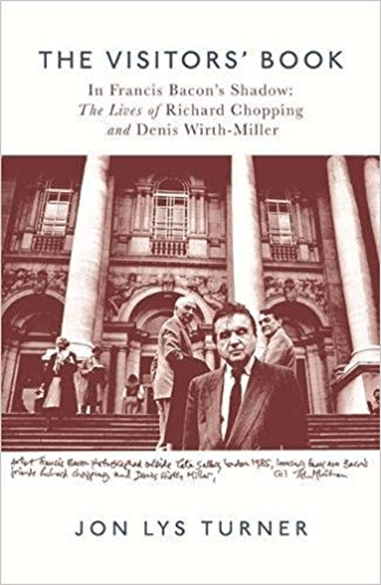
Indeed, if I have the energy I will try and show in a second blog how Bacon could be both a philosophical, emotional and sexually queer person and simultaneously investigate the traditions of the history of art through queerness. This is something he MAY have partly and half-consciously intended in saying to Melvin Bragg in a TV interview that, ‘“… (Michelangelo) gave the greatest voluptuousness to the male body” of any artist’.[22] For me this puts Bacon in the same tradition of having to capture the concatenation of sense, emotion and intellect in the male sexual body in the eyes of other men as exercised both John Minton and (more importantly) the vastly under-rated Keith Vaughan. Bacon would have denied any link I am sure but biography need not be bound by conscious authorial intentions in any artist if it illuminates social-psychological history as I believe the concern with individual and group nude male paintings does this group of artists who definitely knew of each other’s work.[23] Similarly we know, because this biography tells is so, that Bacon’s later disparagement of Denis Wirth-Miller as an artist did not stop him from either using his motifs, especially of grass landscape as a body of paint, in his own work or of collaborating secretly and darkly with Denis as well as complicating the latter’s relationship to the latter’s long-term partner, Richard Chopping.[24]
So this is as far as I go here. But I want to reiterate that this is a VERY FINE biography and that its examination of the links between Bacon’s interests in great literatures and atheistic and existential philosophy are thoroughly illumined in the most original and readable of manners. But whilst ‘homosexuality’ insists upon being a subject of discourse for academics, queer theory must contest those discourses. That is why I believe I write as I do here.
Steve
[1] Stevens & Swan (2021: 369)
[2] One of several appearances of this phrase used to describe men who are not obviously ‘homosexual’ is used of Peter Lacy: ibid: 335.
[3] ibid: 288ff.
[4] One of several appearances of this phrase used to describe men who are not obviously ‘homosexual’ is used of Peter Lacy: ibid: 335.
[5] ibid: 478 citing an author interview with Miles.
[6] Doty, M. (2020) What is the Grass: Walt Whitman in My Life London, Jonathan Cape.
[7] José Esteban Muñoz cited in ibid: 178 but here cited in my blog, available at: https://stevebamlett.home.blog/2020/07/05/queerness-has-an-especially-vexed-relationship-to-evidence-reflecting-on-why-mark-doty-a-queer-poet-insists-on-the-queerness-of-the-body-of-walt-whitman/
[8] David J. Lick, Kerri L. Johnson, Simone V. Gill (2014) ‘Why Do They Have to Flaunt it? Perceptions of Communicative Intent Predict Antigay Prejudice Based Upon Brief Exposure to Nonverbal Cues’ in Social Psychological and Personality Science First Published June 6, 2014, https://doi.org/10.1177/1948550614537311 Available at: https://journals.sagepub.com/doi/abs/10.1177/1948550614537311?journalCode=sppa
[9] Stevens & Swan (2021: 51)
[11] ibid: 275
[12] ibid: 276
[13] ibid: 286
[14] ibid: 469f.
[15] ibid: 437
[16] ibid: 199. My italics.
[17] ibid: 313
[18] ibid: 703
[19] ibid.
[20] ibid: 9
[21] ibid: 289f.
[22] ibid: 644
[23] See my blog based on a MA dissertation proposal more or less squashed by the Open University History of Art department after I complained of potentially homophobic text in study materials (not clear if these were related): https://stevebamlett.home.blog/2019/06/25/queerying-keith-vaughans-groups/
[24] See my blog: https://stevebamlett.home.blog/2020/02/03/reflecting-on-the-writing-biographies-of-queer-couples-st-clair-h-2019-a-lesson-in-art-life-the-colourful-world-of-cedric-morris-arthur-lett-haines-and-one-other-book/


Great post, Steve. There’s always those who require “evidence for” famous people being gay or bi. I was reading about an art historian “disputing” that Caravaggio was gay (I think it was Andrew Graham-Dixon). And other biographers denying that Alexander the Great was bisexual. Isn’t it just straight men getting a bit pissy & homophobic…? I say men because I suspect, on the whole, female commentators are more attuned to noticing/accepting “difference” (used as they are to being “otherised” themselves). Certainly it smacks of a kind of patronising entitlement – silly gay people / women / whoever, always trying to find prove their little identity issues! 🙄
LikeLike
Thanks Rowan.
I agree, although these authors do acknowledge Bacon as ‘homosexual’, the way they co-construct the term makes you wish they were gay-deniers sometime. Great debate you started up.
Steve
LikeLike