Language forever messing ‘up the whole business’: Okechukwu Nzelu’s The Private Joys of Nnenna Maloney (2019) London, Dialogue Books.

The written word, he believed, ought to make things clearer, more immutable. Instead, (it) … was forever dependent on context, always open to misreading, mistranslation, misinterpretation … , this messed up the whole business.
Nzelu (2019:245)
It is a risky business to build a debut novel on a perception of the role of language in all instances of communication, since it demands so much insight into the contexts of communication – between people, communities and with the origin of transcendent truths. That latter transcendent partner in communication, in this novel and for some characters, is God.
You have to be a most able and reflexive creator and hearer of the languages used in communication to write that novel. And on top of that you need to see that novels themselves are reducible to ‘written word’ communications. Is our most basic need as readers or listeners that authors, or other sources of authority, ‘makes things clearer, more immutable’?
Perhaps the nature of that satisfaction is often rather more to offer up to us the ‘messes’ that human talk and performative action get us into, even when we try, however hard, to clear up after ourselves.
And one source of such a mess is the hermeneutic process itself, the desire and process of knowing the meaning (immutable or not so) of what confronts us.
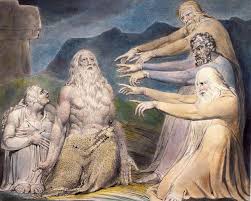
The source of the mess in communication is sometimes just variation in contextual or background ‘noise’ that changes the meaning of words and actions. It could be also the degree of reliability of both the source (‘unreliable narrators’ included) and receiver of the message. It may be the nature of the media used to communicate. Language and talk about language ride high in this novel. This point is made by the use of a translated and forever re-translated and re-encoded Bible. For instance, French translations of the Book of Job amid odds and sods of other French ‘sayings’ clutter a large part of the communications and miscommunications between the participants in a sixth-form French class.[1]
Nnenna sets off into a painful journey to clarify the mess in which her identity seeks to find itself. In part this mess is described in the perennial ‘mess’ of her room, forever set against the fussy homely order of adult Joanie’s domestic spaces, in the hope of avoiding ‘one big ugly mess’.[2] The mess in Nnenna’s room as she embarks on that journey, and as seen by mother Joanie, is itself compared to a difficulty of understanding in language, :
It took her a moment to make sense of what she saw. Nnenna was not exactly a tidy child by nature, but Joanie wasn’t used to seeing her bedroom in this state: it was like seeing a familiar text in a foreign language – it took time to translate. There were books everywhere, and pages and pages of notes strewn around Nnenna like dead leaves from a tree.
ibid: 149f.
The mess resolves itself in part into a pile of books accumulated by Nnenna to teach herself Igbo, the language of her otherwise unknown father. Igbo, French, English in many dialect and subcultural variations (including teenage ones), internet code for chatting, and hetero- and homo-normative use of words about love and relationship all evoke constantly mistranslated codes for communication in the novel. ‘Mess’, especially in relationships, occurs as a result. The idea that the novel concerns a mess made of things that started off as clear intentions in characters, and perhaps the novelist, is not itself new – E. M. Forster consistently calls it the ‘muddle’ to which his own novels, and his life engineered as novel, tended.
And ‘mess’ is creative. The funniest use of the word is in the cruel journey to sexual freedom, even from white homo-normative forms, of the gay Nigerian ex-Cambridge scholar, Johnathan. Silas enjoys non-monogamous sex freed from the heteronormative, but his norms are built on an unacknowledged racism and sexism that confines any experience, even sex, to non-linguistic animal predation (only Jonathan thinks in language in these sections). It takes place in the servant’s (perhaps even ‘normative’ women’s) quarters of Silas’ home, squatting impersonally on the hall, scullery, pantry or kitchen floor. After one such experience, he visits Joanie and Nnenna:
… he was a mess – physically and emotionally. He was an emotional mess because he felt unduly shut out of Silas’ life. He was a physical mess because he was covered in food.
…., ‘but I am happy to see you.’
‘Me too,’ said Jonathan. He wiped the last of the butter from his Adam’s apple. His voice sounded absent.
ibid: 176
I include a little of the dialogue so that the skilful and hilarious use of mess shows a novelist working in full dramatic power, seguing between what is internal and external to his characters – in a way that recalls, at her best, Jane Austen working pathos towards her characters into her delicious ironies. Moreover embedded in this passage are reflections made by Nnenna about her mother Joanie’s belief that ‘face to face interaction’ is a lost cause in the age of social media. It is reflexive writing at its best.
Delight in mess is a beautiful feature of this novel and what makes it tick for most readers I expect. After all, we are all in a perpetual mess or threat of such. If we don’t always notice it, it’s implicit in our pride that we can clear it up (let’s call it the OCD of everyday life).
Indeed that admirable character Joanie illustrates this for us and this is why, despite the perfidy of her parenting intrusions, we understand and love her. But mess most often leads to pathology rather than fun when it based on the unsaid or the under-communicated, except in hints from the surface of things. Thus Nnenna feels that she is reduced to a merely black or brown appearance among different others rather than someone living her black and white identity and life as she chooses. And Johnathan too finds ‘freedom’ as a gay black male, free from question of whether he is ‘really black or ‘really gay’’.[3] At his intersection of the life of both he needs to look to less normative sources for his ‘words’.
…, he took off his hat and let his ears sting in the wind, It was good. He opened his mouth to speak, and let his words of freedom echo through the hills and valleys.
ibid:238
And lives and issues in lives, including categories of identity, beautifully and queerly intersect in this novel. When Danny opens up an issue in Nnenna’s identity by asking why she seems to want proficiency in French rather than ‘your language’,[4] he begins an unconscious search for his own authenticity of being. This marginal character, Danny, who by degrees makes space for Amit, is in turn is obsessed by everyone having the right spatial relation to him. This lovely interchange is coded through exchanges in the game of Sudoku, which the author plays with an irony Jane Austen would love:
It had become a funny ritual of theirs lately, Amit figuring out the answers but leaving enough space for Danny to feel as though, despite his shortcomings, there might be some sort of space for him after all.
ibid:162
Here a novelist ponders and raises subliminal expectations in, and, of his characters that show that intersections sometimes occur to produce beautiful relationships: of class, race, and culture in the case of these two boys. When categories of identity intersect, spaces can both close down in death or open up into living relationships. Hence it’s an open novel about an oppressive world where, nevertheless, suicide is threatened and sometimes happens. Things flourish given free space away from the constrictions of meaning that social convention sometimes imposes on symbols.
Starting from this point in our introduction to this novel, we can go in many directions. Understanding how oppression acts within categories of our socio-cultural life as well as between them, helps reconstruct how its narratives affect us in our own specific case. These categories intersect, and complexly interact, in ways that ensure being gay and black may be experienced as very different from a person who is gay and white, being a woman of both white and black parents may be experienced as different from that of a white woman or black woman from like families. And that these effects can tend to closure of opportunity or to the creation of new empowering spaces.
Nzelu’s novel is about how aspects of identity are experienced in the grid of the desires that instantiate self and the other in relationships of power, bondage and letting free from our greedy attempt to hold onto their original meanings. That grid is even symbolised in the Sudoku playing of Amit and Danny as we have seen. Religion, family, community, art are all means of stabilising this grid but they can be also be the means of stifling its potential to produce change or subliming it into symbolic form. And change means being in control of your own story – guiding the mix of categories and contexts used to interpret it. Thus Nnenna in Paris and in narrative’s ‘Epilogue’:
A lot of people have come from similar backgrounds, but not everyone. She is not the only one now. And even better, nobody knows her, here. She can reinvent herself utterly. … and she can decide her story for herself. Anyway, things have changed.
ibid:308
This novel is a debut novel in a similar way perhaps to the way George Eliot used her novels to deal serially with the phases of her own development. This novel is at its very finest in dealing with the wide range of interactions between teenagers. For teenagers see the world in ways in which everything ‘symbolised everything else; everything pointed towards some larger significance’.[5]
In this context all codes of interactive communications and cooperative action become life-defining, learning Igbo or the conduct of a debating club:
knowing ‘it was a stupid thing to say, but he didn’t know what kind of stupid; … how far his words had gone.
ibid: 137
We symbolise ourselves and the other in the stories we tell knowingly and unknowingly about the narratives that connect us. In our teenage years and through university – the range covered for most characters – those stories have what is felt as summative, projective and enduring weight. Hence the rates of suicide in this age range and why this novel deals with that.
But talking about this may give the wrong impression because this is a novel that reads quickly and lightly despite the weight of what it carries. YOU MUST READ IT!
Steve
[1] Nzelu (2019: 168-175)
[2] ibid: 236
[3] The issue for Nnenna is illustrated on p. 235.
[4] ibid: 137. This requires her to seek Igbo as ONE of her languages, at least by the novel’s end, where her primary contextual language is French, not English.
[5] ibid: 156
 Steve_Bamlett_blog
6 thoughts on “Language forever messing ‘up the whole business’: Okechukwu Nzelu’s ‘The Private Joys of Nnenna Maloney’ (2019)”