Reflecting on why biographies satisfy! Fiona MacCarthy (2019) Walter Gropius: Visionary Founder of the Bauhaus London, Faber & Faber (read in 2020 Paperback ed.)

I absolutely loved this book but find it interesting now, after reading it, to ask myself why I was motivated to read it and what I enjoyed it. Of course authors make a difference, and, although the critical reputation of the book on its first outing were hugely valedictory, it was having read the author’s enormously influential biography of Eric Gill which made me sure I was in safe hands here.
But I chose the Gropius biography not because of any especial curiosity about the man and his life but because of the Bauhaus. And my interest in the Bauhaus was not so much in its architectural design innovation as in the art of Klee and Kandinsky. Yet I was aware that this wasn’t a good enough motivation because the relationship between these two great painters and others to Gropius was not (or not just) that of equal masters in different artistic disciplines but of practitioners in a joint idea in the arts and it was this that in effect attracted me.
Of course if your interest is primarily just in architecture design and practice and the uneasy relationship between these, you’ll find much to interest in here. I understand some things in this area much better than I had previously, my view somewhat soured by Tom Wolfe’s view of Gropius and Le Corbusier and their joint meaning, but it was still Gropius’ influence on the idea of what art is and was that still fascinated before and after. After I read it, I was sure MacCarthy had really helped me understand some basic ideas that I had only half-understood earlier.
And I have to admit that the love of reading biography is very impure. If her book on Gill was so influential because of Gill’s absurd life of sexual ritual, suffused with the most appalling and dark sides of his Catholicism, and the significant harm this did to his family, Gropius’ may add another nail to the reputation of Alma Mahler, his one-time wife and mother of his tragically tug-of-love daughter, Manon. So I’ll look at this in reverse order.
Gropius’ sexual life was never one in which he was the starring role and in her own autobiography, according to MacCarthy, she rendered him as ‘someone on the outer margins of her life’ (McCarthy 2019: p. 485) naming herself after her first husband, Gustav Mahler and her final one, the poet Werfel as Mahler-Werfel.
Even the expressionist artist, Oscar Kokoschka, a lover contemporary with Gropius before and after marriage, was better memorialised. The latter for years after Alma left him had no other love-object than a life-size doll fashioned after Alma’s form, bearing allegiance to a blooded rag from Alma’s abortion of his child as his only child, and carrying both with him.
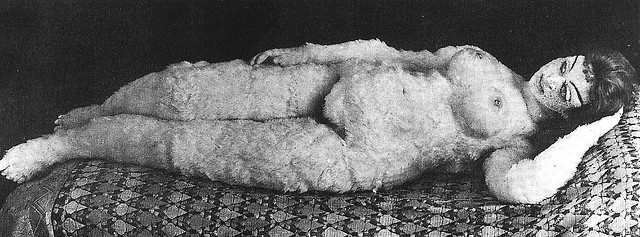
In Gropius’ life Mahler never seems anything, after his ability to understand her abates and her real meaning becomes a barrier to access to a daughter he truly loved. Yet she clearly knew how to flatter him sexually. Away the First World War and while Kokoschka was current in her life, MacCarthy quotes her as writing:
The first time we see each other again, I shall sink down on the ground before you, remain on my knees, and, kneeling, beg you to take your sacred appendage in your hands and place it in my mouth, and then I will use all my finesse, all the refinement I have learned with you …
cited ibid: p.89
Now, this is a quotation (it goes on) that it may be less than fair for the author to quote from a private letter. At the same time pretty damning letters from Gropius showed he shared Alma’s and Germano-Austrian anti-Semitic attitudes but we see Gropius change, such that his defence of Jewish friends is not only true but brave in the circumstances of his time. But it was never heroic.
However, we are told Alma probably bore a swastika tattoo on a hiden part of her body up to the time of her death, and that her behaviour never seems more mature than in this letter as she ages except that her immaturity has more to do with appendages of status, wealth and the fame of her most famous lovers than of the more fleshly type.
Gropius dealt with sexual issues rather well, not allowing his last wife Ise’s long affair with another man, to change his allegiance to her but there is little or no detail of any affairs long and short detailed for him. In the end you wonder whether that is a true record and whether Gropius who always noticed the beauty of the girls he taught when he changed countries is just passing under the radar by leaving no correspondence to be stored by faithless lovers as Alma and Ise did.
Moreover, I wonder whether Alma survives the experience of this long novel not only because of her persistence through it but because she so well conforms to stereotype in the eyes of our culture – as expressed best by Tom Lehrer’s ditty about her:
The loveliest girl in Vienna
Was Alma, the smartest as well.
Once you picked her up on your antenna.
You’d never be free of her spell.
Cited ibid: 466
That a view of her prominent woman was widely held needn’t mean it was true and fair. And I would say that we probably enjoy the depiction of Alma despite any feminist beliefs to which we might profess or hold deeply, as I hope I do the latter.
Hence, one of my reflections about the joy of biography is that it can make demons unfairly of people trying the hardest to hold together the contradictions of their life. It is fun to read of such demons, but maybe we need reserve. I don’t say this because I want to rescue the Alma Mahler reputation – I find the evidence of her far-right-leaning conventionality in public enough to make her less interesting than that, but one wonders whether she isn’t in here in the detail she is to satisfy less harmless tastes than those for other functions of biography.
For, in the sexual league, with ‘sacred appendage’ or not, Gropius seems an ordinary young heterosexual man from a privileged class who mellows into a disappointed older man who has yet spawned a world of applied ideas. And, in doing so, he did more than most men to foster female talent but in that, of course, he sustained binary roles much more than he needed to.
If we move on to the concept of modern art of which he was the human symbol, the book most conveys this best to my mind in two themes:
- the concept of modern art as a holistic blend of all the arts including the art of living, being and believing; the total work of art or Gesamtkunstwerk,[1] and;
- the reconfiguration of aesthetic space as something that lives in ways that questioned its boundaries, often by examining liminal effects at those boundaries.
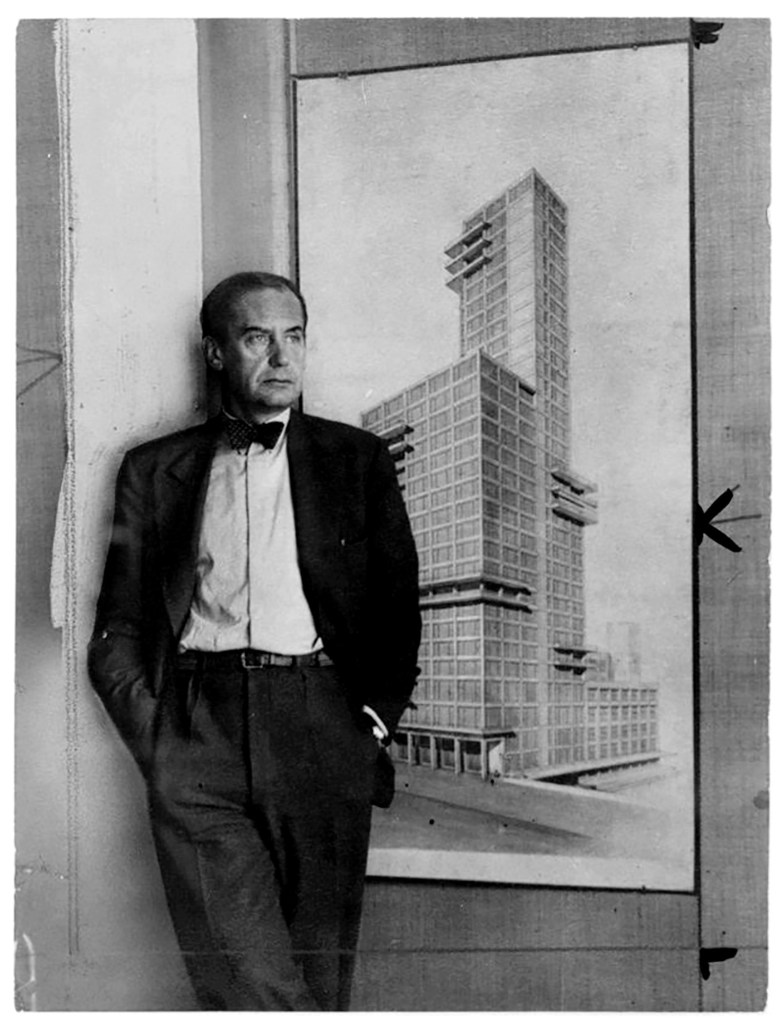
Both themes are illustrated across a range of living, working and leisure spaces, often breaking the boundaries in conventional life and architecture of those spaces. The Harvard Graduate Centre is an obvious case (ibid: 434) but the discussion is at its best here in the discussion of Gropius’ connection to modern theatre and the social happening – although there is too little on the learner balls at the Bauhaus. (I got a wonderful sense of these in Naomi Wood’s (2019) novel, The Hiding Game).
The work Gropius did with the theatrical innovator, Piscator, is described and illustrated by MacCarthy to show how architecture plays the role of social cognition and affect, aimed at maximising audience participation, sometimes in brutal ways in order to shake them from the assumptions of conventionally regulated space into space that offered none of the ‘safe’ boundaries and comforts of conventionally-shed spaces. MacCarthy quotes Gropius thus the purpose of ‘architectural totality’:
The public must be rooted from its intellectual apathy, assaulted, and forced to participate in the play.
Cited ibid: 289
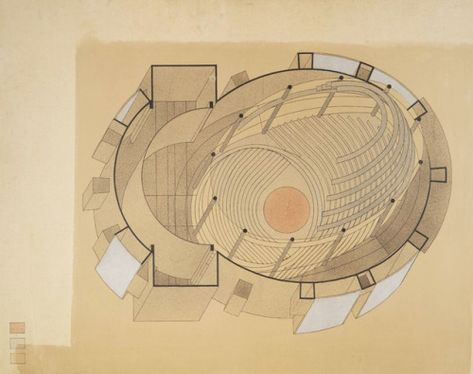
Here are, of course, some of the directorial (or dictatorial) attitudes of the modernist social reformers and aestheticians, as hated and stereotyped by Tom Wolfe. MacCarthy shows it was hated at the time by the greats of English theatre such as Gordon Craig for whom illusory space was the key achievement of lighted and, therefore, occluded privatised space in theatre. But the language of the theatre of violence used by Gropius here should not be taken literally. In answering Craig’s objections, Gropius is quoted to show him defending a variety of theatrical effects freed up by using adaptable theatrical spaces. This was not a cold space based on authoritarian control from the top:
The very idea of the plan for this theatre is increased adaptation to very different scenic concepts. It opposes the rigid establishment f space used up to now in the theatre and makes available a variety of space for different producers …It is exactly the opposite of Mr. Gordon Craig’s fears.
cited ibid:290
I am convinced that MacCarthy makes an excellent case too for seeing Gropius as a social architect and housing designer as a long way from the Soviet models with which e is equated by Tom Wolfe in the defence of the free market. She brilliantly analyses Gropius view that social spaces too were a total work of art in which a democratic vision of access to both country and city, green and building space combined and garden-cities:
… proposing ideas of a new structure for architectural practice and speaking optimistically on post-war architecture’s ‘new conception of space’.
ibid:421
Space is an idea that queries boundaries in social structure and it was not just work, leisure and private space that was being reconfigured in relation to each other but the spaces inhabited by different classes, genders and races. The idea was for progressive and ameliorative reconfiguration of inappropriately and violently divided spaces.
And, for my initial interests, this re-conception of space applied to the relation of painting and sculpture to other arts, crafts and sciences of living. I felt that the relationship with Klee and Kandinsky at the Bauhaus might have merited more development in book but I was really grateful for the material about Gropius’ role in 1930s England and with the artists of Unit One created by Paul Nash in 1933.
The links were made through radical Hampstead and included Ben Nicholson, Barbara Hepworth, and his favourite, Henry Moore. These artists were championed by Herbert Read but near to Read was also Gropius, who called Read, ‘a kindred soul who was wide open to art and architecture which had occupied my life’ (cited ibid: 301).
There is more to be researched about this left-leaning group between the wars which has been lost to a rather apolitical take on them. And Gropius was in the midst of all. What never gets articulated was a left-wing aesthetic but one wonders if this is because we have shown insufficient interests in socio-cultural materials gathered here.
This is a long book with other delights and strengths. Read it please.
Steve
[1] The concept is summarised from its appearance in the original Bauhaus manifesto to the building of the Graduate Center (sic.) at Harvard University in 1949 at ibid: 433-5.

