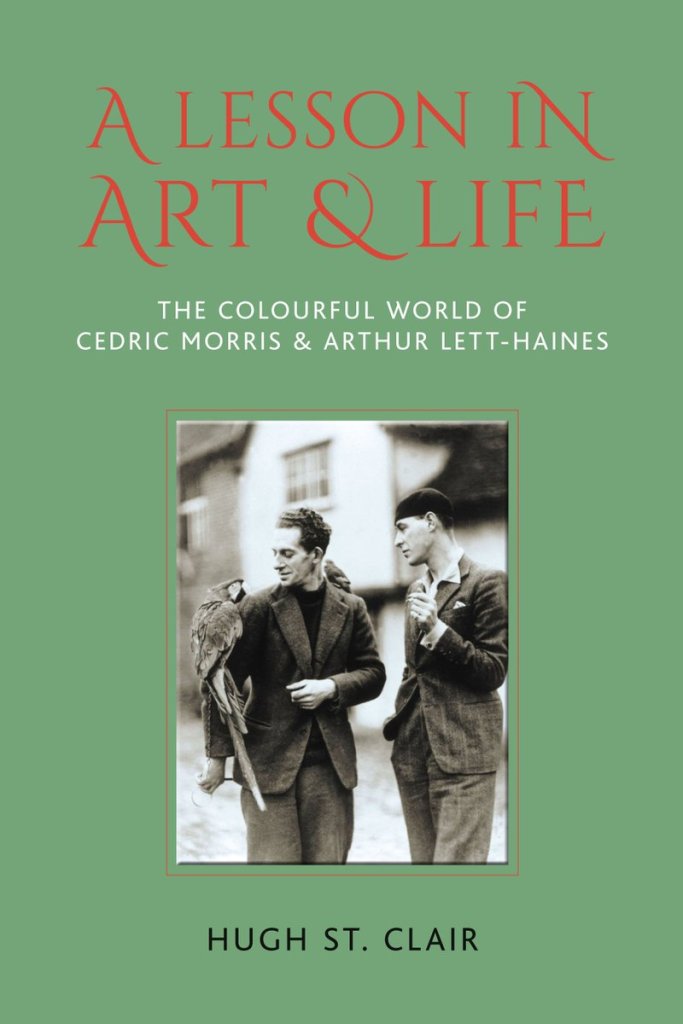
Reflecting on the writing biographies of queer couples: St.Clair, H. (2019) A Lesson in Art & Life: The Colourful World of Cedric Morris & Arthur Lett-Haines, London, Pimpernell Press Ltd & Turner, J.L. (2016) The Visitors’ Book: In Francis Bacon’s Shadow: The Lives of Richard Chopping and Denis Wirth-Miller London, Constable.
The Times obituary for Sir Cedric Morris nade no reference to Arthur Lett-Haines
.St. Clair (2019:190)
Biography is an art that concerns the fashioning of a ‘self’. It constructs a biographer’s sense of the self of their subject but perhaps it also enables us to see how individuals fashion their own self – the actions they choose to take or not take, the words they choose to say or write or not say or say or say or say but not write, and the visual and other records of their own life that they keep in prominence or allow to be destroyed or secreted. They can never trust that, of course, their place in someone else’s memory has not been fashioned differently: after all, as George Eliot noticed we all have ‘an equivalent centre of self, whence the lights and shadows must always fall with a certain difference’[1].
Writing a biography about a couple must always involve even more complex personae. This is even more the case when coupledom must be secreted because being a couple in the outside world is considered illegal. Queer couples often had to fashion independent lives for themselves and their partner that could with stand scrutiny. St. Clair mentions for instance how the use of separate bedrooms for Cedric and Arthur at Benton End (their home, art school and market garden centre of operations) enabled the couple to pass in their local rural community as business partners rather than a queer couple.
That must contribute to the fact, if it is not the primary cause, that such couplings contained fracture lines and encouraged the development of lives ‘together in separation’, although such cases could be found in greater number no doubt in the apparently conventional heterosexual majority, even during the same period of history. But living in a couple had its consequences and no doubt, as Turner tells us (2016:96) contributed to Denis Wirth-Miller’s imprisonment for soliciting in 1944. The person supposedly solicited was a policeman acting as an agent provocateur. Wirth-Miller claimed he had been entrapped.

The fact that queer lives were fashioned not just by self and/or significant other but by the demands of a symbolic order remains salient and we see both of these biographers to some extent unpicking that fiction of the separateness of each of their subjects, especially from each other within each couple, from a safe distance of years.
These are also biographies whose ‘subjects’ touch on each other – Turner’s (2016) book being a considerable source for the period in which for a time Richard, Denis, Cedric and Arthur shared the same house (Benton End) owned by Arthur Lett. That house was itself related to a gay male network. It was first entrusted and then given to him by Cedric’s late lover, of his first ‘affair’ after living with Arthur, Paul Odo Cross. At the time of giving, the latter lived as a in a couple with the very successful East Anglian
Each couple moreover has a major ‘bad-boy’ artist of the period hovering over these lives: Francis Bacon for Richard and Denis, Lucian Freud for Arthur and Cedric, although both were bad boys for all four in our couples in many ways. Both biographies tell of the probable theft of an important Freud work by Denis for instance.
This interweaving of lives is important in queer lives in the period and could be further extended. The network was indeed sometimes named as the Homintern and included many queer artists and art afficionados, such as The Bloomsbury Group, Peter Watson, Stephen Spender, John Lehman and many others, whose sexual identities deviated from norms elsewhere claimed as hegemonic (at least in public). Yet for each of these men in our biographies power was both real – exercised in intellectual and cultural cliques – and fragile. I think this is why so much of Turner’s book is useful on illuminating the hierarchies of taste or fashion set up by art under which Chopping found himself subservient to other gay artists such as Vaughan and Minton as well as Bacon (see Turner 2016:156f. for instance). But what insight this book offers on Bacon, not least from the effects of Denis’ habit of secreting away art works and studies from Bacon that the artist himself would have destroyed.
I read the book on Cedric and Lett-Haines just yesterday; in response to the fact that they appear in the biographies and autobiographies of queer painters I like much better. It was also because of seeing recently archive film of Lucien Freud talking about the influence of Cedric and his ‘boyfriend’.
St. Clair’s book is the first book-length biography of the couple or of either member of it. It reminded me of Turner’s book but is rather different, in that it is also a history of Morris’ relation to flowers both as a breeder, grower and artist. Yet this subject has sometimes been posited as a motif of queer painting – in all these painters except perhaps for Lett-Haines, whose nearest comparison as a painter is probably Edward Burra as an ‘English surrealist’. Flowers are important motif for Cedric just as they were for Gluck. The 2016 Tate Queer British Artexhibition raised speculation that flower and nature painting became a gay trope that off-set concern for bourgeois social convention and was therefore a trope for natural love not bound to such conventions.
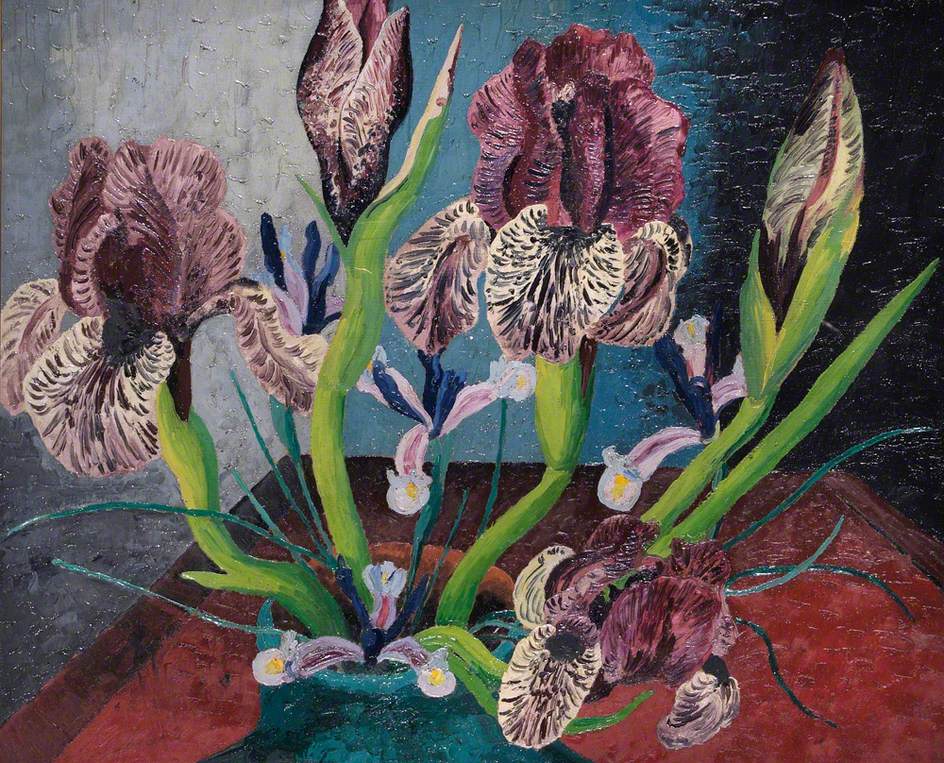
This certainly might be illustrated by the passion of an almost sexualised excess with which Morris not only painted irises, in particular, but also sought new species naming them after himself.
There is no doubt that inequalities of power played a large in the success or otherwise of Cedric and Arthurs’ partnership, just as it did for Richard and Denis. In each case the partner who felt forced to take on more household-bound roles seem to have felt themselves belittled but it is too simple to equate this with mirroring gender roles. Indeed the strength of both relationships is to some extent because these roles were not forced on the partner with less fashion in the art market (Wirth-Miller & Lett-Haines) but because of the flexibility with which their relationships and distribution of roles within it could sustain.
This ‘flexibility’ included ‘affairs’ (for Lett-Haines often with women too) that often strengthened the relationship of the two men, in at least as they were able to find separation from each other’s sexual if not emotional lives. The relationships remind one of those between Carrington, Lytton Strachey and the Partridges or even Vanessa Bell and Duncan Grant, although with a less deep sense of guilt than in the latter.
For instance in 1933 Lett’s sexual companion and pal was Eleanor Hampden Turner, whilst Cedric seemed infatuated by a young male artist, Loraine Conran. All of them stayed at the couple’s then home, The Pound.
The conversation between them was entirely civil; indeed Loraine and Eleanor got on very well and became good friends independently. (Arthur’s) renewed attraction to women puzzled him and he noted in his diary that he must read Psychopathia Sexualis by Richard von Krafft-Ebing, one of the first books on homosexuality and bisexuality.
St. Clair (2019:99)
What fascinates me in reading these histories of male couples is not that they help to prise apart love and sexuality but that they make it clear that human diversity is a fact prior to the conventions and norms that pass themselves as authorised by science, particularly biology. Neither do they place the subject of how couple-relationships form, maintain and endure in the hand of some abstracted social construction.
Indeed while biology, social construction and their mutual interaction play a part in these relationships, especially in the face of these couples ‘having’ children, the agency of people and self-defined groups seems even more important. This despite the fact that social and biological forces will, often heavily as in imprisonment or trapping of individuals, impinge on them.
The role of Maggi Hambling feels in this story like that story of reversals of role between older and younger people, men and women, and other binaries. Even the distance between the two men’s politics is negotiated beautifully.
The issue of children is important when we consider Freud’s queer heterosexuality but a fine example of how people overcome agency is the rebuilding of the relationship of Lett-Haines with his son, Mike, in the teeth of opposition from that son’s legal family and the weight of seventeen years of anti-gay mythology. When John re-established connection, he still felt the power of this social indoctrination to be limiting. As his affection for Arthur grew he still reverted to the effect of ‘convention’.
“It’s not that I do not appreciate or value affection, it’s just that I’m unused to it and it makes me uncomfortable … You have always been represented to me as an ageing pederast whose great hands reached out to grab small boys.”
Letter from John to Arthur, March 17 (year unidentified but => 1959) cited St. Clair (2019:165)
These books are both valuable for those interested in queer lives just as they are for people who want to learn about twentieth-century art. The debate for instance about abstraction against figurative and landscape art can be heard comparing Richard and Denis. But I think the St. Clair book is a treat because it is a work of love – that loves its subjects, flower-gardens and different art traditions in comparison just about as much as each other. The little preface by Philip Mould, and the references to him in the book, make even that TV expert more favoured as a personality.
Steve
[1] From Chapter XXI of George Eliot’s Middlemarch https://www.gutenberg.org/files/145/145-h/145-h.htm


Angus Wilson was not the novelist, but was born in New Zealand and came to the UK after the First World War
LikeLike
Thanks Jean. Sorry for the error. Probably based on wishful thinking. I am a fan of the novelist.
LikeLike
Reference to this now taken out of the piece.
LikeLike