Reflecting on the dual concepts of influence and reference in one case study raised in Exhibition on Screen: David Bickerstaff’s film of Lucian Freud: A Self-Portrait (at Royal Academy of Arts, London) seen at Gala Theatre, Durham, Screen 1: A photograph of a static scenario performed in 1992 by Leigh Bowery & Lucian Freud and photographed by Bruce Bernard compared to Courbet’s (1813 – 1877) The Painter’s Studio (1855).
See also my initial short reflection:LINK HERE
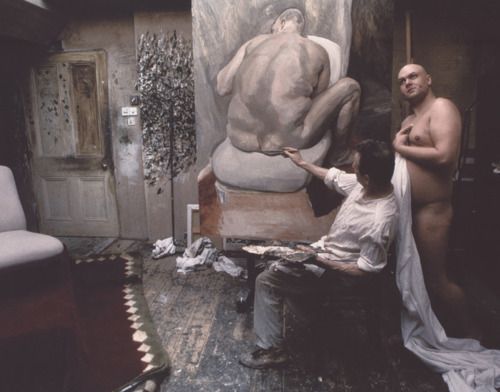
This blurry copy of Bernard’s 1992 photograph (the original is in Sharp 2019:33) shows at least the disposition of the static scene performed by its actors. It can be read on a simple level of a record of Freud’s willingness to acknowledge the influence of Gustave Courbet, whose interest in nude skin and fragments of nudes is clearly an ‘influence’ on him. But as the EOS film makes clear, such influence is not straightforward. It doesn’t suggest mere imitation of subject or method of one painter by another but rather a desire to reference the painter from the past in present activity, whether that be in a painting or a reflection of a painting such as we might take Bernard’s image to convey.
The fact that the later performative image references the earlier one rather than imitates it is clear from certain choices made in the performance and recording of that performance. Courbet’s huge picture is of course presented to its audience as, in its full title, ‘The Painter’s Studio: A real allegory summing up seven years of my artistic and moral life.’ Yet the title confuses – in what sense is an allegory, in which different figures, objects and settings may have one or other symbolic or narrative meanings referenced by them, different when it is a ‘real’ allegory.
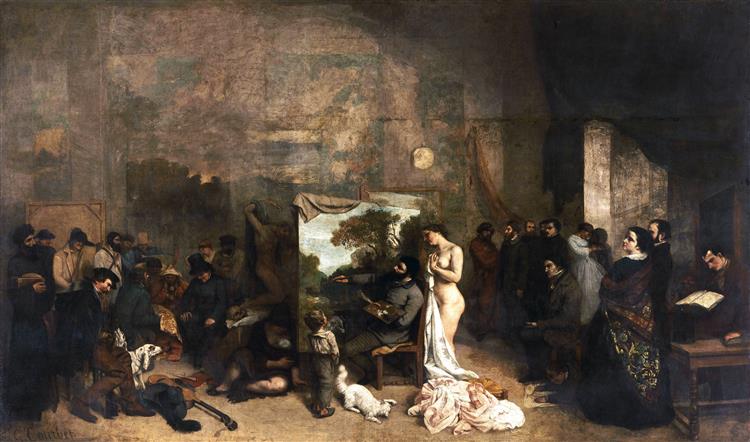
Jack Lindsay (1977:132f.) accepted that Courbet was at a somewhat confused stage of his life in relation to the development of his socialism and of elaborating allegory whose meanings were strictly about finding in allegorical types ‘a wider significance emerging from the social essence of an individual form’. Thus he accepts that whilst the canvas divides his figure between working creative figures on the left and social types of the oppressed and oppressor on the right, the nude model represents, as in older forms of allegory, unclothed Truth, showing her interest in the artist’s endeavours.
Courbet himself mocked probable attempts by probable later critics to make sense of it: ‘they’ll have to make what they can of it’.[1] After all saying that it specifies Courbet’s life as artist and ethical man is a wide domain for the containment of meaning. The picture is not only huge (361 cm × 598 cm), it has a wide scope both in the amount of space and figures that are allowed to be part of it, some of which may be painted figures and spaces on inset paintings, such as the ominous nude Christ or suffering figure in the background to the left (from our point of view) of the picture.
Moreover though Courbet is performing painting here, it is important that the painting he works on is not of the nude model who stands to the side of him but a more conventional landscape, represented in the figure of the small shepherd boy who looks up at the painting from the right. . Both the canvas and Courbet shadow the figure of Christ on the cross in a painting behind the painting on which he works. Thus the nude ‘Truth’ figure – stood on the side of the picture with the Balzacian social types may represent a refiguring of the function of art from the spiritual to social realism of a kind via a rustic idyll. But in fact all of this remains a puzzle. That may indeed be what the painting remains – a painting that declares that it has a message without any attempt to clarify that message.
In the Bernard picture, the actual Leigh Bowery performs the pose and gesture of Courbet’s Truth model, assuming a modesty that stands behind the painter. But Freud’s canvas is also a representation of Bowery – from behind and showing considerably more volume of flesh and subcutaneous fat. The texture and colour of flesh are sharply different. Freud’s brush hovers over the sculptural chiaroscuro effects by which he creates this body of light-catching flesh and shadow caused in depressions in the body’s curved anatomy, the hangover of flesh between torso and buttocks and the crack of the anus itself. It is on the latter where we find the tip of Lucian’s brush.
Bowery himself in the photograph looks less at Freud than the model does at Courbet and faces the viewer whist not seeming to seek the viewer’s eyes. Is there a protest here at the representation of his flesh, which in the painting is exposed to a viewer that Bowery has no control over – no agency in performing himself differently for the viewer as the photographed performatively does, raising his head somewhat in the form of a classical nude.
In my reading of this still of a performance piece, a contrast is drawn between the painted Bowery and its setting and the photographed one, showing Freud as turning his back on any control over the appearance of his flesh that Bowery as a model might seek to possess. Bowery in the painting must succumb merely to be the effects of the story of mortal flesh that Freud continued to tell through his later works. If Bowery performs a pose that asserts human dignity, or at least pride in self, Freud wants to find in the human being not that which cheers them up but that which makes them uncomfortable in acknowledge flesh.
David Dawson (2019:15) quotes Lucian thus:
The task of the artist is to make the human being uncomfortable, and yet we are drawn to a great work by involuntary chemistry, like a hound getting a scent; … it gets the scent and instinct does the rest.[2]
For me that says a lot about Freud’s reluctance impressions of flesh as a thing both composed and decomposing, carry scent as an illusion of its asymmetrical and pitted visual effects from its surfaces and orifices – the feel of oil paint skin and its shine and its own organic small.
There is much more to say about painting and the body here that ought to bring into discussion what Freud learned from examining Titian, especially late Titian, but let’s rest. The good thing about being a blogger writing for yourself basically is you have no duty to carry things through even to your own standards.
Steve
[1] Courbet cited Lindsay, J. 2nd imp. (1977:128) Gustave Courbet: His Life and Art London, Jupiter Books Ltd.
[2] Freud cited Dawson, D. (2019:15) ‘’One Must Fasten One’s gaze” in Hare, R. (ed.) Lucian Freud: The Self-Portrait London, The Royal Academy of Arts, 13-16.


7 thoughts on “Reflecting on the dual concepts of influence and reference in art about art using one case study raised in David Bickerstaff’s film of ‘Lucian Freud: A Self-Portrait’.”