Three Miners In a Cage – A Tom McGuiness etching
Tuesday, 15 May 2018, 20:55
Visible to anyone in the world
THROWN OUT OF THE EMA!
Let’s look for instance at Three Miners in a Cage (hereafter Cage). The function of this painting is clearly not representational realism – the real constriction of cage travel arose from the mass of miners that travelled the cage at once and McGuinness captures that constriction but reduces his miners to three. This ‘Trinity’, and we should never forget Tom’s Catholicism, become a means of filling all available picture-space and the cage with a kind of abstract geometry, using, like Hewer and valorised by Kandinsky, mainly partial triangles. Look at my attempt for instance to reduce the shapes to linearity below. It is pure figural Kandinsky (even the triangle motif) – even down to his White ZigZags (1922):
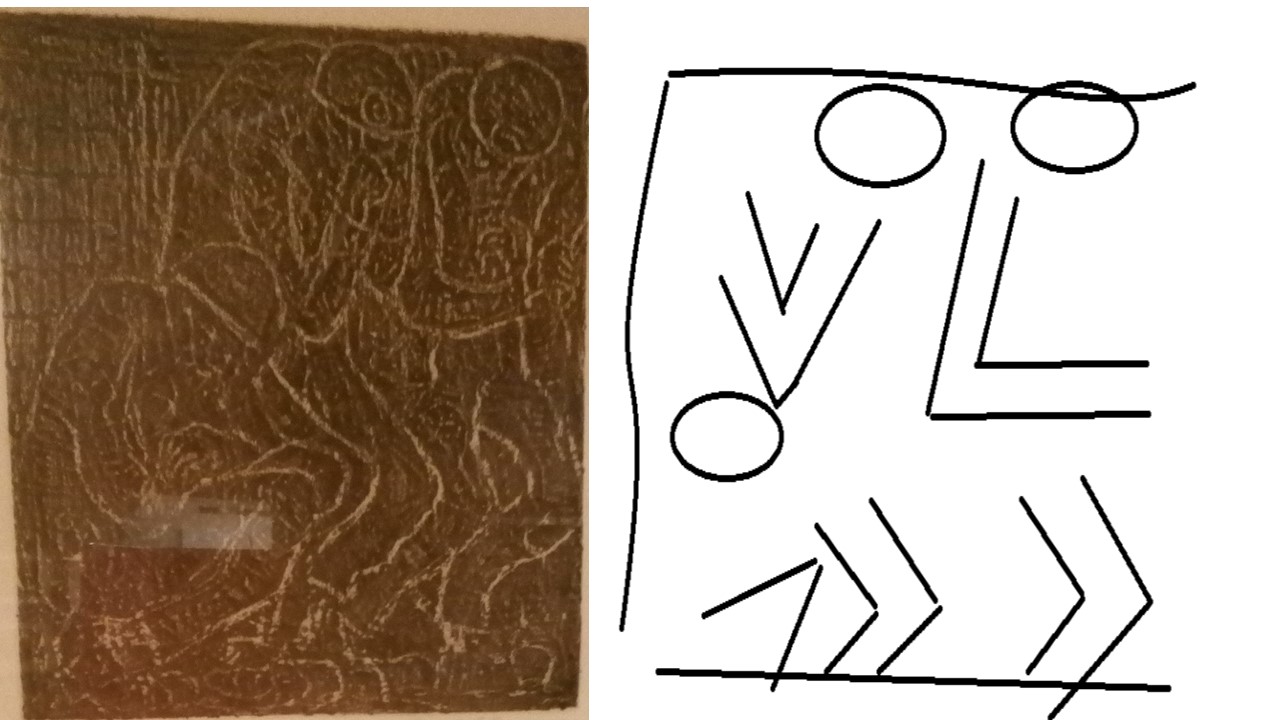
This contrast between a live image and its reduction to abstraction is not meant to simplify our path to meaning (it denotes a symbol rather than an allegory) but it does reveal one source of the rhythms and repetitions in the picture space, which have pictorially a right to left direction and create directional pull between top and bottom edges that is tense visually and restless. Here both abstraction and formal composition convey motion – the cage falls and the miners resist the downward force. The collapse caused by downward pressure is countered by the men’s resistance to it in the rightwards dynamic.
All the best
Steve


Just as an afternote. This kind of abstracted work with figures in MGuinness was important to me. It dramatised in part a debate with my tutor that the use of classical influence was as important in discussing McGuinness as any other artist. Yet, dispirited, I missed it out. I wondered why? The analysis of the painting ‘The Hewer’ still had reference to the use of motive triangles from Kandinsky, who uses the idea of restlessness to describe them. Tom McGuinness described the overall effect he was trying to achieve as one of restlessness. The examiners found this fanciful! Right to miss it out, then? No. My battle with this course was one in which I kept trying to assert, for the sake of my own mental health, that the learning I wanted from it was self-driven, not a response to a learning hierarchy or external standard equated with art history as a discipline. I was quite happy to sacrifice marks – maybe even passing – for this principle.
LikeLike