Did she want to be made ‘The Bride’? Yes, but not the Bride of anybody, including Frankenstein! Seeing ‘The Bride’ today.
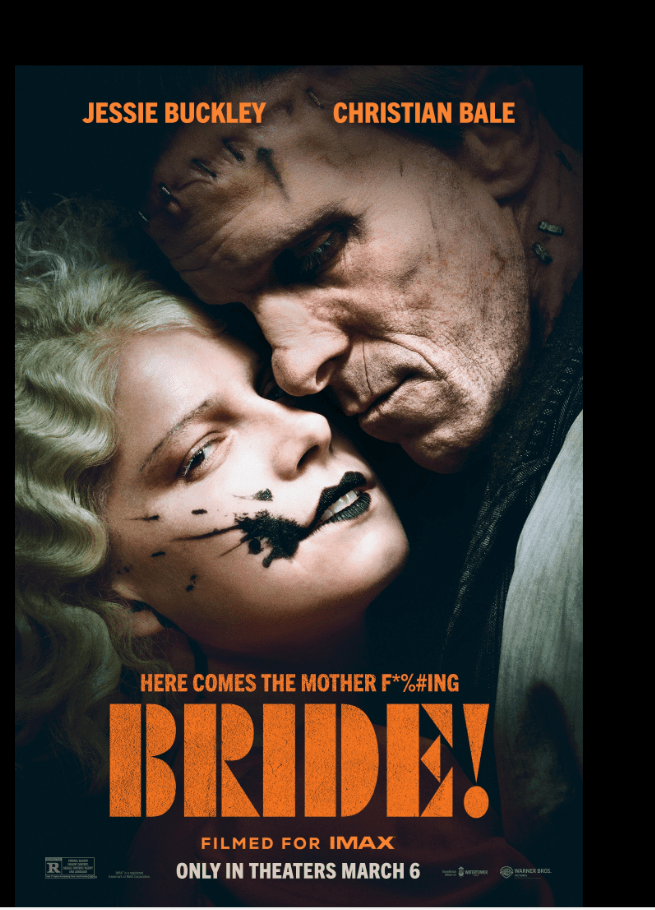
By Warner Bros. Pictures – IMP Awards, Fair use, https://en.wikipedia.org/w/index.php?curid=81164420
It is the year of being wives of men famed in and for their art, and as often misrepresented from some supposed original, for Jessie Buckley. This is the case in The Bride twice over for her – as wife of Frankenstein, the ‘monster’, and, when she plays Mary Wollstonecraft Shelley, either in the afterlife or when transitioned into partial demonic possession of a young girl in 1920s Chicago and talking through her, the poet Percy Bysshe Shelley. Mary’s embodied thunder is not stolen by Percy Bysshe in some of her scenes in The Bride, for he appears only in Mary’s garbled afterlife account of him, where she clearly feels that her husband prefered John Keats to her in every which way, even sexually.
That experience of a spouse who is a man and a poet is quite unlike William Shakespeare’s effect on his wife in Hamnet: he, looking both very handsome and superior as Paul Mescal’s version of him, stealing thunder and plot from the Buckley-wife role. We see Ida, the gansta – moll, being possessed by the undead spirit of Mary Shelley in the first scene of the film but it is not clear why Mary does this, although it becomes increasingly clear that this is her only way of becoming the sexual.partner of a rough male of her own creation, the ‘son’ himself, fictionally created, via Mary, of father, Doctor-scientist Viktor Frankenstein.
Ida appears at first as the moll of Chicago gansta Clyde (or James – Ida tries to encourage these guys to kiss each other – played by John Magaro as Clyde and Matthew Maher as James, both associates of Lupino) in a club owned by Lupino,whom is also present. Both men are stooges of Mafia Grandfather Lupino (a wolf with a taste for the tongues of female snitches kept pickled in jars of played to the hilt of perfection by Zlatko Burić). The film opens with Buckley as a possibly trans-gendered Mary Shelley with a swash-buckling aristocratic English accent and a refined madness which she uses when in partial possession of Ida’s body and tongue (such a vulnerable organ as the plot later reveals).
Before I go on, I think I want to stress the queer aspects of this film, though they live very much on its cusp and .margins of plot and tone, and oft with the potential to be insistent that the ‘Q’ in LGBTQ+ can mean ‘Questioning’ as much as ‘Queer’. When Ida speaks with the voice inside of her of Mary, Mary is insistent the queer clubs frequented by Ida, and her ‘reinvigorated’ body, are very much places she feels close to. The maid of Dr. Cornelia Euphronious, the scientist who assists Frank to dig up Ida and who then reinvigorates her, has a maid called Greta, who though clearly herself a reinvigorated being – her mouth bears the same stains as Ida once the latter becomes Bad Penny – seems related to the life experiments which lost her husband George to Cornelia. Did they become Greta (Jeannie Berlin)? There is no definite answer and even the possibility of question is queried.
Frank’s obsession with Ronnie Reed, played by Jake Gyllenhaal, a Fred Astaire figure in the film, is clearly a romantic obsession with very bodily elements. It is not unlike Frank’s dezire to mould Ida ingo Penelope Rogers, the first name chosen as a modifier because Ida refused the first name Ginger. But even she recignises later in the film that Frank would like her to morph into a romantic- sexual icon like Ginger Rogers. Frank watches Ronnie obsessively and so identifies with him that he sees his own body transposed to Ronnie’s, Ida’s to a ‘Ginger’ substitute. When he meets Ronnie in the flesh, at a party that he and Ida-Penny crash to escape a chasing mob and the police, his expression of devotion is so strong, Ronnie’s tells him that unfortunately, Frank’s ‘not his type‘. Ronnie’s then turns his back on him to flirt with those around him, mainly other males. None of this is unquestionably ‘queer’ in content. Indeed, I would say it is definitively questioningly queer.
This matters because it is what people who hate the film miss or dismiss as careless art. For Francesca Steele in the i newspaper, the film fails to be the feminist statement it wants to be (Ida screams ‘Me too!’ after seeing the commonality of male strategic disempowerment of women) because it can’t make it’s mind up about what category of film it fits into. Whilst elaborating Gyllenhaal’s critique of the project that was James Whale’s original film, The Bride of Frankenstein, she says that Gyllenhaal was intent on satirising the notion that Whales could take for granted; that the Monster’s loneliness and the equation of ‘having a wife for himself’ was a natural solution to that male loneliness and made him all the more indubitably human. Yet, Steele continues:
Sadly,such queries get utterly lost in The Bride, a bold but rambling genre mash-up that can’t decide if is a mobster flick, horror film, romance or – disappointingly – heavy-handed women’s rights sermon meets girl-boss adventure. [1]
The girl-boss element is certainly prevalent. The crux of the story in a late reveal is based on the perfidious betrayal of Ida by a police detective [Peter Sarsgaard as Det. Jake Wiles, a police detective who investigates Frank and the Bride] who employed her and other young women who got killed, and their tongues removed, by the Mafia they were investigating undercover. But this plot plays interactively with Jack Wiles’ relationship to his assistant detective (Penélope Cruz as Myrna Malloy) whose chances of promotion to Chief Detive are nil, until Jake, a good man on the whole, realises his own perfidy to woman who make his job doable and forces the NYPD to replace with Malloy.
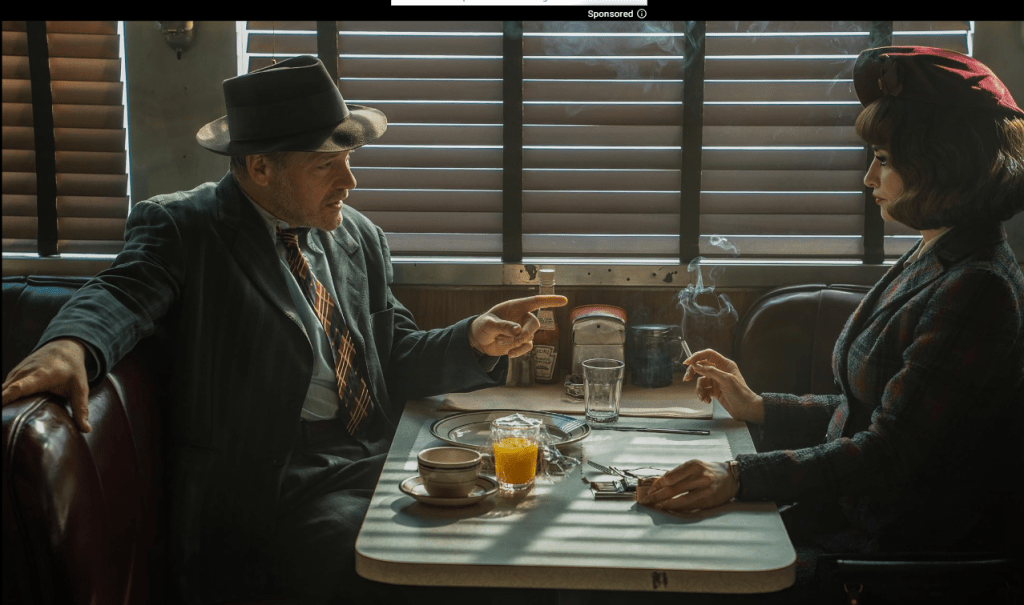
Jake and Myrna in a scene that shows that Jake’s role is the flirtation with witnesses, of whatever sex/gender, and Myrna’s being the true brains of the detection process.
In my take on the film the query hanging over the genre this film works within is a necessary one, one that queries the other category ambiguities in the film’s marginalia: the uncertainties of sexuality, sex/gender, class or social status, legitimate and illegitimate or criminal profession, and, of course, the very many categories of being a ‘bride’. Ida is dug up with and brought back to life (by Annette Bening as Dr. Cornelia Euphronious), a scientist who assists Frank.
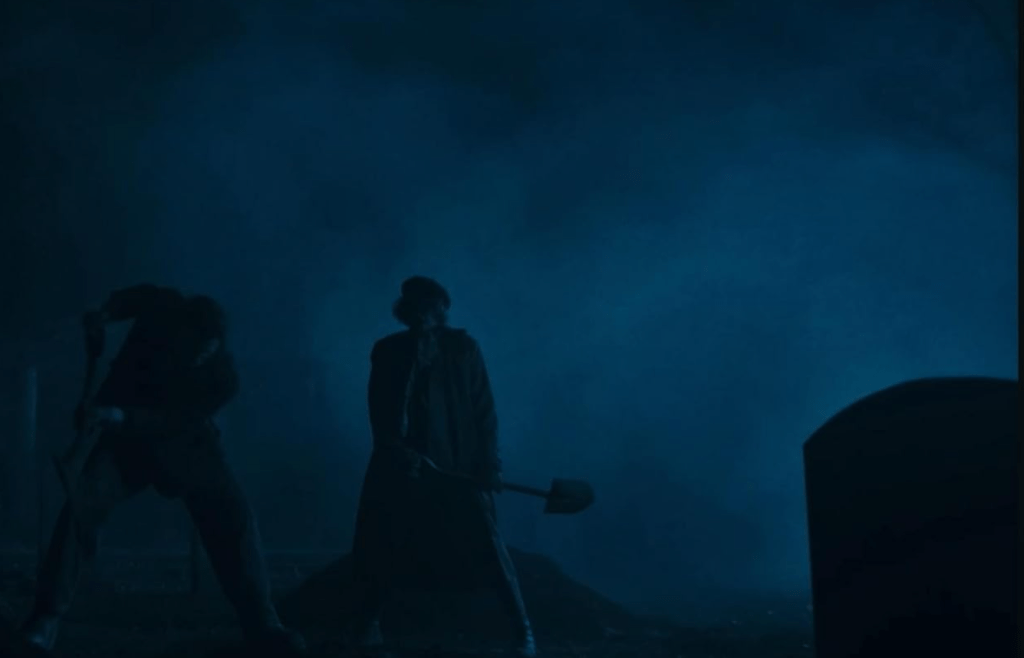
Undead Ida is convinced by Cornelia first and Frank afterwards that, before her amnesia [obviously to be expected after violent death], she was already the affianced of Frank and that theirs was, and will be, the perfect His and Hers (that is heteronormative) marriage.
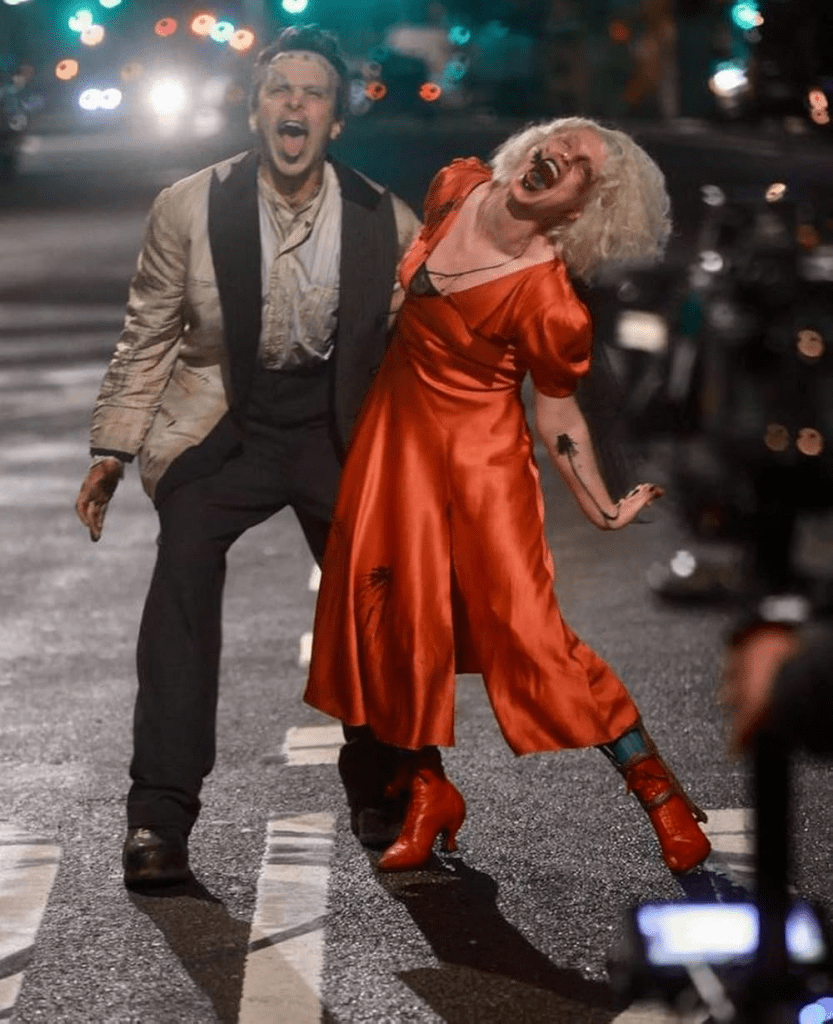
They play at some film genres to show that. Do you see, as I and Francesca Steele do, echoes of Bonnie and Clyde in the still below?
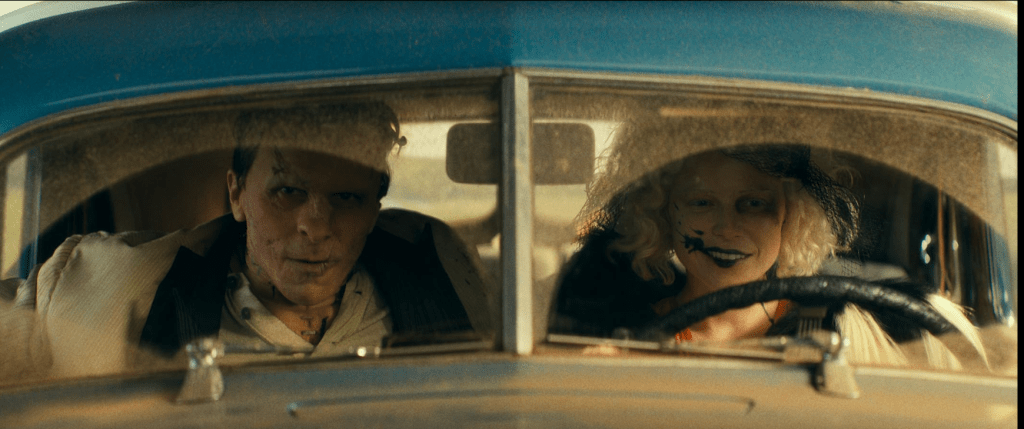
And as for the romance theme, the Monster (in the form of Christopher Bale) is a romantic soul and not ‘in any way a monster’, were it not that circumstances make him angry (or do we all say that!).
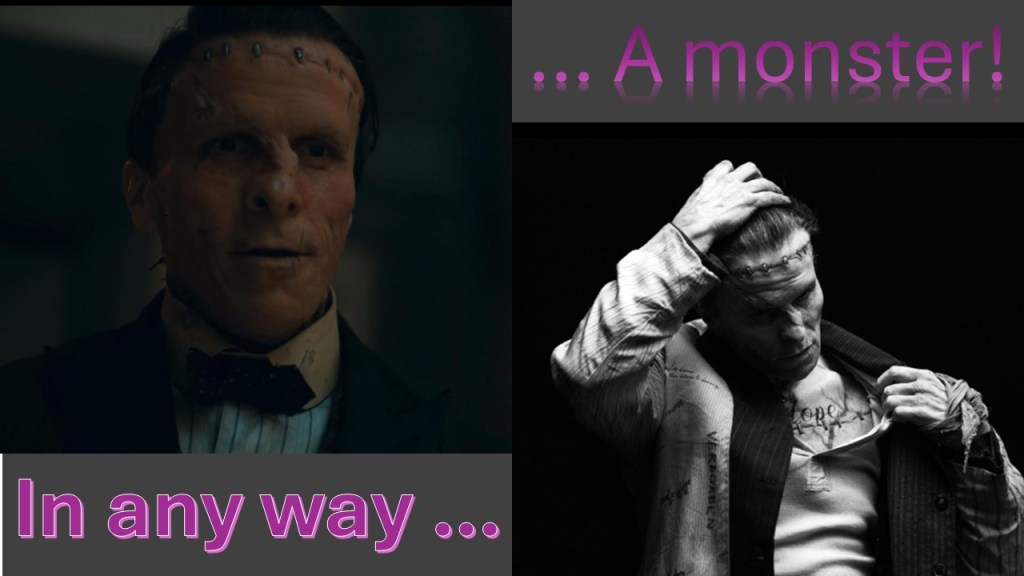
I think Francesca Steele is at her worst when she reduces out the film’s use of adverse and oppressive circumstances to explain the violence attributed to those labelled monsters. She says glibly that they ‘accidentally commit murder’ before turning into Bonnie and Clyde, without prioritising the fact that Frank is motivated by his hatred of violence and rape to which men subject women, especially those not labelled as ‘monsters’.
But it is hardly surprising thar Ida feels disorientated by her lot, and, if not bitter, certainly twisted. But the author of her twisted death is neither of the gangstas she pretends to secxually befriend, nor even Granfather Lupino, but Detective Jake
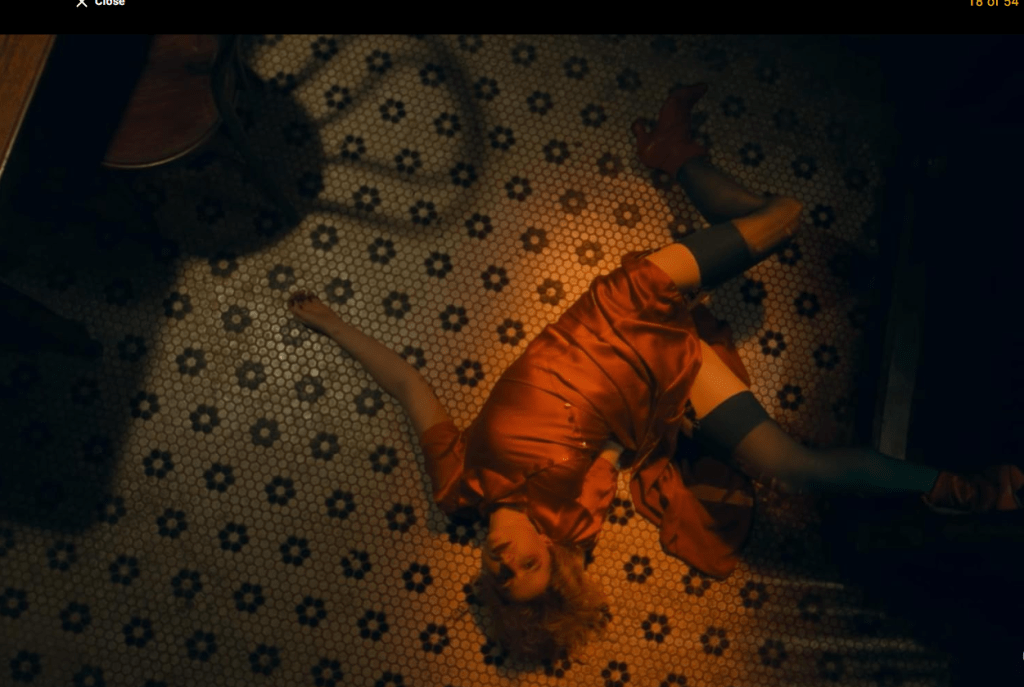
After all, apart from tbe threat of ending up dead (and then surprisingly undead), bodily disfigured, the wife of someone who seems a monster, however notorious, hardly pretends to the games played upon by apparently decent men in the film. It makes the absurd scenes of illegal and unethical reinvigoration, very lovely scenes, quite innocent compared to what the things very ordinary men make out of women who could have been so much more in control of their own destiny.
I think Steele forgets another influence on this film, the 1998 liberty-taking biopic of James Whale’s post-professional life Gods and Monsters, starring Ian McKellen as Whale, and set during the making of The Bride of Frankenstein.
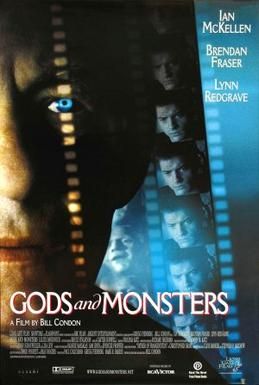
In the early film two men use different strategies to disguise their relationship to feelings that queer their self-image (the elder Whales in public and in the open even to himself; the younger Brendan, the butch gardener, to any interest in romantic or sexual feelings for men at all). Both play power games, even though only the more effective to pass as straight will win them, despite Whales’ apparent, but not very real, class and financial ‘superiority’. The only way Brendan will enact his sensitive feelings to McKellen is by acting as the Boris Karloff version of the monster (Whales’ creation) in loving memory of the director now dead from suicide.
The issues in both films could well be a focus on the very many ways in which those who are typified by others with queer categories, even partially, get punished, often with the collusion from supposed ‘allies’ who are not avoid queerness and the anormative in public. Maggie Gyllenhaal directs and must have much enjoyed casting her brother, Jake Gyllenhaal as ‘Ronnie Reed, a popular Hollywood actor whom Frank idolizes’, whose entire facade stays within social norms and acceptable categories but, in real life hides only by limiting his social circle to those amongst whom his secrets are safe. But being a victim is not the necessary fate of those to whom queerness and category refusal applies. Sometimes, evading constricting categories is the only source of true freedom.
Gyllenhaal may have struck gold with the multiple personae that Buckley so brilliantly enacts in Mary-Ida-Penny (her performance far outshines that in Hamnet) but she has done so too in Christian Bale’s enactment of Frank. He apologises for the smell of his body to Dr Cornelious. It comes from the wounds caused by tearing out the bolts from his neck, properties that James Whales not Mary Shelley grafted onto the persona. He did so to free himself but being free has consequences for others and he knows that.
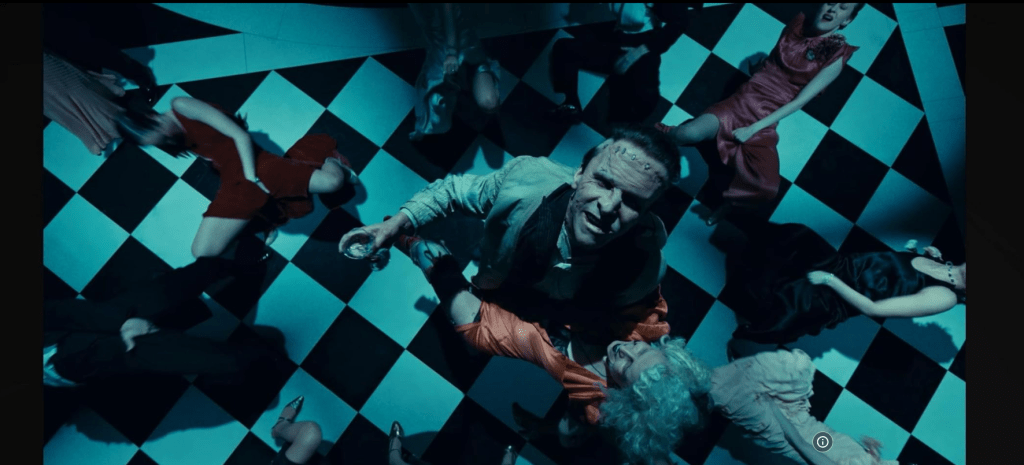
Nevertheless the mix of transsexuals sensitivity and embrace of fun makes Frank a hero. There is a scene in a club with very queer credentials, where a shot from above shows Frank and Ida at the centre of those who have passed out from exhaustion whilst they embrace the meaning of their last motif in the film: ‘all we got to do now is live’.
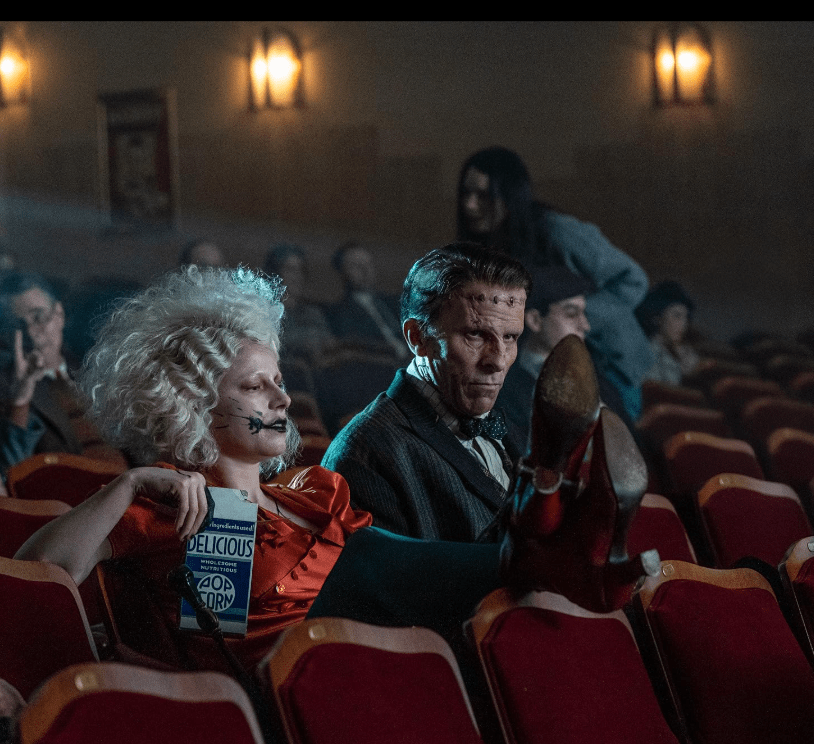
They even watch films with attitude:
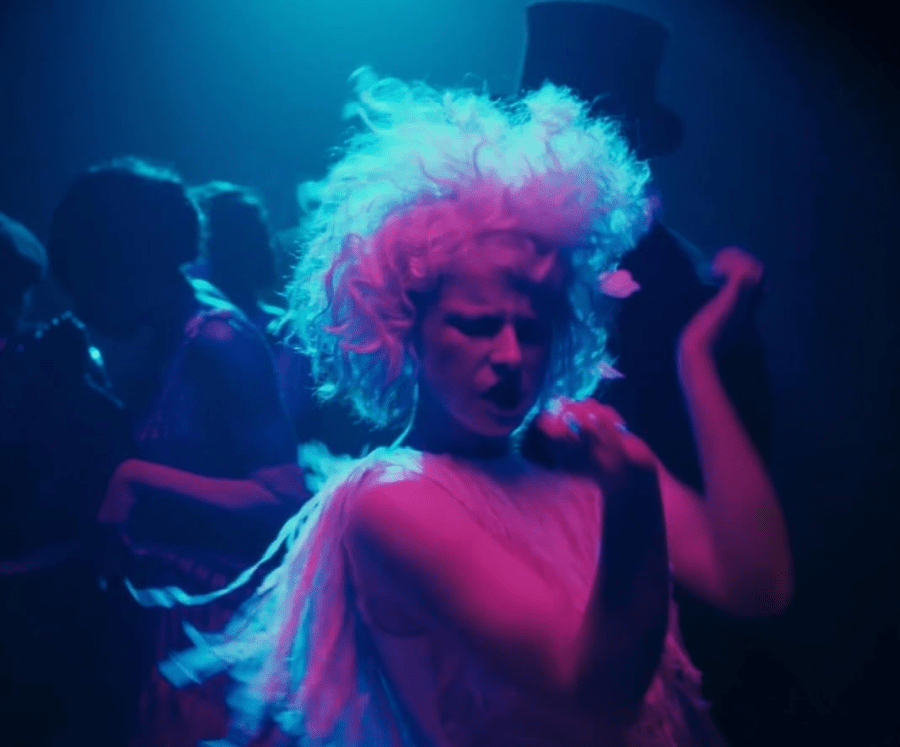
Whether they live, reinvigorated in electric life, is a moot point in the film’s end. To all intents and purposes a frightened state and mob public opinion apparently kills them, but … a bright spark of electricity co.es from a tower room in which their bodies were left lying as if dead. We see them dancing like life itself were dancing, in clubs …
And on the streets.
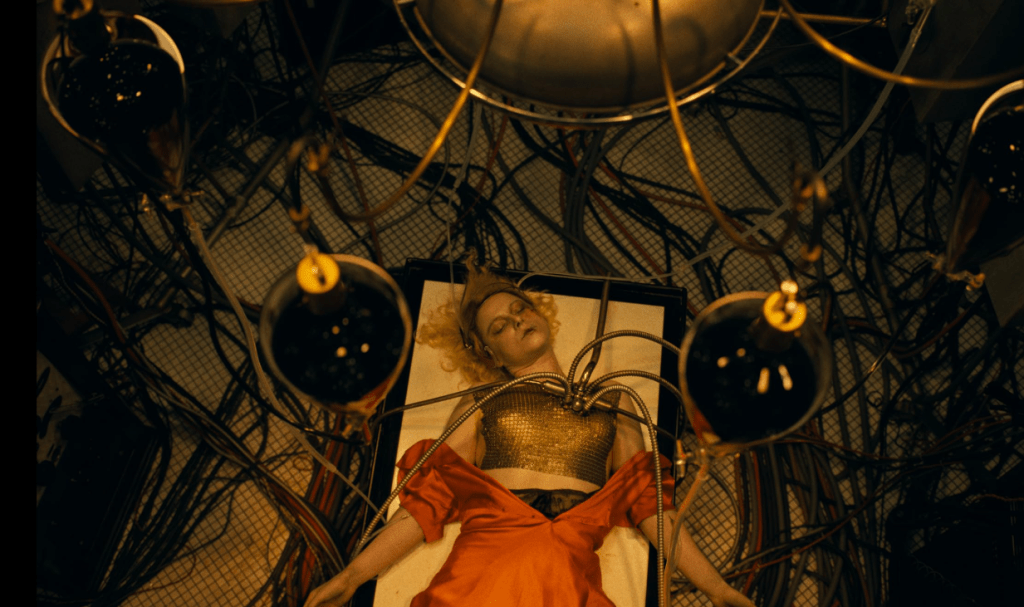
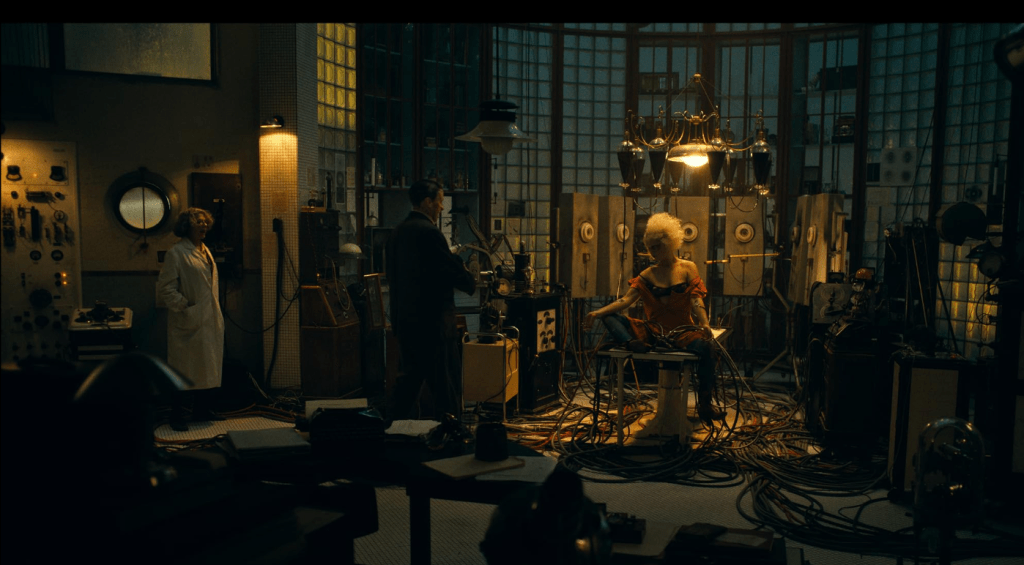
Of course Frank’s project is shadowed by ethical issues of the kind Francesca Steele wants but does not see because they are superseded by his superiority to norms proven through the narrative. But they are there in the scene where Ida is reinvigorated, sat like a doll waiting for usage, such as men have accustomed her to and which she expects from this new monster. It is a brilliant modern Gothic mise-en-scsne.
I loved this film. See it and decide for yourself.
With love
Steven xxxxxxx
_____________________
[1] Francesca Steele (2026:45) ‘Buckley is better than hollow Hollywood feminism’ in the i newspaper (Monday March 6th: 45).
 Steve_Bamlett_blog