Dracula: See excelled here Stoker’s themes of transit, including travel and flow between places and through spaces and times; transition of, and between, character and character traits, even Stoker’s obsession with masculinity and femininity in and between concepts of sex/ gender; and, of course, blood transfusion.
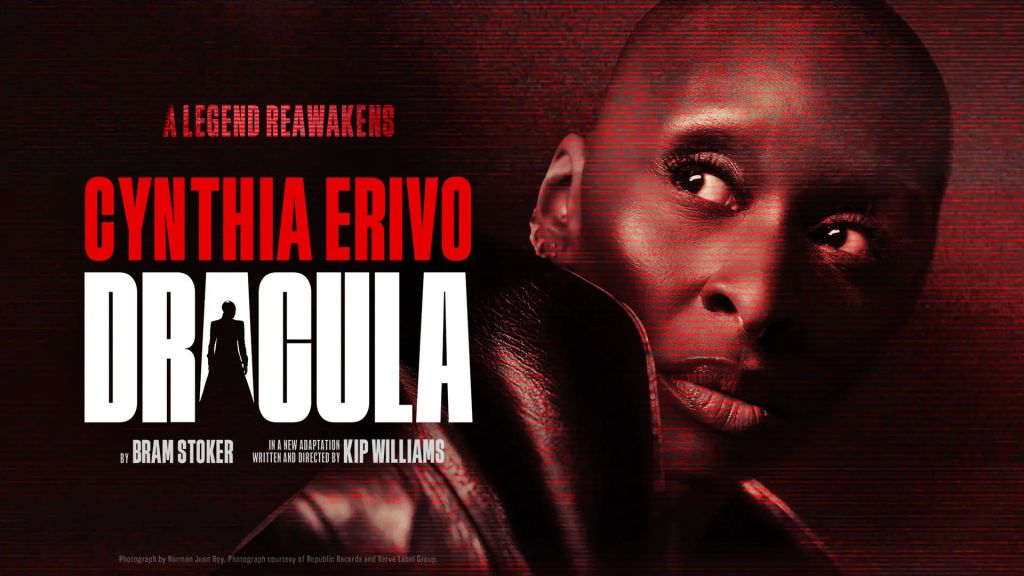
I had read, in my copy of The Guardian, Arifa Akbar’s 2 – star review of Kip William’s adaption of Bram Stoker’s Gothic novel, Dracula, before I even thought of seeing this production. All that was clear was that, in Akbar’s opinion, this was a version turned into a vehicle for a one woman performance for Cynthia Erivo, and that Akbar believed that neither Erico nor the production really had a sense of what drama is.
Below is a bitter taste of Akbar’s critical lifeblood, which elaborates on the staging techniques that Erivo uses to perform the piece, a bare proscenium portalled deep stage onto which stage properties are wheeled and containing a flat film screen whose height above the stage floor is continually manipulated, sometimes hiding the manipulation of properties behind it for a later reveal, as in the case of setfing up the grzveyard in which Lucy Westernra briefly resides before being staked to final death by her former fiance, the recently ennobled Lord Godalming (but to us Arthur, or Art, Holmwood).:
Erivo appears ever smaller and more vulnerable on stage and your eye is drawn away from her, to the screen closeups. Sometimes images are superimposed on each other and look hallucinatory. It shows off what technology can do but the action itself is overwhelmingly static.
That is because the story is narrated by Erivo, with only snippets in dialogue, which gives the sense of an audiobook accompanied by screen illustrations. It comprises mostly diary entries from journals and preserves the epistolary form of the book. Why, when it serves no dramatic purpose other than to remind us of the story’s original form?
Erivo narrates swiftly, with accents differentiating characters along with a quick changing of wigs and clothes. So a pink-red wig and African inflected accent for count Dracula, a pin-striped shirt and clipped British accent for Jonathan Harker, the solicitor who becomes imprisoned in his castle, a high innocent voice for Harker’s fiancee, Mina, a blond wig for her friend Lucy, who falls victim to Dracula. But despite the speed, the atmosphere stays sedate, with none of the fever required, and no peril whatsoever. And characters seem so simplistic that they verge on the comical. Most ludicrous of all is vampire-slayer, Van Helsing, who looks like a gothic version of Gandalf with long white locks and weird goatee. Erivo’s feat of narration also seems to distract her from the actual acting, too neutral in her physical and facial expressions.
I saw the performance at the afternoon matinee on the 5th March at the Noel Coward Theatre on St. Martin’s Lane in a packed house of people entranced and shocked by it’s power for which Akbar’s description gave me no warning.
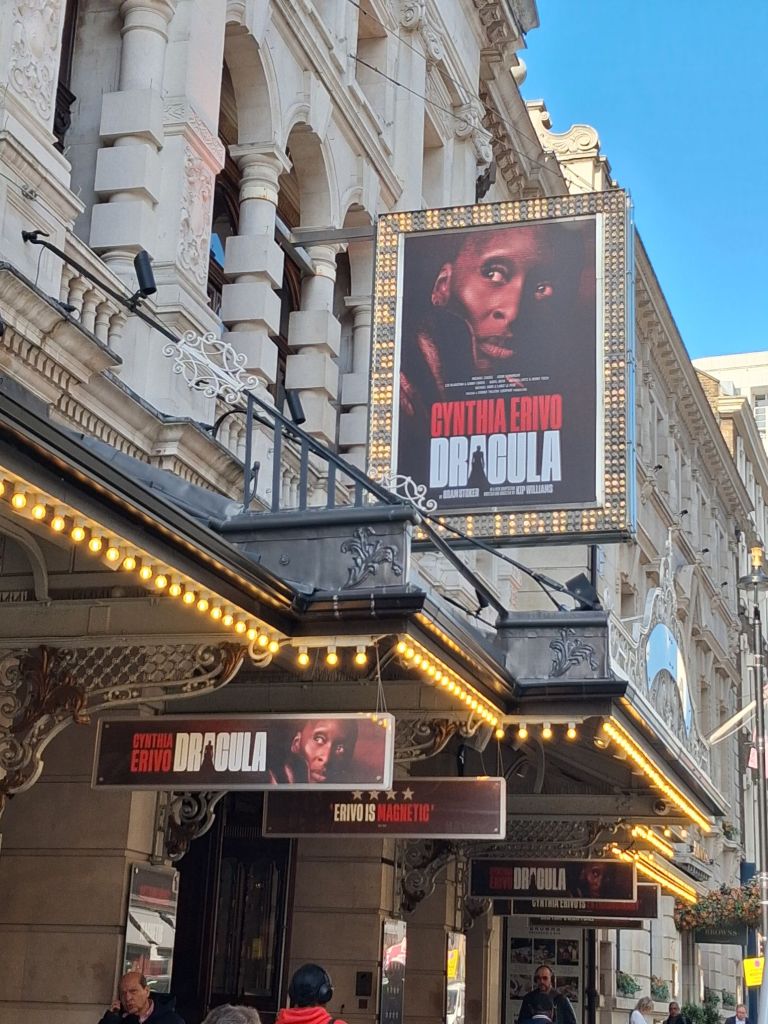
There are accurate details in Akbar but in its overinterpreted ‘take’ on the production, it entirely misleads. Yes, visually our attention is continually varied between Erivo in person on stage and the screen appearance of her but that divergence of view is purposive, a means of disorientating the viewer so that their attention, in visceral movements of the head for me (on the front row of the stalls) being continually physically being pulled from one focal point to another.
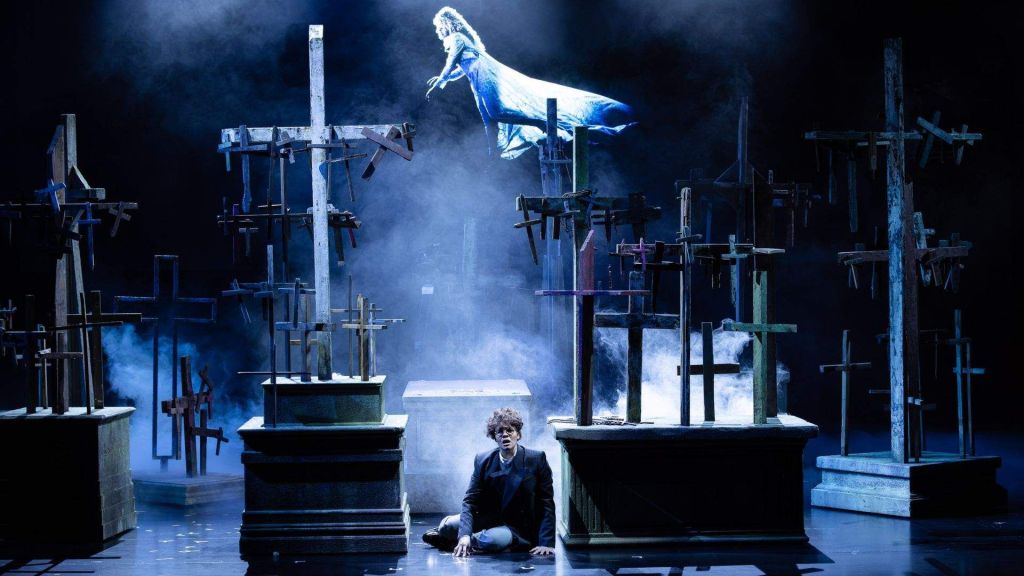
For instance, we see Erivo on stage with a camera or cameras recording her and then pull my head up to see her face, or half- or-full body magnified on screen apparently seen simultaneously projected from the recording camera. These are what Akbar calls ‘close ups’. Here is one, from the graveyard scene, although a still shot using an understudy, I think:
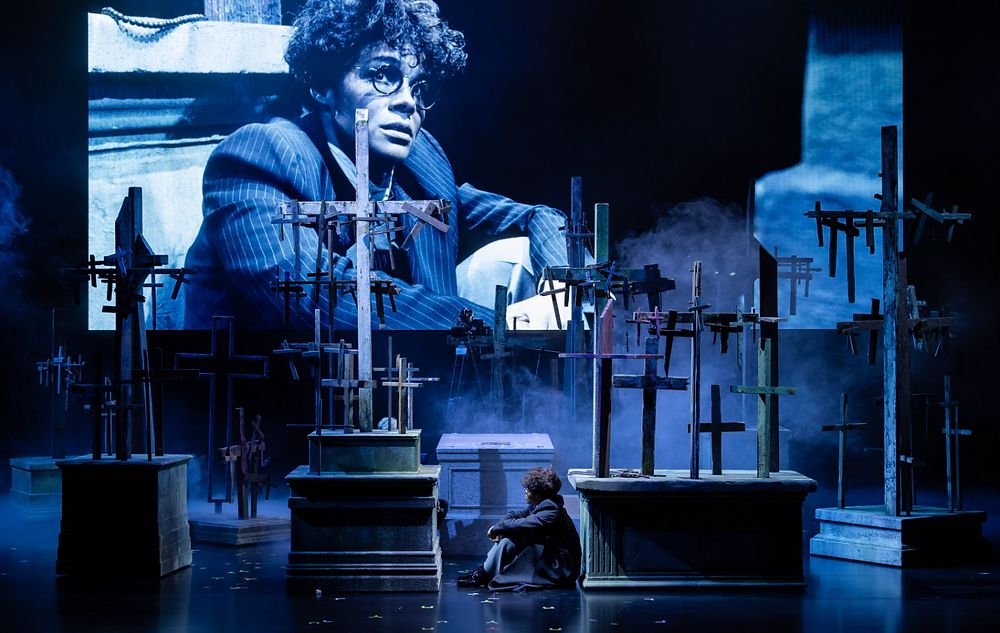
However, Erivo is not alone with the camera(s) often for the various types and sized of them are manipulated by a technical crew, who move silently around her with them, and, on occasion, also with stage props, seats, beds, graves and tombs alike. The images are, when there are multiple cameras on stage with Erivo, formed from a selection from their multiple points of view onto the screen. Usually, we see these operatives and cameras, although above the camera angle of the still means the operative is hidden behind a plaster tomb. However, they are not just close-ups for another reason, although sometimes they are, as in the opening.
The opening shocks in fact, or did me. Erivo enters in the semi-dark, to massive audience ovation in fact, and lies at the back of stage as a camera unaccompanied by visible persons but suspended from the stage gantry moves, relentlessly down on her from above. The result is that almost invisible action of the prone figure in true close but also turned into an image that appears to be vertically standing looking out at us as Jonathan Harker speaking as if from a reading from his journal is projected forward from the screen to oir gaze. It is indeed a huge screen representation of Erivo dressed in the attire of a young lower middle-class professional man.
From the get-go then, diverse simultaneous points of view create illusion of shifting orientation and relative size of stage figures. These effects mount as the onstage Erivo shifts shape between characyers onstage by aid of costume changes. In effect the onstage Erivo can be all of the various other characters orally narrating their accounts; which in the book are in the forms of letters, diaries, hournals or other unseen recording devices (such as Seward’s professional phonographic device usually reserved for case study notes on his ‘lunatic’ patients).
That all this is narration is marked only by the delivery when Erivo is a character who is also one of the stories narrators of speech in a clear, articulate but flattened ‘reading voice’, with the tone of operatic recitative but without the modulation sometimes allowed in opera. This is how the voice works at least if not narrating dialogue where variegated voic is required, such as the Irish lilt Evrio gives to the talk of Renfiels, the ‘zoophagous’ [animal eating] ‘lunatic’, or the broad Yorkshiree voice of the old seafarer from Whitby who sits with Lucy on the Whitby Abbey mound overlooking the harbour in the account of the night of the arrival of the Demeter in Whitby harbour bearing the shape-shifting Count Dracula, who escapes the ship in the form of a huge dog or wolf.
When the characters in the dialogue speak directly, if they are of the major dramatic personae, they speak in the voices as adopted by Evrio for them as filmed projections for each character in the conversation, from separate past filmings of course, for each character is played by Erivo of course and therefore must be filmed separately and not simultaneously except for the current onstage dramatis person, for the stage can contain only one Evrio in the flesh. ,
The different past projections must be collage with the present recording for Evrio to play a group scene – the complexities of filming, or even desiring- woe is me’ are enormous, to say the least. See the example below a still of the narration of the scene around Lucy Westernra’s deathbed, festooned with garlic flower bouquets. I try to explain. It’s intricacies after you have seen it.
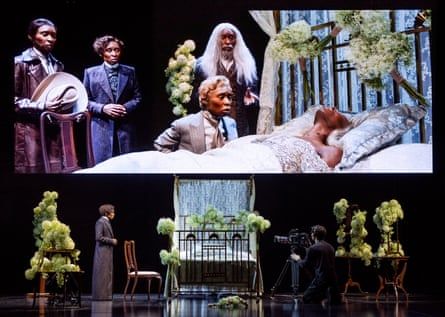
The still shows the huge screen at some height above the stage, whose scene setting and props are that are also mirrored in the recorded film. On the stage we see Erivo in the character of the frock-coated Seward standing behind an empty that is pulled up to the equally empty bed. The only other person we see is the camera operator kneeling at the other side of the onstage bed filming Erivo in role. However in the same scene on the film Erivo in role stands just where she does on stage but is surrounded by a group of characters all played by her and pre-recorded. The point of view of all the characters is created as if it were from the camera-angle of the on-stage despite the fact that Erivo as the characters other than Seward cannot be on-stage. The voice of the character is I think the on-stage one, even though the others are pre-recorded.By the way, this must be a rehearsal still-shot for the character in the bed is bearded and not the role of Lucy being performed by Erivo, as it is in the production.
When the account involves other characters talking or interacting with each other, something like the above always happens but with wide variation. As we see above, in these cases, the screen contains both the avatar of the person reading on the stage, apparently collected live onstage by the person-manipulated movie camera and past shots of Erivo enacting the other roles, in costume, wigs and facial-gesture-formed masks. Sometimes the screen descends to stage level and the onstage Erivo acts with the screenshot other characters also played by Erivo. Obviously this means that the scale of the characters in these scenes is often different. At other times the screen interprets the character of Dracula when Erivo plays it in other avatars from cinema history with her stage role played against the maximally lowered screen, including the clawed creature named Count Orlok, for copyright reasons in the 1922 classic, F.W. Murnau’s Nosferatu: A Symphony of Horror (see my blog at this link on that and Robert Eggers Nosferatu) and some of the aristocratic smoothies based on Lord Byron’s reputation (see my blog at this link, including Gary Oldman).
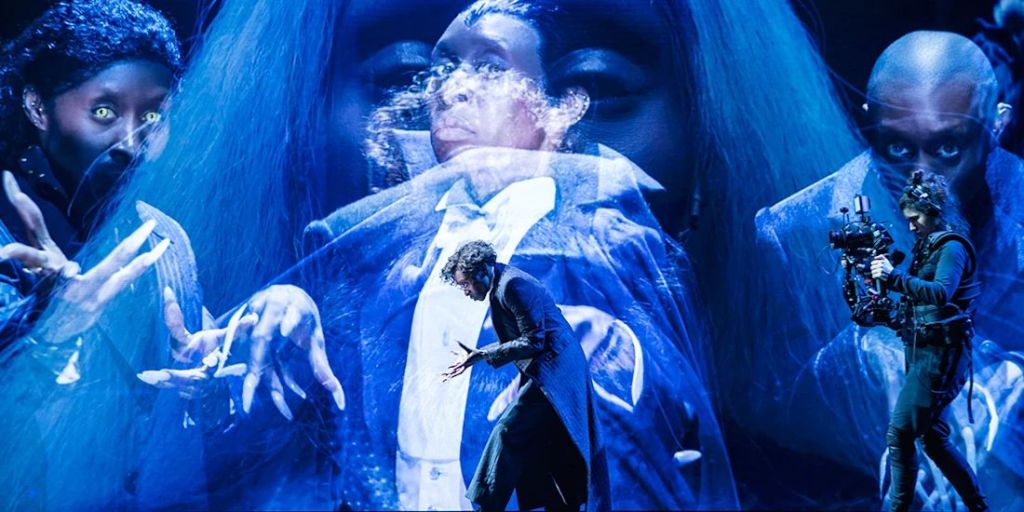
At other times, images of Erivo as Dracula are overlapped multiply to show the incomprehensible multiplicity of the supposed ‘character’, who cannot be contained in one form or in one token of his typical multiple being. However, the still below (using a stage understudy again)shows Harker fronting an overlay of various shots from the three women who Dracula assigns to be his fate as food in Transylvania.Multiplicity plays lots of roles her – not least in opening up the notion of closed desire in our understanding of Victorian sexuality to its multiplicities, something Stoke could not have failed to notice in his own ‘Master’, the actor-manager, Henry Irving, lover of Ellen Terry – mentioned in Dracula as the type of the ‘bloofer lady’ , who slowly digests the blood of willing children.
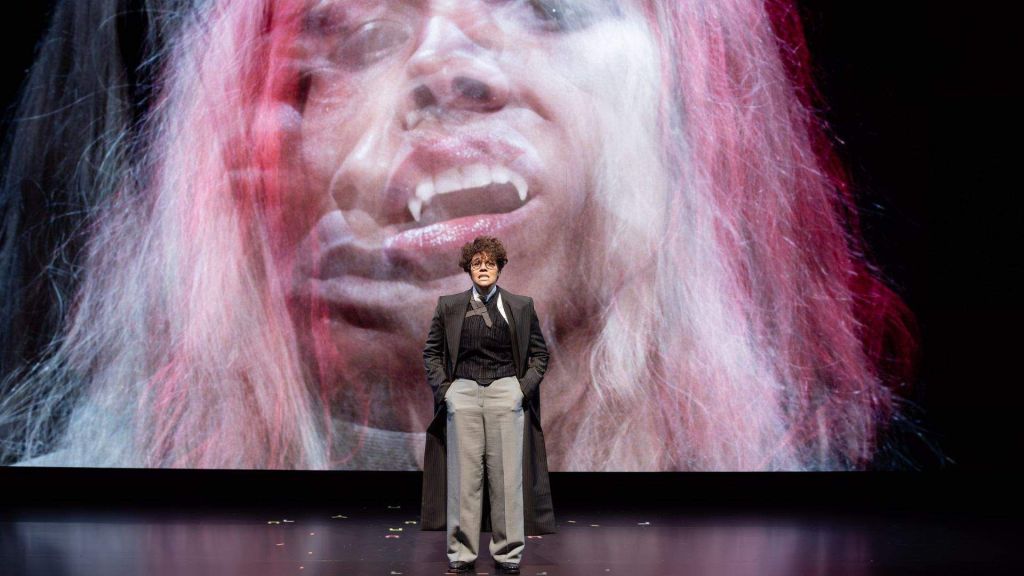
For Akbar to say that all the film work in the film does is to show off ‘what technology can do’ has a worrying affect of my appreciation of Akbar’s knowledge of what drama can be, just as does more so her continuation that in the whole performance ‘the action itself is overwhelmingly static’. It is not. What is the case is that this performance tries to revision the relation of the genre conventions of film acting, especially in the age of Artificial Intelligence (AI) for the filming must be highly AI dependent in this performance, theatre and popular stage show. When Akbar mocks as verging on ‘the comical’ in the manner the characters are created, she forgets that in many genres characters are iconic types, and that even Bram Stoker was not immune to comedy – he has Van Helsing laughing out loud at how many men, Lucy has in her as a result of her blood transfusions – the joke is crudely sexual however Van Helsing tries to explain it away. Akbar mentions:
- a pink-red wig and African inflected accent for count Dracula;
- a pin-striped shirt and clipped British accent for Jonathan Harker, the solicitor who becomes imprisoned in his castle,
- a high innocent voice for Harker’s fiancee, Mina,
- a blond wig for her friend Lucy, who falls victim to Dracula, and, most ‘ludicrous of all’
- vampire-slayer, Van Helsing, who looks like a gothic version of Gandalf with long white locks and weird goatee.
In my view, these characters, ‘flat’ as they might be, are more stereo-typically iconic than meant to be rounded and realistic. I think that you have then to forget consuming Akbar’s acid tooth-drops in order to have any chance of seeing the performance as it actually is, in all its queer strangeness: so strange, and eventually extremely fast-paced to its denouement, through a snow storm whose soap-paper-represented snow fell on us in the front row of the stalls. , that this forgetting was inevitable and happened without my apparent will driving it, as did the forgetting of my reading the novel again. And can Dracula represented in any way really avoid humour. Play the fleeing Lucy Westernra, in her Undead distress, without humour is surely a mistake – and the spectacle of her flying over the graveyard is tremendous (again a still with a stage understudy):
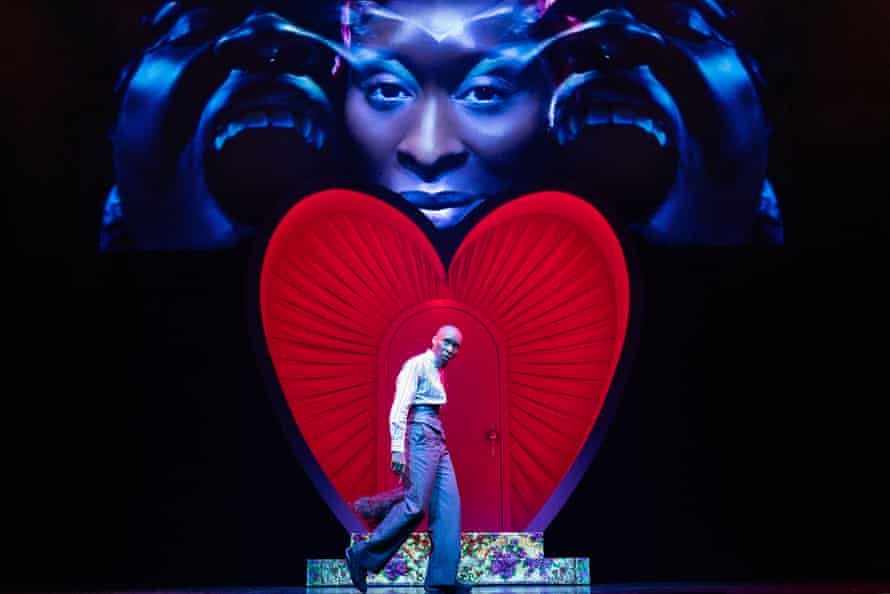
Likewise, why dislike the mock-Victorian-Gothic romantic of the production, particularly its use of a red loveheart to represent Mina’s passion, much more important and more overtly non-monogamous in this version. The heart after all is a doorway we are less careful in opening to all – even the Undead – than perhaps it ought to be.
But let’s finish Akbar off with a final bite. Her review reads as rather perversely ad feminem, blaming all of what the critic sees as a lack of status or quality as drama on the show’s star, who, in Akbar’s account, acts very thinly and ludicrously the roles in the novel’s scenes with little or no quality of real enactment. But drama changes and we should let it change.
Kip William’s stage Dracula is in contrast mainly a transitional form, engaged mainly with the limited range of themes in the book that make good drama, without thi king you can have no drama without solid and well-boundaried individual characters such as, perhaps, Ibsen perfected. The dramatic principle in this production comes from Stoker’s themes of transit, including travel and flow between places and through spaces and times, transition of and between character and character traits, even Stoker’s obsession with masculinity and femininity in and between concepts of sex/ gender; and, of course, blood transfusion. The latter is a concept born in the obsession in vampirism with blood as a marker of race, class and sex/gender. Vampires transfuse and mix the blood of many in one person, but the many blood transfusions in the novel do the same for the living and just living as is the modus vivendi of the Undead (hence possibly more a modus undeadi perhaps).
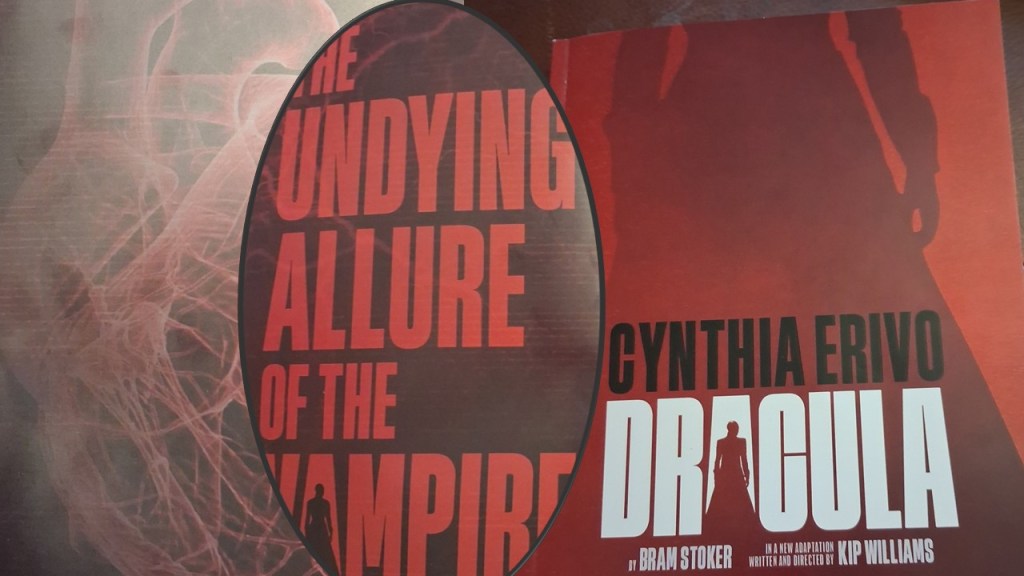
The programme for this production is a remarkably thin one with more adverts than content about the production outside of a cast and crew list., but its one ‘essay’ (by Marianka Swain on The Undying Allure of the Vampire’) concentrates on the fact that the idea of the vampire ‘shapeshifts for every generation’: and hints that this production reveals ‘how we currently feel about concepts such as sexuality and gender, the complexities of identity, ageing and the after-life’. There is nothing in that that isn’t facile but this is not so of the production itself, where transitional identity is also multiple identity, expressed both in transition and simultaneity with fuzzy boundaries, mediated not just between human beings but between humans, animals and ideas of the supernatural, flesh and the Word (or words at least).
Erivo is magnificent in this. I was vert tired all day – could have slept had I not been shockingly stimulated by this production – but this kept me on the edge of my nerves as my blood raced between them, firing at each other. This take is fully justified by the novel. Note this passage in which Van Helsing sees the three vampire women (two dark and one fair – the confusion of sex and race being what it was for colonial Victorian Britain and Ireland – who wanted Jonathan as their own. He has never seen them but read of them in Jonathan’s diaries and that was enough to express a commonality with Jonathan’s wish for poly-amorous delight outside of conventional loyal monogamous sexual affianceship, as geared up as much by desire as by repulsion of his male view of lesbian sex:
There were before me in actual flesh the same three women that Jonathan saw in the room, when they would have kissed his throat. I knew the swaying round forms, the bright teeth, the ruddy colour, the voluptuous lips. They smiled ever at poor dear Madam Mina. And as their laugh came through the silence of the night, they twined their arms and pointed to her, and said in those so sweet tingling tones that Jonathan said were of the intolerable sweetness of the water glasses, “Come, sister. Come to us. Come!” In fear I turned to my poor Madam Mina, and my heart with gladness leapt like flame. For oh! the terror in her sweet eyes, the repulsion, the horror, told a story to my heart that was all of hope. God be thanked she was not, yet, of them.
Honestly, you should want to see this production very much. It stuns while it enchants and challenges.
Bye for now
With love
Steven xxxxxxxxxxxxx
 Steve_Bamlett_blog
One thought on “‘Dracula’: See excelled here Stoker’s themes of transit, including travel and flow between places and through spaces and times; transition of, and between, character and character traits, even Stoker’s obsession with masculinity and femininity in and between concepts of sex/ gender; and, of course, blood transfusion.”