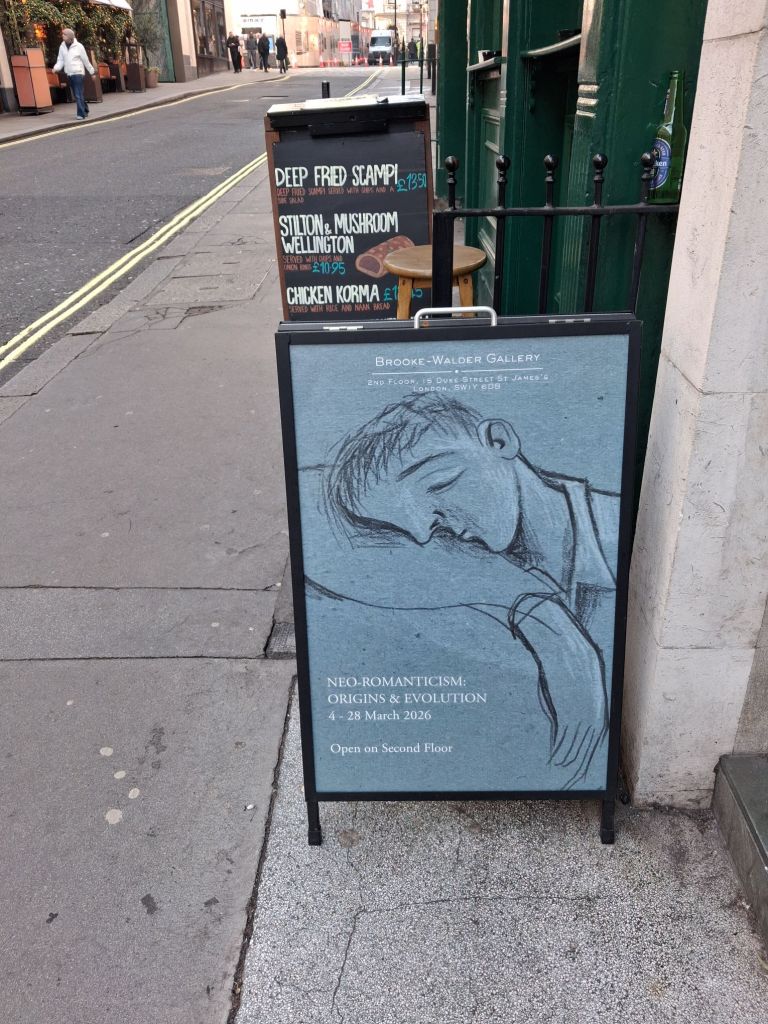
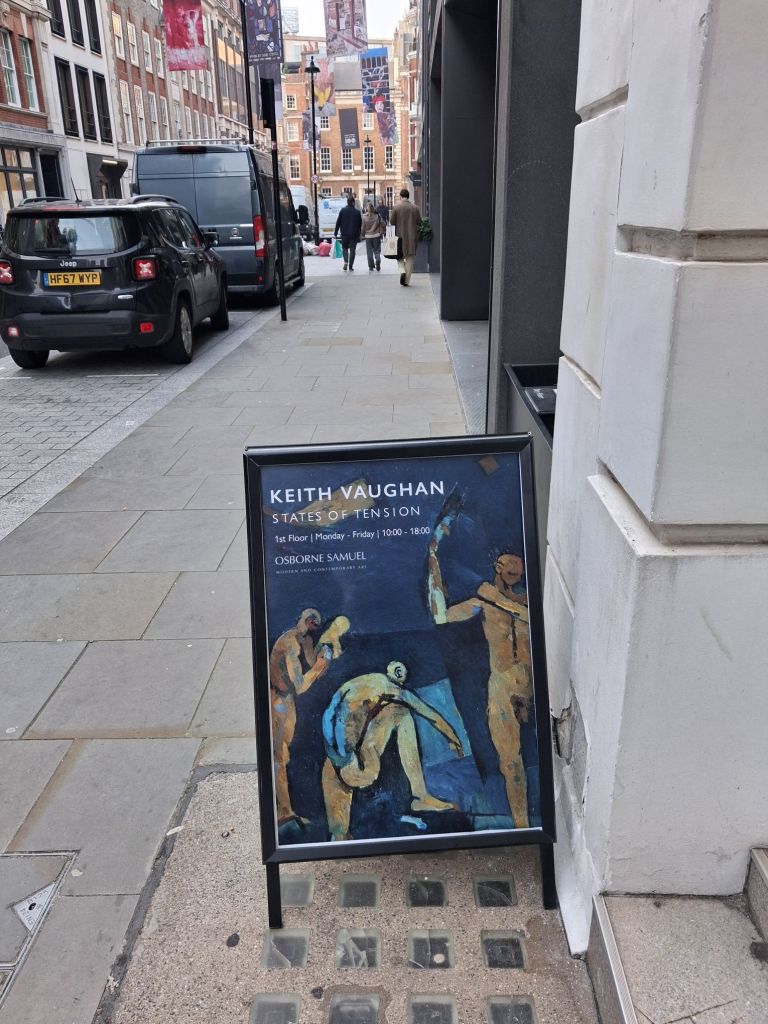
Neo-Romanticism for the new queer you: exhibits at the private Galleries of Brooke-Walder, Duke Street, St. James, & Osbourne Samuel, Cork Street.
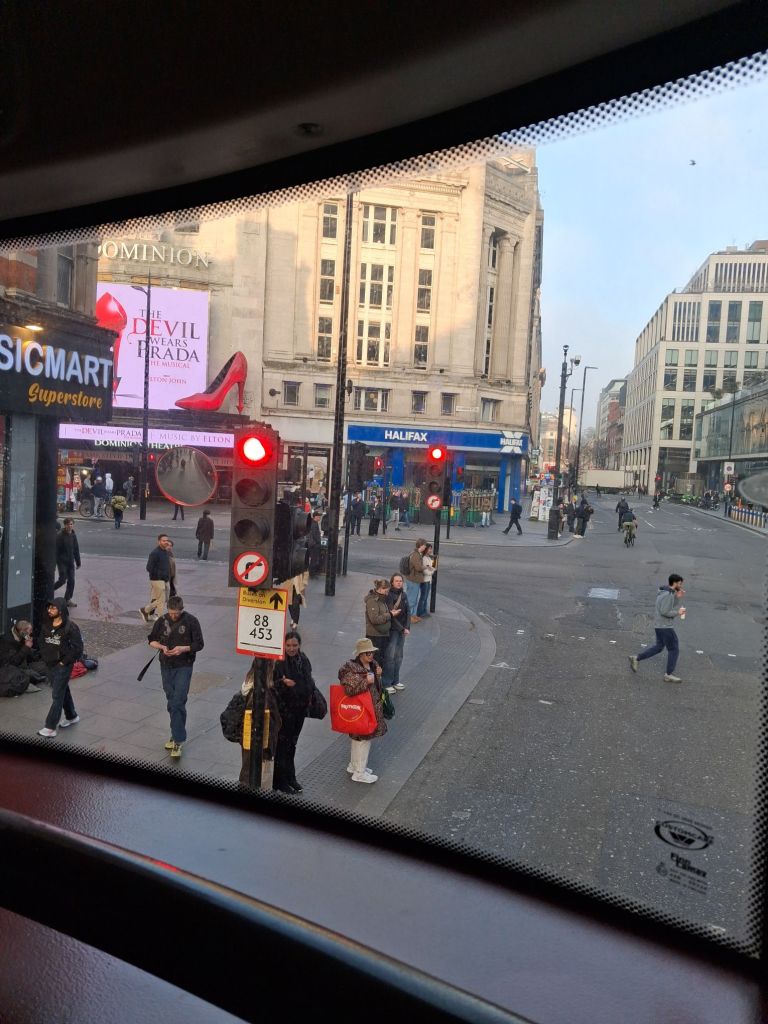
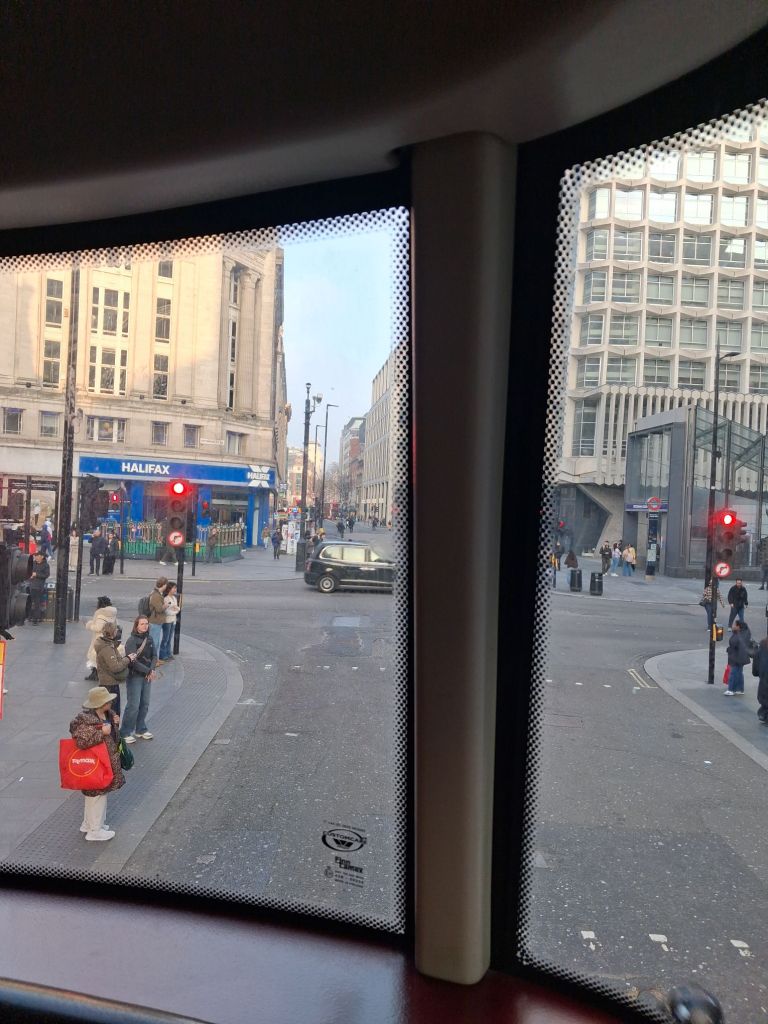
I blogged on this trip yesterday. Today, my main objective is fulfilled and I am starting this on the 390 bus towards King’s Cross and my hotel. Here, is the start point of my writing after the whole of Oxford Street fron John Lewis store. It is Centrepoint between Oxford Street, Charing Cross Road and Tottenham Court Road.
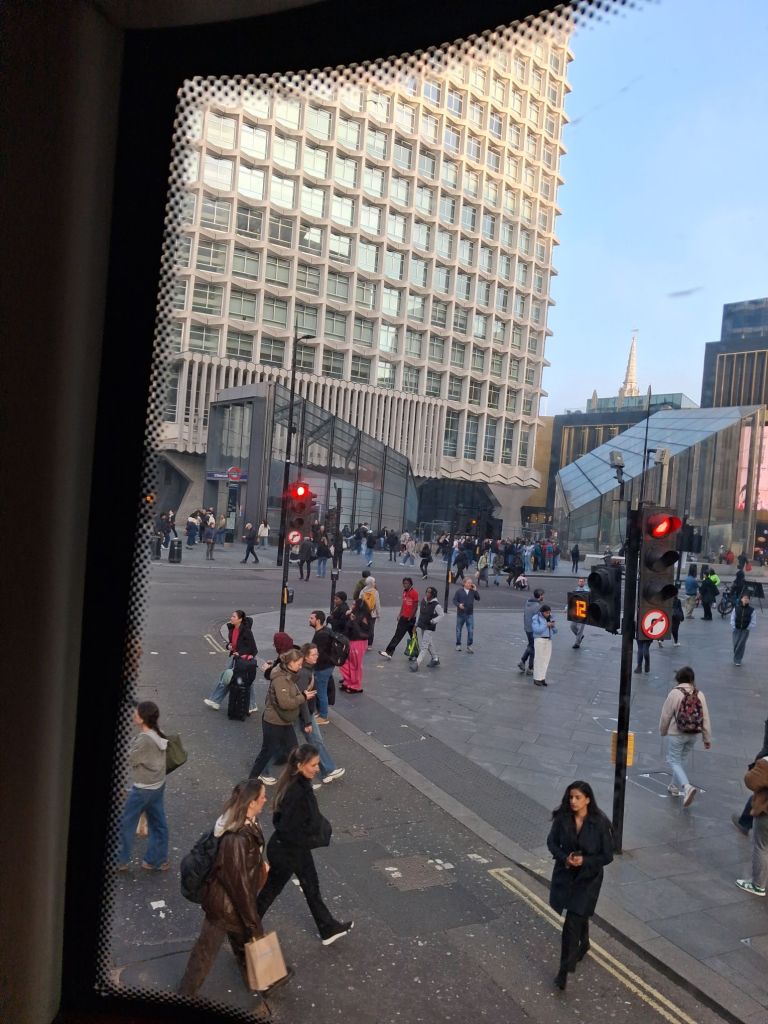
Yet having mounted that part of my blog here, I have reached Euston Station stop on the bus. But let’s begin with the Brooke-Walder exhibition; a delight and a surprise, largely stocked with Keith Vaughan pieces but with surprises from Minton, and to my biggest surprise a John Piper that almost made me eat my word “vapid” used of him in the last piece. Here is the painting and drawn study:
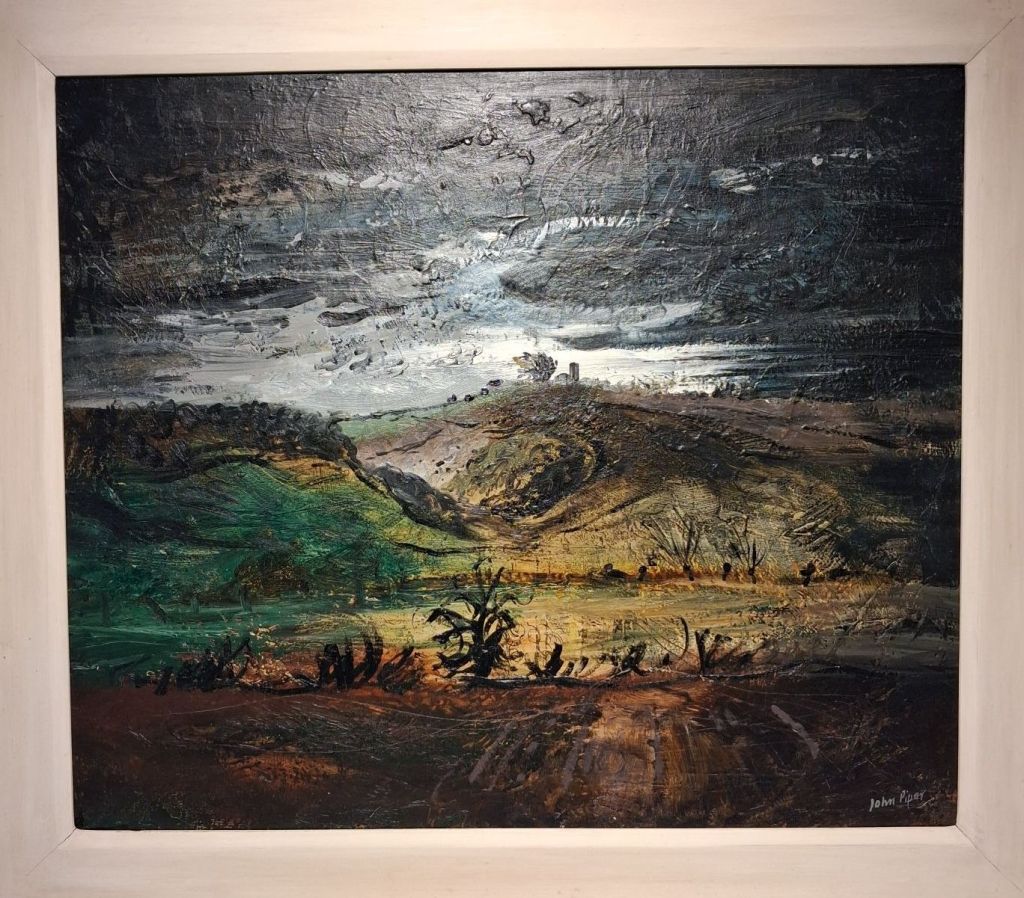
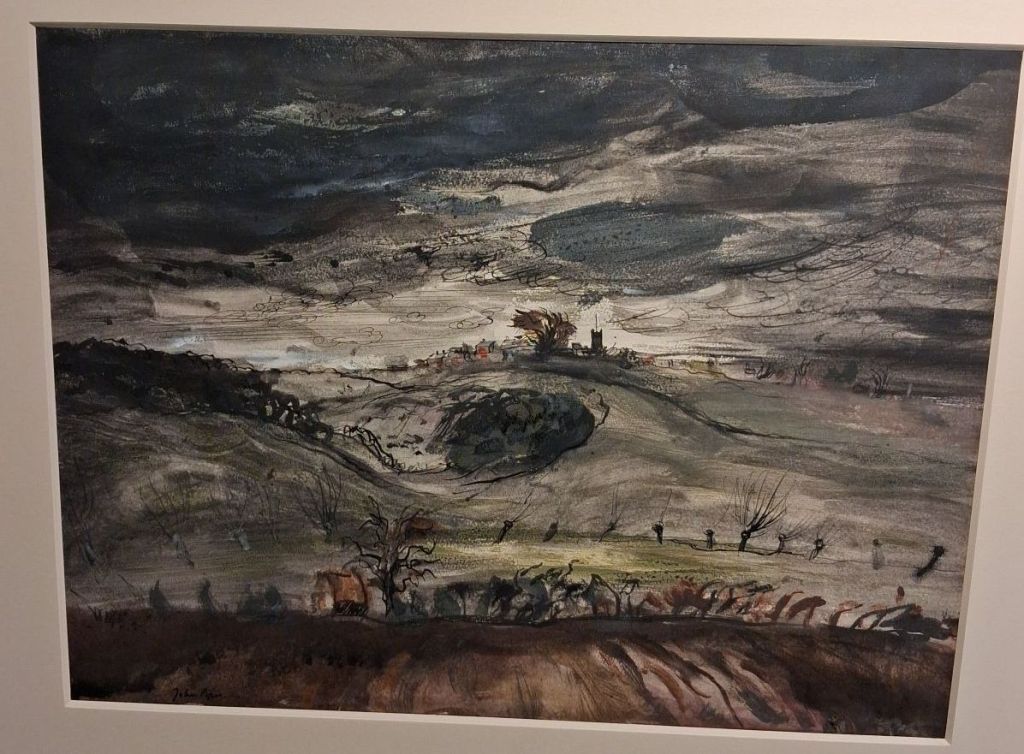
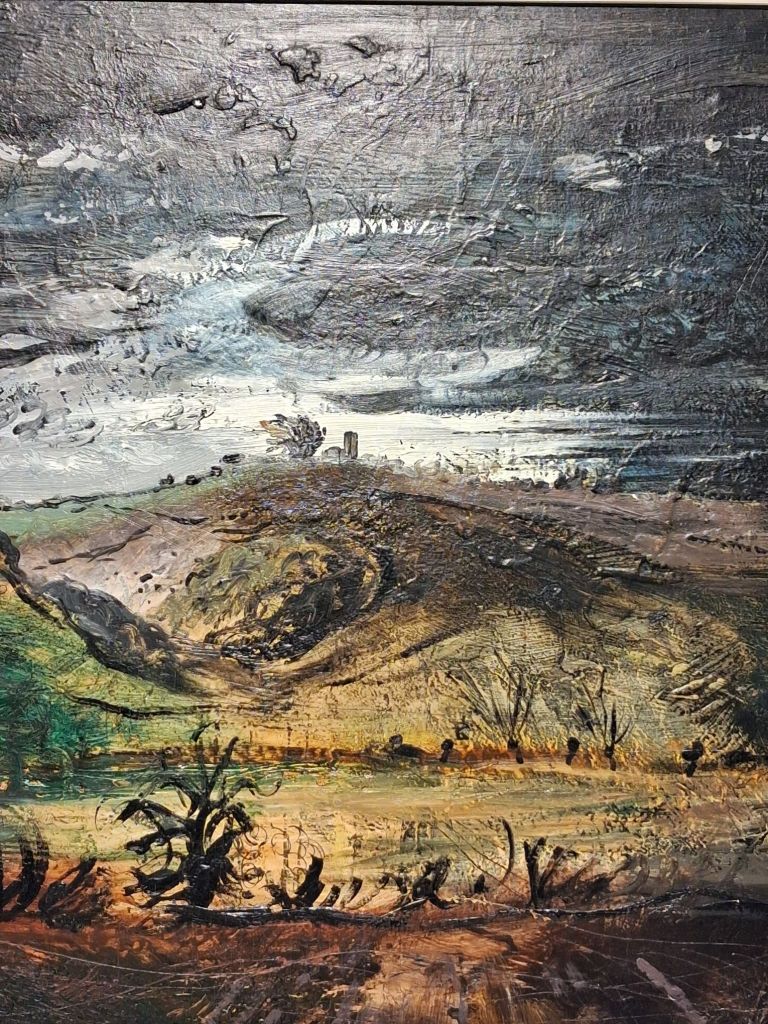
The impasto in the oil is used to build almost three dimensional volume in the manner of Vaughan oils and, possibly its primary user in the group, Graham Sutherland. It’s perhaps clearer in the detail below where a storm cloud is given wet density.
And here is a lovely Sutherland gouache from that exhibition.
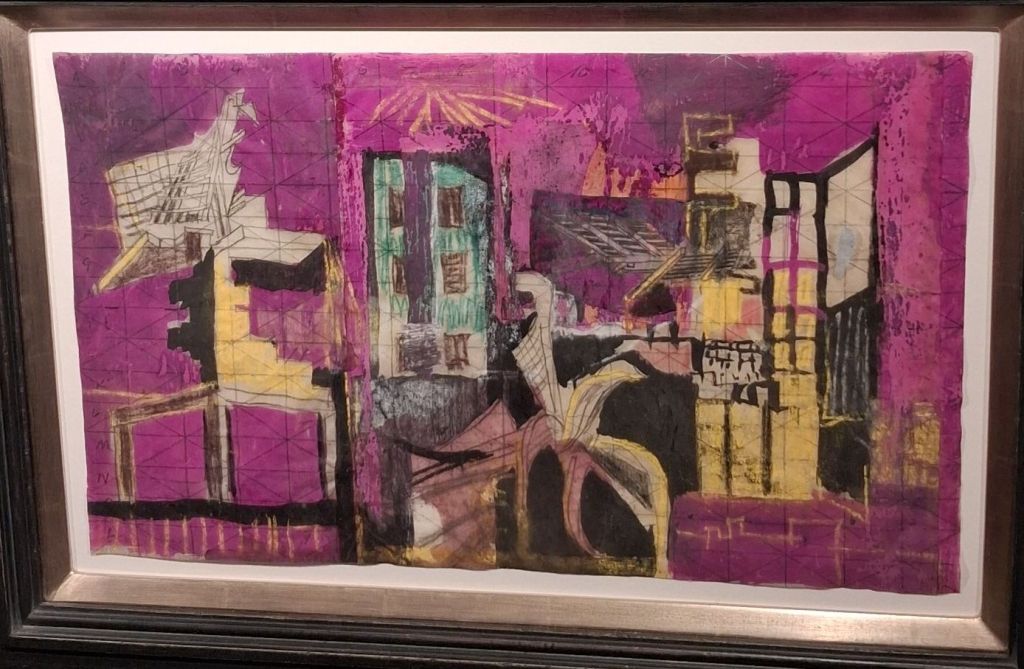
It is of war ruins, but it allowed for a useful cross reference between the exhibitions, for Gerard Hastings in his catalogue essay for the Osbourne Samuel exhibition writes of Vaughan, for instance, learning from Sutherland how to build impasto effects in gouache using a wax-resist method that had the same effect of allowing romantic ‘chaos and sensuality’ to invade a rather more classical ordering of figures and objects on the picture surface. I won’t try and describe the technique myself however, allowing this startling passage to represent Hastings’ views of Vaughan.
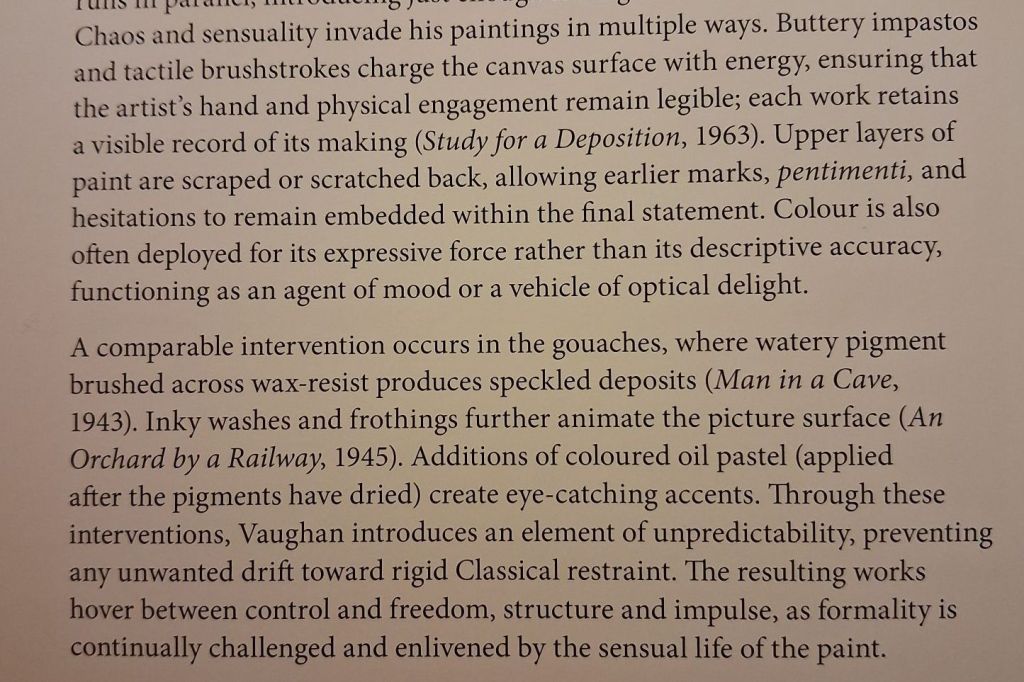
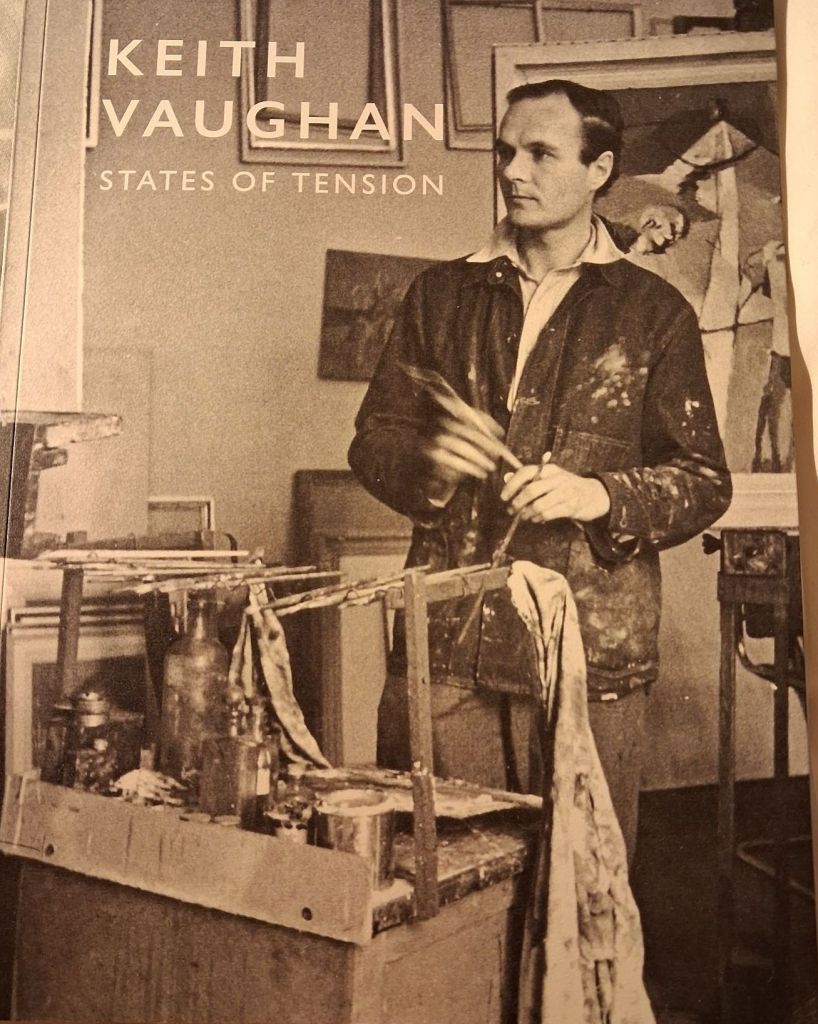
Gerard Hastings (2026: 11) ‘Introduction: States of Tension’ in Matthew Bradbury & Emma Arrindell [Ed.] With Gerard Hastings ‘Keith Vaughan: States of Tension: Catalogue’, London, Osbourne Samuel (cover below).
Technique aside, wherein Hastings finds considerable hard-to-reconcile tensions worked into a painting’s outward performance of its themes and methods, much of this also represents the themes themselves neo-romantics strove for. These together give a picture of a post-war humanity seeking order and community (in Vaughan the aspiration to ordered ‘Assembly’) where only the feeling of tortured flesh and mind are felt within each individual form attempting to comprise itself into that desired order.
This is all simpler, thematically at least, in earlier Neo-Romantic drawings, such as in those tortured nude self-portraits of Minton in a background of war ruins in Brooke-Walder exhibition. These are all the more poignant in the light of our knowledge of Minton seeking sexual solace with servicemen amid London’s ruins.
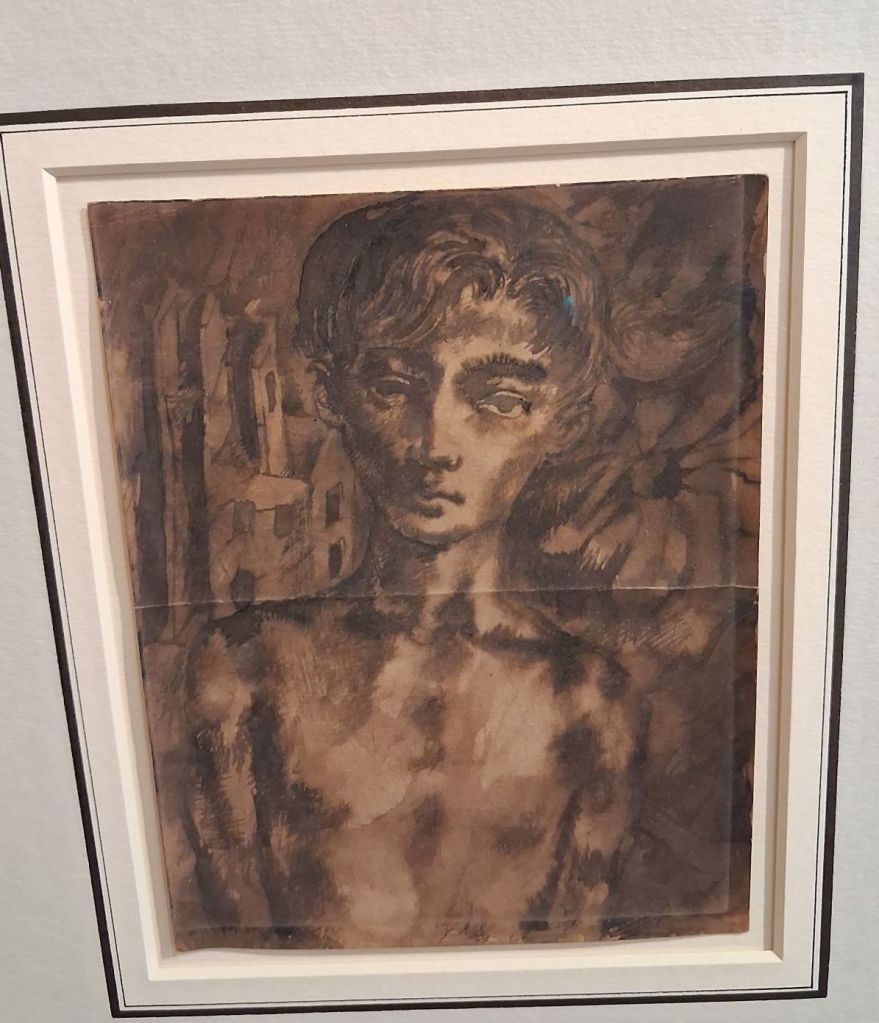
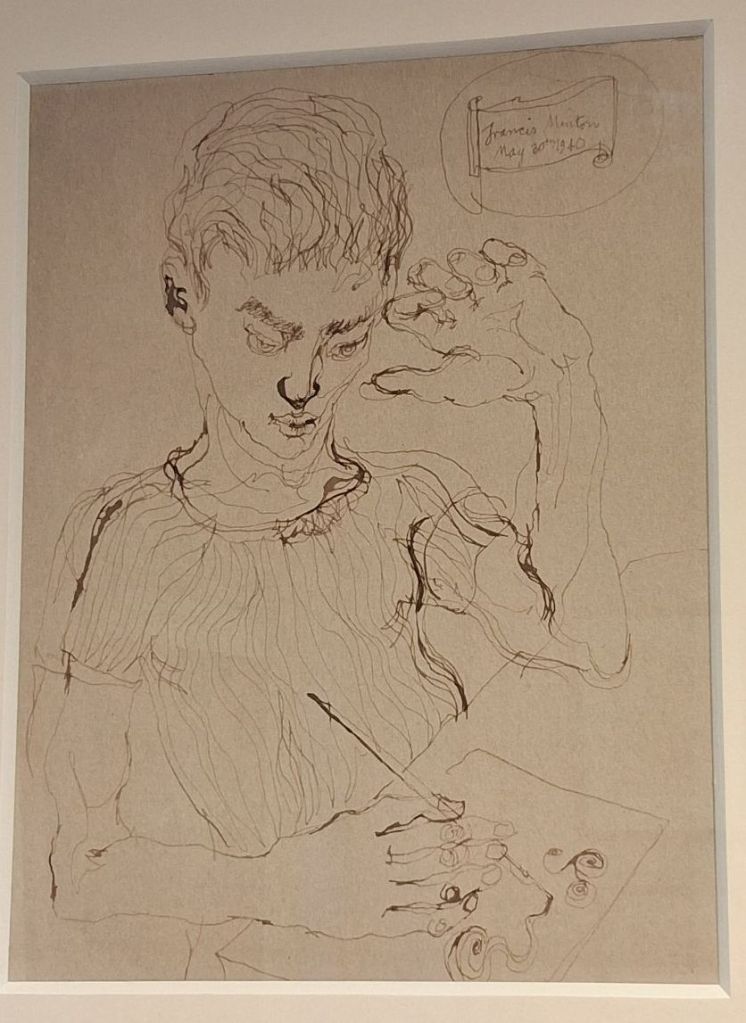
In that first exhibition what is on show are early expressions of ro.antic social alienation, as in the early self-portrait known as Francis Minton, Minton’s view of himself when he used that early discarded first name. Here is a man of diminutive stature with the hard huge hands he later gave to his romantic working class heroes, hands that were rough but purpose builders of something. As he bears them, when they are not drawong, as his left hand is, they seem, as with the right hand to project into the picture surface from its illusory depth and claw that surface. It is a most haunting early statement:
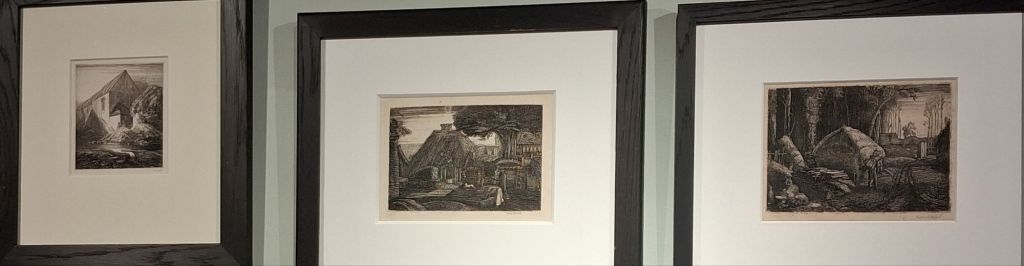
Thete is no single theme to the Brooke-Walder, the pictures are too diverse. There is an attempt to represent Samuel Palmer even, and there had been, I was told, one Blake piece that had unfortunately taken out of the show on the owner’s second thoughts and these small pieces were instructive of the manner some parts of the Neo-Romantic took landscape, especially in the exploitation of shadow.
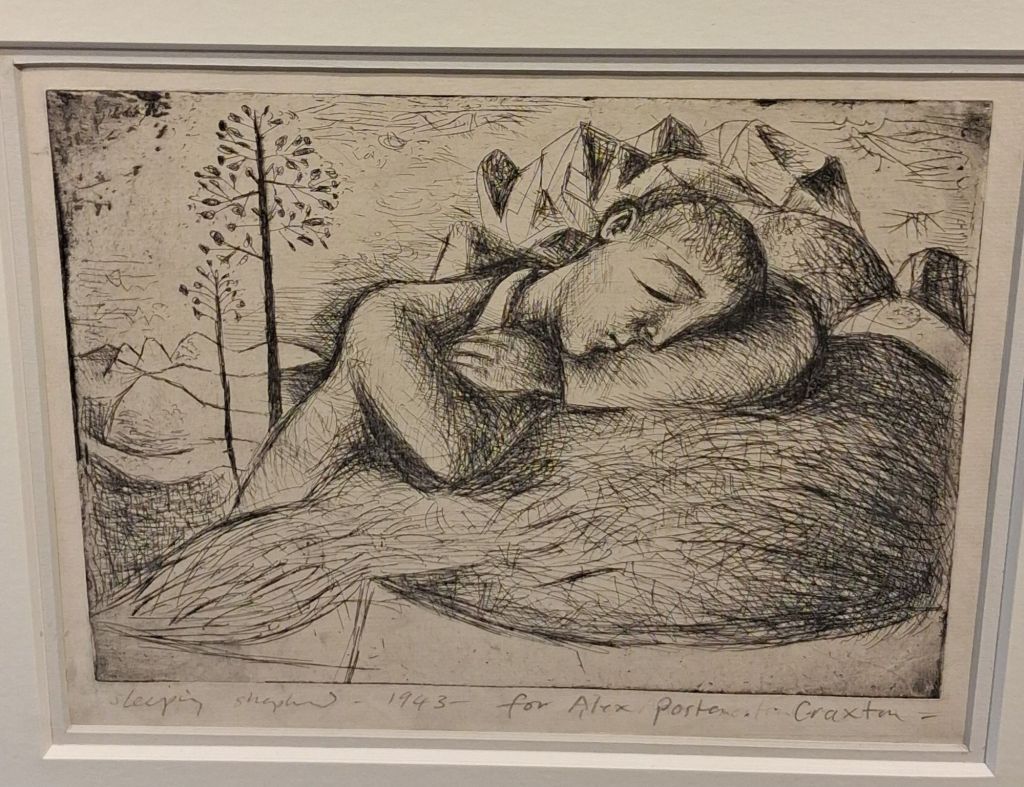
But the pastoral view of humanity is less evident except in early John Craxton which escapes maximal shadow and complexity for dream versuons thereof.
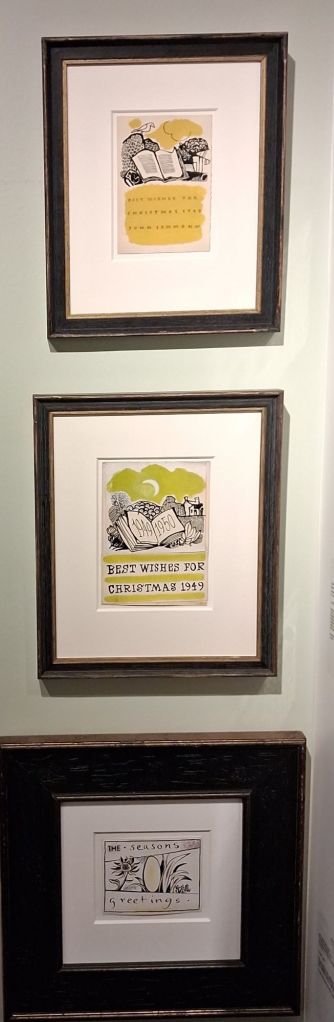
Only in his early illustration was Vaughan even near to this simpler vision. In ephemeral illustrations, Vaughan and Minton were once all one with pretty and bookish English vision, as in these pieces all associated with publisher and queer master, John Lehmann:
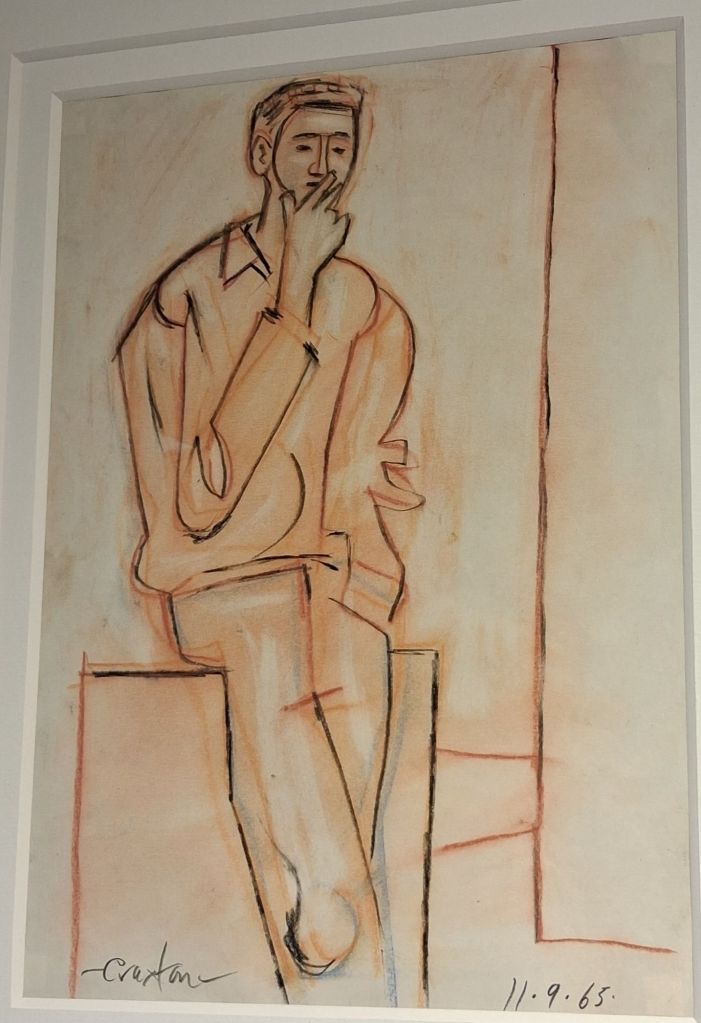
Craxton, escaping England, found hid pastoralism in Greece and sustained a kind of queer mental idealism, at least in portraits exhibited here:
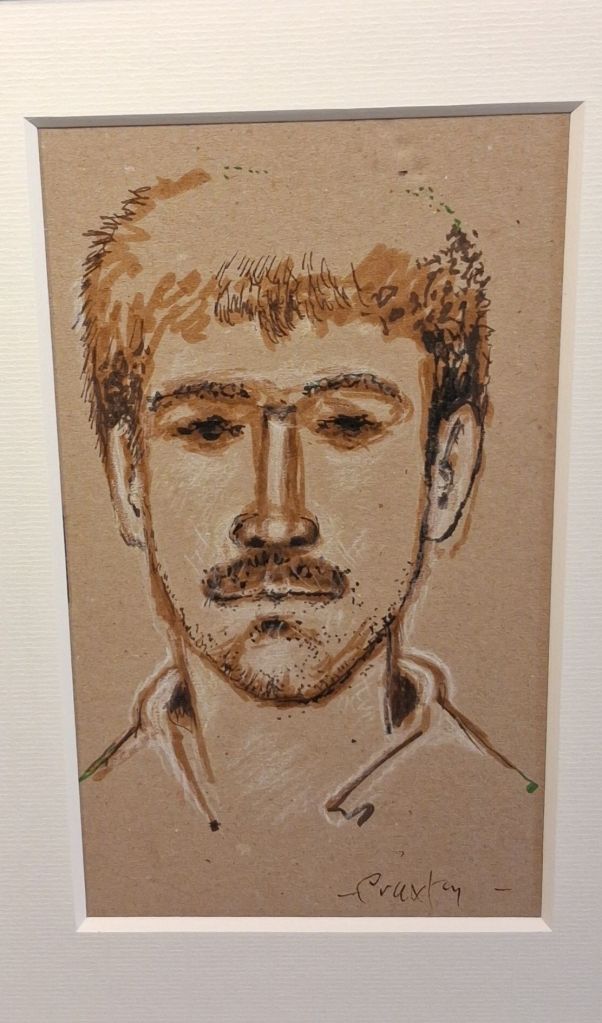
Thete is a confidence in self in that portrait and his isolated male portraits have a boyish youth about their reflectiveness, rather than deep psychological shadow but are beautiful, of course, and so conscious of the body beneath its covers
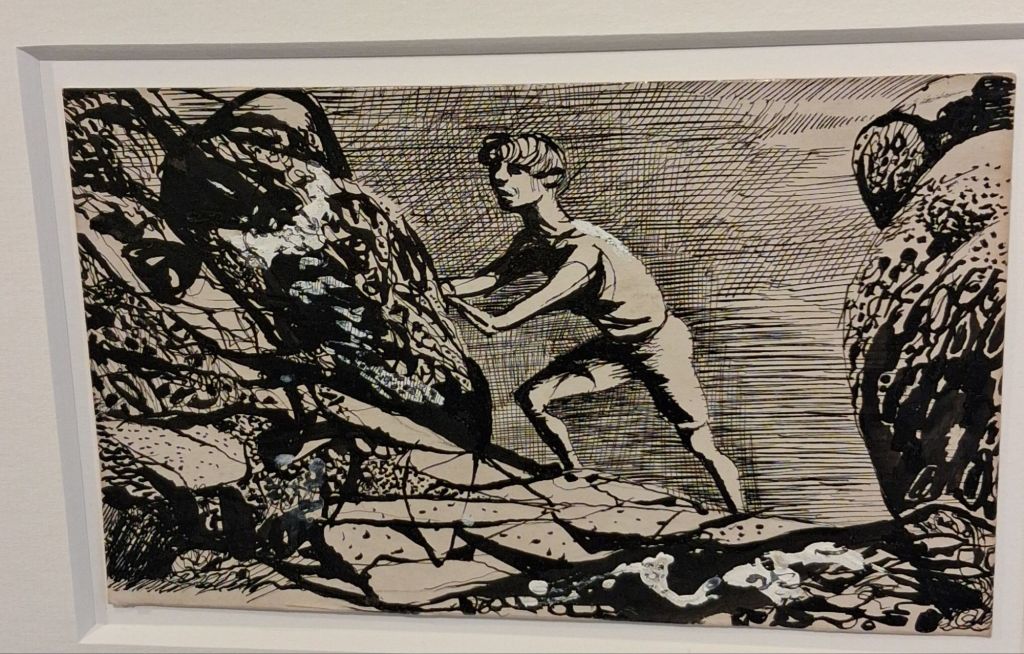
Vaughan retained this in some of his 1950s book illustrations as below in this exceptional study for Newby’ Book of Jem, where the hero’s boyish quest amongst the caves is represented below:
It is the active obverse of the battle to stay differentiated from the rocks by which a passive man stands in the later beautiful but frightening vision. From the other show, of the 1957 Nude Against A Rock.
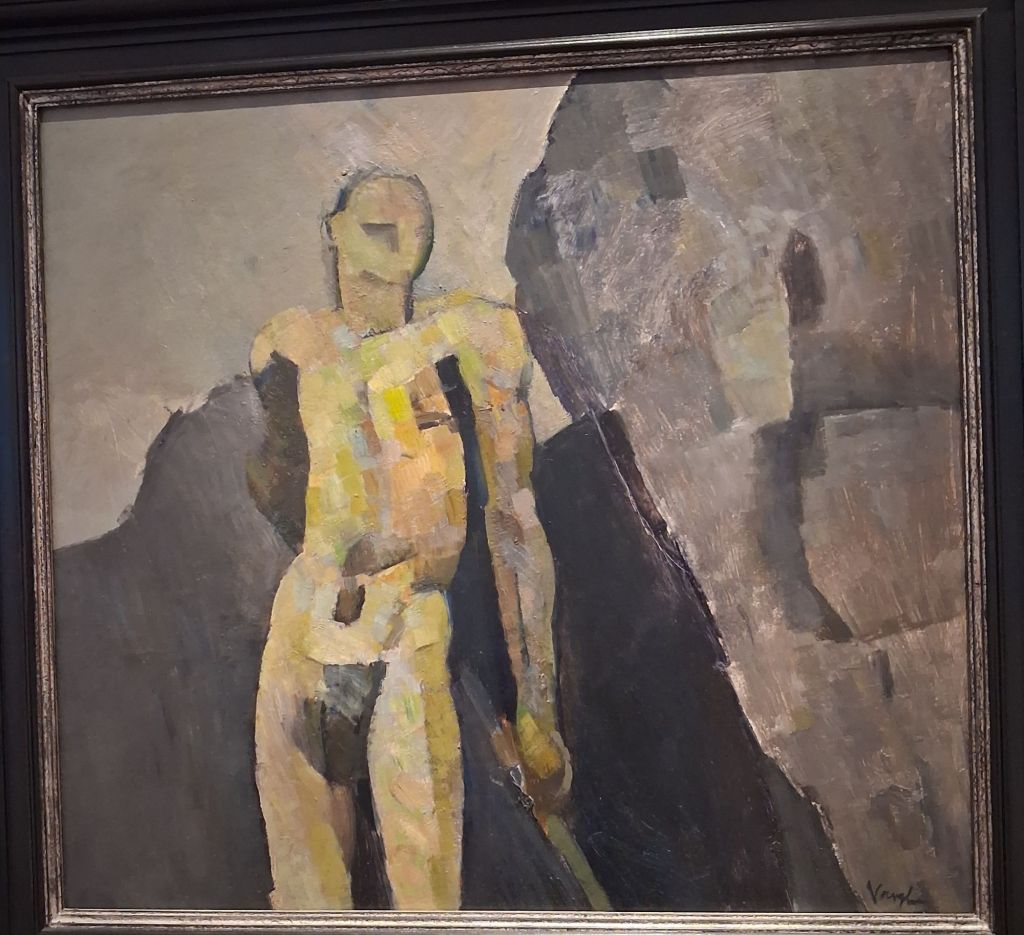
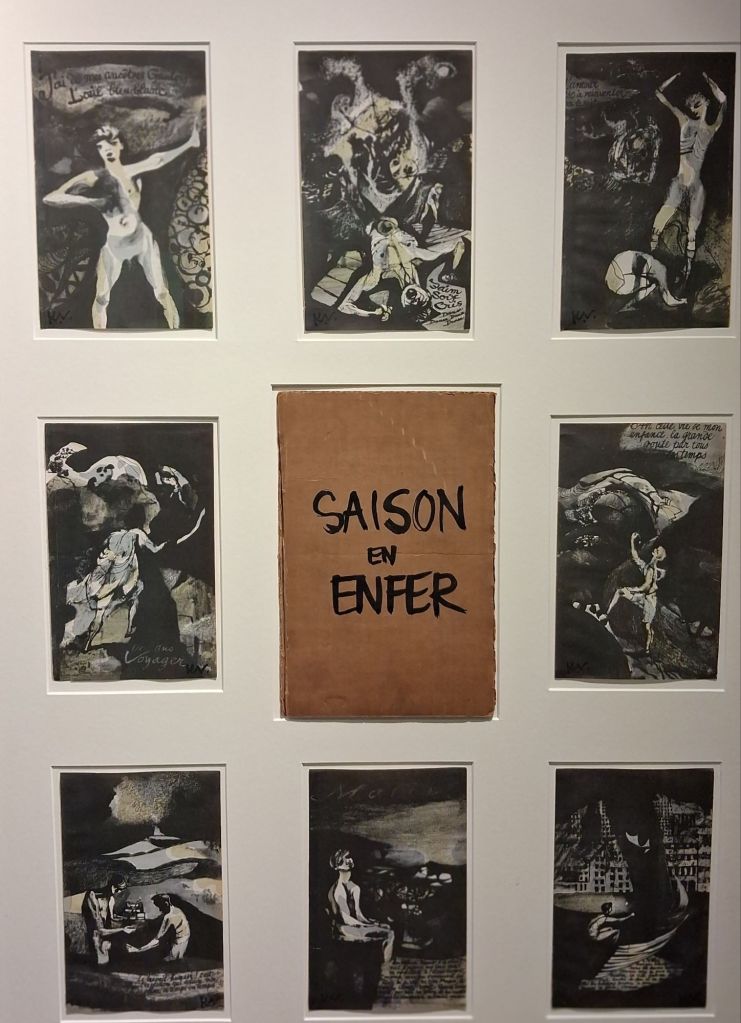
But even in early book illustrations, Vaughan conceptualised his figures guided by philosophical romantic-existentialism, more Gide and Rimbaud than Sartre, as in the fascinating original studies, complete with Vaughan’s homemade folder for Rimbaud’s A Season in Hell, some of which already preferred Nude Against A Rock.
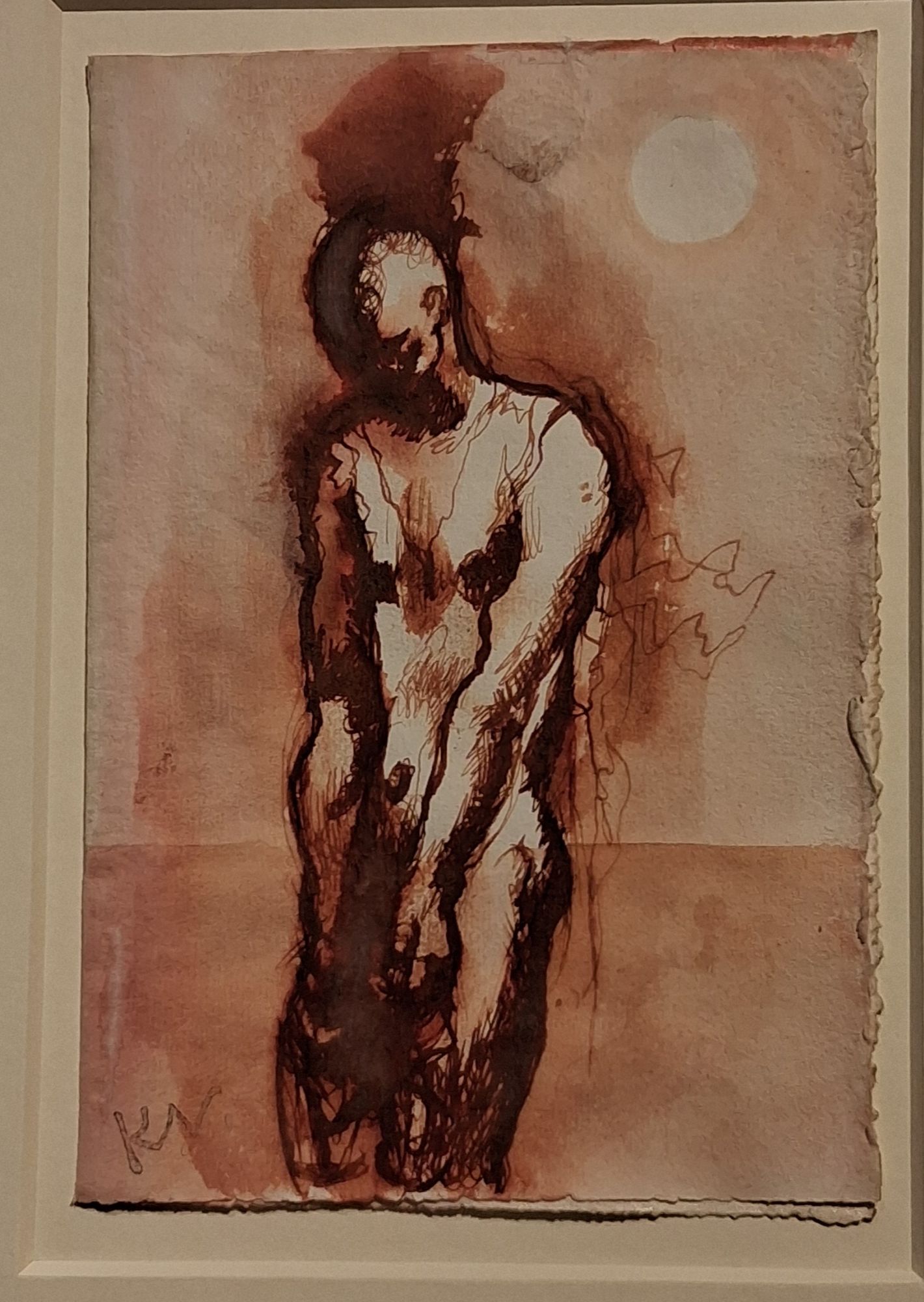
And Vaughan’s isolated men are neither confident nor just reflective. They are alienated and perhaps regressed into vulnerability beneath a waxing moonlight
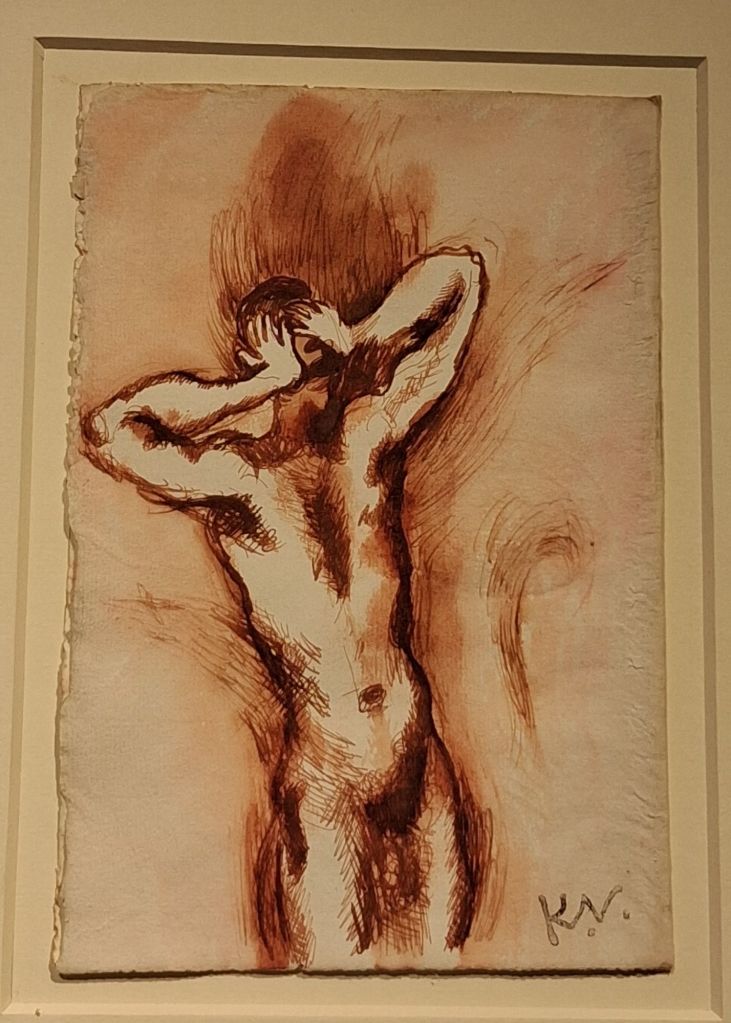
Or they are self-evidently beneath and weighed down by expectations of masculine performance in a kind of despair, weeping:
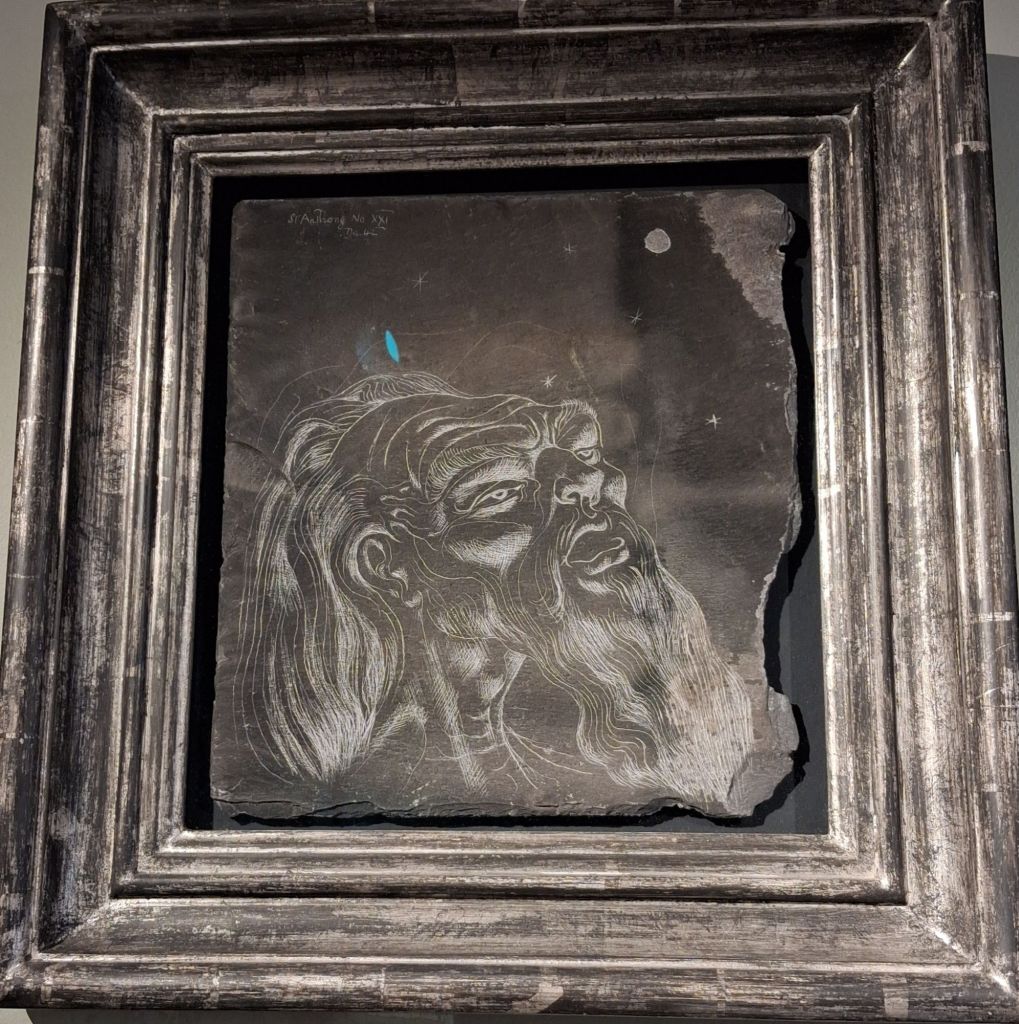
They are nearer to the tortured old man of Ayrton’s vision of himself, perhaps as Daedalus, available in this exhibition, and wtching on slate:
These are also such men as we see in tension within themselves in the Samuel Osbourne exhibition:
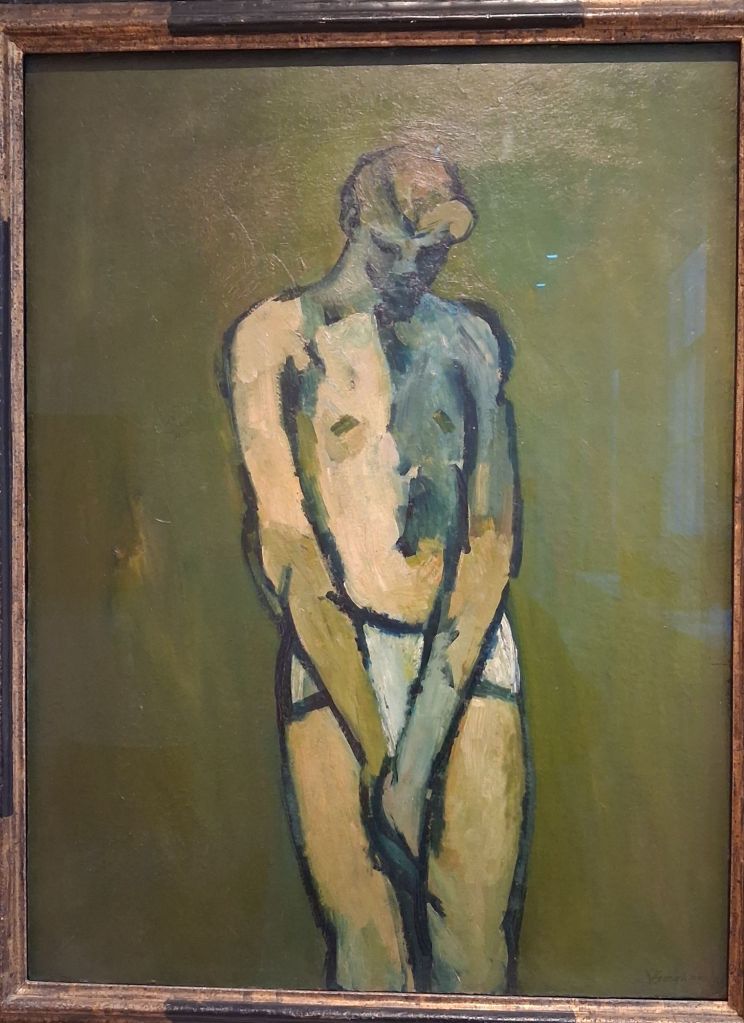
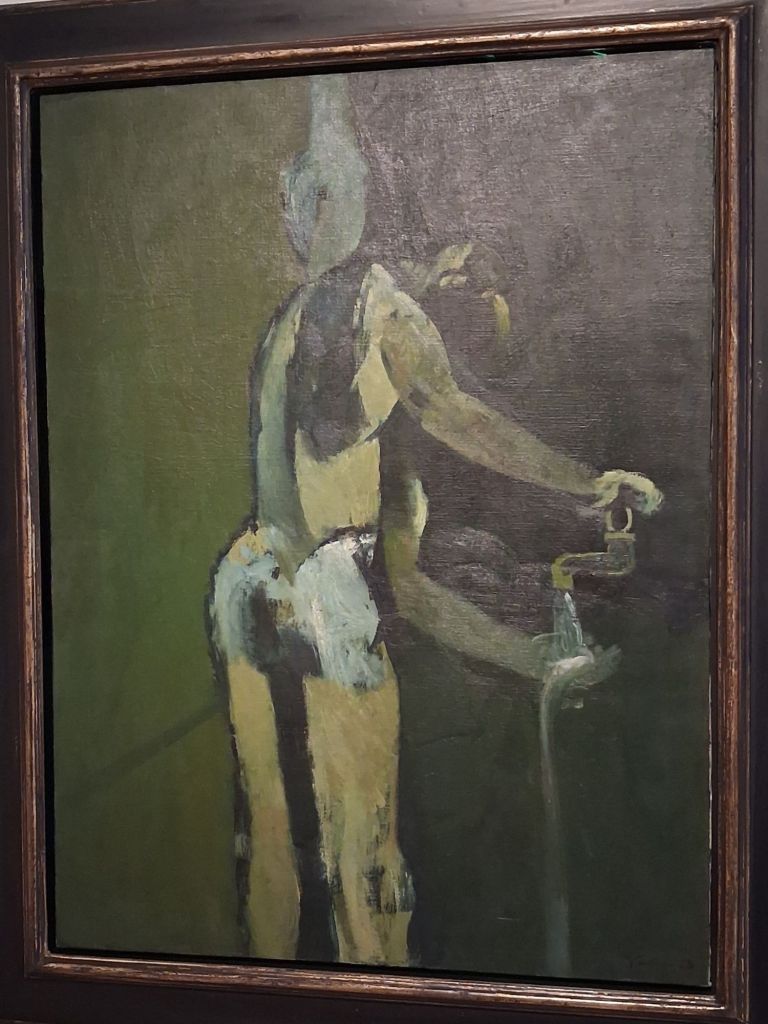
Or that tension lies instead in the representation through a painter’s marks which struggle to show what is rigid and contained, if anteriorly shadowed, against that which is fluid and uncontainable, all erupting from flesh.
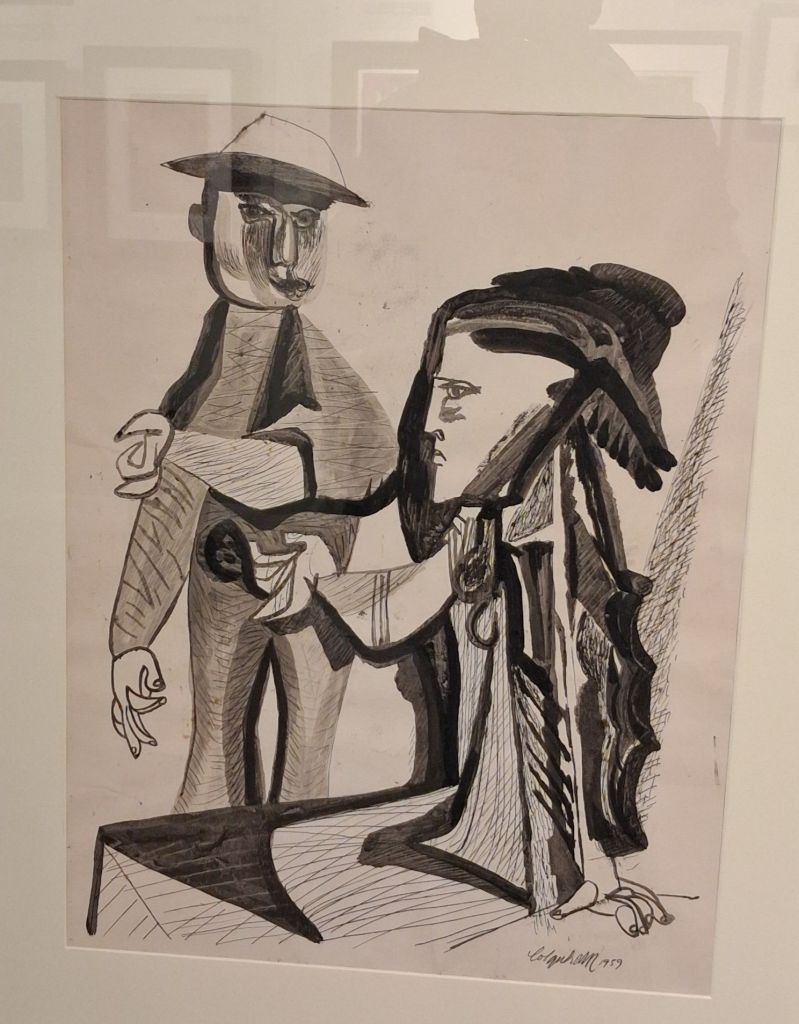
But the drawings and studies in Brooke-Walder show also show that Neo-Romanticism.had keen social concern. It stretches the Neo-Romantic label to put this drawing from Colqhoun in there, but it was a privilege to see it’s near Wyndham Lewis concern with modern types in contrast;
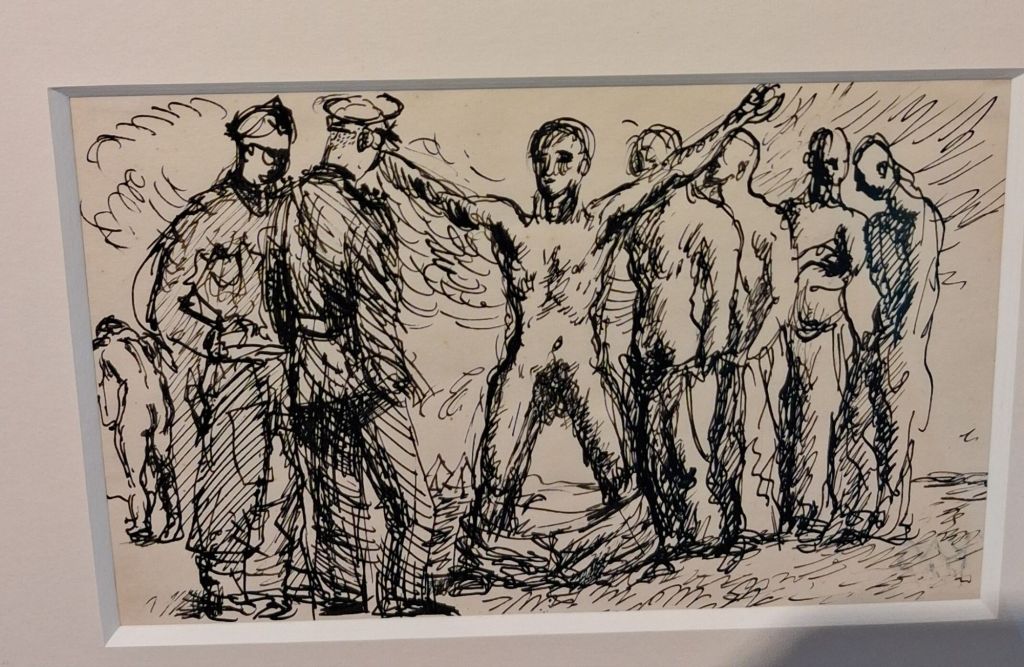
Nevertheless, this is not the joyful sense of what human communion might be, as in Vaughan’s earlier drawings from the barracks from conscientious objectors who went into home service in the 1940s:
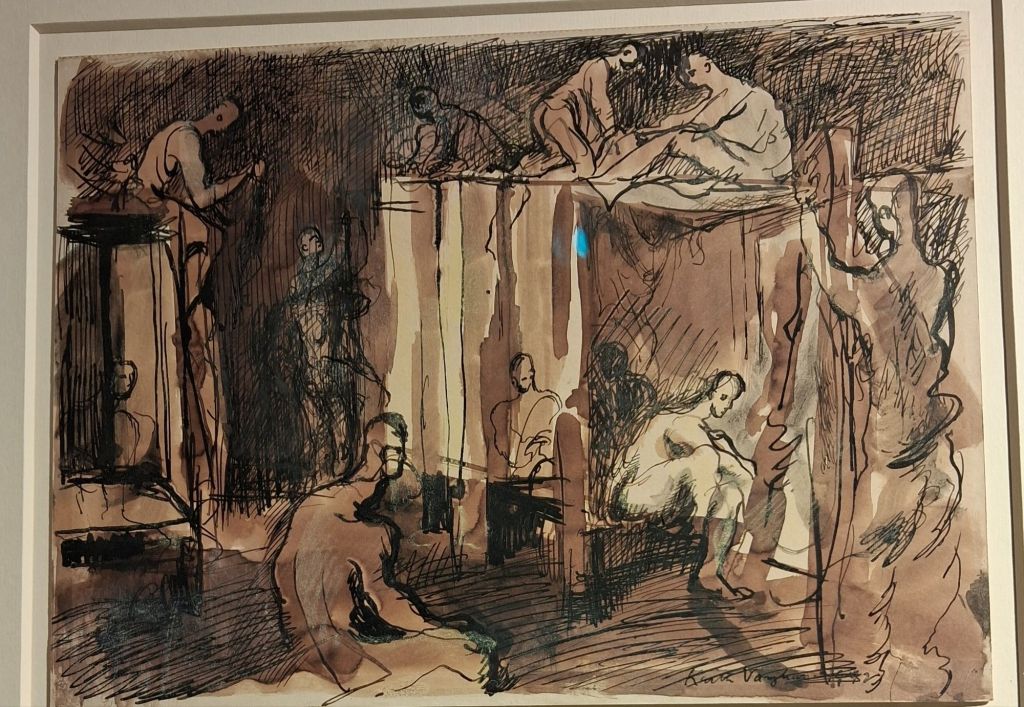
These men’s exposure, as in tbis picture of the naked inspection of them by senior officers below has such fun in it:
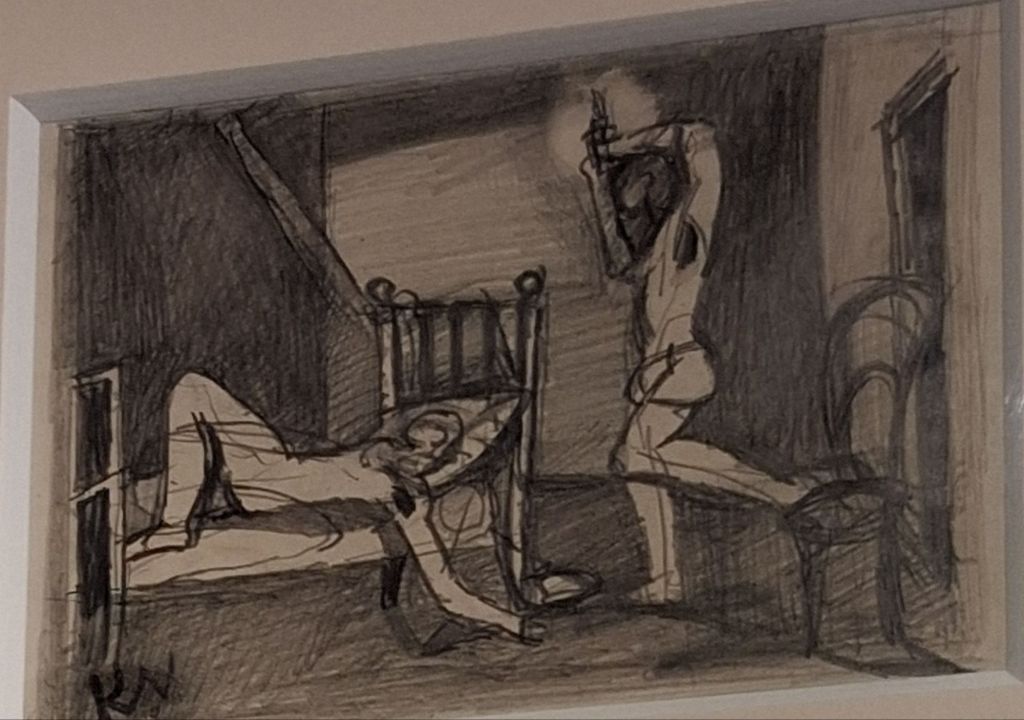
And some such men find themselves in fantasised play;
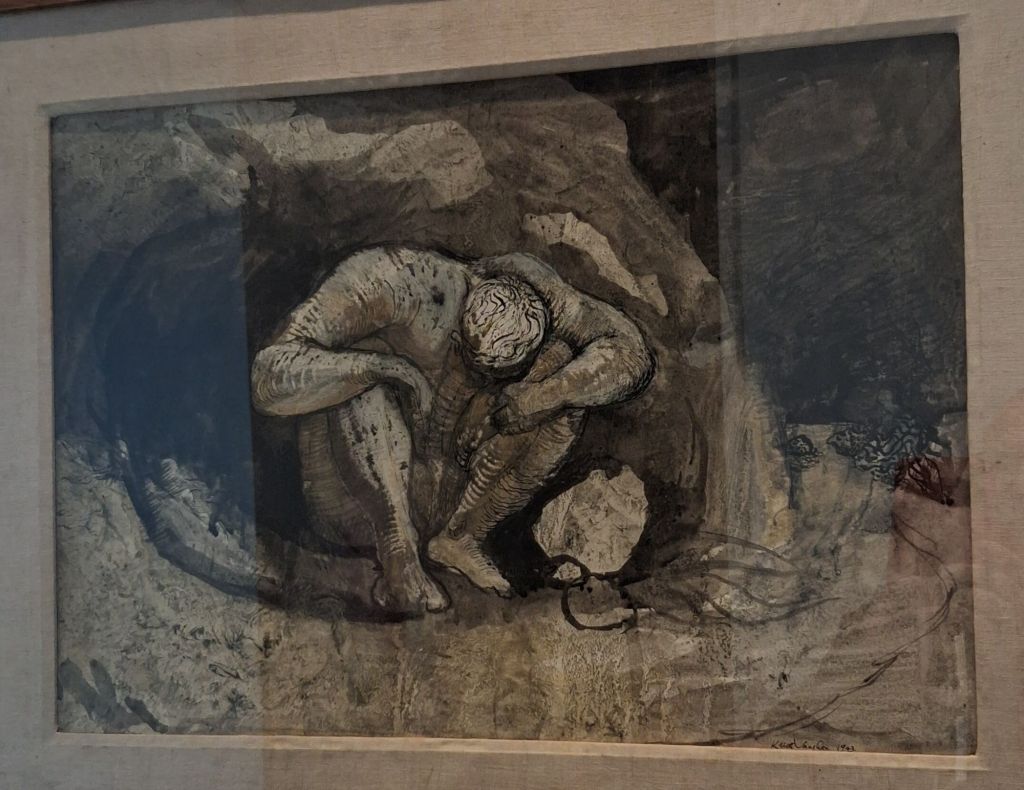
And it is coming together, ib communion or in ‘Assembly’ that was to fascinate Vaughan and source some of the tension in his mature painting that went far beyond the technical.aspects of painterly tension explored by Hastings, although I am sure he is aware of them. One early drawing in the Samuel Osbourne exhibition from the same period in the barracks was triggered by Vaughan’s sense of rejection when he fell in love with a heterosexual colleague there. It’s a very painful.picture of regression indeed, a reteat into a womb-world hole:
But the tension is rarely so isolating, as in the assemblies of only two figures. Even in the early ones there is tension between the figures and within each, existing in spaces that aren’t bridged, gesturally shown in clenched hands. Naked and exposed these men don’t look directly at each other.
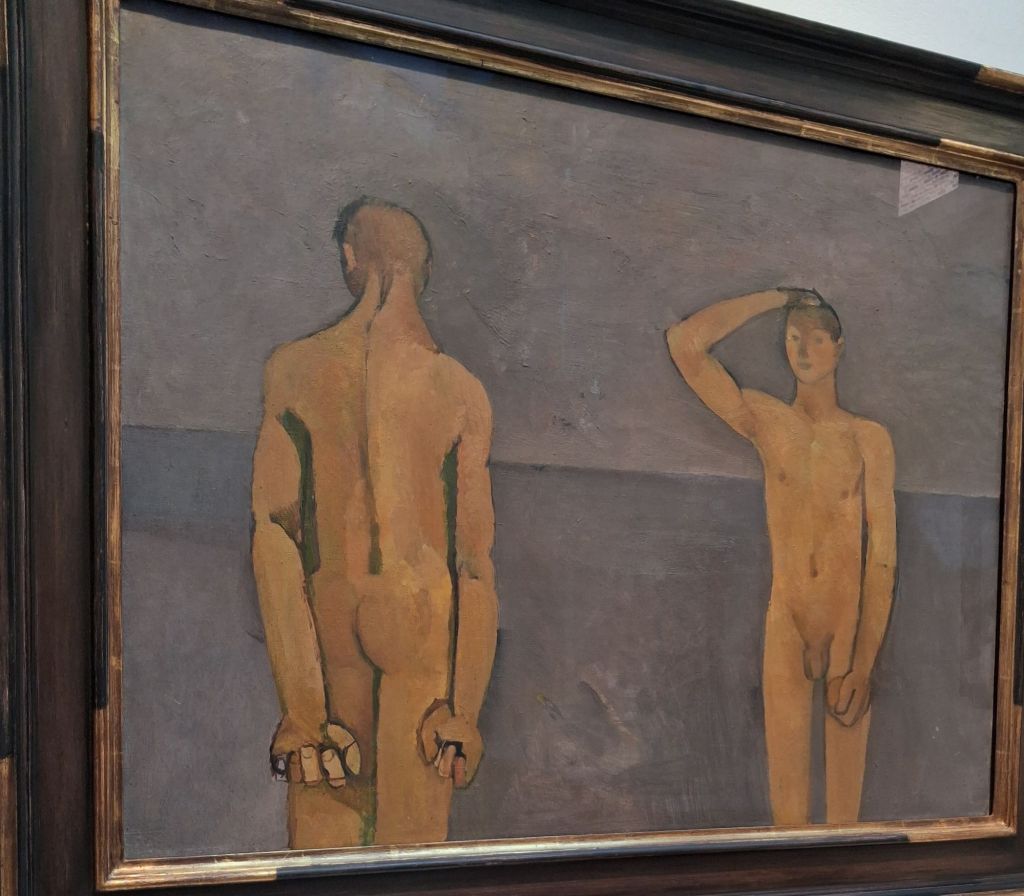
Theze twosome are not necessarily ‘distant’, but they aren’t close either. There is something in absorption, of different kinds even in this lovely coming- together.
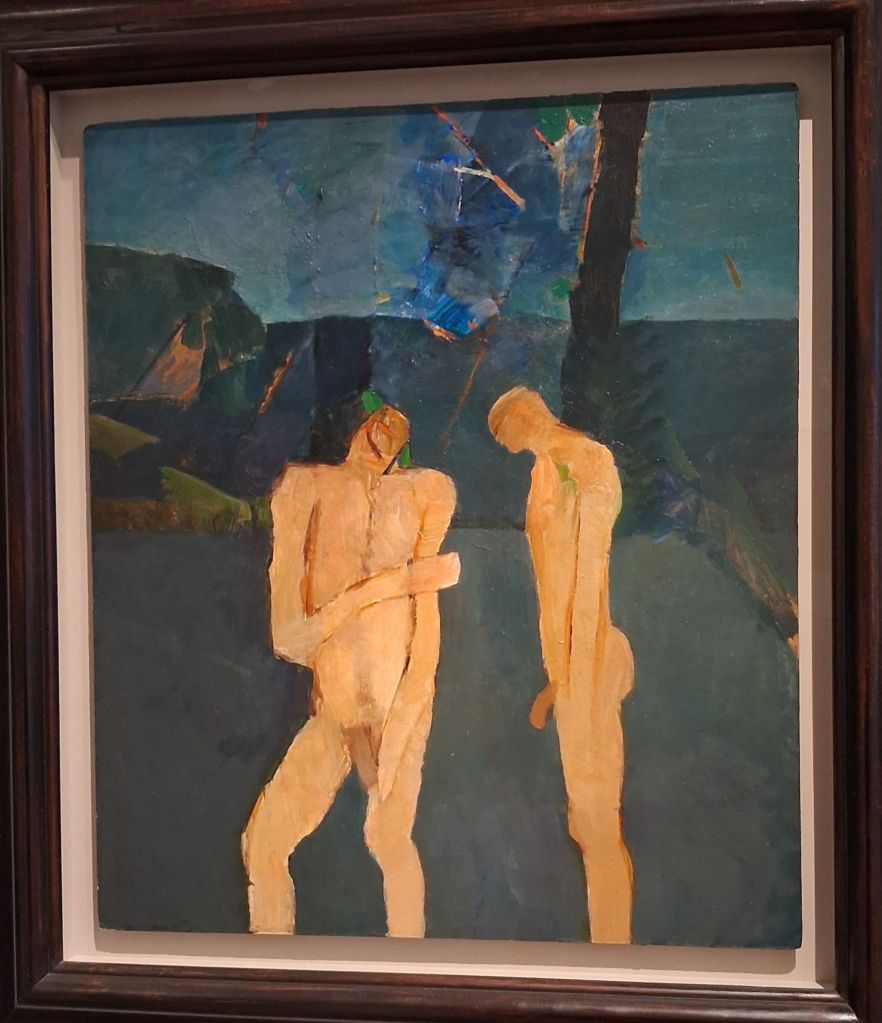
At their most abstracted the two persons can seem like parts torn from each other, whose expression is angular, even when it connects the bodies.
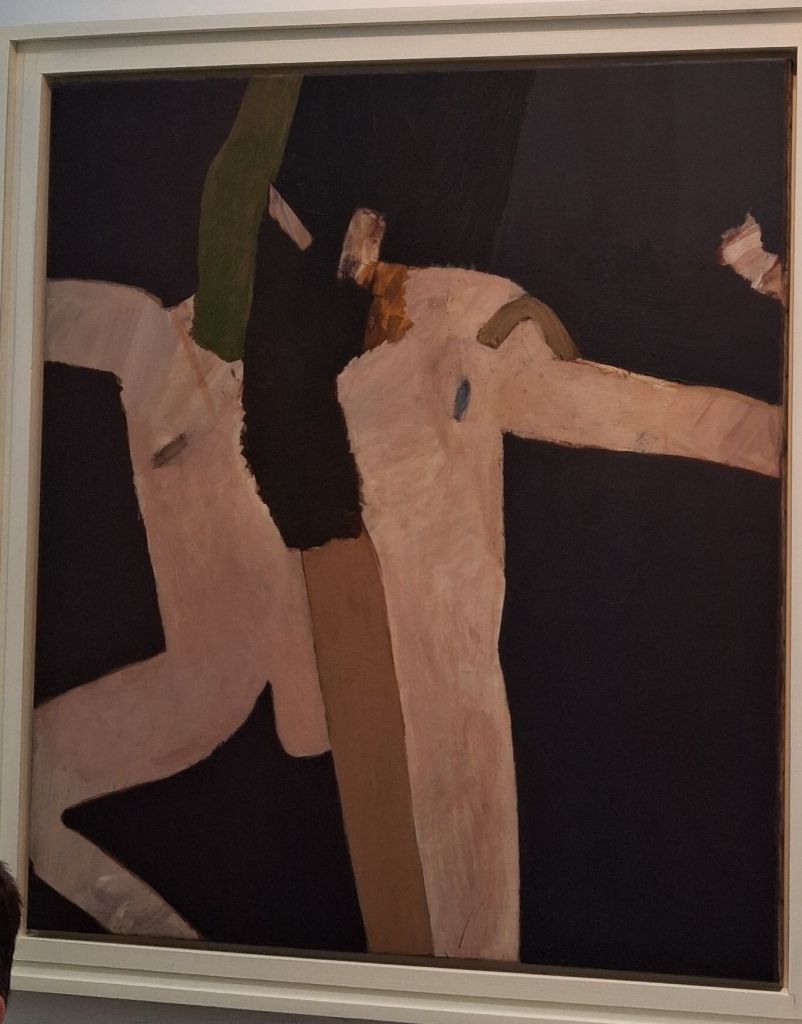
When these mature more abstract embroiled figures are multiple rather than dual, neither the separations nor mutuality in the persons of the group are clear, but, in the one below there are multiple coming together and partings implied.
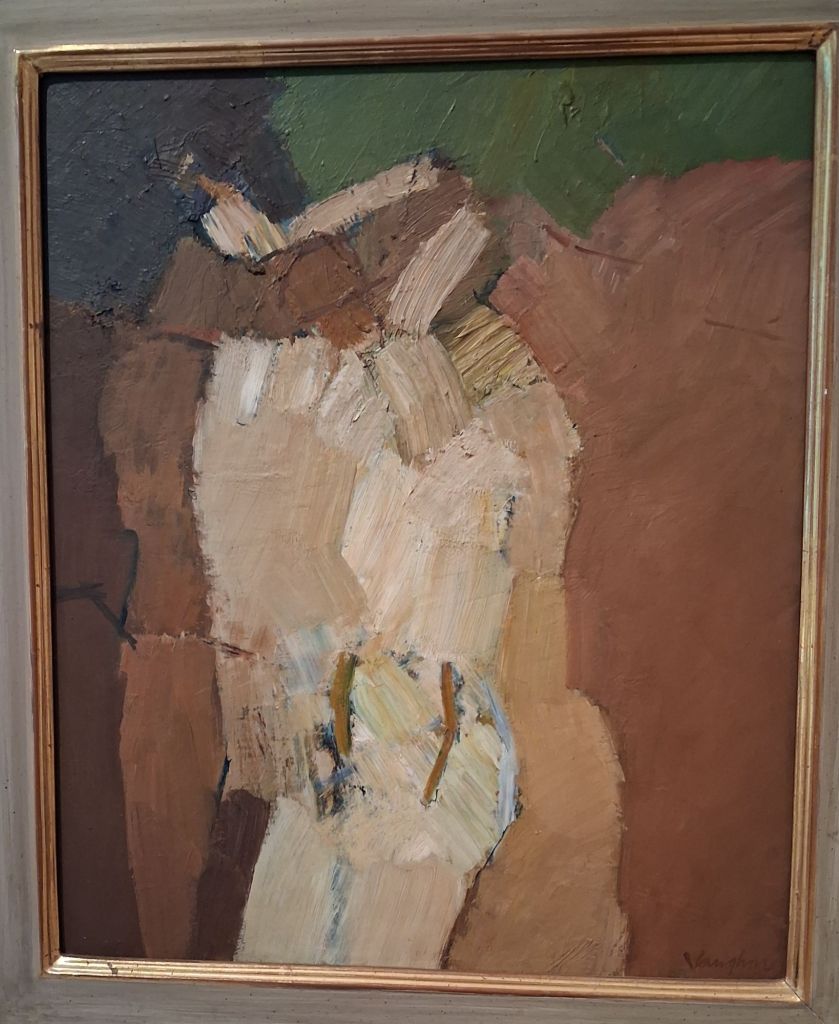
They are in other cases less viscerally together but in conflict tension; in earnest violence or in play, in tbis central beautiful exhibit at Osbourne Samuel Gallery:
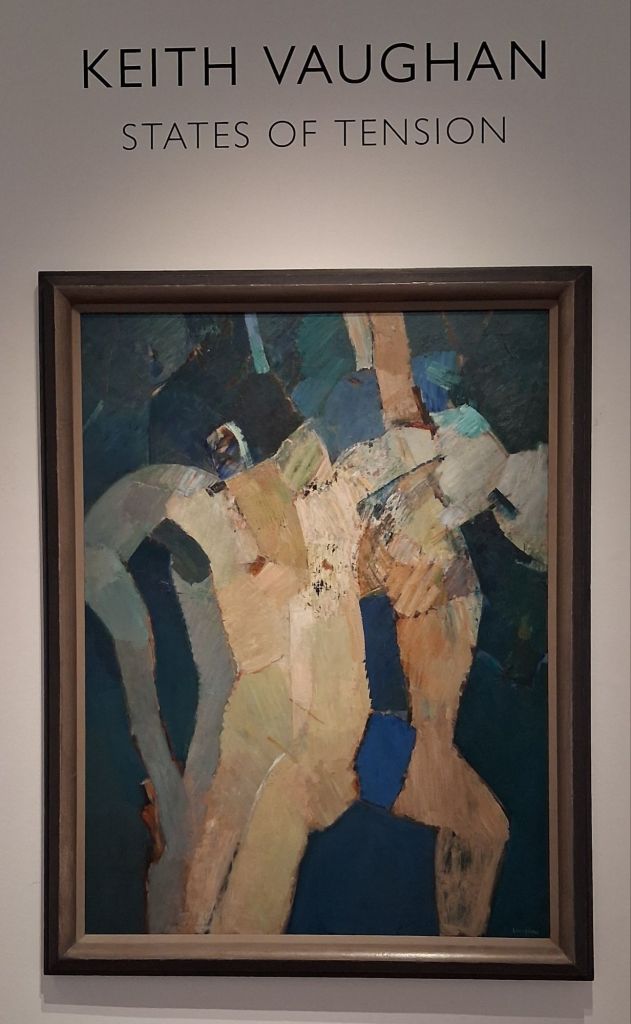
The earlier groups use other strategies for suggesting patterned overlay between figures’ bodies and their separation, as in this Arab Market, which is, to say the last a gnomic title for what we actually see, which are boundaries and their fractures and overflows.
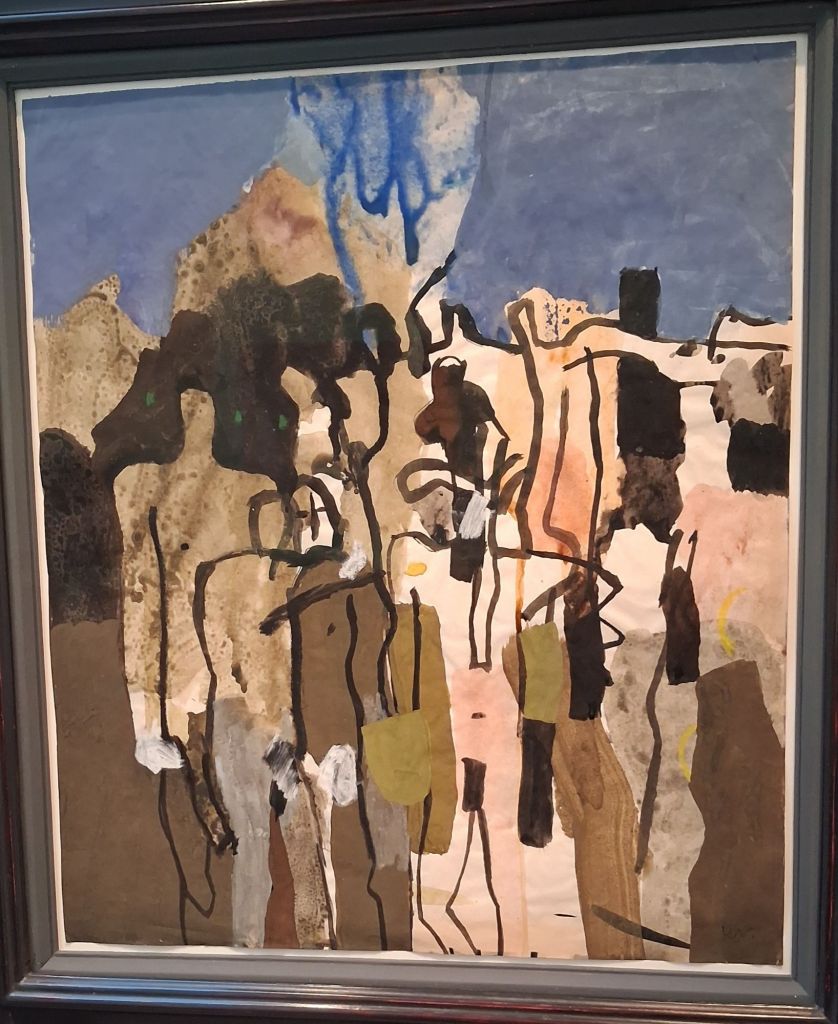
Of course we are near the Assembly pictures here, especially in this lovely beach piece, where the pattern made by figures externally is marred by the tendency of the over-expressiveness of the paint such that the background reads like something within the men’s negotiation of space with distance and partial proximity.
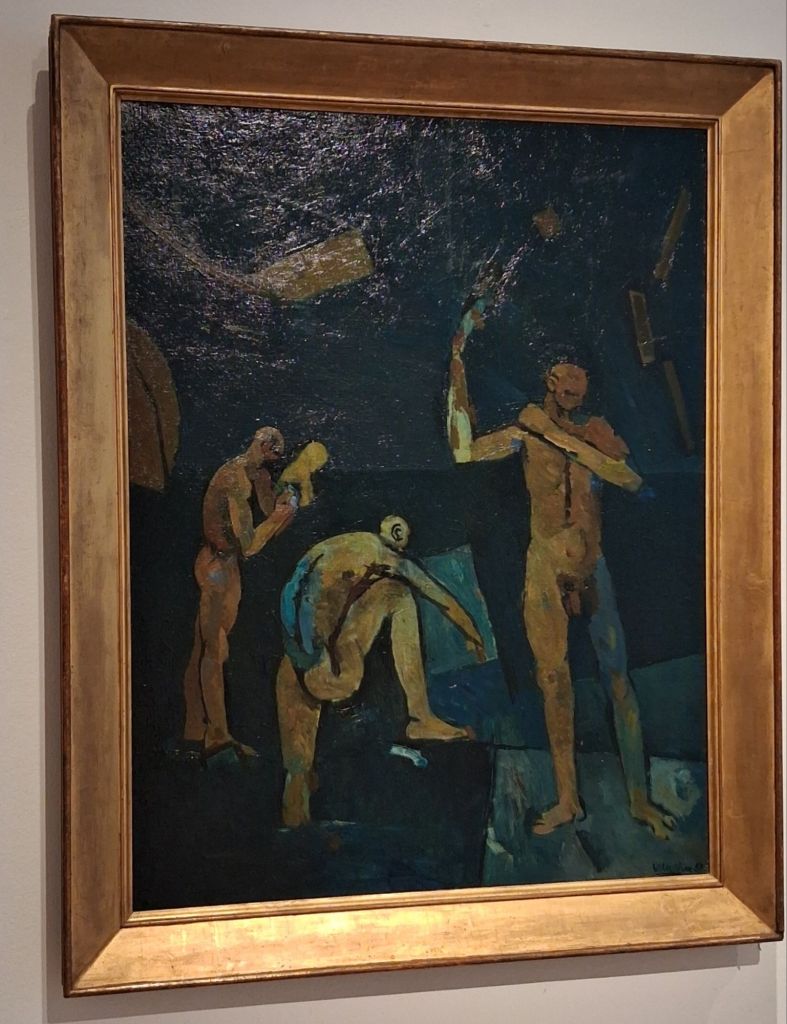
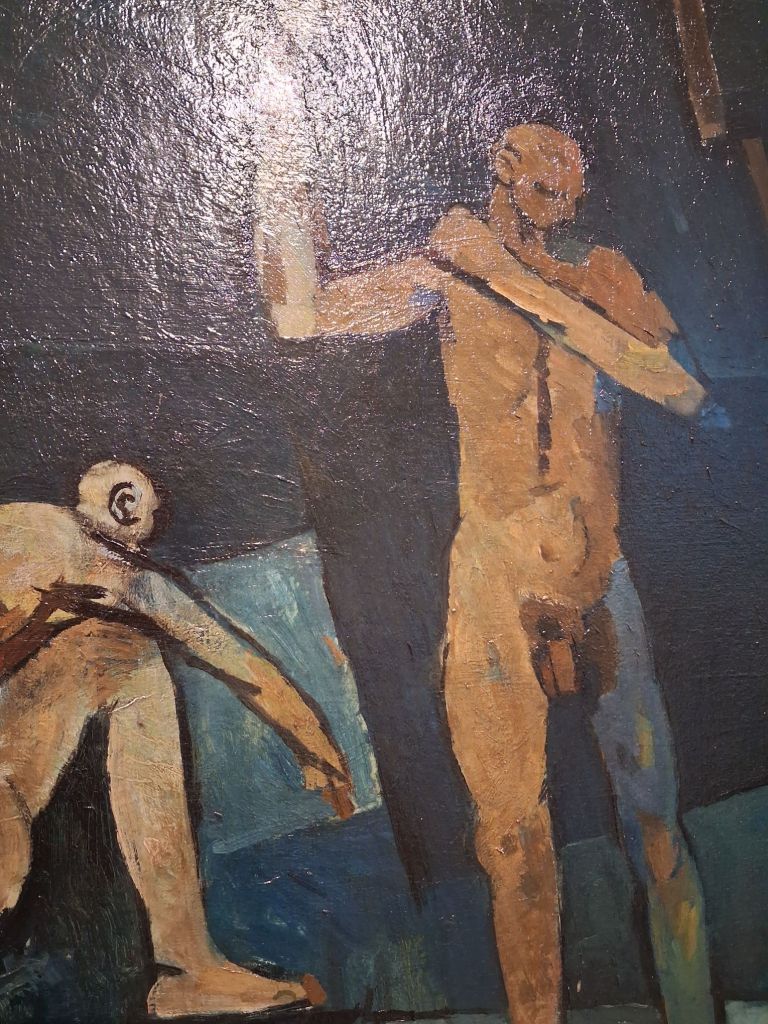
We even find it difficult to read individuald gesturally and communicative or defensive intent. Nothing is simply what it is. It all densely over-means.
I don’t intend to go further but there is more to each exhibition and to their overlaps. Please see them. The distance from Durham was no trouble for such payback. Now for Southbank and the Hayward.
With love
Steven xxxxxxxx
 Steve_Bamlett_blog