The incredible lightness of mind of the film critics and Emerald Fennell’s resumed brilliance in ‘Wuthering Heights’
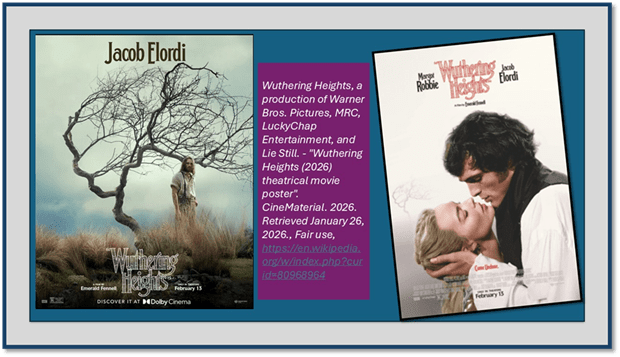
Right from the get-go, Emerald Fennell plays games with her trade-mark reputation for an excess of sexual content and with a deliberate turning of the first and only book by Emily Bronte, into a tale about childlike fascination with sex. Beyond the blank screen we hear intakes of breath and ‘orgasmic’ grunts for long enough to be surprised when we find these are the guttural sounds of a man being strangled to death in a crude nineteenth century hanging. Boys look on and point out that the corpse indeed gets a ‘stiffie’, as presumably they have been told would be the case by others. Meanwhile, a remarkably ambivalent older nun tuts at the boys but appears also to gaze at the grandeur of the ‘stiffie’ the hanged man achieves. Later Isabella Linton discusses her desire to go to a public hanging saying Catherine (now married to her brother) will like it because the person hanged will be a woman.
None of this has much to do with ‘Brontë’s English lit classic’ as everyone seems to call it. Everyone that is but Charlotte Brontë, who in her preface to the posthumous publication of the book stressed the distance of the book from the manners of the grown-up English novel, even those by herself, describing it as:
hewn in a wild workshop, with simple tools, out of homely materials. The statuary found a granite block on a solitary moor; gazing thereon, he saw how from the crag might be elicited a head, savage, swart, sinister; a form moulded with at least one element of grandeur — power.[1]
Everyone thinks Charlotte’s view of the novel is reductive, to say the least, but nevertheless correct in determining the fascination with power of every kind in the novel, and particularly in its hero, Heathcliff Earnshaw. I would guess that though Emerald Fennel insists her film, which puts the title into quotation marks for this reason, is merely a version of the novel and thus free to be selective in the story it tells. It uses great freedoms, even omitting half the book’s story that follows on the death of Cathy and follows the life of her daughter. It misses out the complicated narrative methodology, and vastly simplifies one of Emily’s narrators, Nelly Dean, changing her relation to the story’s development entirely and eradicating the primitive Methodist religion which the novel itself displaces into the growth of public discourse of medicine, property law and capitalism (the source of Heathcliff’s wealth on his return).
However, ‘power’ is still the issue in Fennell’s film, especially the oblique relationship to it of women and the classes on the margins of society – the role of Joseph (an old Methodist of simple morality in the novel, is instructive here – he becomes in the film a lusty young Yorkshire lad, his power as a young man playing out in sexual bondage games with younger working class women. Yet when these women marry tradesmen out of that class, anything Joseph has to offer them is entirely outclassed and show him entirely and utterly powerless within the only societyhe will ever know.
The hanging man who is seen as sexual titillation for the crowd is the first man reduced to powerlessness and his horniness ridiculed. At one point, someone asks what is crime was. No-one answers, at least as I remember, but even if they had we know already it would in the early nineteenth-century have been for a crime motivated by his poverty and powerlessness, for to steal a loaf of bread and be caught could be a hanging matter. However, all that is occulted in Fennell’s film as it plays self-consciously with her reputation for excessive and kinky sexual show in her films.
Emma Brockes’ ‘Diary’ in The Guardian points out, even without seeing the film, that it has been heralded into the world with ‘witheringly bad reviews’ which when they didn’t indicate poor quality (‘“astonishingly hollow” and “whimperingly tame”, … “vapid” and “awful”. … “ersatz” and “quasi-erotic”’) are replete with hints of the sticky, over-sexed and under-thought-out.[2] The Guardian also in a piece by Nadia Khomami but not amongst the paper’s reviews of the film, points out that near to the ‘stand-out star’ of the film is Martin Clunes playing Squire Earnshaw.[3] I agree. Earnshaw is the man who ‘adopts’ young Heathcliff in Liverpool, dragging him back home via the town of Haworth in which presumably the man is hanged.
The links are never made overtly, but surely they are there. Earnshaw is the dark heart of this film’s examination of male power which makes its desires and frustrations felt by brute force whilst playing for sympathy from others as deserved by a man of charity. It is possible Heathcliff is his love-child, but it is also possible that Earnshaw abuses Heathcliff sexually as well as as a punching bag, for we see him attempt to paw the older Heathcliff once Heathcliff has bought out Wuthering Heights as his own ‘home’. The manner in which financial dependency works to impoverish and brutalise, just as much as power is there too in Earnshaw, as in Fennell’s conception of Nelly Dean, for Fennell not a local young woman but the ‘bastard’ daughter of a rich man hidden into domestic service with the Earnshaw’s.
All of these elements of the film may not as well exist for some critics who have seen the film. Adrian Horton’s review in another day’s issue of The Guardian agrees with the USA reviews:
In Wuthering Heights, Fennell makes no pretense of social commentary; this is, to quote Vulture’s Alison Willmore, a work of “smooth-brained sensuality” about two messy people who won’t quit each other.
That makes for arguably Fennell’s dumbest and thus best movie, though it is no less frustrating. For lurking just beneath the film’s slippery, stylish surface is a familiar lack of interest in its female characters. Alternately haughty and horny, beseeching and cruel, Cathy is either one-dimensional victim or villain at will, a vessel of the film’s gaudy tableaus.
Horton uses the film here and elsewhere to object to Emerald Fennell’s (and with that the rest of the female characters other than Nelly Dean) lack of interest in women, and female experience or psychology, without really arguing the case in terms of the film’s motifs and symbols, even that of the doll and the doll’s house, which she adverts to twice below. In the paragraph or so I quote she seems to seek to undermine both Emerald Fennell and both of the female leads (there is no reference to dogs-leads here – Horton does enough of the women-as-dog jokes already) including unfairly Robbie’s past role in Barbie, another life-size doll :
Robbie, a mature actor in her mid-30s, plays Cathy, who is 15 on the page, as if she has just discovered sexual pleasure. Wide-eyed and petulant, naive and yet fully formed, she is an uncanny mix of woman and girl, without much history. Like, say, a life-size doll … and that’s before Cathy plays literal dollhouse in the ostentatious wealth afforded by her marriage (to Shazad Latif’s Mr Linton), a loveless, baroque fantasyland replete with lacquered floors and walls colored to her skin. Robbie’s agile performance, her sui generis emotions in extremis, cannot cover the flatness of the written character. Amid such exuberant excess, she pales.
Worst of all is Linton’s sister Isabella (Alison Oliver), a simpering, daft creature fixated on dolls and ribbons. Oliver is by far the funniest part of the movie, but there’s a sinister shade to her infantile mannerisms and obsequious devotion to Heathcliff. (Fennell, in typical blunt fashion, literalizes the book’s dom-sub valence to their relationship with a dog collar.) Isabella epitomizes the film’s strikingly dim view of its women, who are rudderless, rash and, with the exception of Nelly, hopelessly entranced by Heathcliff. Upon learning of his marriage to Isabella, Cathy pouts. “He’s mine,” she petulantly cries – not because she loves him, but because she named him as a child.
These are, indeed, childish characters, and not in definitionally petty way (though they are that, too). Literally child-ish, in that they embody the crude, totalizing emotions of adolescence. Perhaps Fennell is attempting to convey the extreme societal constrictions on 19th-century women; perhaps she is interested in how thwarted desire blunts our faculties, can turn even the sharpest of us into strange, strung-out creatures.[4]
Horton says all this without seeing it as serious about the representation of a house as a gendered expressive and containing factor in the psychology of the film – the role of the house functions as a symbol of male power and female containment, sometimes a power held without overt demonstration of itself as a thorughly gendered form of power. And she says it as if the symbolic monomaniac simplification of character we call ‘childish’ applied only to the female characters, which it quite simply DOES NOT. Heathcliff, Linton, Joseph, and Earnshaw are no more ‘rounded’ adult emotionally nuanced beings than are Cathy and Isabella. As I try to show in my blog on Saltburn (read if you wish at this link), that film is brilliant ‘though it fails the conventional tests, such as integrity of characters, plots, place and design, and even articulable and non-contradictory meanings demanded by the art of the coherent’.[5] The same is true of ‘Wuthering Heights’, not, of course, though that the novel it is ‘based’ on doesn’t also slur character into psychosocial typologies from the mid nineteenth century.
Strangely it takes professionals from wider creative background than the narrow moral tradition (increasingly biological sex centred as in the case of a small clan amongst The Guardian journalists with their TERF colourings) to see this. Take this rather intelligent view from Irina Grechko in Elle UK on the costume designer’s brilliance (for the film is all about strong creative women using their creative power, who do not need to keep shouting slogans about a victimised ‘biological sex’ and ‘knowing what a woman is’)
The costumes (… root) the clothing in Fennell’s heightened universe rather than a specific historical time frame. This results in a range of inspirations from decades after Emily Brontë’s novel takes place: Franz Xaver Winterhalter portraits; Old Hollywood stars like Vivien Leigh and Lana Turner; and the archives of McQueen, Mugler, and Chanel. These anachronisms deconstruct the destructive characters of Wuthering Heights and provide a visual roadmap that’s recognisable to anyone who’s experienced a relationship that, perhaps, drove them similarly mad. …
When Cathy ascends into a moneyed lifestyle, she undergoes a sartorial metamorphosis via montage: We see her in a series of highly stylised looks that include puffed ballgowns, oversized sleeves, and fur accessories. She begins to wear pearl earrings, crystal tiaras, and statement necklaces that appear more like cuffs and chains rather than beautiful adornments. Tiny red-tinted sunglasses look as cartoonish as Cathy feels in her new home, …
The brilliance of Durran’s work is that it doesn’t soften the story’s fashion into romantic fare, instead doubling down on the narrative’s uglier side, which — in traditional interpretations— tends to be swept under the rug: the characters’ cruelty, status hunger, humiliating downfalls, and the kind of primal longing and violent desire that turns everyone feral.[6]
What is wrong with film critics like Horton is that they so wish to be literary critics, picking holes in the now traditional feminist interpretation, hardened into dogma, to use against women, like Emerald Fennell and her costume designer, Jacqueline Durran, for the lack of orthodoxy in their undoubted critical feminist take on life. Horton’s review ends with a slap at costume design itself as an art, in favour of what she believes is a plea for ‘rounded’ character and ‘real women’:
But the problem with hinging a film on self-destructive eroticism is that it requires a self to destruct – the messy, confusing, contradictory substance of desire. Otherwise, it’s just dress-up.[7]
The idea that the self is a given is as absurd as that the role that we nominate ‘male’ and ‘female’ are givens, both driven by ideology and its fantastic exuberance in most directions, even in the construction of what we call ‘real’ selves. Film watchers have long realised that filmic art uses a different language for its expression of meaning – one that congregates (even if we stick with visual aspects alone) signs from different art contributions, which became to be called Mise-en-scène, and it is in this art of film arts that Fennell is brilliant, not least in coordinating contributions from other artists to complement her directorial vision. Wikipedia has a good-enough definition of the ‘undefinable’ term from film criticism, one so required under the newest filmic art, especially that by creative feminist artists like Fennell:
Mise-en-scène has been called film criticism‘s “grand undefined term“. Ed Sikov has attempted to define it as “the totality of expressive content within the image”.[3] It has been criticized for its focus on the dramatic design aspects rather than the plot itself, as those who utilize mise-en-scène tend to look at what is “put before the camera” rather than the story. The use of mise-en-scène is significant as it allows the director to convey messages to the viewer through what is placed in the scene, not just the scripted lines spoken and acted in the scene. Mise-en-scène allows the director to not only convey their message but also implement their aesthetic; as such, each director has their own unique mise-en-scène. Mise-en-scène refers to everything in front of the camera, including the set design, lighting, and actors, and the ultimate way that this influences how the scene comes together for the audience.
Having noted this I’d ask any viewer of the film who still reads the waspish reviews given of it, especially in the UK mainstream press, to look at particular stills which in the movie have an impression that lingers longer than even the camera on the scene, such as the one below, which shows the inhabitants of the Wuthering Heights manorial hall. From left to right are Heathcliff, Earnshaw – nearest the ‘hearth’ he commands to be lit or not – and the superior servant, who sees herself as a ‘lady’s companion’, Nelly Dean, gathered round a fire, but frozen and deadened by the absence of Cathy, who is overplaying her invalid condition at Thrushcross Grange in order to soak up the advantages of a possible marriage into the Linton family.
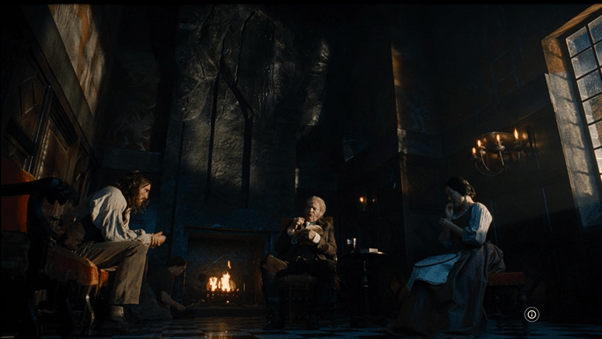
The lighting (and deliberative shadowing), set design, the proxemics of character placements, emphasise the power of mise-en-scène to create metamorphic suggestions of space and time – the shadow of a mock-Victorian Gothic arch on the wall over the fire mantle suggesting a large church or cathedral, the energy of the roughly-clad and hairy (like the wolf he is sometimes suggested to be) Heathcliff, suggesting the oncoming pounce of something like a malign supernatural ‘animal’ or infernal force, akin to the fire, confined in the light shed upon him, and not yet daring to spring out of it. The other characters seem to audit his nervous stillness, one a power-hungry patriarch, expecting an uplift from his daughter’s shifty move to gain upward mobility into modern capital rather than the declining power of himself as a landowner only. All these are mise-en-scène effects. And see these too in the portrayal of Catherine’s elevation below:
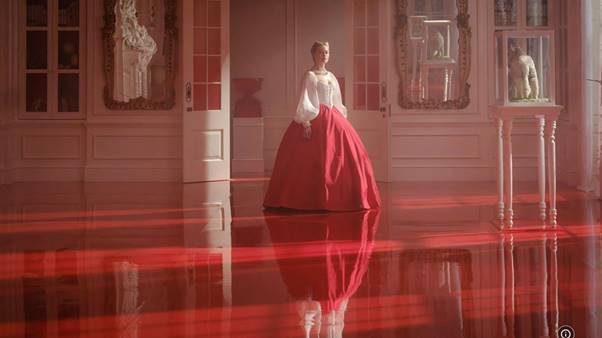
Whilst illustrating Grechko’s points about Durran’s costume design, the costume has become part of the mise-en-scène that demands a reflective floor that doubles the image of Catherine; one of them being inverted below her. The floor is as vermilion as Catherine’s bell skirt, contrasting the floor with the white walls, just as the skirt contrasts with the white top with puff sleeves, except that light fades, shades and multi-tones the environmental colours. Framed classical figures, even if don’t make them out – and, if you do, they will prove semantically significant – form a recessive image in mirrors of a framed white male torso.
At other times recessive imagery is beautifully complex, as in the scene below of the Linton dining room after the Linton-Earnshaw marriage, Cathy at the back near to a doll’s house that resembles the architecture of Thrushcross Grange and when opened out contains dolls like the characters, even mirroring in little the mise-en-scène of the room in which the whole illusion stands. The room has late eighteenth-century Baroque elegance, as does the set dining table, but the effect of artifice is also an effect of infinitely regressive containment of women and domestic waiters who ‘only stand and wait’ on the whim of the domestic master of the house, as true in monied facades as the rude hall of Wuthering Heights, the latter though now rapidly becoming worthless anyway in these late days.
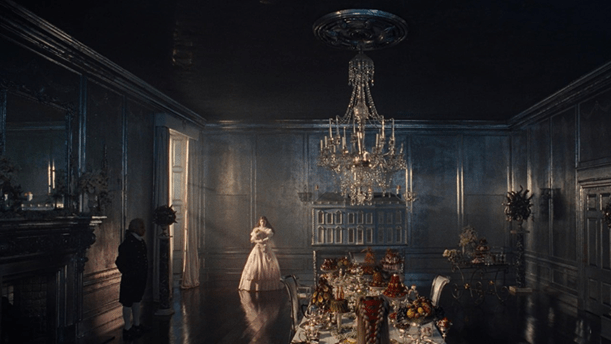
In these rooms not only waiters and footmen wait, but huddled families do the same, sensing that something fearsome threatens the security of their inner space, giving new meaning to its bright blood-red stained floors, as if it contained a deep pool of the passion drained from its walls that are like some ‘whited sepulchre’, but contained and imprisoned inside it where the dead and undead lie.
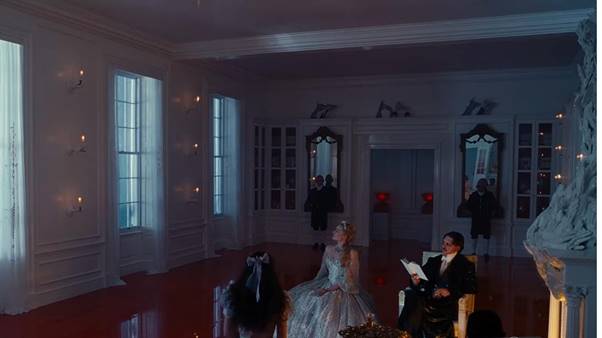
And let’s take the point that Horton turns into a deficiency in Emerald Fennell; her use of images, like dolls and dolls houses, just as Ibsen did (see my blog on his The Doll’s House at this link). Horton makes a double point. The excessiveness of the home interiors at Thrushcross Grange ‘pales’ Cathy’s skin, she being used to the wildness and freshness of external air, but Horton also (wickedly) wants us to believe that the excess of the film’s mise-en-scène, not that she uses the term nor wants to understand why she should, shows how ‘pallid’ and bloodless an actor Robbie is. I disagree and that is because the theme of the dolls house is not as vapid as Horton says when asking us to think in the section of her review cited above that:
Perhaps Fennell is attempting to convey the extreme societal constrictions on 19th-century women; perhaps she is interested in how thwarted desire blunts our faculties, can turn even the sharpest of us into strange, strung-out creatures.
Personally, I do not believe that there is any ‘perhaps’ in there at all. Fennell is not creating a period film at all. Look at the still below from the scene where Isabella gifts to Cathy a doll dressed, coiffed, and ‘made-up’ (in more than one sense of the term) exactly as she currently is so that, when placed inside the replica room in the replica dolls’ house, she will be placed exactly as the model is in the present moment, whatever fantastic time-space that should be. Nothing can speak of metaphor more clearly than this scene, where meaning is found in environmental context, not just the history of women’s struggle for freedom.
The point is obviously about ‘likeness’ and mimesis- about how the copy of models becomes a strategy for human containment for women – but not just in the nineteenth century. It is not that women are infantilised in the film but that the typing of women as ‘decorative’ playthings is still as urgent an issue now as it was for Mary Wollstonecraft, who quoted one of the worst of perceptions of Jean-Jacques Rousseau about sex/gender as being this:
“Children of both sexes have a great many amusements in common; and so they ought; have they not also many such when they are grown up? Each sex has also its peculiar taste to distinguish in this particular. Boys love sports of noise and activity; to beat the drum, to whip the top, and to drag about their little carts: girls, on the other hand, are fonder of things of show and ornament; such as mirrors, trinkets, and dolls; the doll is the peculiar amusement of the females; from whence we see their taste plainly adapted to their destination. The physical part of the art of pleasing lies in dress; and this is all which children are capacitated to cultivate of that art.”[8]
The Brontë sisters, and rufty-tufty Bronwell, who with his sisters wove stories around doll-figures, as a whole, would have been in dismay at the sage Rousseau for that sentiment, as much as Wollstonecraft was. To render the feminine as that suited to interiors because you believe their biological natures and role make them ‘plainly adapted to their destination’, is precisely the point Emerald Fennell resurrects, and through the anachronism used in their means of conveyance, makes us aware that time and space changes nothing without the deconstruction of supposed verities like biological sex.
Isabella, in tones of pink, faces Cathy in this still. We see only the braided plait interlaced with scarlet ribbon, exactly like the doll that is being gifted to Cathy by Isabella, in front of the facia of a masterly house in which they both will imprison it and themselves for ‘security’. This is not because Fennell infantilises the characters, though in Isabella’s case she is the supreme infant, but because we must read the scene symbolically, allowing it to sink in deeply, through the mirror it holds up to the moulding of the vulnerable subject, wherein precisely it is their vulnerability that is moulded, as well as their desire, caught up in images of incarceration and bondage.
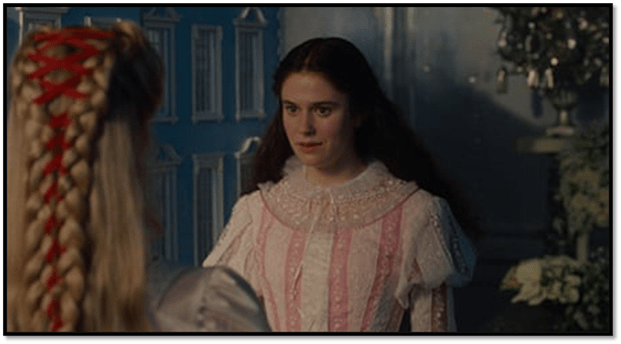
In the stills we have already seen, the meanings that matter speak through the total arrangement and conception of what we see as it passes before our eyes and links up with our thoughts and feelings. We see ideas that, having been echoed in Fennell’s mind’s eye, are then seen by us as constructions of which, in making sense of them, we find fragments of past cultures speaking of how things like pain, pleasure, innocence, experience and power are constituted in configurations of a world where acts of love and hate mix together in the performance of almost indistinguishable cruelty and kindness. All these behaviours play out upon the other in over-charged interactions, that we equate with that ambivalent thing we call passion and suffering.
In one scene, for instance, in a garden, Fragonard’s famous painting of The Swing is recalled. This garden, with its images of whited flowers and walls is equally where Cathy and Isabella come to blame each other for their failure in having come to terms with the realities of coming to see that men hold all the cards in society (and own all the houses in which they play them).
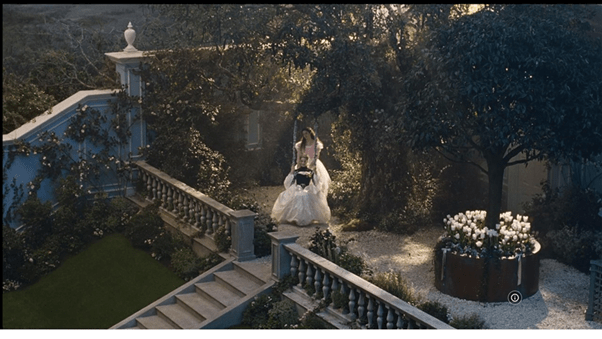
Even landscapes are suffused with symptoms of the psychologically unprocessed. The film’s setting is seen as entirely imaginary from the start when we see from a distance the setting of the house known as Wuthering Heights:
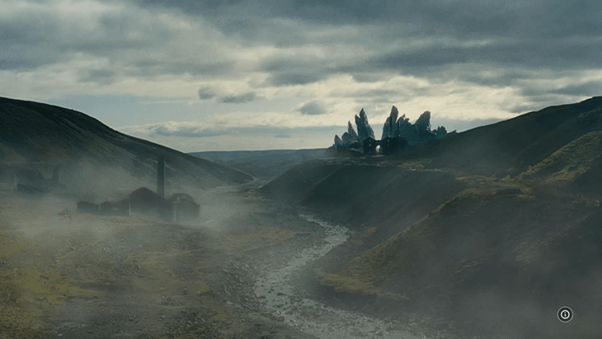
That landscape does not, by the way, remind me of the moors near Haworth but of those in the Northern Pennines, the lower building looking much like a lead mine, as the beck winding round it seems like the Tees or Wear near its source. Wuthering Heights is imagined as crowned with crags but crags of great artifice, clearly an AI addition.
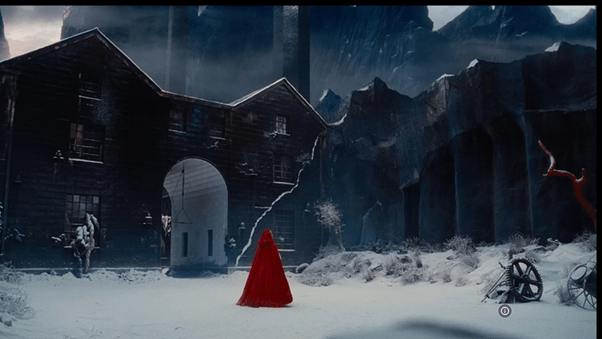
When Cathy visits her father in his financial ruin later, the setting of the home is a metaphor for the instability of human habitation of the earth or work on mineral nature, which is deliberately presented as a place vulnerable to the natural world (scarred by human damage) around it. Cathy in red appears no doubt to some as it does to me as a reminder of Red Riding Hood’s approach to the home of her grand-family that has become the lair too of a wolf. The layering of snow on the crags runs like a crack, a flaw, through the scene, reminding us that ‘home’ is a place of danger for women, not necessarily a place of security. The gantry from which we saw a pig’s carcass hanging earlier in the film, its screams during its slaughter still in our head, still hangs over the whited portal to the courtyard of the Earnshaw ‘house’, a house of pain indeed.
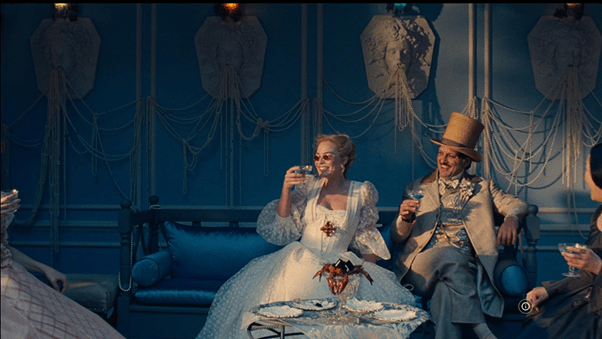
But likewise the artifice of wealth is also rendered symbolic of pain and cruelty. The scene everyone remembers must be the Linton part in which Cathy has donned red-tinted glasses, perhaps to see as rosy, through such tinted glasses, what we see as cold and glacial. Sitting above a glass containing what looks like some freshly boiled-to-death crustacean in pink, like Cathy’s brooch – her dress and teeth glint in artificial white but are linked by this to the light shed on the face of a Medusa on the wall between the Lintons, vomiting pearls that also look like chains of bondage: pain and pleasure touch just as do cruelty that severs heads and teeth that smile upon the scene.
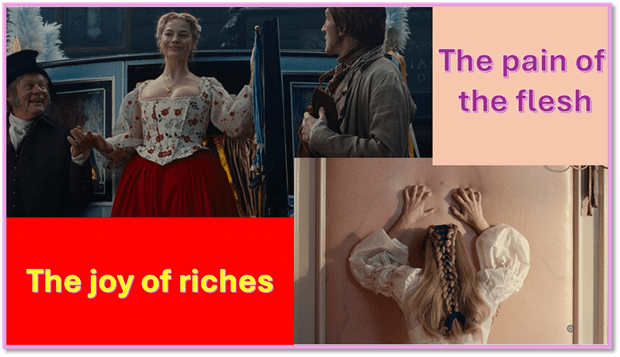
That riches are the same thing as possessiveness and cruelty is the lesson of Emily’s novel too – but Fennell makes it the sole focus of her film, which is less about sex than informed ownership of what gives pleasure and feels as love, not without pain – for pain is not the binary opposite of pleasure, but only with pain to which we consent, with the capacity to know how to consent. Isabella does not have that capacity but her fate is to become the illustration of how power intrudes into determining how we decide what pleasured us or merely pains us. How Linton decorates Cathy with riches is one thing. How he turns her bedroom in the soft materials coloured (and veined) to exactly match her skin colour is another. She becomes trapped in the objectification of her flesh, only able to claw at its outer perfection.
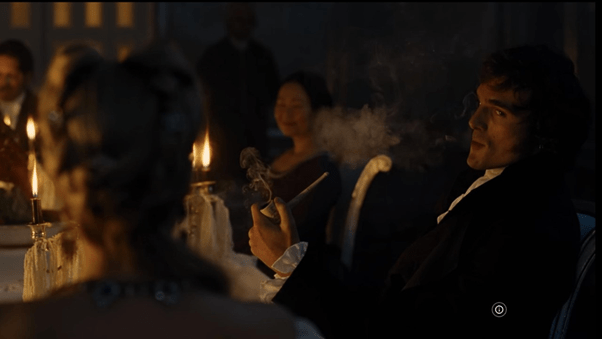
The treatment of Heathcliff and his wonderful embodiment by Jacob Elordi is part of all this. As we reflect on the film, we would like to pick out the sheer misogyny of the male pleasures he performs in mastery, such as when invited to dinner at Thrushcross Grange, now clean shaven, smart, and, definitively cocky, as a rich entrepreneur. He smokes as if advertising the pleasure of it and to show the power of his gaze in eliciting desire and contests over the ownership of that desire.
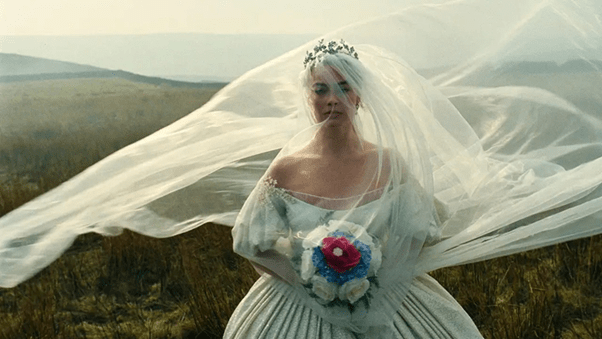
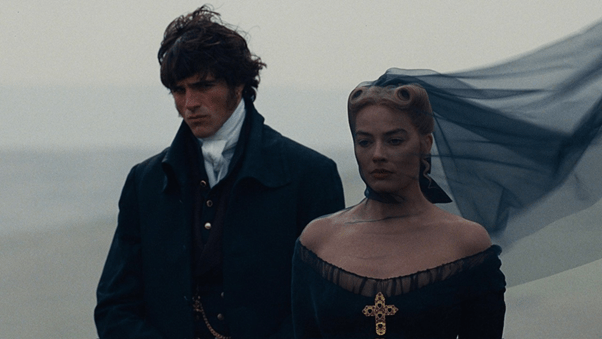
A lot of the meaning of this film is evoked through the swirl of matter as an element of mise-en-scène. It is in the mist that obscures, the rain that drenches, the wind that lifts and spreads matter. Much of the visible weather of the film obscures persons lost in it and make them appear as if characters in a story told in their own preparatory memories.
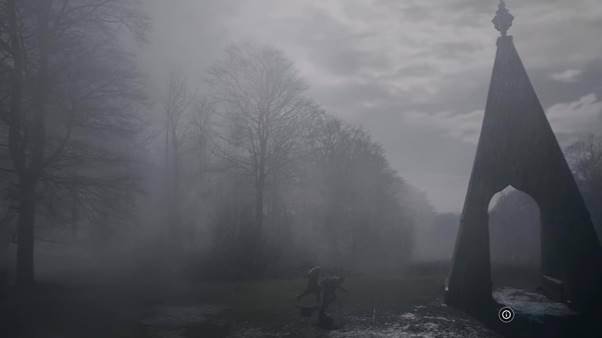
Symbols of life or death are carried in wind, as in the manner in which a wedding or a mourning veil manifests the motion of wind continuing despite our attempts to hold it still in symbols. Cathy preparing for a rich wedding that she determines will not incarcerate her, or manifesting adulterous love at the funeral of her father by sly holding of hands behind her back, are all made apparent in the ability of the wind to disperse and transform those veils into passing manifestations of a weather that persists in moving on.
You will gather that I do like this film and do not need to see it in terms of the novel, Wuthering Heights. That novel contains its own level of fantasy in a sterner grip of the social changes that were passing through lives and communities in nineteenth century Yorkshire, but a film is a film. Critics of this film have wasted much time refusing to see it in its own’s terms and displacing it with some loyalty to their knowledge of the novel, as if that great novel were a vulnerable thing, which it is not.
Apparently the staff of the Brontë Parsonage Museum at Haworth don’t even bother to make the comparison and variously insist that it must be seen in its own terms not that of how someone evaluates a novel bigger than all of us. Even Emily’s biographer, Dr Claire Callaghan, found the way the film follows its own groove using its own methods (mise-en-scène more than anything else) ‘refreshing’. Ruth, the’ visitor experience’ officer at Haworth Parsonage says the best things of all in my view: that the film bears witness to ‘some essential truths to the book and the relationship of Cathy and Heathcliff’, with more emphasis on the machinery of human cruelty than in past more romanticised versions.[9]
Don’t be put off by the critics. Mainly they apply an incredible lightness of mind to the film, easily blown away by the winds and storms of this film so much in honour of the film-maker’s art. Do see it.
With love
Steven xxxxxxx
[1] The Preface is available in full at this webpage: Charlotte Brontë’s Preface to Wuthering Heights by Emily Brontë, https://www.literaryladiesguide.com/literary-musings/charlotte-brontes-preface-to-wuthering-heights-by-emily-bronte/
[2] Emma Brockes (2026: 29) ‘Diary’ in The Guardian Saturday 14th February 2026: 29
[3] Nadia Komami (2026: 25) ‘Stand-out star of Wuthering Heights?’ in The Guardian Saturday 14th February 2026: 25
[4] Adrian Horton (2026) ‘Emerald Fennell’s Wuthering Heights is big movie with a very small mind’ in The Guardian (Mon 16 Feb 2026 11.11 GMT) available at: https://www.theguardian.com/film/2026/feb/16/emerald-fennell-wuthering-heights-review?CMP=share_btn_url
[5] Why is ‘Saltburn’ such a brilliant film, though it fails the conventional tests, such as integrity of characters, plots, place and design, and even articulable and non-contradictory meanings demanded by the art of the coherent? – Steve_Bamlett_blog at https://livesteven.com/2024/01/09/why-is-saltburn-such-a-brilliant-film-though-it-fails-the-conventional-tests-such-as-integrity-of-characters-plots-place-and-design-and-even-articulable-and-non-contradictory-meanings-demande/
[6] Irina Grechko (2026)’The ‘Wuthering Heights’ costumes aren’t historically accurate. That’s what makes them so good’ in Elle UK (17/2/2020 Online) Available at: https://www.msn.com/en-gb/lifestyle/lifestylegeneral/the-wuthering-heights-costumes-aren-t-historically-accurate-that-s-what-makes-them-so-good/ar-AA1WrKEl?ocid=msedgdhp&pc=U531&cvid=69958bb2d55a4a5fa5af438b5142b1eb&ei=16
[7] Adrian Horton, op.cit.
[8] Chapter 5 of The Vindication of the Rights of Women available at: A Vindication of the Rights of Woman – Ch 5, https://www.marxists.org/reference/archive/wollstonecraft-mary/1792/vindication-rights-woman/ch05.htm
[9] All cited by Catherine Shoard (2026: 25) ‘”Is it for purists? No. Is it good? Yes!” Fennell hits the spot in Brontë Country’ in The Guardian Saturday 14th February 2026: 25
 Steve_Bamlett_blog