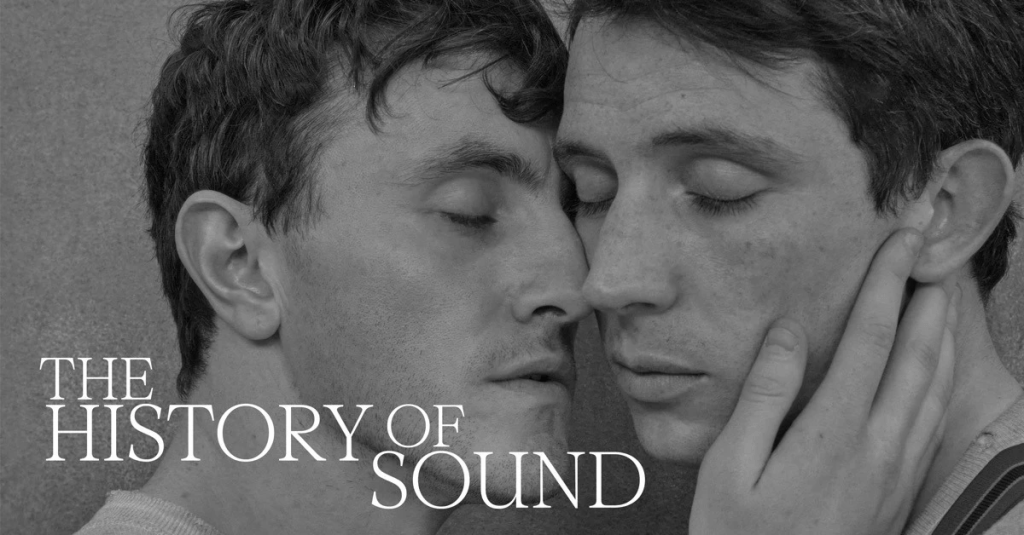
I saw the new Oliver Hermanus film today, The History of Sound, with Geoff and dear friend Catherine. before going I had make the terrible mistake of seeing some of the reviews of the film, all it seems by people hardly equipped to speak of film as art, for this is precisely what this film is, art of a very high order that cannot be made to fit the thin generic categories used in these voiews to describe. It is structured more like a symphony than a simple narrative, around arrivals and departures, invitations to stay and linger in a specific section or move on to another expected other. We see many people from the back leaving or walking a road, its structure is, in more than analogy, a series of ‘movements’ towards or away from something – mothers, lovers, wives or over-determined story-lines. Apparently from the first a story about how two lovers meet in a smoky male drinking house in New England where we, like Lionel see David from behind at the piano, playing country-music that Lionel never thought could be heard anywhere near the Musical Conservatory both students attend.
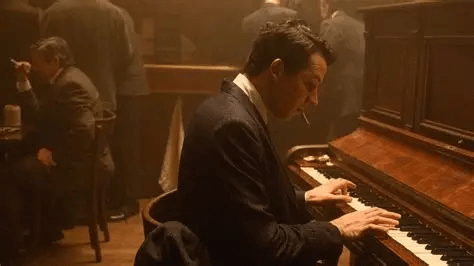
That kind of story-line gets made heavily ironic by the end of the film and we learn of the backstory of David White (Josh O’Connor), a backstory that rather reinterprets the meeting of David by Lionel Worthing (Paul Mescal).And that scene, like many others is covered with haze. We think the haze is supplied by looking at the men through the medium of romantic sensibility – but it turns out to the cigarette smoke, in a film full of people who smoke cigarettes heavily.

Hermanus apparently, says Sophie Monks Kauffman in The Independent asserted with regard to his film ‘the importance of queer films not being weighed down by shame’. Kauffman seems to take on board this idea as a reason for her, and everyone else waiting for a ‘gay love story’ to express massive disappointment. She says, with the usual air of hot gossip thought to be pertinent to major film releases:
An understandable level of buzz followed the news that two of our hottest young actors, Paul Mescal and Josh O’Connor, were starring in gay love story. But anyone pulling up in the hope of a passionate epic will experience severe anticlimax. The History of Sound is not a continuous relationship drama but about a brief encounter that colours a life, and it is not characterised by the powers of its leading men – who have both delivered stronger performances in better films. It is another slight, sentimental film by the man who made the Bill Nighty vehicle Living. [1]
Of course, perhaps there is room for disappointment. Anyone seeing the censors description of the appearance of a scene of ‘brief full sex’ will have wondered why when they find that the sex between the two main male characters has to be imagined from the post-coital morning scenes of half-draped bodies alone in bed and understand only when we see the real sex scene which is between Lionel and his English wife at her mother’s country-house. The men are seen more often in their walks together in city and country, wherein David always seems to have the lead role, even in inviting Lionel home with him on the first night of their meeting, guiding him to his flat and thence to bed after squirting water from his mouth into Lionel’s, an unmistakable imposition of closeness of parts.
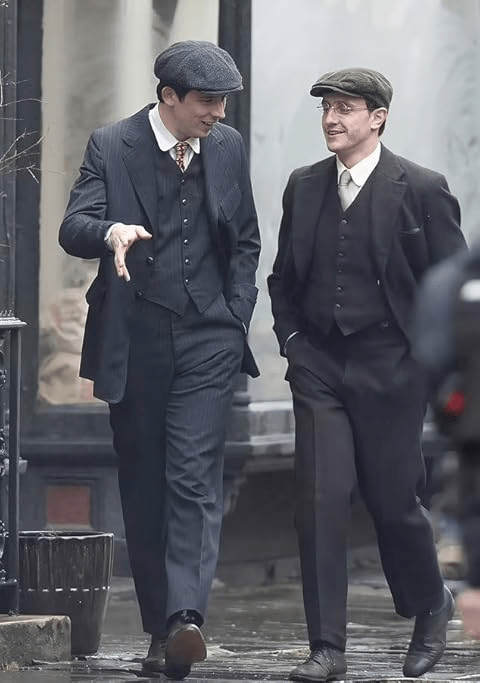
Lionel has the look of James Joyce or Stephen Daedalus, rather than the figure of Orpheus, he is later made to figure as in bed with his wife, Clarissa (nee Roux) in a bedroom festooned with seventeenth-century art panels, including Orpheus giving the fateful look back to Eurydice, as Lionel will do to her later when he leaves the marriage to her in the staircase of their Oxford Senior Common Room. That’s not the first betraying departure. Before it is this story, as it related by Wikipedia: ‘Lionel, now living in Rome, tells his male lover Luca of his dissatisfaction singing in a local choir and of his taking a job at the University of Oxford, ending their relationship on bad terms’.

Clarissa with Lionel at Oxford in 1923.
Kaufmann is, of course, totally wrong to expect that a film need be either a ‘gay love story’ or not. This film is true top the fact that love was a matter of ‘affairs’ more than matches for gay men in the 1920s, and that either partner may be or will be married in their lives, or involved in other affairs. Moreover, the fact of these other episodes can sometimes, perhaps most often, suppressed from the account the lovers give to each other while in their temporary affiances. This was a matter of practicality rather than nature. david is more expert at male gay sexual attachment building than Lionel but we only learn later why that might be, as his high-flying life turns to cinders, like that of Icarus flying too near the sun of what he feels might be ‘true love’, in another domain than the homophovbic world all the characters inhabit.
Kauffman claims the film drags, as others have said, but it only does so if you expect the narrative to work like a conventional one, with one beginning, middle and end, rather a series of small hellos, short engaging adventures and small goodbyes, that dare not perform themselves as if they were tragic. Her statement of the ‘drag of the film is brutal as in these tatements:
With a screenplay by Ben Shattuck adapting his own short story, director Oliver Hermanus takes a small, poignant idea and warps it into a two-hour film. … / … Hermanus cannot get beneath the surface to what binds these men together. Their rapport is polite, then friendly, then familiar. It just never reaches love. / …. The big guns, such as they are, come out for a trip they later take through rural Maine to collect songs. “My grandfather used to say that happiness isn’t a story, so there isn’t much to say about those first two weeks,” says Lionel of this fleeting period of togetherness.
But the lack of words ‘to say’ about their happy adventure in love is not a limitation. Granddad has a point about stories – they rarely fit the realities of achieved love where talk is not at a premium, or is code for the exchange of some other interactive exchange and dynamic movement of feelings between persons. At one point Kaufman says: ‘David collects the stray feathers that have fled Lionel’s pillow and stuffs them back in as a secret act of care’, as he follows him through the backwoods. This is subtle and one of many coded languages of love, except that Kaufman claims it is ‘one of Hermanus’s few subtle accomplishments’. Pearls before swine is the phrase that comes to mind as I think of Kauffman’s glibness.,
Even more of a Miss Piggy in this respect is Jo-Ann Titmarsn, writing in the Evening Standard. She says:
The film moves around from the US to Rome to the UK and back, most of it seeped in the same murky hues. For a film about music and harmony, alas this story is pretty monotonous. Ironically, it is not helped by the score. Mescal and O’Connor put in fine performances here, but the problem lies in the screenplay and direction, which allows little joy or change of pace to muscle their way in. The story is trite and does not bear great scrutiny — for example, did impoverished rural farmers send telegrams to say someone was dying back then? / When Oscar Coates, who wrote the score, moves away from strings and uses only voices, the film comes to life. At one point, the protagonist mentions “a false note”. Despite the beautifully sung songs and the truly lovely and sympathetic lead actors, unfortunately that is precisely what this film is. [2]
Believe me the monotony of pace does not come from the film, nor the m’murky hues’ from poor cinematographic art – pace changes are many: they come in rises and falls with intermezzos like the movements of music. The ‘false note’speech can only be understood if the viewer is attuned to the reality of queer love stories in the 1920s, and of the statistics among queer men of recourse to suicide when the falseness of their marriages (and the need for secrecy they make even more necessary) is their only understanding of them eventually. It is a beautiful moment not one for a hot pen to splash out in lieu of really reacting with appropriate emotional pearls – but swine remain swine!
Coded moments are many. Lionel bathes in a street fountain in Rome before he leaves Luca, as if trying to recall how and why water brought him close to something other than Luca’s prettiness. His arms spread in mockery byt also true representation of a crucifixion happening to him that he does not understand:

One extended metaphor in the film is the explanation of ‘sound’ as an invisible feature of life that it appears can never be made still or available for exact representation in other media. The men, prompted by Lionel see it as something that, in an explanation to children by Lionel, that ‘shakes the air’ in such a way that these shakes can be represented and moulded in wax, the wax cylinders on which the songs in Maine are recorded – and one particularly important voice note from David to Lionel. It is difficult to say more giving really big ‘spoilers’ for new viewers. But that language is recalled more than in body language when the men feel the way voices and songs ‘shake the air’ in their own voice box / larynx. Below David does it as he realises Lionel’s genius in capturing and representing the invisible – including, I believe, those ‘shakes in the air of the body’ that mark love.
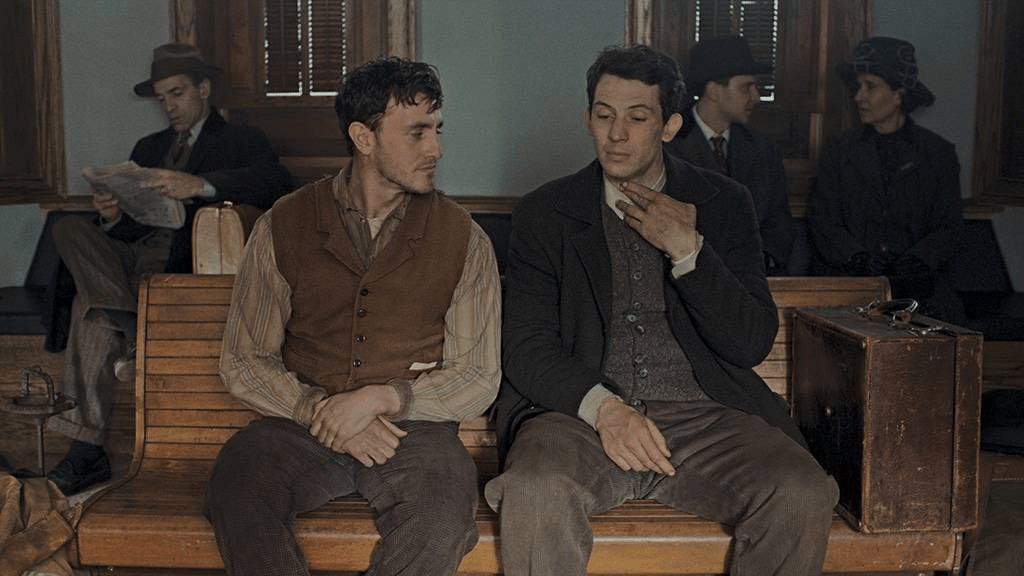
And, though it is logical to understand how much small gestures of body meant love between men forced to show it in other than public languages, I say this without taking into account the Kauffman’s and Titmarsh’s of this uncomprehending world.
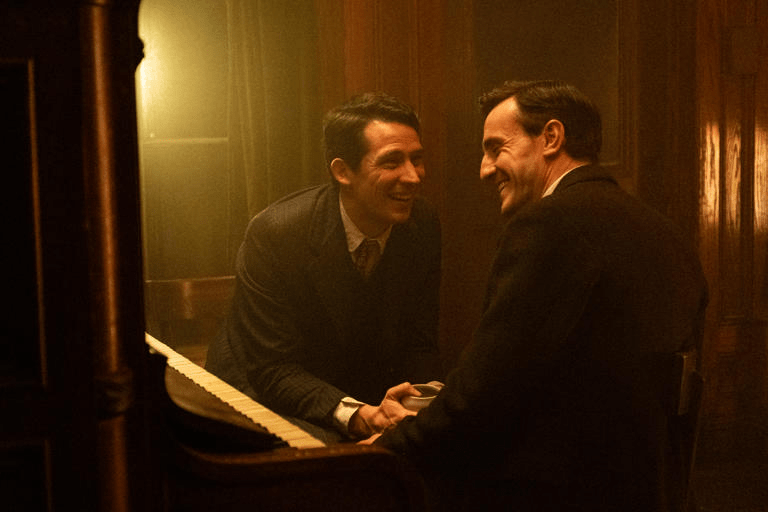
This is a most beautiful film. Don’t read the reviews (even mine). Just see it. It is a superlative work of art and the acting of the key males peerless and under-stated, so much better than that in Hamnet, to tell truth.
All for now
With Love
Steven xxxxxxxx
_______________________________________________
[1] Sophie Monks Kaufman (2025) ‘The History of Sound review – Paul Mescal’s gay love story is severely anticlimactic’ in The Independent ( Thursday 22 January 2026 10:17 GMT) Available at: https://www.independent.co.uk/arts-entertainment/films/reviews/the-history-of-sound-review-paul-mescal-b2905429.html
[2] Jo-Ann Titmarsh (2025) ‘The history of sound: Off-key even as O’Connor and Mescal sing sweetly’ in Evening Standard (via MSN) Available at: https://www.msn.com/en-us/music/news/the-history-of-sound-off-key-even-as-o-connor-and-mescal-sing-sweetly/ar-AA1UKvOL?ocid=BingNewsSerp
 Steve_Bamlett_blog