The fifth, or ‘confession’ stage of the Alcoholics Anonymous programme of steps to recovery from addiction is that the addict has: ‘Admitted to God, to ourselves, and to another human being the exact nature of our wrongs’. What kind of drama does that produce? This blog reflects on seeing Jack Lowden and Martin Freeman in The National Theatre Live screening of The Fifth Step at 7 p.m at Durham Gala Theatre.
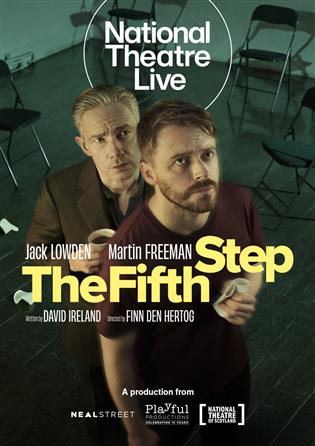
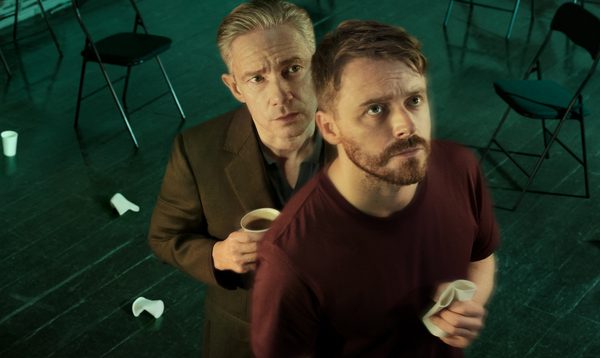
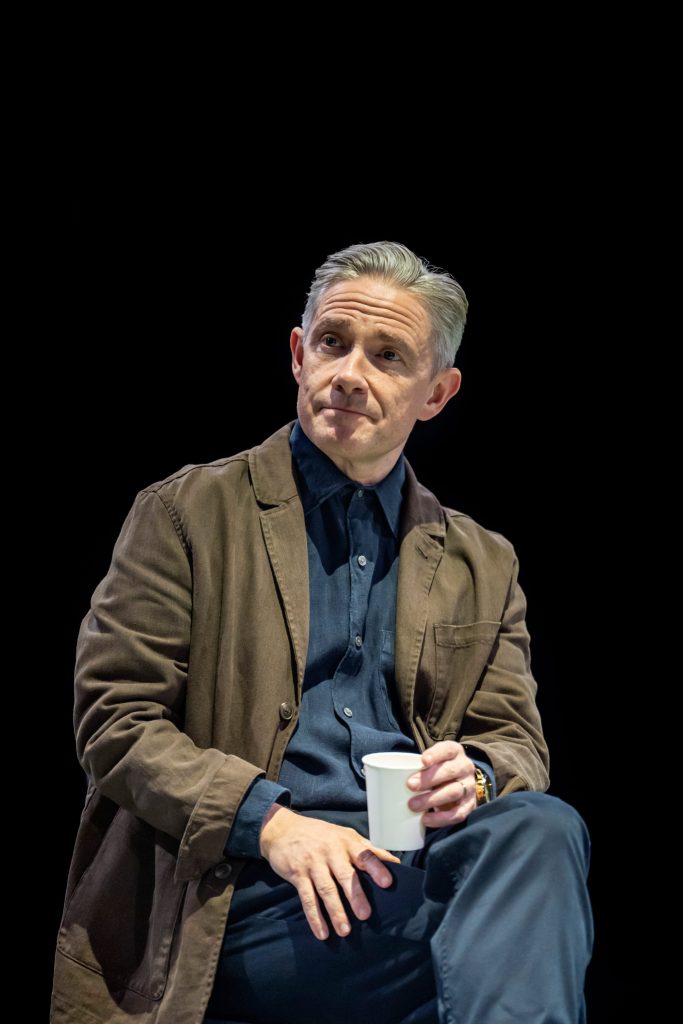
David Ireland ‘s play I have not read, which is unusual for me, and, having seen it,I am unlikely to do so. This play is enjoyable mainly in terms of the great performances of its star duo: Jack Lowden as Luka, a working class man thrust deep into all the nuance, in its public face at least, of the 12 Step programme of Alcoholics Anonymous [AA], and Martin Freeman as James, a middle class man, who, has coasted through it boasting 20 years of sobriety but with not a hint of the moral quality encouraged by tje stages preceding the 5th Step to which this play progresses and ends.
Those early steps are:
- Step 1: honesty
- Step 2: faith
- Step 3: surrender
- Step 4: self-examination.
The company description of the plot says that:
On the journey to sobriety, the pair bond over black coffee, trade stories, and build a fragile friendship out of their shared experiences
On the cusp of Step 5, their conversations must turn to confessionals, with progress hinging on Luka revealing secrets that could lead back to alcohol. But it’s clear that James also has dangerous truths in his past, truths that threaten the trust on which both their recoveries depend.
Yet, there is little sense of the feel of AA in any of this, other than at the satirical level. James is like a seasoned AA member in that he has read Carl Jung and patronises Luka with his reductive explanations of what Jung meant by the need or ‘spiritual awakening’ and belief in a ‘Higher Power’ than the ego, which Jung characterised as narcissistic in the alcoholic. The comic refrain that ‘God’ in the 3rd and 5th Step could be a plastic coffee cup becomes very trying as a running semi-joke between the two and is a disappointing way to end the play
Luka is a more likeable character but also a class stereotype like James, though Lowden’s performance of the tics of low self-esteem are wonderful, though the play makes them over-run and doesn’t develop them into interesting ideas about the somatic symptoms of failed self-control or regulation.
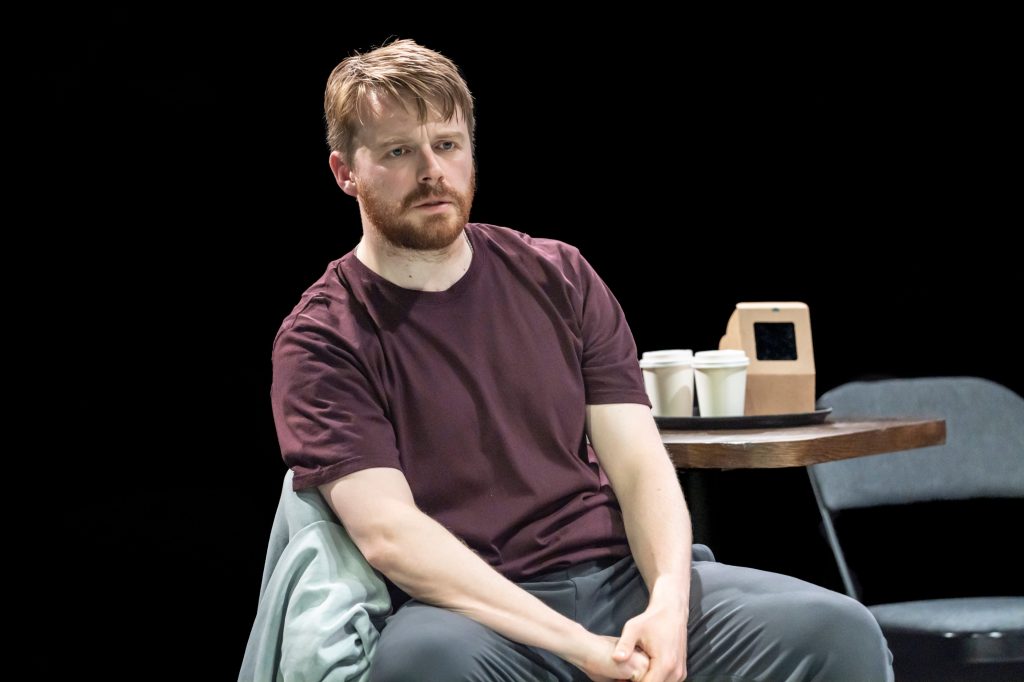
Luka is a tremendous character because so much of his role is about uncontrolled energy: his progress to ‘health’ being characterised as a channelling of those energies from abstention into something quite frenetic. It is all about refusing boundaries, even the boundaries of the stage.

Again, the publicity for the production makes a point of the staging thus:
Directed intimately in-the-round by Finn den Hertog, The Fifth Step is a provocative, entertaining and dryly funny new play from David Ireland.
The screened version continually shows the stage from above and perhaps overdoes the close ups hen Lowden is challenging stage boundaries. It is a wonderful stage, as the actors top are wonderful. All are under-used by a playscript that never dives that deep into the psychology of AA.

‘Dryly funny’ the script may be but the humour is all in the characters and forces them into the shallowest of graves where overdone joiners goes to die.
As a masterclass in acting with very under-cooked material this play can’t be beaten. Both actors confront each other brilliantly as if they were mouthing interesting material.

But the truth is the material is not interesting or well researched and over concerned with male narcissism as if that was all alcoholism.was about, an easy idea to get. I rejoiced in Luka so getting the upper hand on James that James asks him to go for a drink with him – in a pub.

But great acting of poor material is not what drama us about. You have to believe in the conflict and in the reconciliation, the power games and the deep desire to submit to the other. The ideas are all there nut thecwriting too shallow.
Of course I enjoyed my evening but the 90 minutes of the one act still dragged by the end.
But you may enjoy it.
With love
Steven xxxxxxx
 Steve_Bamlett_blog
I just saw this today. Brilliantly staged and performed, but not a very honest or hopeful portrayal of the AA experience. Enjoyed some of the humor, but you get a lot of humor in AA meetings themselves. Curious to know the playwright’s experience with the fellowship–based on the portrayal, my guess would be he tried it but soured on it.
LikeLike
Brilliant analysis Michael. I agree so much. There is a lot that’s problematic in AA of course.
LikeLike
Decades ago, I, while sympathetic, would look down on those who had ‘allowed’ themselves to become addicted to hard drugs or alcohol. Although I’ve not been personally or familially affected by the opioid overdose crisis, I suffer enough unrelenting PTSD symptoms (etcetera) to know, enjoy and appreciate the great release by consuming alcohol or THC.
In the book (WHAT HAPPENED TO YOU? Conversations on Trauma, Resilience and Healing) he co-authored with Oprah Winfrey, Dr. Bruce D. Perry (M.D., Ph.D.) writes in regards to self-medicating trauma, substance abuse and addiction: “For people who are pretty well-regulated, whose basic needs have been met, who have other healthy forms of reward, taking a drug will have some impact, but the pull to come back and use again and again is not as powerful. It may be a pleasurable feeling, but you’re not necessarily going to become addicted. Addiction is complex. But I believe that many people who struggle with drug and alcohol abuse are actually trying to self-medicate due to their developmental histories of adversity and trauma.”
Albeit, while people should not be ashamed of their substance addiction, they also should not give in to it by completely giving up on any potential for eventual sobriety or perhaps a reduction in their consumption of the health-hazardous substance.
LikeLike
I agree, Frank. AA is one methodology only, and its reliance on belief and trust that is sometimes betrayed is one of its problems, as in this play and Douglas Sturt’s novel. I wish the one size fits all approach to addiction weren’t so widespread. As you illustrate people come to addiction with different resources.
LikeLike
While people should not give in to their substance addiction by completely giving up on any potential for eventual sobriety or perhaps a reduction in their consumption of the health-hazardous substance, they also should not be ashamed of it.
In the case of fentanyl, international and more-local illegal merchants of the drug-abuse/-addiction scourge are (rightfully) targeted for long-overdue political action and criminal justice, yet Western pharmaceutical corporations have intentionally pushed their own very addictive and profitable opiate product essentially with justice-system impunity resulting in direct and indirect immense suffering and overdose death numbers for many years later and likely many more yet to come.
It indeed was a real ethical and moral crime, yet, likely due to their potent lobbyist influence on heavily-capitalistic Western governance, they got off relatively lightly and only through civil litigation. … Instead, drug addiction and addicts are misperceived by supposedly sober folk as being weak-willed and/or having committed the moral crime.
LikeLike