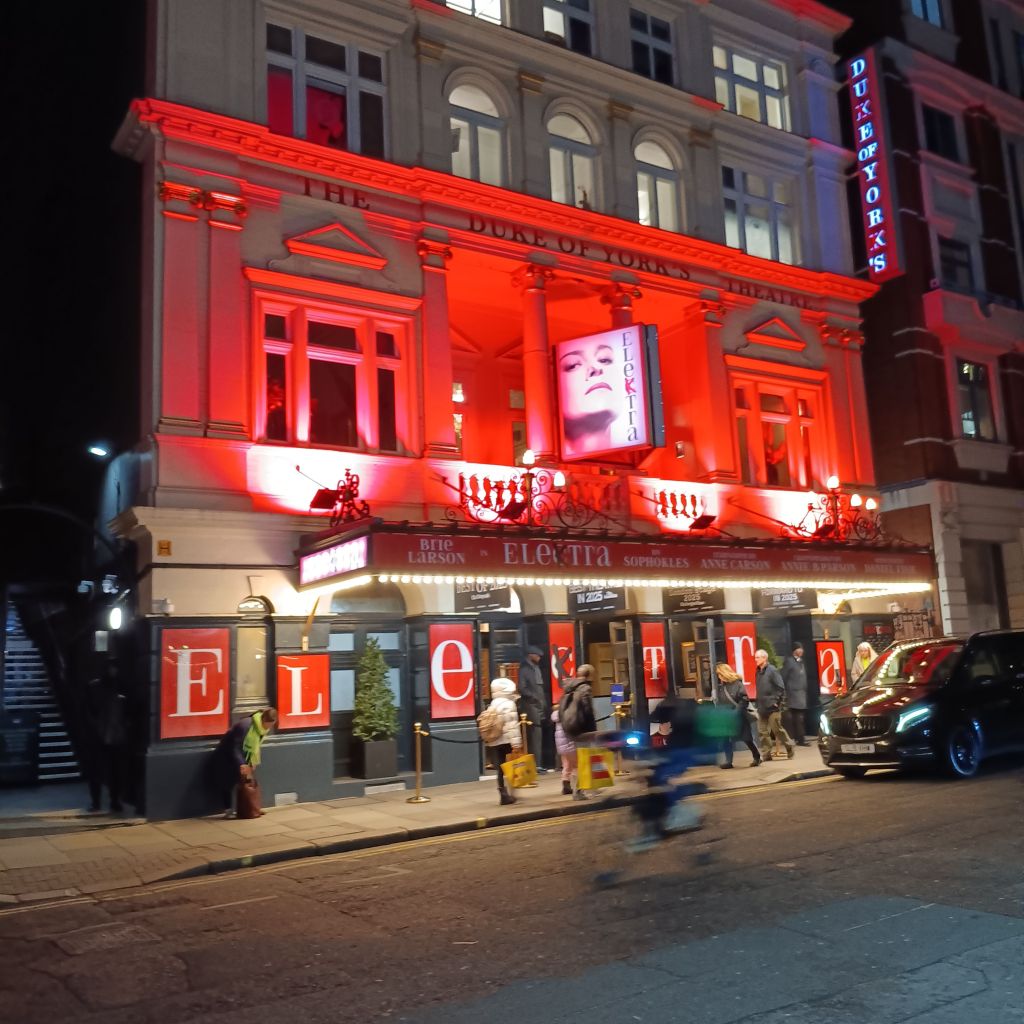
My blog yesterday ended with wondering about how unhelpful assumptions about Greek theatrical conventions can be and with a particular piece of the text of Carson’s translation of Elektra. It was the scene in which Orestes takes revenge on his mother in some place described in stage directions as ‘within’. On the Greek stage, this would, we think, have taken place in a building on the stage of the auditorium we call sometimes a tiring house, it’s name on Shakespeare’s stage, but more properly the skene in Greece. It was for changes of costume or its adornment which could take place there as well as for the voicing of action ‘inside’ some imagined building – palace or military field structure.
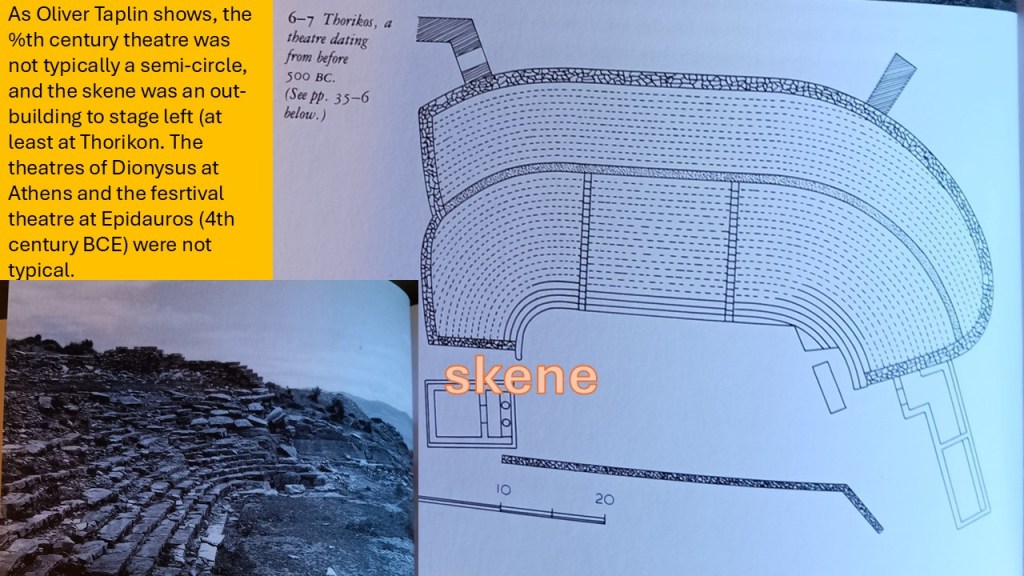
But let’s move a little from theatres and spaces we see to those imagined in text and sometimes interacting with visible external space. Here is the piece I pointed to yesterday:
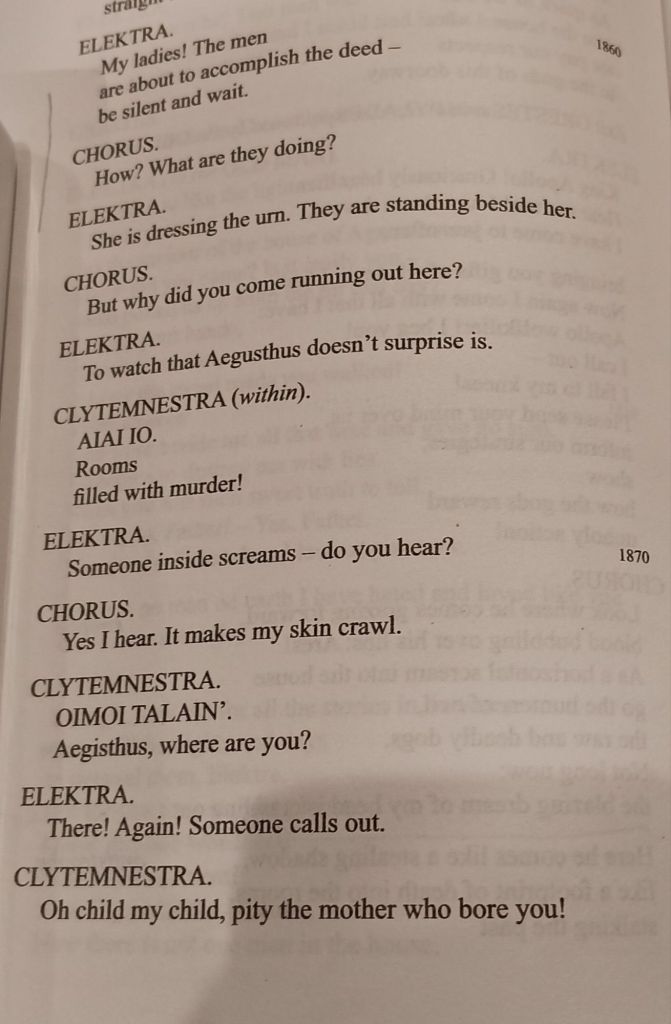
My photograph of Sophocles & Anne Carson [2025 production issue: page 70] Elektra London , Nick Hern Books.
The whole scene is sound and poetry. Its meaning is about the limits of internalised violence as an expression of self. When Clytemnestra makes a scream that Carson transliterates from the sounds if the Greek characters ‘AIAI IO’ used by Sophocles to denote this, she follows it with ‘Rooms filled with murder’ in which we are invited to imagine an internal space proportioned to the size we associate with bloody matricide. Elektra says to the chorus still in the space ‘without’, the visible stage: ‘Someone inside screams‘. She urges the unseen Orestes to penetrate her body with his sword again the unseen Clytemnestra, their mother.
In a play full of external screams representing unseeable internal imaginations of familial horror, these words coupled with staging make play with what we see inside and outside, with subjective versus objective space – and the truth that Elektra cites, possibly of how she feels herself to be: fragmentedand uncentred – a psychological state of dissociation where when you scream you feel that someone, some entity within you, screams not the yourself you feel that you know an/or others know.
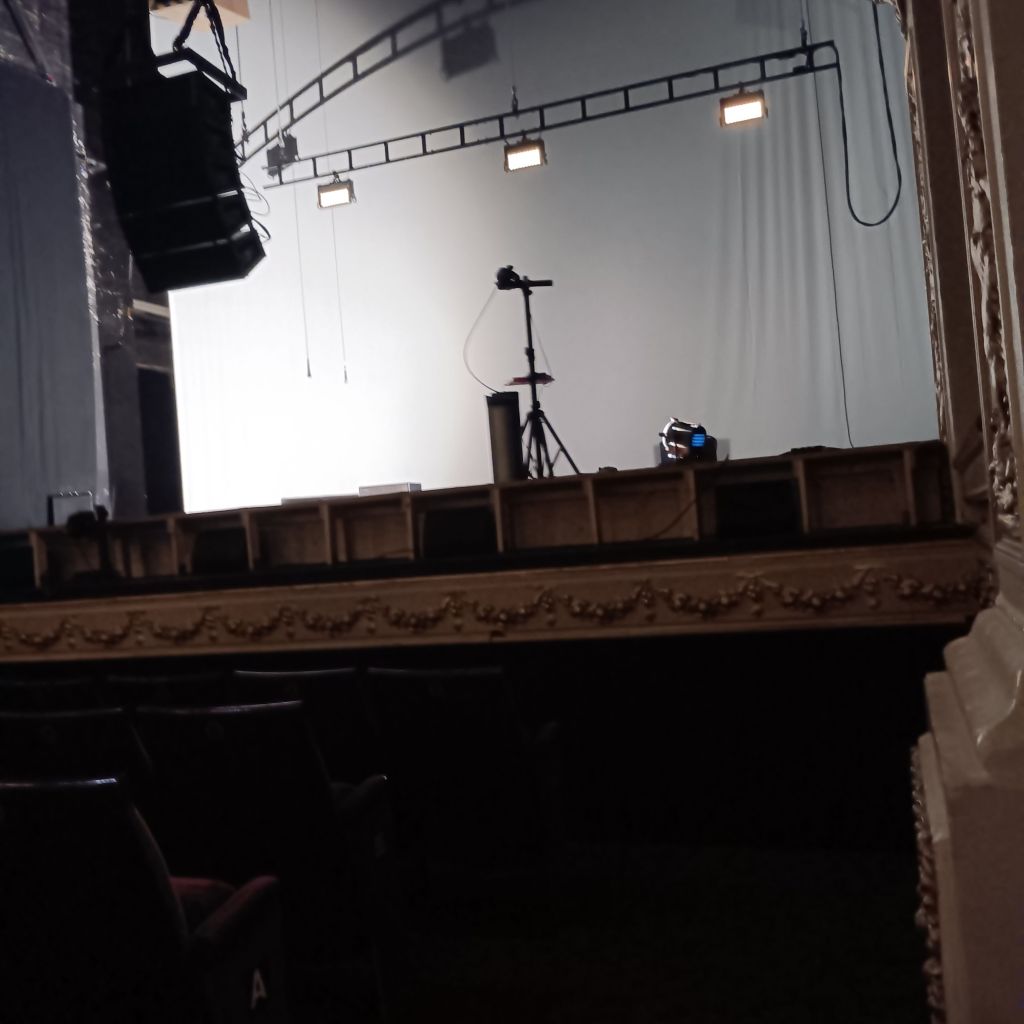
This production turned all this on its head. The stage space was the bare proscenium of The Duke of York’s, seen below before the action started, and the only time photography is allowed, except for curtain calls.
From the beginning, a white backdrop obscures the back of the stage but from the moment the choric troop of ladies of Mycenae are first seen, it is from behind that lifted drop revealing the ugly naked wall of the stage building interior. This troop of women dances, sings, and recites verse in unison. For much of the action, the backdrop is absent, although it is often dropped again, seeming to bear, [in reality or projection] abstractly patterned marks that look like slashes across it.
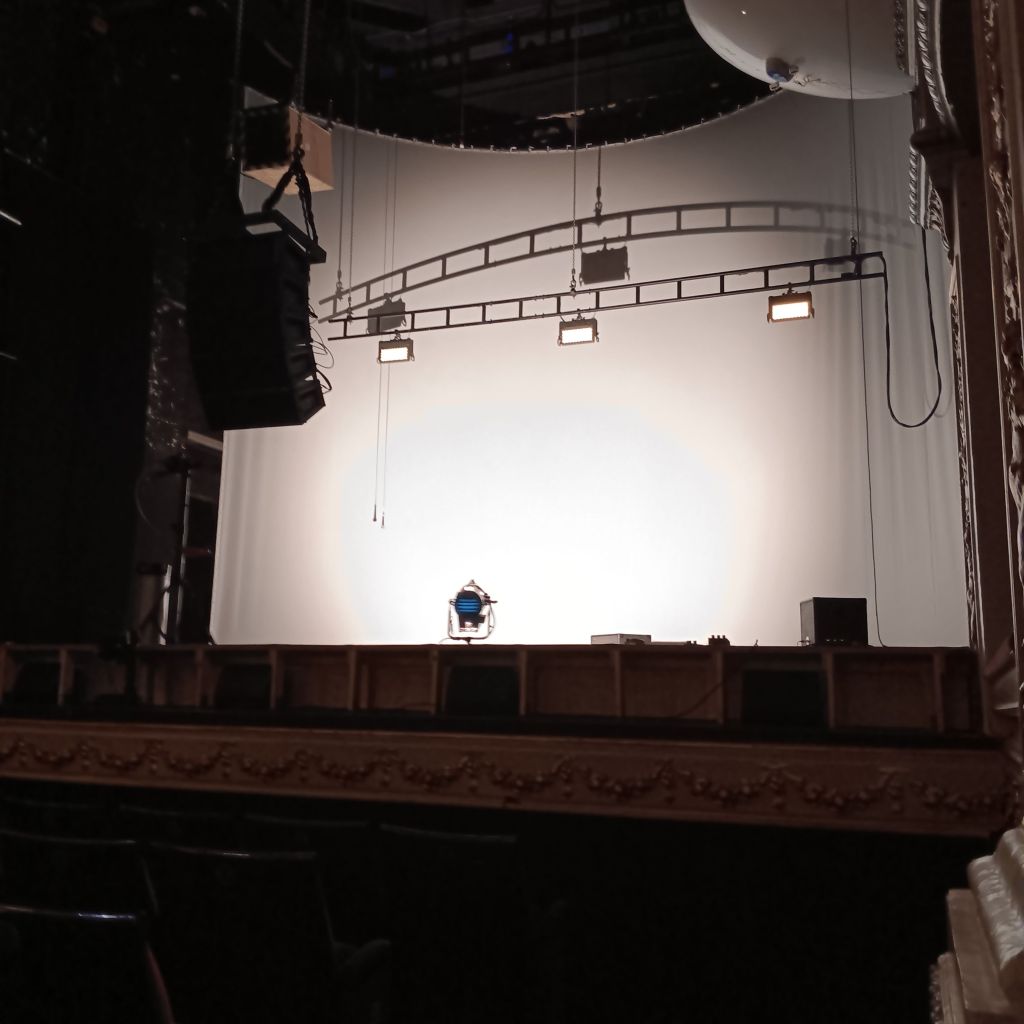
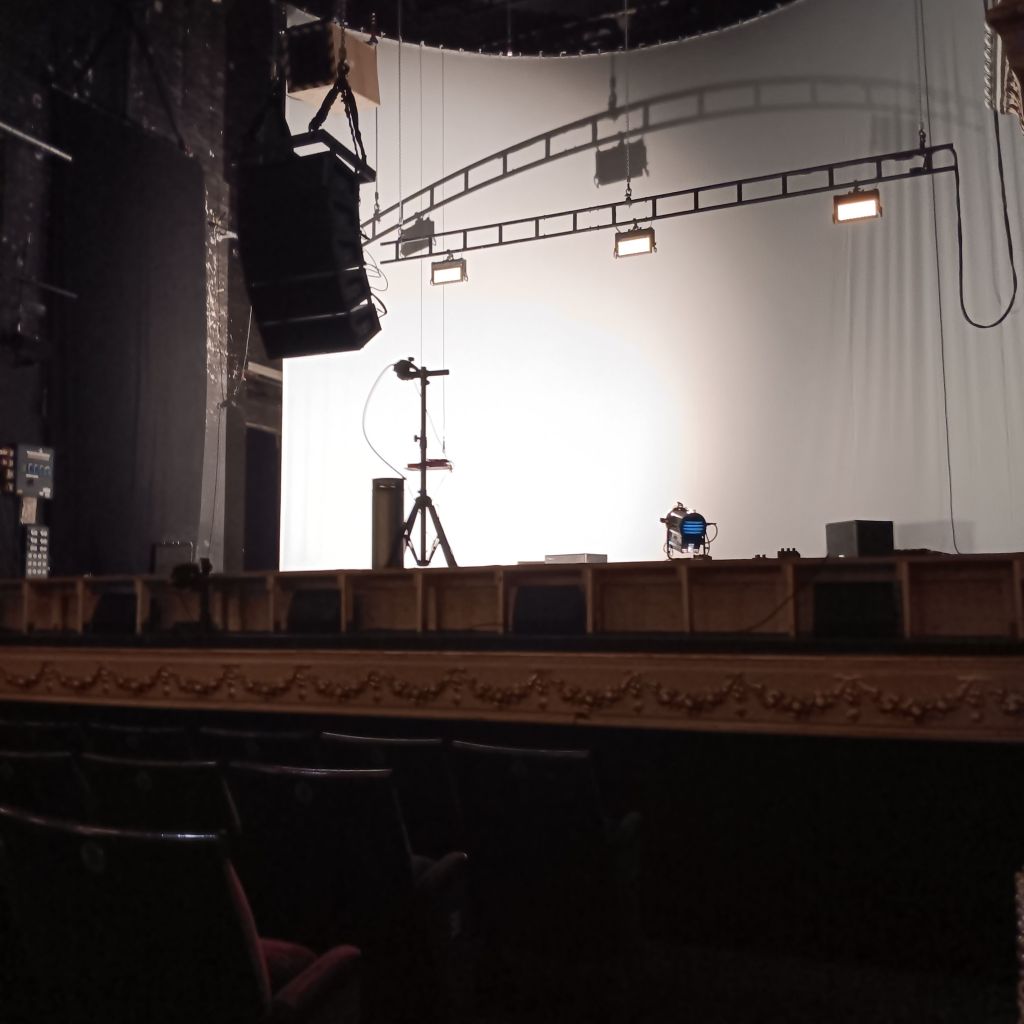
The centre stage utilises a moving circle continually revolving around the still central space of the stage and carrying with it bits and pieces of theatre and gig show apparatus – sound mics, lighting projectors, sound projector boxes and so on. Often, the chorus takes up positions, each member equidistant to the others on the cicumference of the revolving part of the stage in an ever moving circle, from which they gaze within to the still centre with or without main actors in it or outside of the circle, being each seen by the audience by virtue of the revolution of the physical revolution of the troupe. Sometimes, main characters ride the moving cyclical stage or are carried by it as they otherwise mobilise across the stage. It intrigues because it disrupts entirely the sense of how insides and outside are representative on stage and reformulate the need for insides to be invisible to audiences as they are represented.
How, then, was the scene excerpted above represented. I add it here again to refresh your memory of the words:
As the scene played out, both Orestes and Clytemnestra were visible on the stage: for much of it Orestes sat on a chair upon the revolving stage, and Clytemnestra throughout it, her body slouching as if dead at the moment of her stabbings, which were not seen or enacted, except in stylised effects of them in Clytemnestra’s body posture. What a great actor Stockard Channing turned out to be, even in the company of Brie Larson for whom the word excellence would be too modest.
The issue in the scene was that, because actors were visibly presented to mouth the words they were scripted to mouth though in an acting abstracted or alienated somewhat from the roles they otherwise fleshed out, what was supposed to be said in some space inside or outside shifted in meaning, became verbal symbols for imagined interiority. So many outsides and insides were on the stage, revolving circles and inner stasis, cirumnambient theatre space outside the revolving cast, the outside and inside of story, enacted space, bodies, and recessive and regressive minds which had become fluid in interaction.
The aim of this production and this translation appears to be to help us understand why a scream is sometimes the only externalisation visible of a highly populated and dynamic inner life, that described by Chrystomeis (Elektra’s sister, and Clytemnestra of the dream she gas related to her own inner feelings about the murder of her first husband, Agamemnon. This is why this production stuck with me. It troubled me even in ways that made me feel I had learned something, but that what I had learned I may not be able to articulate outside myself. It made me wonder if the dry ice smoke effect that started at the beginning of Orestes and Elektra putting into action the plot to kill Clytemnestra until it filled the whole of the stage space, even flowing down in the front rows of the stall where I was sitting. Figures became voices. Voices came from inside a mass of fog, whilst we were blinded to the actual embodied encounters except in shade through the mist and in dread imagination.
And then I thought back to seeing Oedipus. Here, the stage used various technical devices to describe space and to metamorphose it. There was an island of space jutting into the auditorium to form a pier. It served in the play as if a stage in an open-air public, or more correctly civic space, from which Theban leaders could give speeches to their public. For the purposes of the play, the speeches were deliveted directly to the present theatre audience as if it were the Theban populace, and the scripted responses from the public, usually of a reactionary kind, came from them,the voices coming out behind me.
The proscenium stage of the Old Vic is extremely deep, but was not exposed to its original walls as in Elektra. Inztrzd projection walls were used in which previously unsent portals could open to create more inner, or widen into.outer space. At first, the scene was either in blackout or suffered with white light, but later, a red glare predominated over a vast near infinite perspective with a redder sun-like disc at its hot centre. Space, therefore, was malleable – hard to be sure about in terms of its real, or even apparent dimensions; to say nothing of the space it might represent, whether inside or outside of any boundary or building wall. The fitted with dance motion in the chorus of dancers that sometimes mimed different paces of motion whilst always returning to the same static space. Blackouts were so total and complete that they even removed the conventional sight of an old grand institutional theatre.
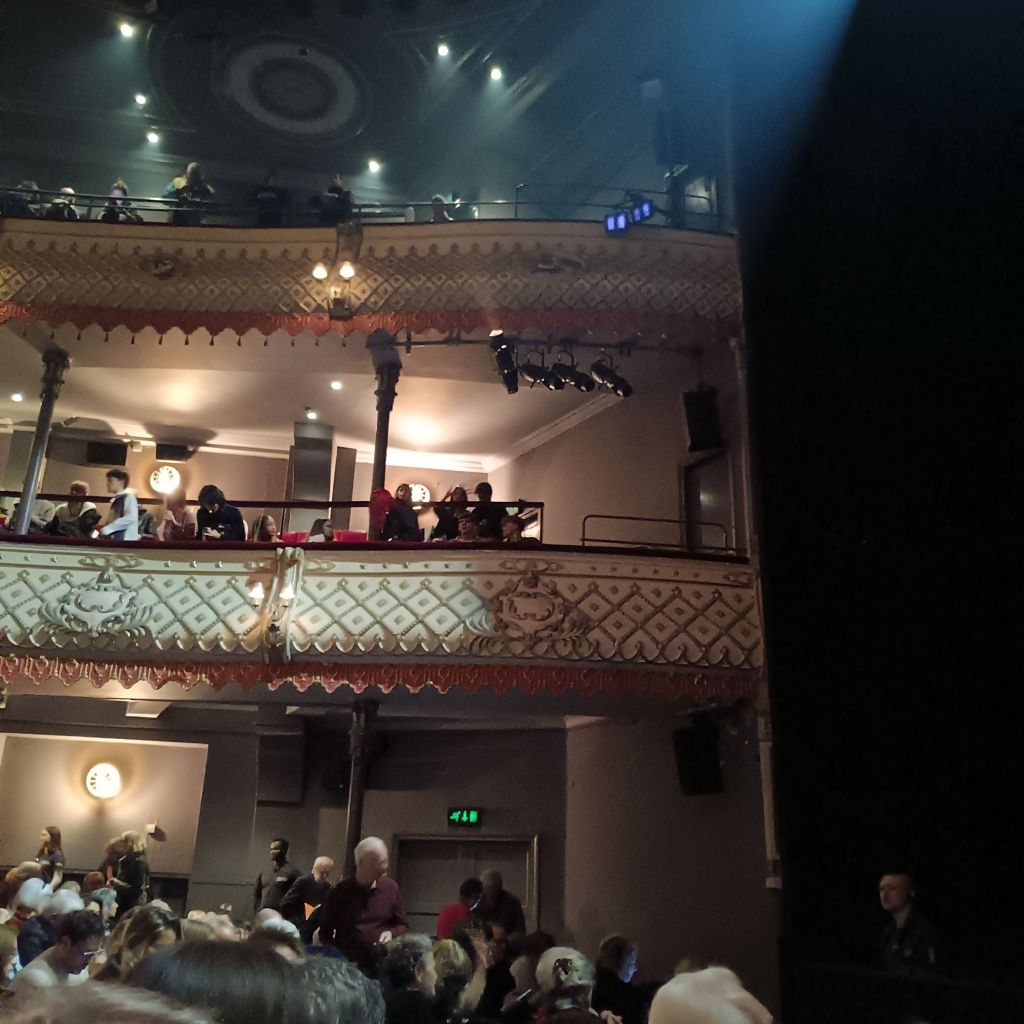
Place and time – all spatial coordinates for moving beings – were fluid in the production and were hard to disjoint or analyse (for the difficulty of knowing was the chosen theme of the play and emphasised in the programme with an essay by classicist Edith Hall). However bodies, even of skilled dancers were not exactly fluid but articulated. They fell into disjointed frenzy either move or disabling of motion.
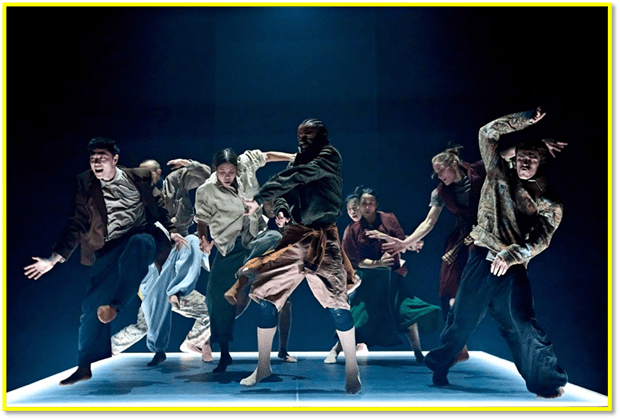
Last n8ght tired and e.otionally exhausted and despairing of outing my true feelings about the shows seen, I tried some black k verse about seeing yhe fabulously disjointed body of tne Oedipus show. Since now, travelling home, I feel no more hopeful of getting it
Bodies have disjoints whether they are
One single disarticulating whole
Or wholly one body of many such
Twisting out, then singularly into
Itself. The Ancients hear a music in pain,
That we moderns hear as a slow drone.
But I can leave my fragments now, as I remember two cast -wonderful ones- walking away from curtain calls. In the example below, the mist still lingered used in the play Elektra.

Below, I will leave too some musings on Theatre design, complex language forms in theatre and the representation of space. They show, at least, my turmoil then.
The design of theatre should not make issues obvious. It is, anyway, an interaction between sound, sight, and haptic senses that feel as if the touch of something on or near your skin. The basic binary that it is good to break down is that between what is inside and outside, what is light or dark, clear or seen in cloud. Words work best when the body speaks, too, and not in the same tone or in the same rhythm of those word’s surface effects. Then we reach under words for something more substantial – the Word made Flesh also has guts, visceral.
Poetry can arise when a word breaks out of the limits of its intended meaning.
If every time the word no is used in any language formation or sense, it breaks through simple flexibilities of contextual meani g and becomes a rhthmic negation of the way discourse usually works.
Thus, Brie Larson sung her words, producing many kinds of music.
Space is usually what the.theatre thinks it must disguise under flats and scenes that represent some reality. That ‘lie’ about the represented world can never make a theatre that speaks frankly to us.
So I am now on the train – possibly near York where I change – so goodbye. I have my visit to The Leigh Bowerey exhibition to report tomorrow.
With love
Steven xxxxx

 Steve_Bamlett_blog