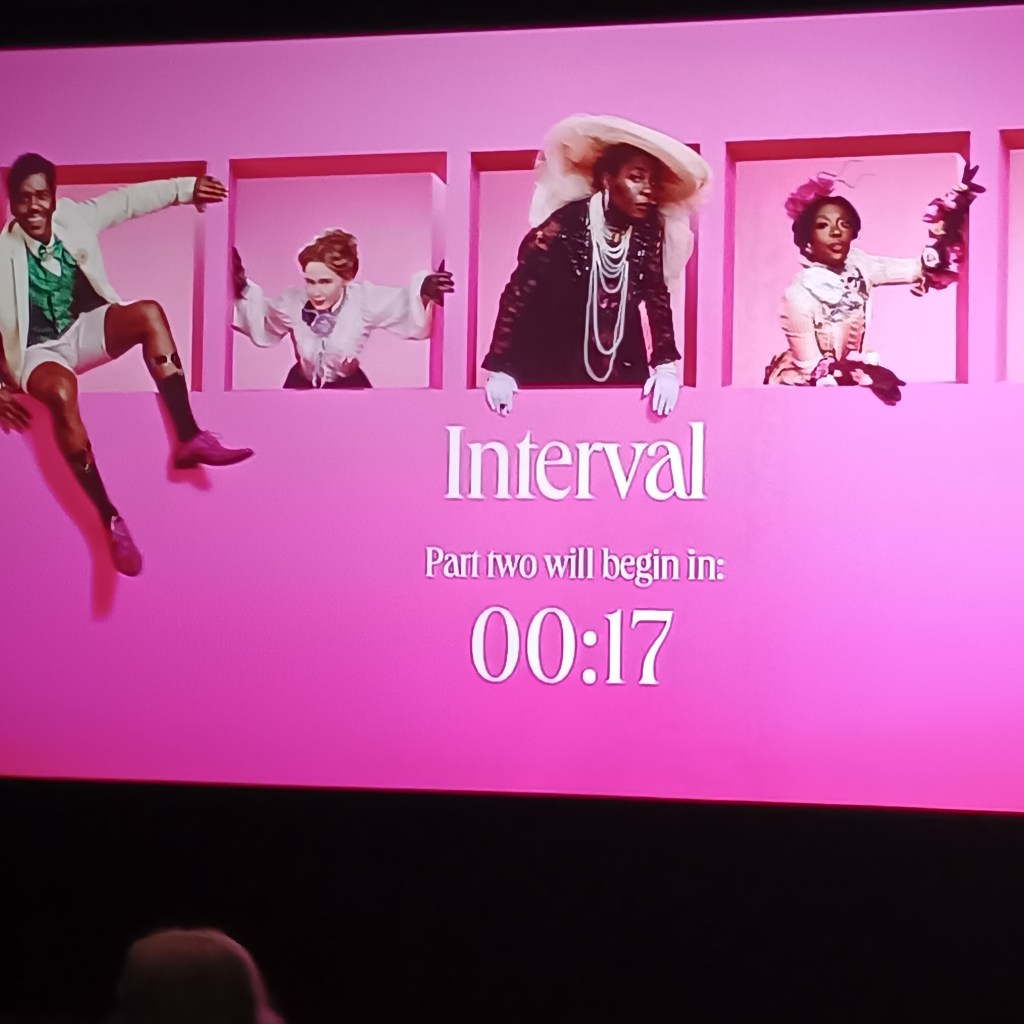
My photograph of the screen in the interval of ‘ The Importance of Being Earnest’ at the Gala Theatre Durham
The words cited in my title are from Gwendolen Fairfax, one of the two young women in this play in love with the name ‘Ernest’. Is the name or style of a man his reality? The play ends with Jack Worthing discovering that he is the legitimate baby of a military man, an Ernest, and styled after him, extolling the ‘vital importance of Being Earnest’, as well as being an Ernest by name, and not, as Lady Bracknell calls him out, as being ‘trivial’. Hugh Skinner as Jack Worthing’ shouts this out from a table top, with his arms raised and played out as if the ending of a drag number, having forgotten his costume, in a club he might frequent with Algernon Moncrieff. It is a moment of high camp, that will rhyme with the epilogue / curtain-call where everyone is in some kind of extravagant drag .

The still photographs from hereon, including that above, are available on the show’s webpage on the National Theatre’s (NT) website: https://www.nationaltheatre.org.uk/whats-on/the-importance-of-being-earnest/
This is probably the very best production of this play I have ever seen, even at the level of the rather careful attention to Wilde’s words that it allows. Partly this is because the meta-theatricality of the play’s conception is constantly emphasised. This isn’t done by adding words usually, although the scene change behind a curtain from the exterior to the interior of Jack Worthing’s country home whilst Jack and Algernon contest the right of the latter to eat all the muffins served earlier is referenced openly by added dialogue.
The additions to text that matter are mainly in overwrought stage business in which the queer and wildly comprehensive sexual nature of all the participants, female and male, is celebrated. Of course, what also are added are a prologue and epilogue [the latter also serving as the most extravagant and pleasing curtain call ever seen] that raise the level of fantasy around the notion of ‘Bunburying’ Bunbury represents the role of extra marital play outside of expected social norms.It is not only high camp that is celebrated here but the play of desire outside the boundaries. Bunbury is an invented character with grave and serious health issues used by Algernon to win him time out from the everyday of his life. In the prologue, Ncuti Gatwa plays Algy in fabulous drag, playing the pianoforte in order to elicit desire from other men, one themselves in drag. It is one too with the play Algy makes with the audience, winking acknowledgement of their probably secret knowledge of each other sexually.
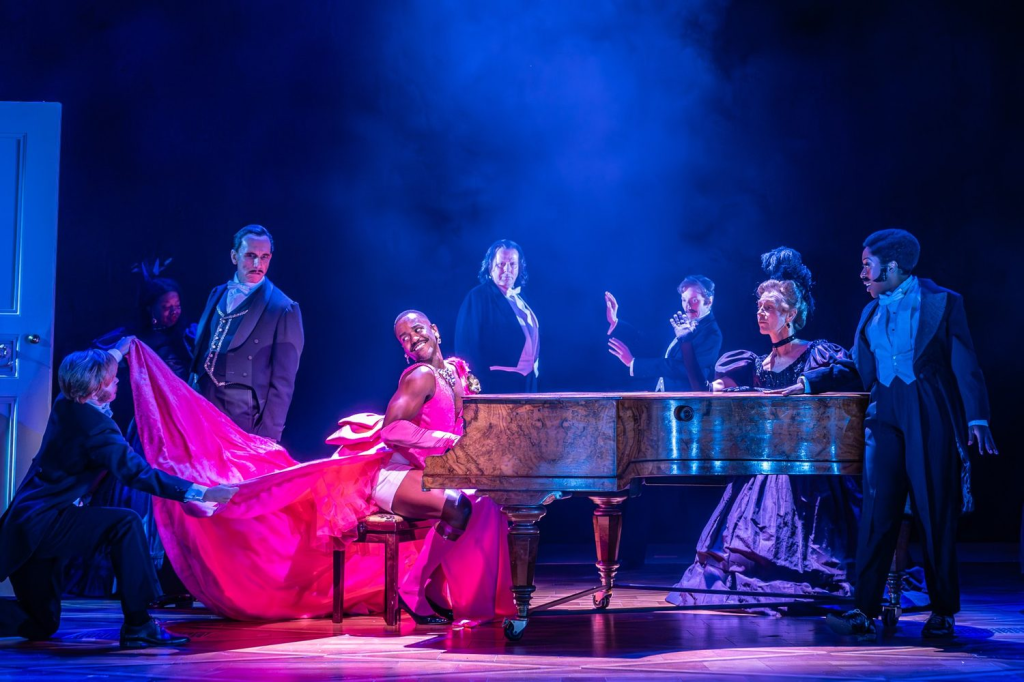
Seen in a rehearsal still from the show’s webpage, the aim is clearly to focus on the role of constructing a playful object of desire beyond boundaries and utilising staged performance of the desirous that resides in its objects.
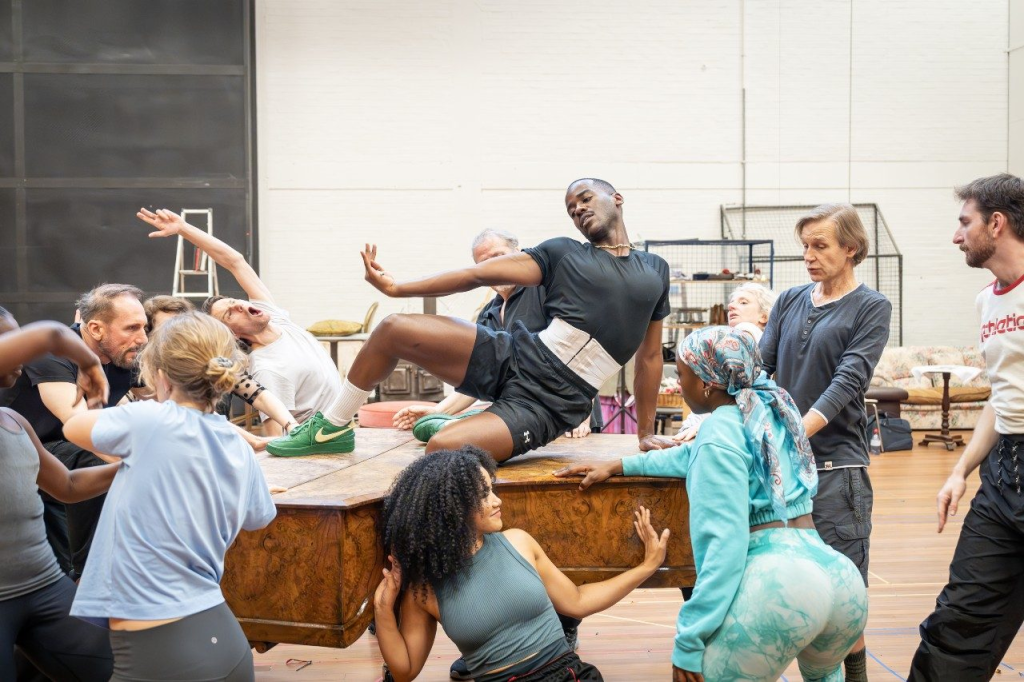
In that sense, the prologue already predicts table-top ‘moral’ of the play as delivered by Jack / Ernest to Lady Bracknell:
LADY BRACKNELL. My nephew, you seem to be displaying signs of triviality.
JACK. On the contrary, Aunt Augusta, I’ve now realised for the first time in my life the vital Importance of Being Earnest.
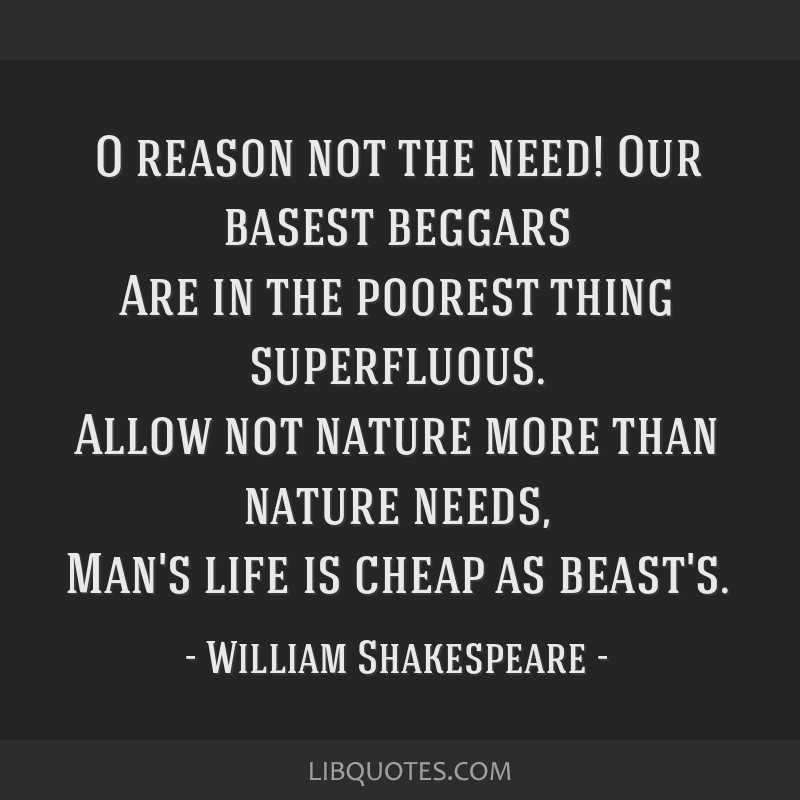
Jack’s conclusion is not unlike Gwendolen’s belief that: ‘In matters of grave importance, style, not sincerity is the vital thing’. The attack on sincerity is also an attack on authenticity and a world dominated by ‘matters of grave importance’ and seriousness (it was called by Wilde ‘a trivial comedy for serious people’) that insists that the stamp of those traits incarcerates human desire, wants and needs and denies its location in the fantasy realm of the ‘superfluous’ (that winch is excessive and flows over); a ‘serious statement of which lies in King Lear:
Here then is a programme in which every detail runs to excess- perhaps in the gaze of Cecily on the penis of one of the Herculean statues guarding the entrance to Jack’s house from within, the extreme shivers of sexualised delight in both girls about their men, each other or other men or women, or the pleased shock they feel in observing excessive behaviour:
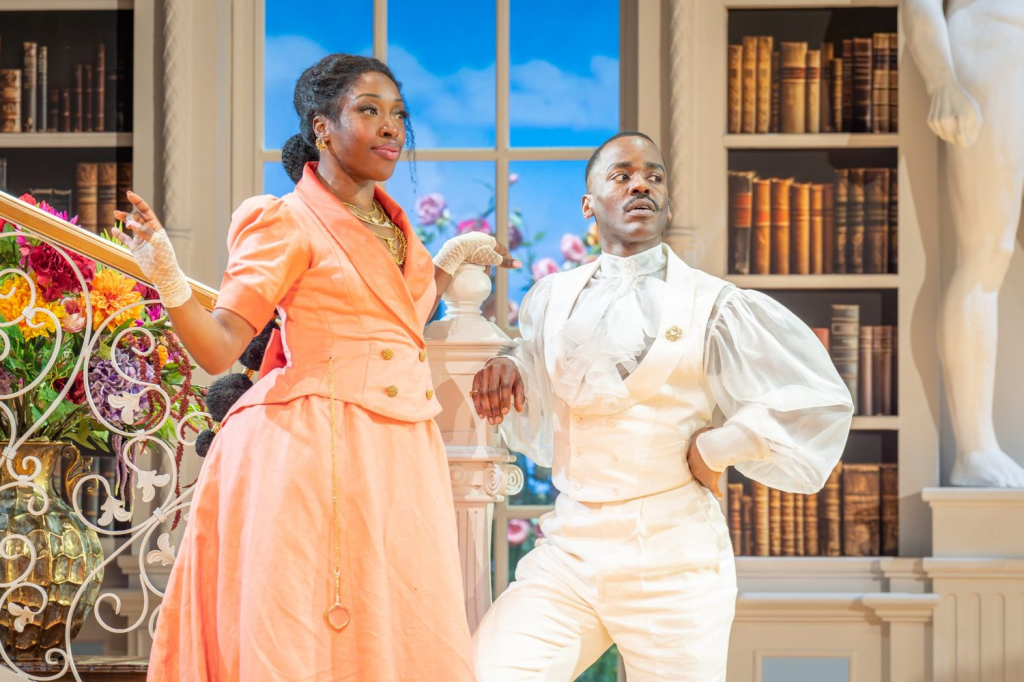
From the beginning, we work towards Jack’s liberation as Ernest – yet his earnestness is merely an excess of what others call triviality. The brilliant Hugh Skinner plays Jack as a pouting public school boy who thinks he looks in earnest at others and has to be cajoled into ‘time out’ – Bunburying with Algy.
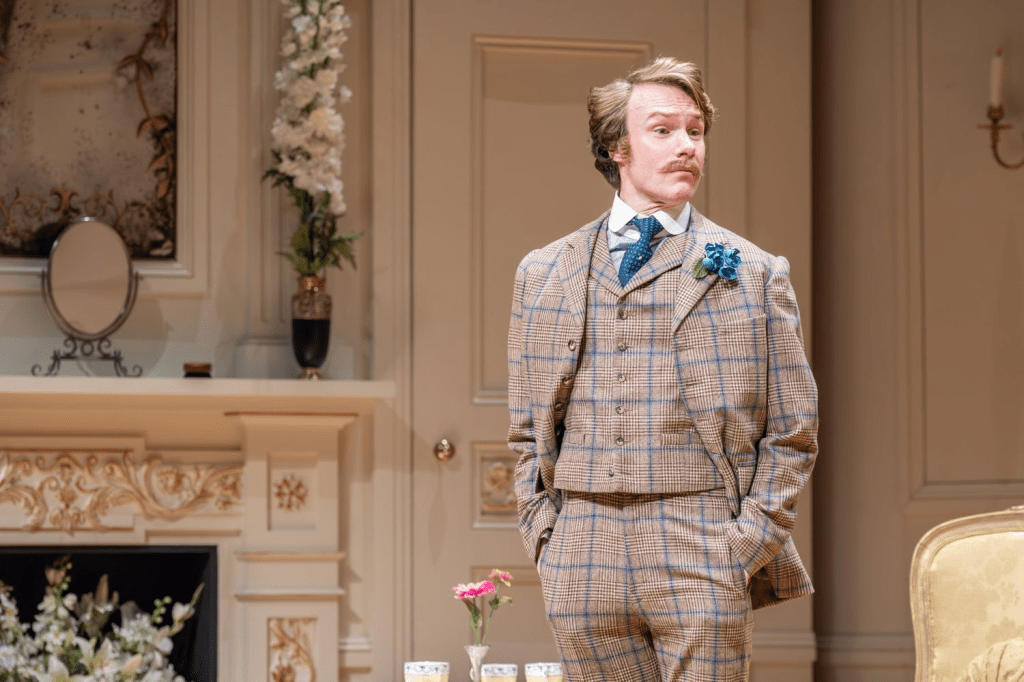
From the start, Algy’s excessiveness is a matter of costume, pose, and gesture – the open legged pose below ought to be masculine, but it remains non-binary. It is there to contrast with Jack’s attempt to sit as if he were shrinking into himself, his hands covering his groin the more Algy exposes that domain.

Other characters too find that their lives tended to some excess that they have lost along the career of their life – like the manuscript of Miss Prism’s three-volume novel and a baby, whose origins (and paternity) are perhaps well covered by Lady Bracknell’s sister, Jack’s mother. Most lost things are not found, though Jack Worthing stores everything – the military and court lists for instance in his library – in the hope of their being useful later. He stores even the handbag as the only evidence of his birthright.
In fact that ‘handbag’ is also another symbol of Miss Prism’s lost hopes of a life and fulfillment. As, as yet without hope of retrieval, it is clear it represents some minor (if not perhaps for her) elements of behaviour superfluous to simple need. Asked to examine it when found by Jack (the stage business here is wonderfully superfluous in noise, action and the utilisation of theatrical space), Prism has one of trhe finest speeches in the play – a factI never noticed until this production, in its delivery by the wonderful Amanda Lawrence:
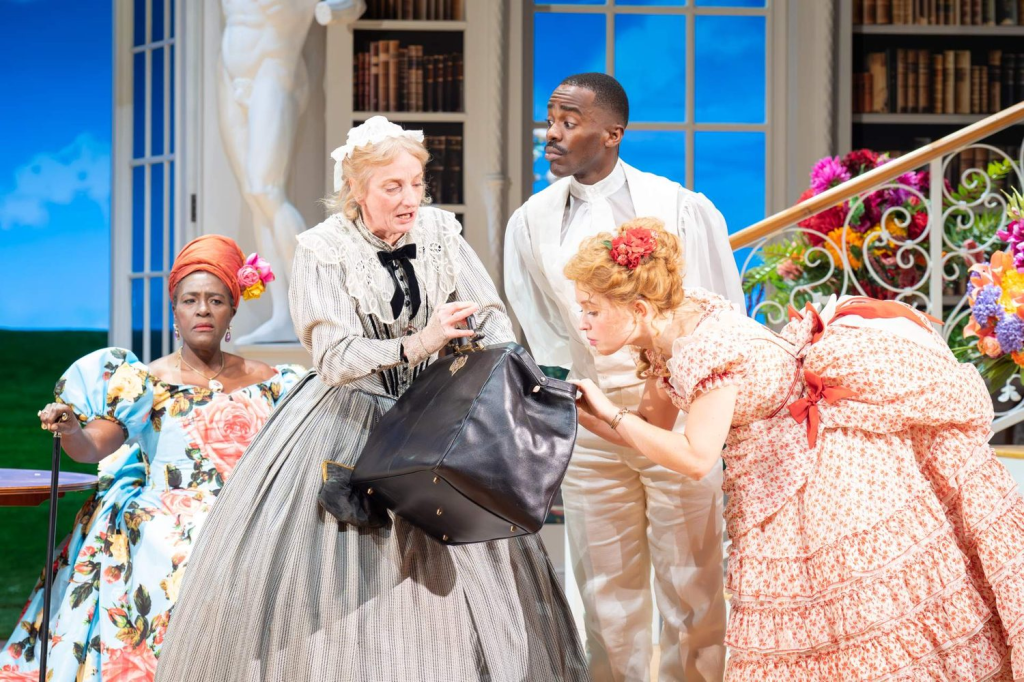
The bag is so capacious in this production, it can be examined with interest by Cecily, a young woman exceedingly interested in symbols of the sexual parts, for their clues. Moreover, this staged with the statuesque figure of Lady Bracknell behind it.
MISS PRISM: [Calmly.] It seems to be mine. Yes, here is the injury it received through the upsetting of a Gower Street omnibus in younger and happier days. Here is the stain on the lining caused by the explosion of a temperance beverage, an incident that occurred at Leamington. And here, on the lock, are my initials. I had forgotten that in an extravagant mood I had had them placed there. The bag is undoubtedly mine. I am delighted to have it so unexpectedly restored to me. It has been a great inconvenience being without it all these years.
The script from Wilde gives the stage direction ‘calmly’ to the actor. Lawrence played it so that the speech rose into a crescendo of near mania, if one carefully regulated. Prisms cast white light into its colourful constituents) and even this older woman remembers that that life needs its ‘upsetting’ disruptions, ‘explosions – even if of temperance liquid – and lost moments of an ‘extravagant mood’.
Sharon D Clarke plays the role of Lady B as if she knew that if you had to upstage Margaret Rutherford, the part had to be played in close relation to the handbag, even if from a careful and secretive distance. And Clarke understands even more that Lady Bracknell’s dislike of public excess hides a great deal of it. Played with a high scarlet headdress, nothing about Lady B’s exterior is anything but excessive, however repressive her voice. In the still below, the placing of the actor uses the space between the two naked Hercules’ figures and is complemented by the blooms outside and a veritable Carmen Miranda cornucopia of fruit on the table next to her:

This larger-than-life Lady can, and does, deliver lines like this in response to Jack’s description of Cecily’s medical history: ‘Ah! A life crowded with incident, I see; though perhaps somewhat too exciting for a young girl. I am not myself in favour of premature experiences’. It is funny as delivered by Clarke because we know that her life has already been more than one of meetings with the Lady Bloxxoms of this world, and that her tastes are not so pallid as to be entirely fulfilled by cucumber sandwiches.
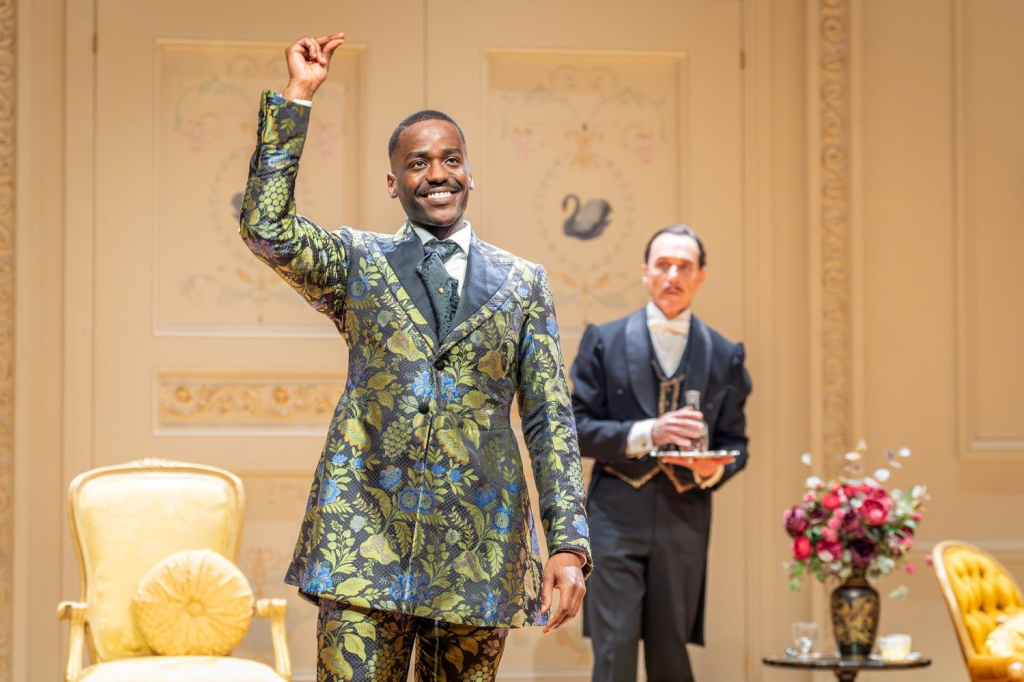
She and Algie both have excessive appetites – Algie is always eating (even all of the cucumber sandwiches as well as Jack’s muffins). He is always hungry – always ready to be taken to dine, and this certainly seems the secret world of the Moncrieffs and Bracknells in this play. Yet only in this production did I notice it. As Algy says in the final act to Jack: ‘You can’t possibly ask me to go without having some dinner. It’s absurd. I never go without my dinner. No one ever does, except vegetarians and people like that’. In truth, vegetarians might also be excessive if not for meat! But there’s the rub.
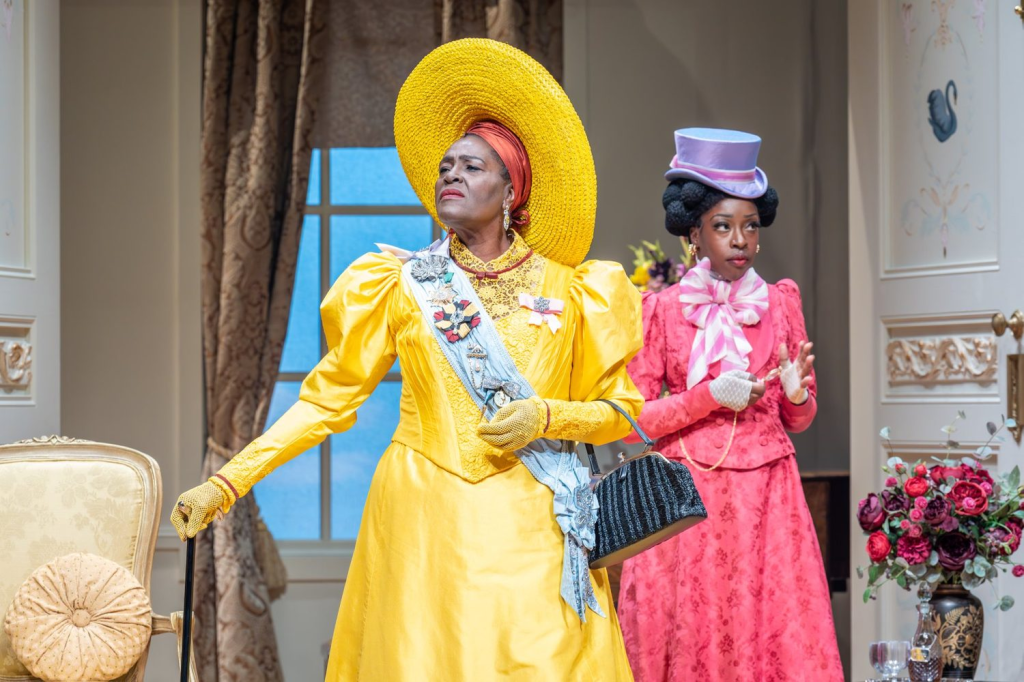
Ronkẹ Adékọluẹ́jọ́’s Gwendolen is the true heir of Sharon Clarke’s Lady Bracknell. Both are heavily associated with blossoming flowers, if those of the elder lady are rather stiff and formal so as not to be flaunted obviously and outwardly. Both are manipulative and know what they want. Likewise Cecily, whose self-seeking behaviour can even amaze Algie (acting below as Ernest). Everything must come at once for Cecily:
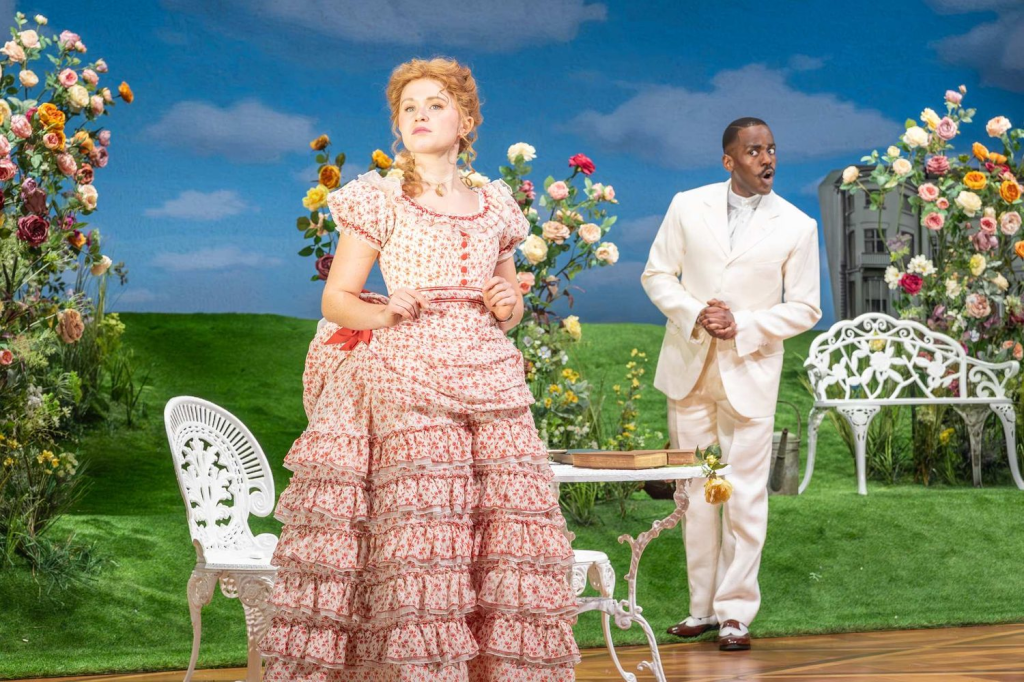
CECILY. Algy, could you wait for me till I was thirty-five?
ALGERNON. Of course I could, Cecily. You know I could.
CECILY. Yes, I felt it instinctively, but I couldn’t wait all that time. I hate waiting even five minutes for anybody. It always makes me rather cross. I am not punctual myself, I know, but I do like punctuality in others, and waiting, even to be married, is quite out of the question.
ALGERNON. Then what is to be done, Cecily?
This is sneaky writing. It is meant to be evidence that women are perhaps as driven by sexual want and desire as men. It is they who cannot or will not ‘wait’ despite the surface appearance of fidelity. The answer to Algy’s question is that only social convention forces desire to await marriage. As Gwendolen says later, she will not change ‘except in her affections’, and no-one is expected to be that patient. Bunbury may be killed, or exploded, by Algy (or in some ‘revolutionary outrage that he deserves according to Lady B.) but the likelihood is nothing in the play’s resolution contradicts’s Algy’s earlier need of Bunbury, even if by another name:
ALGERNON. Nothing will induce me to part with Bunbury, and if you ever get married, which seems to me extremely problematic, you will be very glad to know Bunbury. A man who marries without knowing Bunbury has a very tedious time of it.
JACK. That is nonsense. If I marry a charming girl like Gwendolen, and she is the only girl I ever saw in my life that I would marry, I certainly won’t want to know Bunbury.
ALGERNON. Then your wife will. You don’t seem to realise, that in married life three is company and two is none.
JACK. [Sententiously.] That, my dear young friend, is the theory that the corrupt French Drama has been propounding for the last fifty years.
ALGERNON. Yes; and that the happy English home has proved in half the time.
There needs to be some allowance for excess of appetite – for food, company or excitement, even for the Reverend Chasuble. Asked by Lady Bracknell what ‘position’ Chasuble holds in his his household, the response is: ‘[Severely.] I am a celibate, madam’. Chasuble’s response is one of a mind somewhat tainted by excess it won’t acknowledge. Chasuble will change in the blink of an eyelid, as will Prism, who increasingly is like Cecily in not wanting to be kept waiting for her man to come: ‘I was told you expected me in the vestry, dear Canon. I have been waiting for you there for an hour and three-quarters‘.
This is a production you will wait forever to see the like of again, and for me it saved the play from the tedium past productions have pushed it into. See the reruns.

From top left clockwise: Algernon, Jack, Lady Bracknell, Miss Prism, Chasuble.
With love
Steven xxxxxxxxxxxxxxxxxx
_____________________________________________________________________
[1] The cast of the National Theatre Production: ‘Rounding out the cast are ensemble members Shereener Browne (The Effect), Jasmine Kerr (Follies), Gillian McCafferty (The Rise & Fall of Little Voice), Elliot Pritchard (Museum of Austerity) and John Vernon (Coriolanus). They join previously announced cast members Ronkẹ Adékọluẹ́jọ́ (Blues for an Alabama Sky) as Gwendolen Fairfax, Julian Bleach (Doctor Who) as Lane and Merriman, Richard Cant (Stan & Ollie) as Reverend Canon Chasuble, Sharon D Clarke (Ma Rainey’s Black Bottom) as Lady Bracknell, Ncuti Gatwa (Doctor Who) as Algernon Moncrieff, Amanda Lawrence (Star Wars: Episode – IX The Rise of Skywalker) as Miss Prism, Eliza Scanlen (Little Women) as Cecily Cardew and Hugh Skinner (W1A) as Jack Worthing’ [https://theatreweekly.com/full-cast-announced-for-national-theatres-the-importance-of-being-earnest/}
 Steve_Bamlett_blog