
I am still attempting to catalogue my library and have just completed the section containing works by John Burnside, a writer who died recently but whose work I followed since I first read, in a whirl his The Devil’s Footprints, working my way backwards in his oeuvre as I and he moved forwards. I would always attend events he was involved in – though mainly in the Edinburgh Book festival, including one where he appeared undeniably still under the influence of alcohol he had taken. Burnside moved uneasily in the public sphere, unable to hide his dependencies and their malign treatment by institutions from the masculine toxicity of his father’s influence and the redemptive grace of his mothers, his two volumes of memoir were like open wounds, exploring where and what he came from and where he might be fated to end, with voyages around the diagnostic language that often tried to nail him down.
But wounds are part of the ongoing transformations of life. In a story he named Ether, published first in The Edinburgh Review: Translations, Altered States (Issue 99, Spring 1998, pages 9 – 18), he even imagined in ‘a story of own’ as he projected it but what was in fact a combination of versions of the story of the Biblical Lazarus and other stories of those others, most hauntingly that of Thomas à Kempis being buried alive – a story that haunted him, he imagines Lazarus’ being forgetful of the experience of death but retaining ‘a partial memory of the soul or rather, not the soul, but the idea of a soul, half-pulse, half-wound, like a skylark’s song-threaded larynx‘.(1 my ermphasis)
Like many images in Burnside this one is both haunting and troubling in its liminal relation to sense-making as we know it in functional prose. Burnside knew about birds and would have known that the larynx, if it exists in birds, is non-vocal; that role – the production of song and other sounds being specialised, in birds alone in a different formation, (at the base not the top of the windpipe), the syrinx. Is Burnside using ‘song-threaded’ to modify the word ‘larynx’ such that it becomes the equivalent of a syrinx, postulating its formation from pulse and muscle reformation in history, for some ornithologists believe that the syrinx was developed during the long duration of dinosaurian-bird evolution from the existing larynx as found in mammals.
I do not know, but song is clearly seen as something to which damage and wounding of fleshy structure contribute as well as the production of air pulses. The stitching up of the larynx function and anatomy into a differently located structure, syrinx, feels visceral. we feel the needle that that threads this new structure, and it is something to do with the pain thought to constitute deeper human experience, for the skylark is never more here than a simile to understand something about the larynx-based human voice.
Lots of the story has similar problems. This was my first reading of it yet elements within it resonate with the published stories and with some he told in public events I witnessed at Edinburgh Book Festival – such as the story of Thomas à Kempis, which he had heard from religious men who knew of the exhumation of the holy man’s coffin and the grisly rebuttal it contained of the putative saint’s belief that even in death and rising again he could imitate the life-story of Jesus Christ, a story in Ether rejected as being ‘my own’ bur resurrected just as he imagines his mother too, as he sits at her grave, having been buried alive like Thomas. Yet Burnside too wanted a ‘resurrection’ story for himself as much as à Kempis, even if in terms of a narrative rather than an experience. Here is the bit – horrible enough – in Ether where he says so: (2)
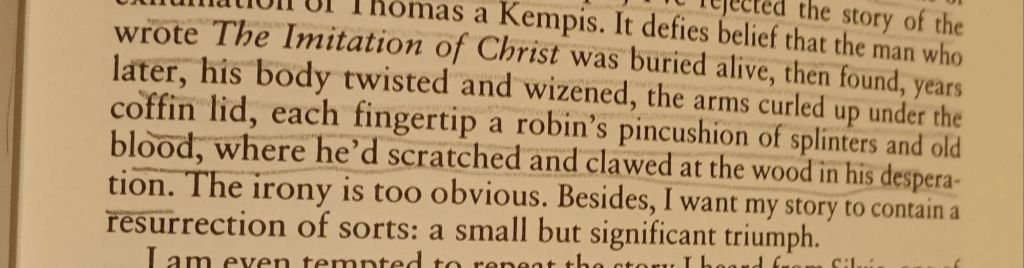
That image of a robin’s pincushion, a blight (though harmless) caused by the gall wasp larvae upon organic growth conveys a beauty where it ought not to be , but is also tantamount to the belief that a ‘natural art’ is produced not just by expulsive work though some mechanism of art production (a larynx or a pen or a typewriter) but by experience of ineffable pain and terror.

A robin’s pincushion
And having found this story I cannot let it go – either from my library (for I have not found it (yet) in other published story collections) or that part of my mind where the painful experience recorded by self and others is stored – networked as it is likely to be with more mundane things in that mind. And much else in the tory recalls my experience of Burnside as writing, a writer and a true story-teller in the flesh. I said my experience of him started with The Devil’s Footprints . That book fed off a story of 1855 about the signs of a devil’s walking presence in snow that has ever since stood as a symbol of how truth and fiction are tied in with desire, the wanting to believe or not believe. But when I saw Burnside talk about it and the meaning of snow it related he said to another story – one painful and dark still to him. He tells this story too in a riff in Ether on the meaning of snow (one I wish I had remembered when I wrote my last blog on snow as a felt and literary phenomenon – use the link to read it). He tells the story more fully than he did in person (3):
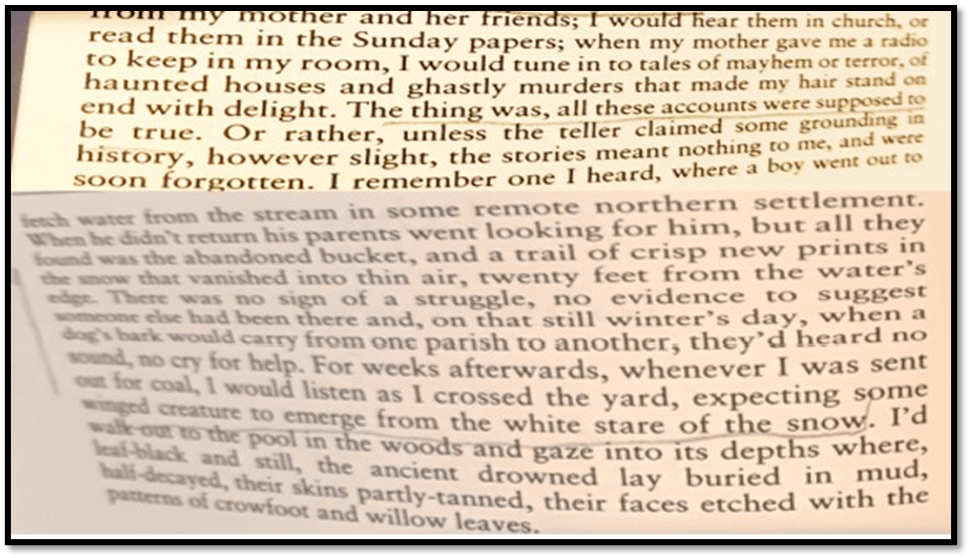
At that event – it was actually on his novel Glister, another story of boys under existential (and in Glister sexualised) threat – I asked why and how he revived Gothic fantasy as a mode of writing that had meaning for the contemporary age. Burnside sort of exploded for he was, he said, fed up of literary types seeing fantasy and the Gothic where truth actually lies. This tells us much of how we need to read Burnside, which is not as a mere literary experimentalist with genre but as having ‘some grounding in history’; some claim that the story was ‘supposed to be true’.That ‘some winged creature would emerge from the white stare of the snow’ is in the same imaginative (but not there imaginary, space as the story of The Devil’s Footprints. For Burnside the capture of the living by the dead is real enough – it just matters whether it is a clean capture – in white snow where all prints disappear as the angel / devil ascends with his prey or game, his food or Ganymede, or in the primeval dirt and mud under water or deep in the soil, a story he later in the story associates with the folk myth of Jenny Greenteeth.
The fascination with death is meaningless in Ether’s world of stories where there is no desired resurrection. Hence the need for Lazarus, But the resurrection into life from death is more impacted by Derek Parfit than the mythologies of all religions but especially Christianity. Parfit is a special philosopher of his time, for he has argued most convincingly that we need not lose our idea that there is an infinite existence possible to us, one that over-bounds the walls of death, but that it is not a personal one, not one that personality owns and possesses but rather inheres in a complex idea of a community of both continuing pain and pleasure. That is why, if Ether is ‘a’one story of my own’, that my own is both cleanly impersonal; and gas faded into the resources of the community that continues and is consumed by the greedy avaricious self that claws at its coffin lid after ‘death’ because it has discovered it has no personal significance at all. Burnside’s imagination is radically green (so green it prefers the white stare of the clean snow) and red with living blood – communitarian at the core of a red heart. At the moment it is peopled not by ‘people with clean stories but stories yet without people to fully live them: ‘a whole book of stories, full of people like me, hoping for a different life, a state of grace, a cleaner way of being’.
That cleaner way of living associates with ascent and disappearance from a snowy surface (as in The Devil’s Footprints) rather than muddy disappearance into ‘the depths’ leaving only a ‘mocking stillness’ on the surface of the water.(4) Snow is after all ‘real time’ – not:
watching a clock: that’s entirely artificial. an analogue; … Snow, on the other hand, is real time. The same flake never falls twice; no two are alike. The patterns are always changing. It’s difficult to tell reality from the illusion. In fanciful moments, I think of this as a representation of eternity, in the most perishable form possible. (5)
Have you thought of time and space in their eternal manifestation of a community of individuated snow flakes each contributing and each perishing for the good of the whole – ‘cleanly’ and not dirtily and nastily and selfishly – because the individuality of each is less the point than their communality, though the latter depends on the former for its progressive health as one. Eternity is not the ‘mocking stillness’ of the surface of water that hides Jenny Greenteeth, it is the acceptance and embrace of the ‘stillness’ of death. Stillness is not mere motionlessness it is also silence and this is how the stories in Ether play with the word, but stillness is an adverbial continuity (as near to eternity as we get as humans and even them cleanly and impersonally: it always still will be as in the story of Silvia [‘one of my mother’s friend’ but still : Who is Silvia? (that human spiritual nymph of the woods whom Shakespeare sings of): (6)
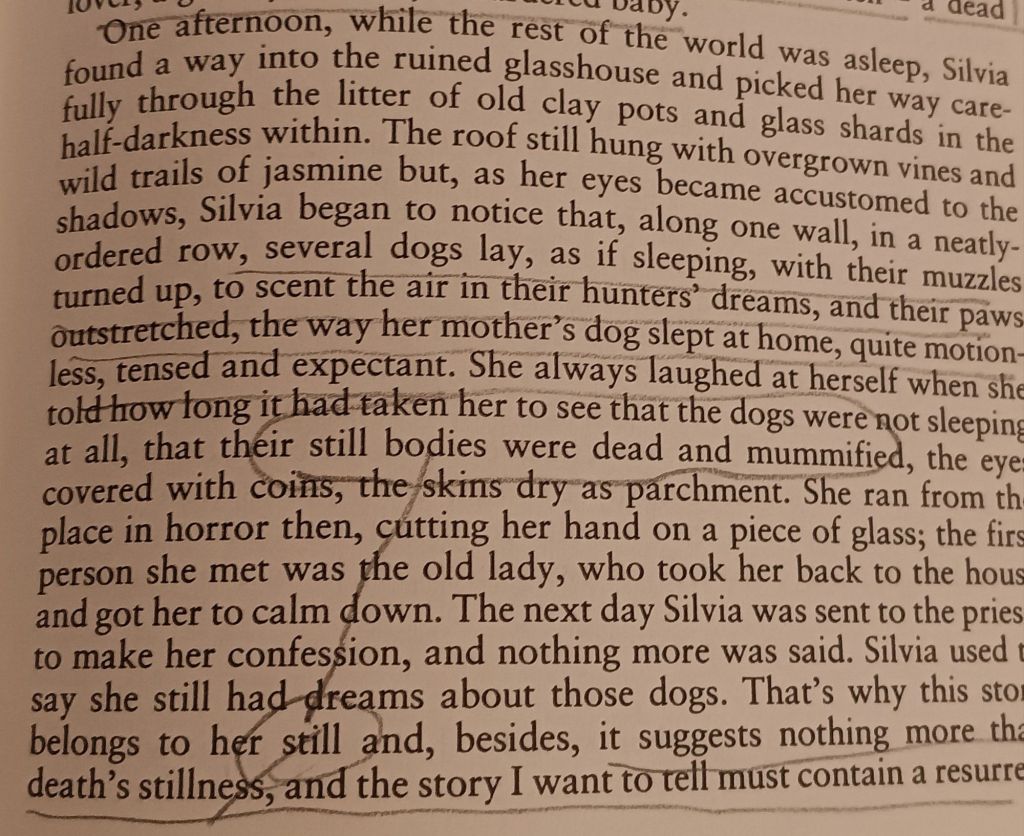
Still bodies are dead ones but mummified their silent motionlessness is near a forever moment about which silence reins (‘nothing more was said’) but death’s stillness belongs to Sylvia, that impersonal nymph or mum’s friend, STILL (continuous in time-space).And that why the prose continue that ‘the story I want to tell must contain a resurrection’.
John Burnside died this year (on the 29th May) and I hope he is with us still – in the cleanest, most hopeful, and most continuing because impersonal way.

As I said in that blog soon after his death:
In the end, poetry lives in such wordy evocation of wordlessness, non- sonority of sound, and the invisibility of that to be displayed to others. Thus, the poem ends, with the poet dedicating himself to those who ‘still remain’ who, with his insight, have:
..., come to light
as glitches in the fabric,all
the shadows in a looking-glass that seem
familiar: seen things, forged from things not seen.

X, lls. 12 - 14, p. 35
All of this speaks not only beautifully as Shelley might, but also in the shadow of Saint Paul, the whole book being a human deconstruction of the prophetic verse of 2 Corinthians 18, which provides the epigram for this sonnet sequence:
18 While we look not at the things which are seen, but at the things which are not seen: for the things which are seen are temporal; but the things which are not seen are eternal.

__________________________________________________________________
Are you with John, Silvia and me still. You will continue with us and none of us matters much except as we love truth and beauty not as the world wants us, it seems, to see it. See it still!
With love
Steven XXXXXXXXXXXXXXXXXXX
(1) John Burnside (1998: 18) Ether in The Edinburgh Review: Translations, Altered States (Issue 99, Spring 1998, pages 9 – 18)
(2) ibid: 10
(3) ibid: 9 – 10
(4) ibid: 13
(5) ibid: 10
(6) ibid: 11
 Steve_Bamlett_blog
One thought on “Remembering John Burnside. All he wanted to do ‘was tell one story my own. … something that begins in the world, but ends up somewhere else, as an entirely mental event’.”