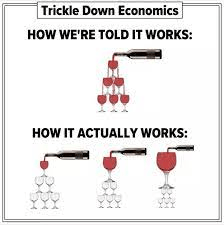
It was okay once for Labour MPs to laugh at Liz Truss’ belief that stimulating production through decreasing barriers to the rich getting really and relatively richer benefited the relarively poor. Wealth, Truss insists, trickles down the economic structure – increasing private wealth increases the wealth of all and reduces the problem of scarcity of resources, Truss also told us. Now this is the official policy (if not spoken of in Truss’s crude terms, it is as crude as Truss in the end) of a Labour Government. The ranks in the party are not broken in riposte. That we can not increase public wealth in national assets like the NHS until we have growth, as Starmer and Streeting never tire of saying, is an even cruder assumption.
For me, I have to say, not wanting to prioritise the pursuit of growth in a world strangled nearly to death in ecological terms by waste by products of that pursuit is enough to argue the case. However an important new book argues the case against the contradictions of present Tory-lite policy with more economic nous, introducing the need not to continue to show how shocked we are by public poverty in rich countries alone but instead show how shocked we should be by the unexamined practice of encouraging, and not addressing politically ‘wealtherty’, as recently discussed by Sarah Kerr.

With no more knowledge than might be suggested by having an A grade in A-level Economics from the 1970s, I would not dare to try and explain Kerr’s views. A good starting point exists though in the London School of Economics (LSE) webpage question and answer session with the author (find it at this link). Here she begins to define ‘wealthery’ as a ‘working definition,’ making us think differently about the most awful of contradictions of modern capitalism – increasing public poverty in a state of growing private wealth.
It’s important to say straight away that wealtherty is a working definition – and I’m really open to people adding new ideas, or challenging the ones there. Like all models and concepts, it is only relevant if it is useful. … wealtherty is about making the case that the social effects of wealth inequality are diffuse.
The four basic components are:
- 1) The active enablement of hyper-concentration. This is about the legal code and the ‘effective’ institutional strategies that enable ever increasing extremes of wealth ownership;
- 2) The perpetuation of social and policy divisions based on this distinction (fiscal and social policy, claimants and customers). This is about governing richer and poorer populations differently;
- 3) Unequal access to political power and influence. This is about dominating political discourse and steering it to reflect the needs of the rich;
- 4) Active gatekeeping of epistemic and epistemological resources. This is about gatekeeping who gets to know and what constitutes knowledge.
Wealtherty exists when the dynamic between these elements is self-sustaining and has made itself invisible – a form of wealth privilege. This makes it unlikely that beneficiaries of the system will be motivated to enact change.
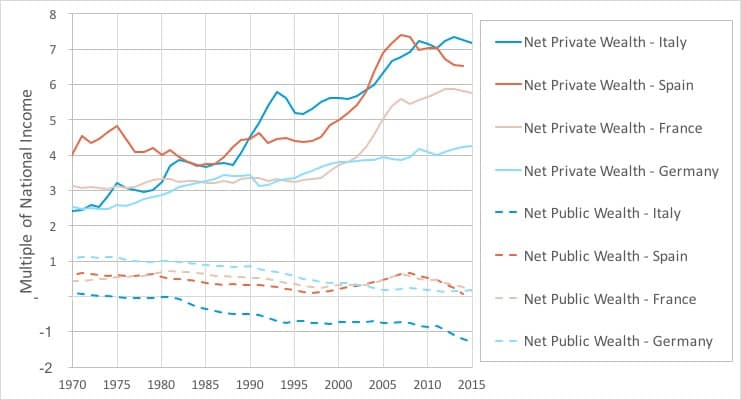
Labour politicians flee back to silent support for the ‘trickle-down’ argument because they fail to see the barriers to the flow of private wealth from the the top to the bottom (in rankings of social wealth) in modern economies. This is likely given that this is the trend in other European economies too. It is not just that private affluence amidst public squalor is unacceptable (though the LSE blogs are good on that too – see this link) but that they betoken mechanisms that can’t be changed without a more radical understanding than that of Keir Starmer and Rachel Reeves. See the trends up to 2015 in Europe in the graphic from finance-watch below (see link for more). Such trends have been set in stone as necessary realities in the minds of follower-economists (economists who repeat what is as if it is what must be) like Reeves and parroted by Starmer.
It is a tragedy that we have a Labour government in power that has fed, and will continue to feed, the narratives of national decline caused by immigration and cultural diversity, and that wealth growth is compatible with necessary greening of the economy. Much of that is explained by the stupidity of this government about the dangers of not examining ‘wealtherty’.
Well, that’s what I think, anyway.
Love
Steven xxxxxxxxx
 Steve_Bamlett_blog